Family Radio Service (FRS): The Complete Guide
FRS is the radio service almost every household already owns without knowing its name — the blister-pack walkie-talkies from the sporting goods aisle. It requires no license, costs nothing to operate, and is genuinely useful for what it’s designed for: short-range communication between family members. This guide covers the rules, the frequencies, the privacy codes that don’t actually give you privacy, and how FRS fits realistically into a household comms plan alongside its licensed sibling, GMRS.
- What Is FRS, and Why No License
- Permissible Uses
- FRS & GMRS Frequencies, Channels & Power
- Equipment Certification: What’s Actually Legal to Use
- Older (Pre-2017) FRS Radios
- Privacy Codes: CTCSS, DCS, and Why There’s No Actual Privacy
- “Extra” Channels on Some Radios
- Realistic Range Expectations
- Where FRS Fits in Your Comms Plan
- Reference Downloads
1. What Is FRS, and Why No License
FRS is a “licensed by rule” service under 47 CFR Part 95, Subpart B. “Licensed by rule” means the rules themselves grant permission to operate — there’s no application, no fee, and no FCC license to hold. You buy a radio, follow the rules, and you’re compliant.
That simplicity is also FRS’s ceiling. Because anyone can use it without so much as registering, the tradeoff is lower power and shorter range than its licensed cousin, GMRS.
2. Permissible Uses
FRS is intended primarily for short-distance communication between individuals, as defined in §95.531. One permitted use worth knowing about: FRS and GMRS frequencies can also carry digital data containing location information between units. Some consumer GPS devices — the Garmin Rino series is the best-known example — use these frequencies to exchange position data directly between handsets, no cellular or satellite subscription required.
3. FRS & GMRS Frequencies, Channels & Power
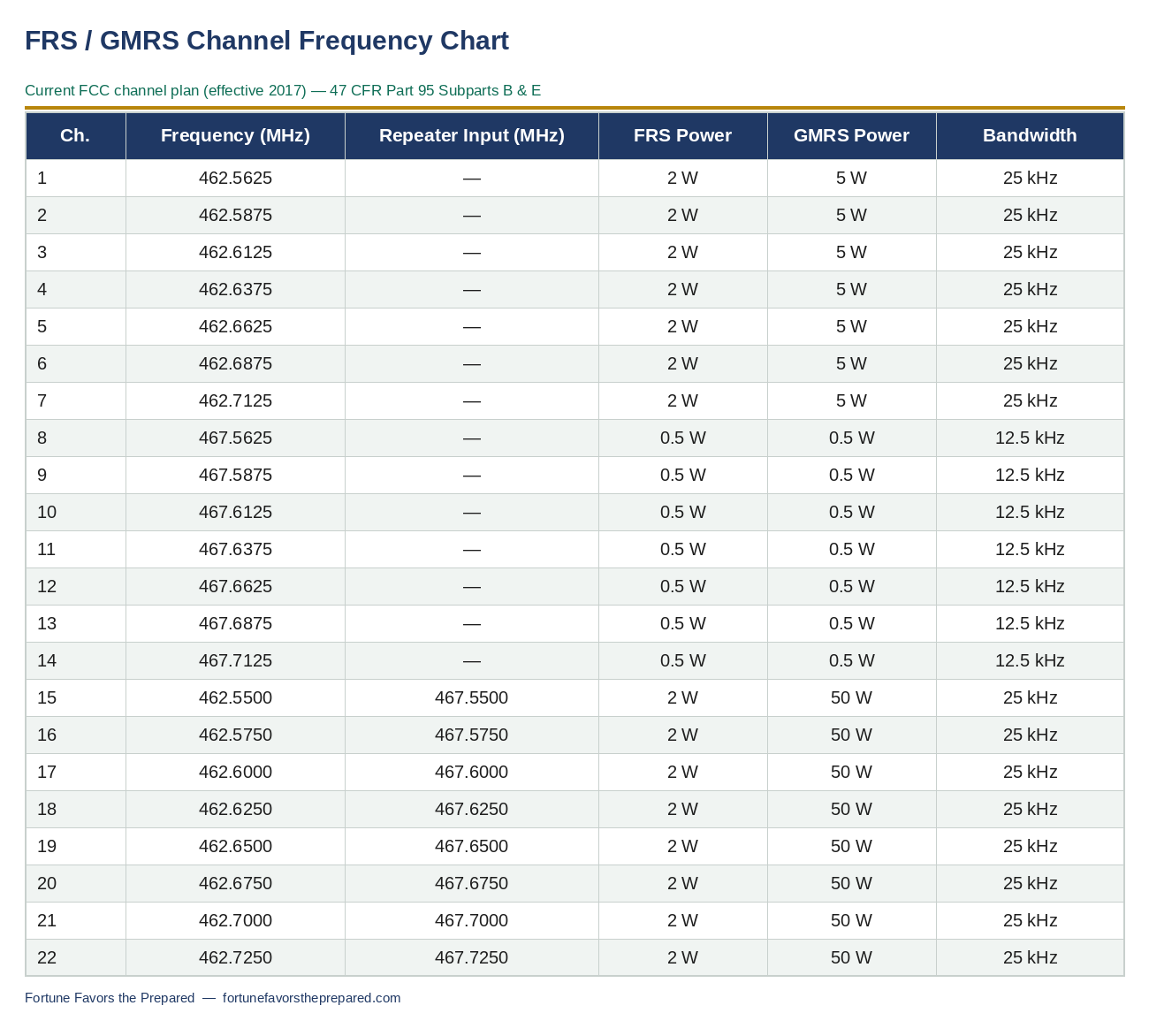
FRS and GMRS share the same channel plan; the difference is power and, for the higher channels, whether a repeater is permitted. Most FRS radios display a channel number rather than a frequency, so the mapping below is worth keeping handy.
- Channels 1–7: 25 kHz bandwidth — FRS limited to 2 W, GMRS permitted up to 5 W
- Channels 8–14: 12.5 kHz (narrowband) — both FRS and GMRS limited to 0.5 W
- Channels 15–22: 25 kHz bandwidth — FRS limited to 2 W; GMRS permitted up to 50 W and may use a repeater
In practice, an FRS radio and a GMRS radio can talk to each other on channels 1–14 since both are transmitting at FRS-legal power or below. On channels 15–22, a GMRS radio running above 2 W is transmitting outside what an FRS-only device is licensed to use, even though both devices can still receive each other fine.
| Channel | Frequency (MHz) | Repeater Input (MHz) | FRS Power | GMRS Power | Bandwidth |
|---|---|---|---|---|---|
| 1 | 462.5625 | — | 2 W | 5 W | 25 kHz |
| 2 | 462.5875 | — | 2 W | 5 W | 25 kHz |
| 3 | 462.6125 | — | 2 W | 5 W | 25 kHz |
| 4 | 462.6375 | — | 2 W | 5 W | 25 kHz |
| 5 | 462.6625 | — | 2 W | 5 W | 25 kHz |
| 6 | 462.6875 | — | 2 W | 5 W | 25 kHz |
| 7 | 462.7125 | — | 2 W | 5 W | 25 kHz |
| 8 | 467.5625 | — | 0.5 W | 0.5 W | 12.5 kHz |
| 9 | 467.5875 | — | 0.5 W | 0.5 W | 12.5 kHz |
| 10 | 467.6125 | — | 0.5 W | 0.5 W | 12.5 kHz |
| 11 | 467.6375 | — | 0.5 W | 0.5 W | 12.5 kHz |
| 12 | 467.6625 | — | 0.5 W | 0.5 W | 12.5 kHz |
| 13 | 467.6875 | — | 0.5 W | 0.5 W | 12.5 kHz |
| 14 | 467.7125 | — | 0.5 W | 0.5 W | 12.5 kHz |
| 15 | 462.5500 | 467.5500 | 2 W | 50 W | 25 kHz |
| 16 | 462.5750 | 467.5750 | 2 W | 50 W | 25 kHz |
| 17 | 462.6000 | 467.6000 | 2 W | 50 W | 25 kHz |
| 18 | 462.6250 | 467.6250 | 2 W | 50 W | 25 kHz |
| 19 | 462.6500 | 467.6500 | 2 W | 50 W | 25 kHz |
| 20 | 462.6750 | 467.6750 | 2 W | 50 W | 25 kHz |
| 21 | 462.7000 | 467.7000 | 2 W | 50 W | 25 kHz |
| 22 | 462.7250 | 467.7250 | 2 W | 50 W | 25 kHz |
A printable version of this table is in the reference downloads below.
4. Equipment Certification: What’s Actually Legal to Use
FRS’s “no license required” simplicity is easy to mistake for “no rules about equipment.” That’s backwards. Because anyone can operate FRS without so much as registering, the equipment certification requirement under §95.561 is the entire enforcement mechanism — it’s what stands in for a license. Every FRS unit must be certified for FRS use, certification is denied to any radio type that doesn’t meet FRS’s own rules, and — since December 2017 — certification is also denied to any hand-held capable of operating under FRS and any other licensed or licensed-by-rule service (Part 15 devices excepted).
Popular wide-band amateur handhelds — the Baofeng UV-5R is the best-known example, but AnyTone’s popular DMR/analog radios (the AT-D878UV and similar) work the same way, along with a number of other imports — are built around true VFO tuning rather than a locked channel list. That’s a legitimate feature for their intended, licensed amateur use. It also means the hardware can physically transmit on FRS frequencies, GMRS frequencies, MURS frequencies, and a wide range of Part 90 land-mobile and business-band frequencies, including the nationally-designated interoperability calling channels public safety agencies use for mutual aid.
None of that capability is authorization. These radios are certified (where certified at all) under Part 97 for amateur use, not under §95.561 for FRS. Transmitting on an FRS channel with one is a real equipment-certification violation — not a gray area, and not something that changes based on power level or which license the operator happens to hold.
Selling a radio built this way is its own, separate violation. 47 CFR §2.803, backed by 47 U.S.C. §302(b) of the Communications Act, bars manufacturing, importing, shipping, marketing, selling, or offering to sell a radio frequency device that isn’t authorized for the services it can reach. §95.591 makes this explicit for FRS: no person may sell or offer to sell a hand-held capable of operating under FRS and any other licensed or licensed-by-rule service. The FCC has real enforcement history under the general §2.803 rule in this exact product family: in 2018 it cited Baofeng’s US importer (DA-18-801) for marketing UV-5R-series radios “capable of operating outside the scope of its equipment authorization” — in that case, beyond the frequency range and power limits of the radio’s own Part 90 grant, not an FRS violation specifically. Same general principle, though: marketing a radio beyond what it’s authorized for is a seller/importer violation in its own right, independent of what any individual owner does with it.
AnyTone and Baofeng reach that same wide capability by different routes. AnyTone’s own U.S. distributor confirms the AT-D878UV/868/578 series is one hardware platform sold in exactly two authorized configurations — a Part 97 amateur version and a separate Part 90 commercial version. Switching between them requires connecting the radio to AnyTone’s CPS software and deliberately changing its “Band Mode”; it doesn’t happen from the keypad or by accident. The wide frequency reach exists because it’s the same radio also sold as a certified Part 90 commercial unit — the underlying hardware has to cover Part 90’s broader land-mobile allocation, and the amateur-only configuration is simply the narrower of the two. Baofeng-type radios are frequently the opposite: many units, especially older or non-U.S.-authorized imports, transmit across that same range with no unlock step, no official software, and no deliberate reconfiguration at all — open out of the box. Different path, same outcome: a radio capable of transmitting outside its authorized service, and using it there is a violation regardless of which path got it there.
Separately, Part 90 land-mobile and interoperability channels require their own specific license tied to an eligible entity and aren’t open to the general public, regardless of what a radio can be tuned to reach.
Radios built for Part 90 commercial and public-safety use commonly include voice encryption (AES, DES, or similar) as a standard, legal feature for eligible business and agency licensees. That capability doesn’t carry over onto FRS, GMRS, MURS, or the amateur bands just because it’s built into the same physical radio — using it there is a separate, explicit violation on each service:
- FRS: §95.381 bars certifying any Personal Radio Service transmitter with voice-scrambling or obscuring features (for applications filed on or after December 27, 2017). Separately, §95.333’s general prohibition on coded messages or hidden meanings applies to FRS, with only “10-codes” carved out.
- GMRS and MURS: the same §95.381 certification bar applies across all Personal Radio Services, not just FRS, and GMRS carries its own specific coded-message prohibition under §95.1733(a)(3) (again, “10-codes” excepted).
- Amateur (ham) radio: §97.113(a)(4) separately and explicitly bars “messages in codes or ciphers intended to obscure the meaning thereof.” The FCC has already considered and rejected adding an emergency-services exception to this rule (2013, RM-11699), so there’s no carve-out for MAG or disaster-response use.
Turning on a commercial radio’s encryption while operating on any of these services isn’t a gray area or an acceptable “just for our group” workaround — it’s a distinct violation on top of anything else already covered in this section.
Two Part 97 (amateur radio) provisions get cited as blanket permission to use any frequency in a genuine emergency: §97.403 (“Safety of life and protection of property”) and §97.405 (“Station in distress”). Both allow “any means of radiocommunication at its disposal” for immediate life-safety or distress communication when normal systems aren’t available. Read carefully, neither says what it’s commonly assumed to say.
- Who it covers: both sections say “an amateur station” — not “any person,” licensed or not. An unlicensed person gets no cover from either rule, in any emergency, on any frequency.
- What it most defensibly authorizes: the strongest reading of the text, and of how the FCC actually enforces Part 97, is that this relaxes ordinary operating restrictions (permitted modes, message content, procedure) for an already-licensed amateur station during a genuine emergency — not a grant of authority to transmit outside the amateur bands entirely, and not authority to exceed your own license class’s frequency privileges (a Technician using an Extra-only sub-band, for example). The FCC and ARRL’s Volunteer Monitor Program actively enforce license-class band-segment violations as a standalone infraction, with no documented emergency carve-out.
- The FCC’s own informal guidance has been inconsistent: one field response on record reportedly supported using a modified amateur radio on non-amateur frequencies in extremis, while another directly contradicted it, stating Part 97 only covers amateur frequencies. Conflicting informal statements from individual staff aren’t a reliable legal foundation to plan around.
- Part 95 (FRS, GMRS, MURS) has no equivalent provision at all. Whatever leniency exists there in a genuine emergency is a matter of FCC enforcement discretion, not a codified right.
Treat §97.403/405 as a narrow safety valve for a licensed amateur operating within the amateur service during a genuine, immediate emergency — not as a general “any frequency, any radio, any operator” emergency exception. It doesn’t cover unlicensed operators, and it doesn’t reliably cover leaving your license class’s privileges or the amateur allocation altogether.
None of the above makes these radios a bad choice — used inside their actual authorization, they’re genuinely useful, for reasons that have nothing to do with the multi-service capability discussed above:
- As amateur radios, for licensed operators. If a household or MAG member holds an amateur license, the wide-band VFO, digital (DMR) support, and dual-band coverage are real, fully legal capabilities on the ham bands — simplex, repeaters, and coordinated digital networks. For a group with several licensed hams, this is often the actual backbone of an Alternate or Contingency comms tier under a PACE plan.
- For monitoring, not transmitting. Receiving is not restricted the way transmitting is. Broad receive coverage lets a household or MAG maintain situational awareness across FRS/GMRS/MURS, weather, and other traffic on a single set — entirely legal, right up until someone keys the mic, at which point every certification and licensing rule above applies in full.
- As a standardized platform across a MAG’s amateur fleet. Shared batteries, accessories, and programming software across a group’s amateur radios is a legitimate logistics and training win. Pair them with separate, properly FRS-certified radios for actual FRS use rather than asking one radio to cover both.
- Through the actual Part 90 path, where it applies. An organization that genuinely qualifies as an eligible Part 90 entity can apply for that license and buy the manufacturer’s separately-certified Part 90 commercial configuration — the legitimate version of the same hardware platform discussed above, rather than the amateur-certified one.
The common thread: the radio’s flexibility earns its keep when it’s used inside the lane it’s actually certified and licensed for, and the rest of the kit includes a properly certified radio for each other service rather than asking one device to cover all of them.
5. Older (Pre-2017) FRS Radios
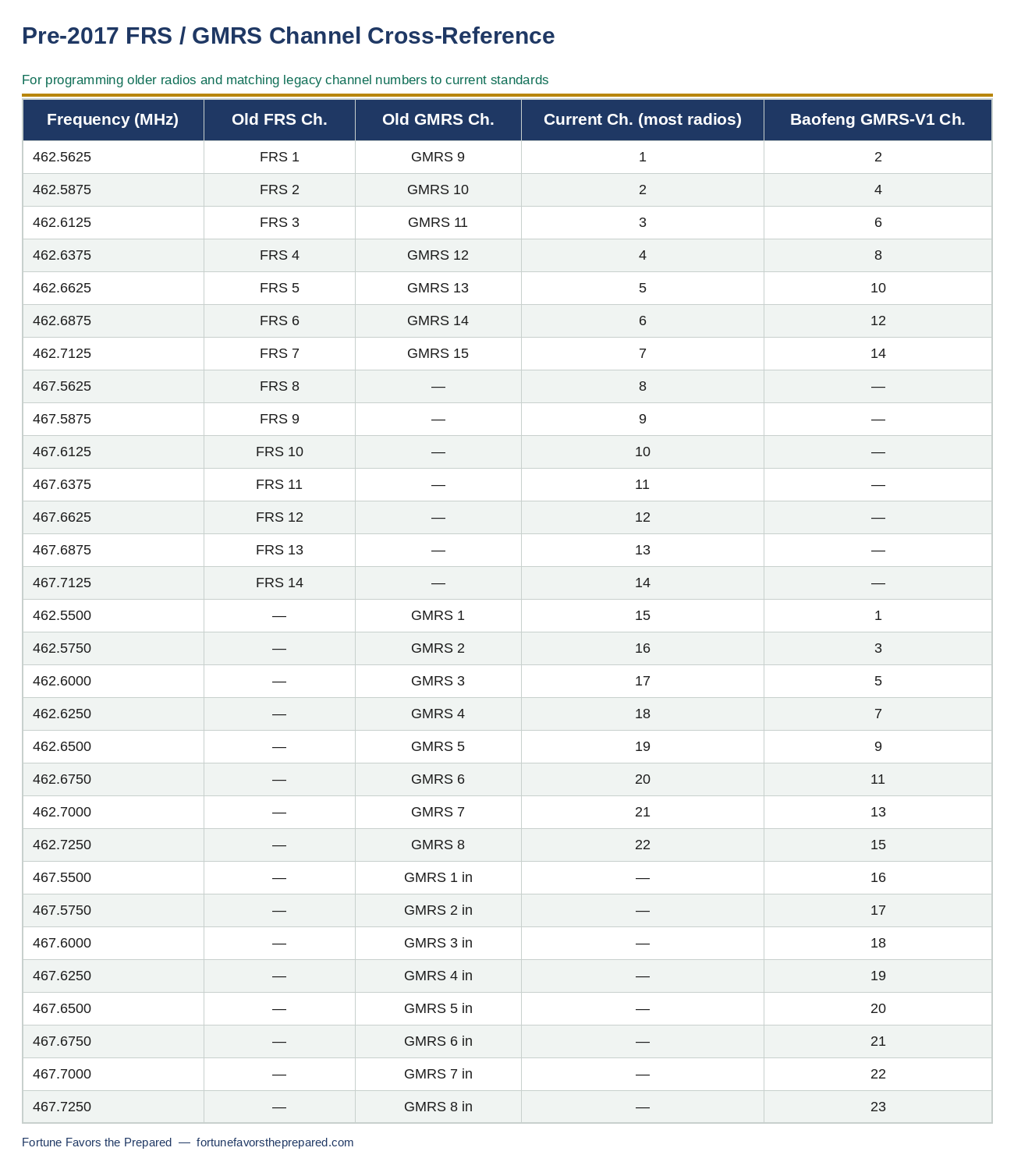
The FCC overhauled Personal Radio Service rules in 2017. Before that update, FRS and GMRS had separate, non-overlapping channel numbers on part of the band, and every FRS radio was capped at 0.5 W across all channels regardless of which channel it was on. A large number of these older radios are still in service, and their channel numbering doesn’t match current radios — which matters if you’re trying to get a new radio to talk to an old one, or programming a legacy unit from a frequency list.
The cross-reference table below maps old FRS channel numbers, old GMRS channel numbers, and current channel numbers to the same underlying frequency, plus the numbering used by the popular Baofeng GMRS-V1.
6. Privacy Codes: CTCSS, DCS, and Why There’s No Actual Privacy
Pre-2017 FRS radios in particular often labeled a setting “privacy code,” and the name is misleading. What that setting actually controls is a sub-audible tone — CTCSS (an analog tone, familiar to hams as a “PL tone”) or DCS (a digital code) — that your radio transmits continuously underneath your voice. A radio set to the same tone or code will only unmute for transmissions carrying that same tone; a radio on a different tone, or no tone at all, will still hear every word.
CTCSS and DCS tones filter what you hear; they do nothing to prevent anyone else from hearing you. Anyone monitoring the channel without a tone set, or with a scanner, hears your transmission in the clear regardless of which “privacy code” you’ve selected. If your household or MAG has an actual requirement to protect the content of a message, that’s a COMSEC problem — see COM-03 COMSEC — not something a tone squelch setting can solve.
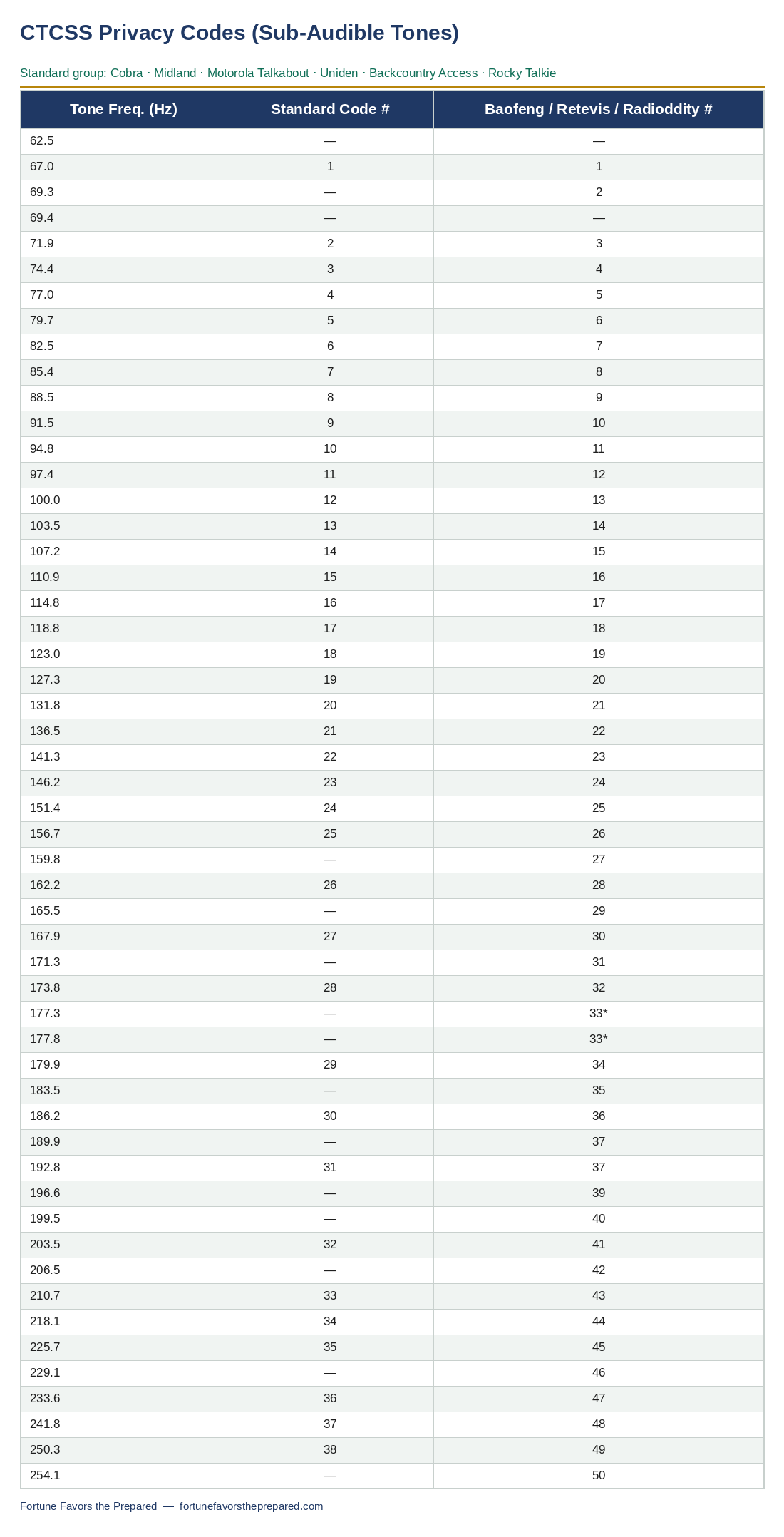
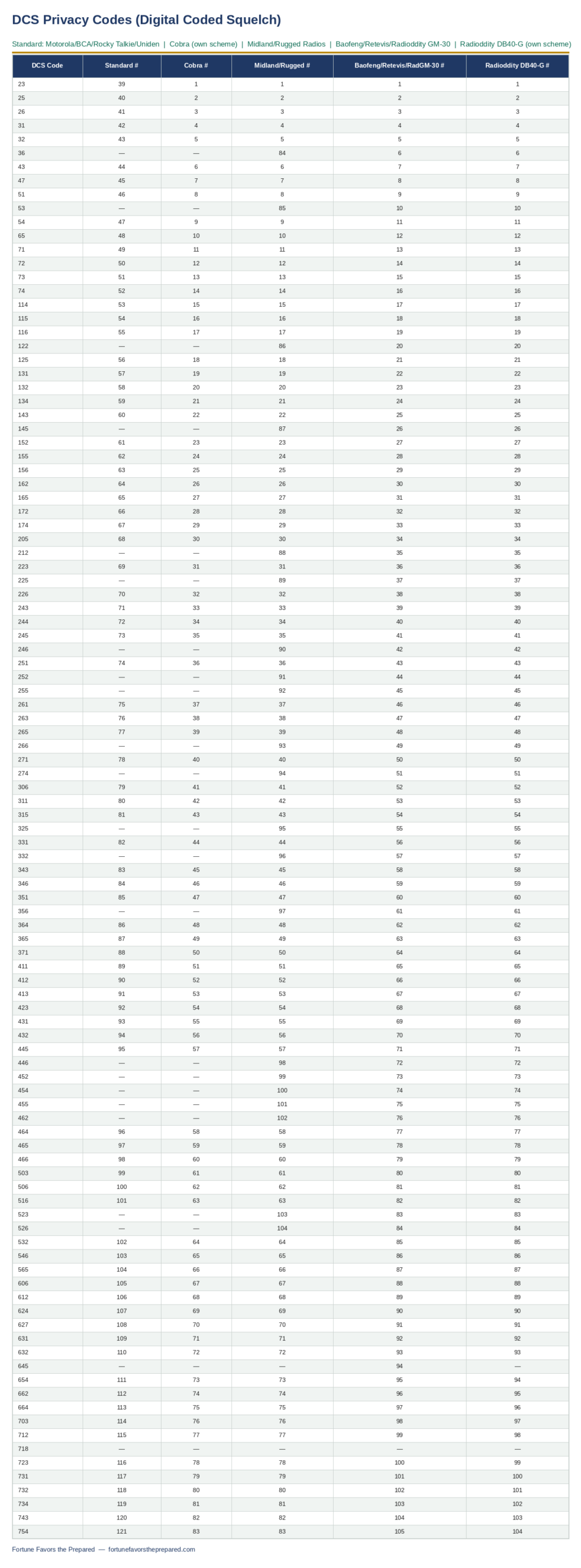
The other wrinkle: most manufacturers list only a number for their “privacy code,” not the actual CTCSS frequency or DCS value underneath it, and those numbers are not standardized across brands. On Baofeng, Retevis, Radioddity, Cherokee 465, or Radio Shack, code 3 is 71.9 Hz; on Backcountry Access, Cobra, Midland, Motorola Talkabout, Rocky Talkie, Uniden, or Rugged Radios, code 3 is 74.4 Hz. Set one household to “channel 17, code 3” and another to the same words on a different brand and they will not hear each other — and nothing will look wrong on either radio. The tables below cross-reference the manufacturer numbering back to the actual tone or code, and against each other, so you can match radios from different brands to the same tone if you need mixed equipment to talk to each other.
On an ICS-205, the RX Tone and TX Tone columns want the actual tone in hertz or the three-digit DCS code — never the number your radio’s menu happens to display. That’s the only form of it that means the same thing on every radio your plan has to work with. See COM-05 ICS-205 Communications Plan.
CTCSS (Analog Tone) Cross-Reference
Cobra, Midland, Motorola Talkabout, Uniden, Backcountry Access, and Rocky Talkie share one numbering scheme. Rugged Radios uses its own, separate numbering with several additional tones. Baofeng, Retevis, and Radioddity — popular for their price and programmability — share a third scheme, with a couple of quirks: Baofeng maps both 177.3 Hz and 177.8 Hz to the same displayed code, and shows 37 rather than 38 at 192.8 Hz. The chart below covers the two most common schemes; if you’re running Rugged Radios gear, cross-check it against the full manufacturer table in the reference PDF below.
Baofeng, Retevis, and Radioddity are included here because a lot of readers already own one and need the tone numbers to match against other equipment — not as an endorsement of using them on FRS or GMRS. See the equipment certification discussion above for why these radios aren’t legal for either service regardless of power setting.
DCS (Digital Code) Cross-Reference
DCS splits into more numbering schemes than CTCSS does. Backcountry Access, Motorola, Rocky Talkie, and Uniden share one scheme. Cobra runs its own — it’s missing entirely from about 20 of the higher codes that Midland and Rugged Radios (which share a scheme with each other) do have. Baofeng, Retevis, and the Radioddity GM-30 share a fourth scheme; the Radioddity DB40-G runs one number lower from code 654 upward and omits 645 altogether, so don’t assume it matches its own sibling model.
7. “Extra” Channels on Some Radios
Some FRS and GMRS radios — Midland’s lineup is the most common example — advertise “extra” channels beyond the standard set. These are typically the radio manufacturer’s own labeling of frequencies or tone combinations that fall outside the plain-vanilla channel list, and they’re only meaningful if every radio in your group is the same brand and model family. If you’re standardizing equipment across a household or MAG, decide early whether you’re relying on any manufacturer-specific extra channels, since a different brand’s radio simply won’t have them.
8. Realistic Range Expectations
Ignore the packaging. Marketing claims of “up to 20+ miles” describe a best-case, unobstructed, radio-tower-height scenario that essentially never occurs in normal use. FRS radios are capped at 2 W (or less), require a fixed antenna under the current rules, and without getting that antenna up high you are working with close to true line of sight. In practical, on-the-ground use — standing at ground level, houses and trees in the way — expect well under a mile, and often closer to a half mile. Plan your household’s FRS expectations around that reality, not the box.
9. Where FRS Fits in Your Comms Plan
FRS is not a serious primary method for a household or MAG communications plan, but it’s an excellent, zero-cost layer for short-range, in-the-moment coordination — kids in the yard, family members spread across a campsite, or a short-range fallback if a licensed radio fails. Used deliberately, it earns a real slot as a Contingency or Emergency tier in a properly built PACE structure; see COM-01 PACE Planning for how to lay that structure out so FRS has a defined role rather than being an afterthought.
If your household is weighing whether FRS is enough or whether it’s time to get GMRS-licensed for the power and repeater access, that’s covered in full in the companion article, General Mobile Radio Service (GMRS): The Complete Guide. Diversifying further onto a third, VHF-band service is covered in the MURS Complete Guide.
Reference Downloads
Full reference sheet (recommended): the complete channel and privacy-code tables, all manufacturers, all quirks noted — compiled by N0TFU as the official COM-05 reference sheet.
Quick-view charts for the same data, sized for a media library download or a spot on the wall next to the radio:
- FRS/GMRS Channel Frequency Chart
 frs-gmrs-channel-frequency-chart.png
 - Pre-2017 FRS/GMRS Channel Cross-Reference
pre2017-frs-gmrs-crossreference.png
- CTCSS Privacy Code Chart
ctcss-privacy-codes.png
- DCS Privacy Code Chart
dcs-privacy-codes.png
Verify any tone or code against your own radio before relying on it operationally — manufacturers revise firmware and code maps without notice.
Sources: 47 CFR Part 95 Subpart B; FRS/GMRS Frequencies and Privacy Codes, compiled by N0TFU (June 2026 revision), reference sheet for FFTP COM-05. This article consolidates and updates a prior Fortune Favors the Prepared post on FRS.
Semper Paratus, Semper Gumby