Skip to content

Fortune Favors the Prepared

Semper Paratus, Semper Gumby

Menu
  • The Continuity Chronicles
  • Intelligence Reports
        • DAILY THREAT REPORT
        • DAILY THREAT REPORT – LITE
        • DAILY PREPAREDNESS BRIEF
        • Analytical Standards and Tradecraft
        • Acronym & Abbreviations Glossary
        • Source Registry
        • FLASH & SPECIAL REPORTS
        • Area-Specific Assessment Report
        • SOFT TARGET SECURITY BRIEF
        • THE HOUSEHOLD BRIEF
        • COMMS WATCH
        • FINANCE SECTOR
        • HEALTHCARE SECTOR
        • TRANSPORTATION & LOGISTICS SECTOR
        • AI, DATA CENTER & INFRASTRUCTURE REPORT
        • CONSTRUCTION & MANUFACTURING SECTOR
        • Water and Wastewater Security Report
        • Energy Sector Report
        • Strategic Intelligence Supplement
  • WATCH DESK
  • About
        • The Why
        • Vision and Mission
        • Services
          • Business Resiliency
        • Testimonials
        • Insider
        • Friends
          • Patriot Volunteer Examiner (VE) Team
          • Angery American
          • Signal Stuff
          • Forward Observer
  • Communications
        • Stump Knocker
          • SOI
          • STUMP KNOCKER DMR UPDATES
          • MMDVM Hotspot
        • Preparedness Communications
          • What Radio Should I Get for Preparedness?
            • What Radio to Buy?
              • What Radio to Buy? – video
              • Ham Radio on a Budget
              • Live – What Radio to Buy?
              • Portable Radio Kit
              • Mobile Communications
          • Emergency Communications Principles
          • Communications Options
          • Starter Radio Paths by Preparedness Scenario
          • How Communications Fail
          • HF Communications
            • SHTF HF Communications
            • Simple Antenna Builds for HF – video
            • NVIS in Amateur Radio
        • Amateur (HAM) Radio
          • Why Do I Need a Ham License?
            • How to Obtain Your Amateur Radio License
              • Amateur Radio Learning Resources
              • Finding a Ham Exam
                • HAM Exam Accommodation
              • Getting Into Ham Radio – Video
            • Are You Expired?
            • Why You Should Upgrade to a General Ham License
          • HAM Simplex Frequency Card
          • Analog versus Digital
          • Analog vs Digital Voice: A Preparedness-Focused Comparison
          • CTCSS and DCS
          • Programming Radios with Software
          • ARES, RACES, ACS and AUXCOMM
          • Ham Radio Beyond Line-of-Sight
            • Linked Analog Repeaters
            • EchoLink and IRLP
            • AllStarLink
            • Yaesu System Fusion & WIRES-X
            • D-STAR
            • Digital Mobile Radio (DMR)
            • P25 in Amateur Radio
            • NXDN in Amateur Radio
            • Amateur Radio Satellites (AMSAT)
            • The 60-Meter Band (5 MHz)
          • Meshtastic
          • HAM VoIP
        • Personal Radio Services
          • FCC Rules for Personal Radio Services
          • Family Radio Service (FRS)
          • General Mobile Radio Service (GMRS)
            • GMRS Repeaters
            • Getting a GMRS License
            • FRS / GMRS / MURS Frequency Card
          • Multi-Use Radio Service (MURS)
          • Citizen Band (CB) Radio
            • CB Frequency Card
        • Other Radio Services
          • Communications Continuity Programs and Capabilities
          • Marine Communications
        • Cell Sites and Their Services
          • When Cell Service Fails
          • Radio over LTE and Rapid Radios
            • LTE Radio Comparison
        • Satellite Communications
          • America’s Secret Eyes
          • The Commercial Eye
          • Seeing Through Everything (SAR)
            • Remote Area Emergency Communication Devices
            • Which Beacon Should You Carry?
          • Personal Satellite Communications
        • Wired Communications
          • MAG Phone System
          • TA-312/PT Field Telephone and SB-22/PT Switchboard
          • Understanding Telephone Wiring
          • The AT&T Long Lines Program
        • Communications Planning
          • Communications Plan Annex
            • Communications P.A.C.E.
            • Finding Information for Your Communications Plan
            • Area-Specific Assessment Report
          • Automatic Link Establishment (ALE)
          • Understanding Communications Resiliency
        • Communications Resiliency Programs
          • ARES, RACES and ACS
          • Auxiliary Communications (AUXCOMM)
          • Military Auxiliary Radio System (MARS)
          • U.S. Coast Guard Auxiliary Communications
          • Civil Air Patrol Communications
          • The 60-Meter Band (5 MHz)
            • Understanding the 60-Meter Band
        • Government Communications Continuity Programs
          • Government Emergency Telecommunications Service (GETS) and Wireless Priority Service (WPS)
          • National Warning System (NAWAS)
          • National Interoperable Frequencies
          • The FEMA National Net (FNARS)
          • National Emergency Communications Network (NECN)
          • The SHARES Program
          • State Emergency Capability Using Radio Effectively (Operation SECURE)
          • The High Frequency Global Communications System (HFGCS)
          • Satellite Mutual Aid Radio Talkgroup (SMART)
          • The AT&T Long Lines Program
        • Communications & Emissions Discipline
          • Communications Security (COMSEC)
            • Book Cipher
            • One Time Pads (OTP)
              • Decrypting One Time Pad Message
              • One Time Pads (OTP) Live Video
              • One Time Pad Training
          • Cryptographic Security (CRYPTOSEC)
          • Transmission Security (TRANSEC)
          • Communications Transmission Discipline (TRANSDISC)
          • Emissions Control (EMCON)
          • Communications & Emissions Training Framework
        • DMR Programming
          • DMR Programming – Talk Groups
          • DMR Programming - Roaming
          • MMDVM and Yaesu System Fusion (YSF)
          • Encryption in DMR Radios
        • Digital Mobile Radio (DMR) Networks
          • WR3IRS Interstate DMR Network
            • South Central PA (SC PA)
            • North East PA (NE PA)
            • Washington-Baltimore (W-B)
            • West Central Florida (WCF)
          • Florida Digital Amateur Radio Network (F-DARN)
          • Southeast Florida DMR Repeater Network W2GGI
          • Virginia DMR (DMRVA)
          • NC PRN DMR Network
          • SC Hospital Emergency Amateur Radio Team (SCHEART)
          • HEARS – Hospital Emergency Amateur Radio System
          • New England Digital Emergency Communications Network (NEDECN)
        • Baofeng/BTECH Radios Quick Guide
          • Manually Programming a Baofeng Radio – Video
          • A User’s User Manual for Baofeng Radios
        • MESSAGES & REPORTS
          • Phonetics
          • Procedure Words (Prowords)
          • Date Time Group (DTG)
          • NTS Radiogram Form
            • ARL Numbered Radiograms
          • SALUTE, SPOT, and SALT Reports
          • ACE/LACE Reports
          • GOTWA Report
          • CASREP (Casualty Report) Format
          • MEDEVAC Request Report
          • Formatted Messages (downloads)
        • Communications Knowledge Library
          • Communications Resiliency
          • Radio Etiquette, Jargon, and Best Practices
          • AmRRON RESOURCES & REFERENCES
          • Anytone Programmable Keys
          • Phonetics
          • Amateur Radio Colorado
            • Colorado Linked Repeater Systems
        • COMMUNICATIONS REFERENCES
  • Planning
        • Family Emergency Plan – The Basics
          • Family Emergency Plan
            • Area-Specific Assessment Report
          • Why Every Family Needs an Emergency Plan
        • Family Contingency Binder
          • Family Contingency Binder MindMap
        • Triggers
          • Preparedness Conditions – PREP-CON
            • Preparedness Conditions (PREP-CON) MindMap
          • Space Weather
        • Family Emergency Plan Workbook
          • Family Emergency Plan Workbook - owner resources
            • Area-Specific Assessment Report
            • Family Emergency Planning Form
            • Communications Plan
              • P.A.C.E.
            • Emergency Evacuation
            • Emergency Food Supplies
            • Family Contingency Binder
            • Message Drops
            • Get Home Bag
            • Bug Out Bag & Bins
            • Miscellaneous
        • Household Recovery Workbook
          • Disaster Debris — What to Do at the Curb
          • Dealing With Grief
        • Next of Kin Workbook
        • METT-TC: Decision Discipline
          • METT-TC - tactical planning
        • Planning Your Preps
          • Charity in Planning
        • Mutual Assistance Group
          • Mutual Assistance Groups (MAGs): Skills, Vetting, and Building Real Resilience
          • Mutual Assistance Group (MAG): Recruitment Code of Conduct
          • MAG: Private Vetting & Intake Process
          • Compartmentalization in Mutual Assistance Groups (MAGs)
          • Resiliency Index
          • Continuity of Government & Application to MAGs
  • Threat Assessment
        • Personal Preparedness Assessment Workbook
          • Personal Preparedness Assessment Report
          • Personal Preparedness Assessment Workbook - owner resources
        • Readiness Conditions for Preparedness
          • PREP-CON - Preparedness Conditions
          • COMCON – Communications Readiness Condition
          • WX-CON Weather Conditions
          • SWX-CON Space Weather Condition
          • CONCON – Civilian Continuity Conditions
        • Readiness Conditions – Hierarchy and Relationships
          • LERTCON – Alert Condition
          • DEFCON – Defense Readiness Condition
          • COGCON - Continuity of Government
          • INFOCON – Information Operations Condition
          • FPCON – Force Protection Condition
          • EMERCON – Emergency Condition
          • CYBERCON – Cyber Readiness Conditions
          • CPCON – Cyberspace Protection Condition
          • WATCHCON – Watch Condition
          • SIPRNet – Secret Internet Protocol Router Network
          • REDCON – Readiness Condition
          • NC3CON – Nuclear Command, Control, and Communications
        • Readiness Conditions in The Conspiracy Chronicles
          • CERCON – Cerberus Readiness Condition
          • COMCON – Communications Readiness Condition
          • C-OPS – CERBERUS Operational Status Conditions
          • CONCON – Civilian Continuity Conditions
        • Being Prepared for Civil Unrest
          • Civil Unrest – Area Intelligence
          • Civil Unrest – Be Prepared
          • Civil Unrest – Defense
          • Civil Unrest – Defense (part 2)
        • Staying Informed Before, During and After Emergencies
          • Weather Awareness
            • Weather Event Codes
            • Weather Radio Comparison
        • Cascade Analysis & Infrastructure
          • Cascade Effects
          • Community Lifelines
          • Area Intelligence
          • Area-Specific Assessment Report
          • National Power Grid
  • Intelligence
        • ANALYSIS, TRADECRAFT & REPORTING
          • Analytical Standards and Tradecraft
          • Analytical Tradecraft: A Guide to OSINT Analysis
            • OSINT Analysis Study & Reference Guide
          • Understanding Intelligence Analysis Tools
            • Understanding Analysis of Competing Hypotheses (ACH)
              • ANALYSIS OF COMPETING HYPOTHESES (ACH) - TRAINING CURRICULUM
            • Understanding MDCOA
            • Understanding OAKOC
        • Operations Security (OPSEC)
          • OPSEC for Teens
          • OPSEC for Kids
          • The Gray Man
          • OPSEC: Don't Become the Target
          • Counterintelligence Tradecraft for the Prepared
        • Community Intelligence
          • Area Intelligence – Now!
            • Area-Specific Assessment Report
          • Community SITREP
          • Radio Traffic Situational Analysis During Emergencies
            • Radio Traffic Situational Analysis (RTSA) -TRAINING CURRICULUM
          • SALUTE, SPOT, and SALT Reports
        • ELECTRONIC THREAT & SURVEILLANCE
          • Staying Informed Before, During and After Emergencies
          • Integrated Public Alert and Warning System (IPAWS)
          • Communications Continuity Programs and Capabilities
          • Short Wave Scanning
          • America’s Secret Eyes
          • The Five Eyes Satellite Intelligence Network
          • Seeing Through Everything (SAR)
            • Which Beacon Should You Carry?
          • Wireless Recon Devices
        • INTELLIGENCE DISCIPLINES
          • Communications Intelligence (COMINT)
          • Electronic Intelligence (ELINT)
          • Tactical Electronic Intelligence (TACELINT)
          • Signals Intelligence (SIGINT) – the basics (2020)
          • Signals Intelligence – Information Gathering Basics (2022)
          • Signals Intelligence (SIGINT)
          • Technical & Infrastructure Intelligence (TECHINT)
          • Electronic Counter-Surveillance
          • Open-Source Intelligence (OSINT)
            • How to Conduct a Daily Threat Analysis Using OSINT
          • Measurement and Signature Intelligence (MASINT)
          • Electronic Surveillance (ES)
          • Overhead Imagery & Geospatial Intelligence (IMINT / GEOINT)
        • INTELLIGENCE REFERENCES
  • Medical
        • Medical Training
          • Patient Assessment & Casualty Management
            • MARCH-PAWS Rapid Assessment
              • MARCH-PAWS TRAINING CURRICULUM
            • DCAP-BTLS – Secondary Trauma Assessment
            • SAMPLE + OPQRST Secondary Assessment
              • Medical History as a Preparedness Skill
                • Medical History as a Preparedness Skill – TRAINING CURRICULUM
            • START Triage
            • MEDEVAC Request Report
            • Patient Assessment – Documentation
              • Patient Care Report Forms
              • CASREP (Casualty Report) Format
        • Medical Kits
          • Individual First Aid Kit (IFAK)
          • BooBoo and IFAK Kits Video
          • BooBoo & IFAK Kit Mind Map
          • Large Kit - video
        • Medical Myths
          • Medical Myths – Tampons
          • Medical Myths – Ingested Poisoning
        • MEDICAL REFERENCES
  • Transportation
    • Transportation Plan B
    • Improvised Transportation
    • Preparedness For Winter Travel
  • Animals
    • Preparedness for Pets
  • Food
        • Why You Should Start a Food Storage Plan
        • Food Storage Quick Start
        • Buying in Bulk
        • Inventory Tracking
        • FOOD PRESERVATION RESOURCES
  • Water
  • Power
        • Power Grid
        • UPS
  • Bags etc.
        • Bug Out versus Get Home Bags
        • Get Home Bag – Contents
          • Get Home Bag – video
          • Get Home and Bug Out Bags - video from live 2-10
  • Navigation & Signalling
        • Practitioners Guide to GPS
          • Quick Instruction Sets
        • Emergency Signaling
        • Covert Signals
        • Which Emergency Beacon Should You Carry?
        • Sketched Strip Map
  • References
        • PLANNING & OPERATIONS
        • SECURITY OPERATIONS
        • INTELLIGENCE
        • CRYPTOLOGY
        • COMMUNICATIONS
        • REPORTING FORMATS
        • GENERAL/MISC
        • MEDICAL
        • FOOD PRESERVATION
        • CRITICAL INFRASTRUCTURE
        • SURVIVAL MANUALS
        • OPSEC
        • COUNTER INSURGENCY & CIVIL DISTURBANCE
        • EMP / CME
        • Training
          • Training Videos
          • One Time Pad (OTP) Exercises
            • 45662
            • 222135ZDEC22
  • Blog
    • Boomer
      • Day 1 – The Journey Home
      • Day 2 – First Day in the New Home
      • Day 3 – More Training
      • Day 4 – Dad Goes Back to Work
      • Day 5 – A Day at Home with More Training with Dad (Boomer’s version)
      • Day 6 – More Training with Dad at Home
      • Day 7 – Dad Goes Back to Work, Boring Day
    • Mountain Readiness Fallout Workshops
    • Mapping DMR Repeaters
    • COMMUNICATIONS RESILIENCY
    • Getting The Message Through
    • What are you preparing for?
    • Never Let an Opportunity Go To Waste
    • Cascade Effects and the Perfect Storm
    • DO NOT REPLY
    • Space Weather Warning
    • Good, and Sad, News
    • Necessity vs. Luxury
    • Don’t Put off Until Tomorrow
    • No Plan Survives First Contact
    • Threat and Hazard Identification and Risk Assessment (THIRA)
    • Live – What Radio to Buy?
    • Big Daddy Unlimited Affiliate
    • Food – Tue 16th 7pm MST
    • Live from 2021-2-3
    • Live 2021-01-26
    • FLASH SALE
    • Live 2021-01-11
    • What Is Freedom?
    • Preparedness for Pets
    • What If The Lights Go Out?
    • Hoarding or Prepping?
    • Why Do I Need a Ham License?
    • How Bad is the SolarWinds Orion Issue?
    • How To Begin Prepping
    • Members Only Live Videos
    • Live 11/24
    • Ham Radio VoIP Phone
    • Training Calendar
    • A Chat (with some whisky)
    • Blog 2020 11 02
    • Live with Charlie Hogwood
    • EARTH EX 2020
    • A Live with Angery American
    • Have You Woken Up Yet?
    • BUG OUT READY
    • The Gray Man
    • Area Intelligence – Now!
    • Being Prepared for Civil Unrest
    • It Depends
    • The Art of Being Prepared – The New Prepper
    • Get Home versus Bug Out Bags
    • Why You Need an IFAK AND Training
  • Shop
  • Contact
    • Mailing List
  • Media and Press
Menu

Dealing With Grief

Years ago, while studying to be a paramedic, I learned about the 7 Stages of Death and Dying, first described by psychiatrist Elizabeth Kubler-Ross. Over the decades since, I have watched those same stages play out in disaster after disaster — not just in survivors picking through the wreckage of their homes, but in the responders standing next to them. We all process catastrophic loss differently. I have been unfortunate enough to witness it far too many times, from both sides of the line.

When disaster strikes — a wildfire, flood, tornado, earthquake, or any sudden event that strips away what felt permanent — the visible losses are immediate. The home, the neighborhood, the routine, the sense of safety. What is less visible, and far less talked about, is the grief that follows. Not necessarily grief for a person, but grief for what was. That grief is real, it is recognized by mental health science, and it follows a predictable path.

That predictability matters. When you know what is coming, you can name it. When you can name it, you can manage it. And when you can manage it, you make better decisions at exactly the moment when decision quality determines everything — whether your insurance claim survives, whether your family holds together, whether you rebuild or give up.

This is not a clinical document. It is what thirty years of watching people go through the worst days of their lives has taught me, layered on top of what the science says. Read it now, before you need it. Or share it with someone who already does.

“Most people in the first 72 hours after a disaster believe they are handling it well. They are not. Acute stress impairs judgment, working memory, and risk assessment in ways the person experiencing it cannot detect from the inside.”


Part I

The Population Arc: What Communities Experience

Before looking at individual grief, it helps to understand the broader trajectory that disaster-affected communities follow. This timeline, documented by disaster mental health researchers and embedded in how SAMHSA and the Red Cross train responders, maps the emotional arc at the community level. Your individual experience may not follow it exactly — but understanding where the population tends to be helps explain the environment you are navigating.

Community mental health phases after disaster
Phase 1  |  Day 0 to 72 hrs
Acute

Shock, dissociation, hypervigilance, sleep disruption, appetite loss, irritability. Most consequential decisions get made here. Impaired judgment is at its peak. Most people do not recognize these as trauma responses — they believe they are “handling it well.”

Phase 2  |  Week 1 to 4
Honeymoon / Heroic

Community solidarity is high. Adrenaline is still elevated. There is a palpable “we got this” energy. This phase looks healthy and often is. It is also frequently masking an accumulating trauma debt that will surface later. People defer their own care to help others.

Phase 3  |  Month 2 to 12
Disillusionment

The bottom drops out. Insurance denials hit. Contractors are unreliable. Aid moves slower than expected. Substance use spikes. Domestic violence spikes. Suicide ideation spikes. This is statistically the deadliest phase psychologically — and exactly when external support has faded and media attention has moved on.

Phase 4  |  Year 1 and beyond
Reconstruction

Rebuilding meaning, integrating the loss. Post-traumatic growth for some; chronic PTSD for others. Predictable anniversary reactions for years. The trajectory from here depends heavily on whether support was available during Phase 3.

Notice the gap: community support, media coverage, and volunteer resources tend to peak during Phase 2 — and then collapse. The people who need the most help in Phase 3 are navigating it largely alone. If you are reading this in Phase 3, that is not a coincidence. That is the design flaw in how we as a society respond to disaster. Name it. It is not a personal failing.


Part II

The 7 Stages of Grief, Applied to Disaster Loss

Kubler-Ross originally developed her framework for people facing terminal illness and death. What she documented — and what has been observed in disaster settings ever since — is that profound loss, of any kind, tends to move through recognizable emotional territory. The loss does not have to be of a person. The loss of a home, a neighborhood, a way of life, a sense of safety — these trigger the same grief response.

These stages are not steps on a checklist. They are territories. You may spend weeks in one, hours in another. You may skip one entirely and then find it waiting for you six months later. The map is not the territory — but having a map still helps.
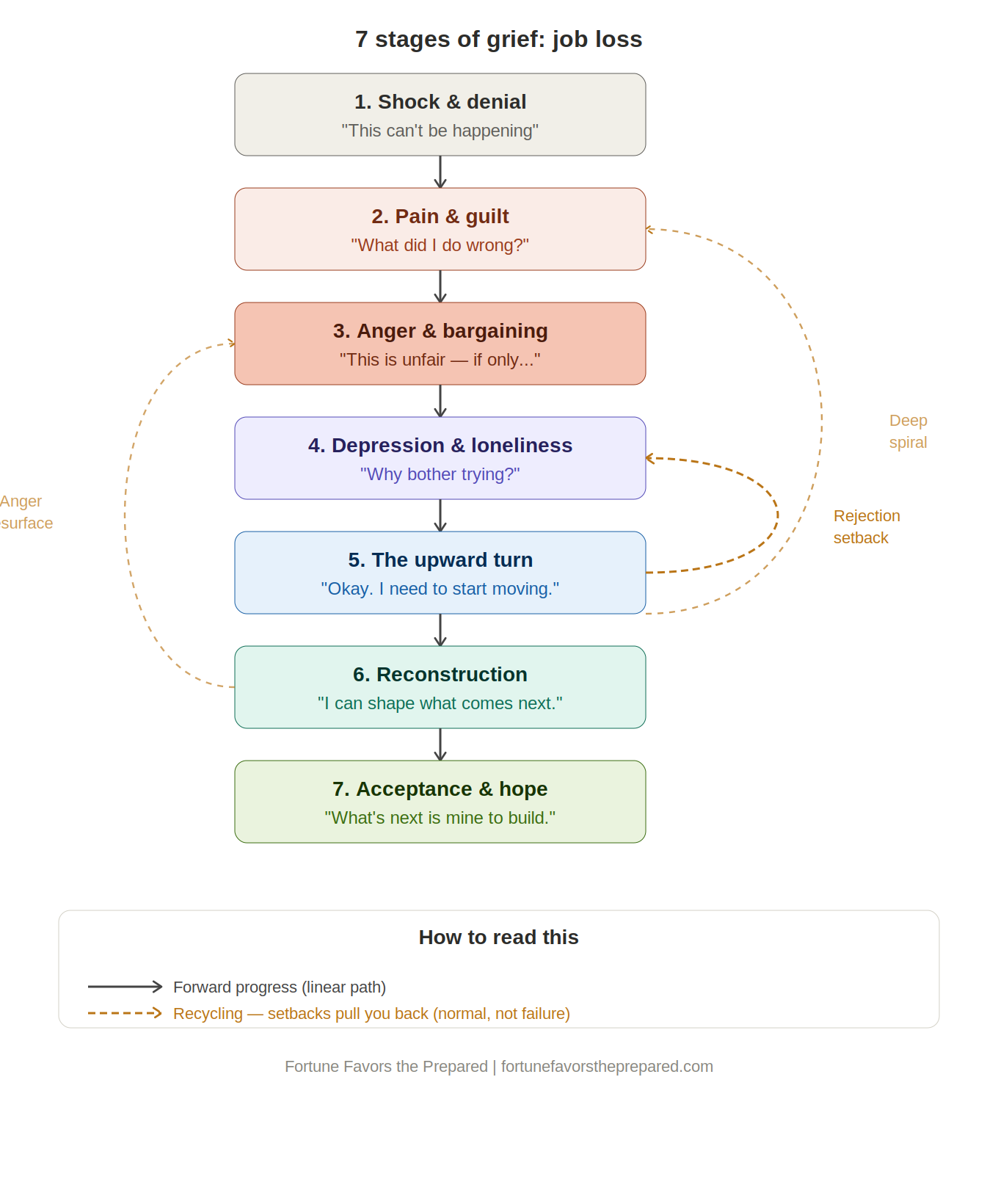
Diagram showing the 7 stages of grief applied to disaster loss, with linear forward path and recycling arrows showing how people cycle back through earlier stages
The 7 stages are rarely linear. Dashed arrows show the most common recycling patterns — how setbacks loop people back to earlier stages before recovery continues forward.
Stage 01

Shock and Denial

“This can’t be real. I keep expecting to go home.”

In the first hours and days after a disaster, the mind protects itself with numbness. You may feel strangely calm, almost detached from what is happening around you. Some people describe watching themselves move through the immediate aftermath as if observing from a distance. You may find yourself minimizing the damage, certain that things will somehow return to normal quickly, making plans based on an optimistic assessment that does not match reality.

This is not weakness. It is a neurological protection mechanism. The brain manages an unbearable information load by throttling it. Shock is adaptive in the short term — it allows you to function when full emotional processing would be incapacitating. The problem is that shock impairs judgment in ways that are not visible to the person experiencing it.

This is why the single most important rule of early disaster recovery is: do not make irreversible decisions in the first 72 hours. Do not sign contractor agreements. Do not accept insurance settlements. Do not agree to anything permanent. The person making those decisions is not operating at full capacity, no matter how certain they feel.

Practical anchor: Document everything before you touch anything. Photos, video, time-stamped notes. The decisions that come later — insurance claims, FEMA applications, contractor disputes — will be won or lost on documentation made in these early hours.
Before the next disaster

The workbook that gets you ready for the year after.

The single most important rule of Stage 1 is: don’t make irreversible decisions in the first 72 hours. But knowing that rule doesn’t help if you don’t already know your insurance policy, your FEMA IA deadlines, or what receipts to keep. The Household Recovery Workbook is designed to be completed before a disaster — so that when shock hits, the answers are already written down.

■ Section 1 pre-fills your insurance master, mortgage register, and household identity. Do it now, not under duress.
■ Checklists for the first 72 hours, damage documentation, contractor vetting, FEMA IA navigation, and the mental health timeline.
■ 168 pages. Loose-leaf. Three-ring binder ready. Built by a practitioner with 30 years of field experience.
See What’s Inside → Order · $29.95
Stage 02

Pain and Guilt

“I should have been more prepared. I should have left earlier.”

As the protective numbness of shock begins to recede, pain rushes in to fill the space. Not just grief for what was lost, but something sharper: the conviction that the loss was preventable, and that you are responsible for not preventing it. Survivors of disaster replay decisions with exhausting intensity. The evacuation they delayed by a day. The documents they didn’t put in a waterproof bag. The neighbor they meant to check on. The emergency kit they always intended to build.

Responders are not immune. First responders, emergency managers, and volunteers who worked the event often carry a parallel guilt: the call they couldn’t get to in time, the resource that wasn’t available, the person they couldn’t reach. The operational debrief and the emotional debrief are separate processes, and both matter.

Here is what the guilt rarely accounts for: disasters are low-probability, high-consequence events specifically designed by their nature to outpace normal human preparation. The person who didn’t evacuate early enough was probably weighing real competing considerations — work, family, previous false alarms, uncertainty about the threat level. The family without a 72-hour kit was not uniquely irresponsible. Most households are not prepared. That is a systemic failure, not a personal one.

That does not make the guilt disappear. But naming it for what it is — a normal grief response, not an accurate indictment — creates enough space to keep functioning.

For responders: Peer support programs exist specifically for this phase. Critical Incident Stress Management (CISM) and organizational peer support are not signs of weakness — they are professional tools. Use them.
Stage 03

Anger and Bargaining

“Why wasn’t there more warning? Someone should pay for this.”

Grief turns outward. The anger that arrives in Stage 3 is often indiscriminate — directed at government agencies, emergency management systems, neighbors who seemed to fare better, insurance companies, contractors who overpromise, aid organizations with confusing eligibility requirements. The anger is real, and often some portion of it is justified. Systems do fail. Warning times are sometimes inadequate. Insurance companies do behave badly. These are legitimate grievances.

What makes this phase dangerous is that anger degrades decision quality in specific ways. It increases risk tolerance. It creates urgency that doesn’t match the actual timeline of recovery. It makes people sign agreements they shouldn’t sign, make accusations that complicate later negotiations, and burn relationships they will need in the months ahead. The contractor who shows up on Day 3 offering to start work immediately, cash up front — he is counting on Stage 3 grief to close the deal.

Bargaining runs alongside the anger: “If FEMA approves the claim, everything will be okay.” “If we can just get back into the house by [date], we can manage.” These conditional frames create false finish lines that, when they move — as they almost always do — produce a secondary collapse. Recovery timelines for significant property damage are measured in months to years, not weeks. That is not pessimism. It is operational reality, and building against it protects you from unnecessary secondary grief.

Rule of thumb: Any contractor, adjuster, or aid representative who creates urgency around a signature deserves extra scrutiny, not less. The legitimate ones can wait a week. The predatory ones cannot.
Stage 04

Depression and Loneliness

“I don’t see how we come back from this.”

This is the heaviest stage, and statistically the most dangerous. The adrenaline that sustained the acute phase is gone. The community solidarity of the first weeks has faded. The volunteers have gone home. The media coverage has moved to the next event. Your support network, having rallied in the first weeks, has returned to the demands of their own lives. And you are still in the middle of it.

This is the disillusionment phase at the individual level. Insurance denials hit. The adjuster’s assessment comes in lower than expected. A contractor disappears after taking a deposit. FEMA assistance is less than you needed. Temporary housing is cramped and disorienting. The children are struggling in new schools. The workplace is losing patience. And the timeline to resolution keeps moving.

The behavioral signs of this stage — withdrawal from social contact, substance use, neglect of self-care, increased family conflict, inability to manage the practical work of recovery — are not character failings. They are predictable physiological and psychological responses to sustained, compounded loss under conditions of inadequate support. Knowing that does not make them easier. But it does mean that professional support is appropriate, effective, and warranted — not as a last resort, but as a reasonable response to an unreasonable situation.

The people most at risk in this phase are often the ones who appeared to be managing best in the early stages. Caregiver burnout is real: the person who held the household together through the acute phase may be the one who crashes hardest when the scaffolding comes down.

Watch for: The caregiver who is “holding it together” for everyone else. That person needs to be cared for too. Build it into the recovery deliberately — not as an afterthought.
Stage 05

The Upward Turn

“Okay. We have to start somewhere.”

At some point — and the timing varies enormously from person to person — the weight lifts slightly. Not gone. Not resolved. But manageable in a way it wasn’t before. Energy returns in fragments. The paralysis that made simple decisions feel impossible begins to ease. You make a call you’d been putting off, and it goes better than expected. You attend a recovery meeting and feel, for the first time, that the people running the process might actually be competent.

This phase can be fragile. A denial letter, an unexpected repair cost, a contractor setback, or an anniversary date can temporarily push someone back into depression or anger. That is not regression. That is the normal, nonlinear shape of grief. The stage model is a map, not a railroad. Most people cycle through earlier stages multiple times before the upward turn becomes more durable.

What characterizes this phase is not optimism — it is not that everything feels okay, or that the losses feel smaller. It is that action becomes possible again. The gap between knowing what needs to be done and being able to do it begins to close. That is enough. Start there.

Small wins matter: The upward turn is built from concrete, completable tasks. Identify the next specific action — one call, one form, one appointment — not the full recovery plan. Momentum is built one step at a time.
Stage 06

Reconstruction

“I can actually see what this looks like on the other side.”

Reconstruction is the work phase — not just of the physical structure, but of life. Active decision-making replaces reactive crisis management. Strategic thinking about the future becomes possible. You are not just responding to what the disaster did; you are making intentional choices about what comes next.

The emotional processing that was impossible in earlier phases becomes accessible now. People in this phase often find themselves able to think clearly about what the loss meant, what they want to preserve from the life they had, and what they might choose to change. Some of the most important decisions of a person’s life get made in this phase — about where to live, what to prioritize, what kind of community to invest in. Making those decisions consciously, with adequate information and support, produces better outcomes than making them reactively.

Reconstruction is also where the practical work intensifies: contractor management, insurance negotiations, FEMA appeals, financial planning for the long rebuild. Having documented everything in the acute phase pays dividends here. The household with a complete paper trail wins disputes that the household without one loses.

Document everything, still: The documentation discipline that started in Stage 1 is just as important here. Every contractor conversation, every insurance call, every commitment made verbally — write it down, time-stamp it, save it.
Stage 07

Acceptance and Integration

“This happened. It changed us. We carry it forward.”

Acceptance is not erasure. It does not mean the loss was acceptable, that the damage was fine, or that things are back to the way they were. They are not. Recovery restores function; it does not restore the original. The house may be rebuilt, but it is not the same house. The neighborhood may recover, but some neighbors did not come back. The sense of safety may return, but it carries a different texture — one that knows, now, what can happen.

What acceptance does mean is that the event has been integrated into the story of who you are, rather than remaining an open wound that defines everything. The grief is there, but it is not consuming. You can think about what happened without being pulled under. You can talk about it, plan against recurrence, even help others navigating the same territory.

For some people, this phase brings what researchers call post-traumatic growth: a reprioritization of what matters, a deeper connection to community, a clarity about values that crisis strips down to the essential. For others, this phase requires ongoing professional support and never fully resembles what came before. Both outcomes are real. Both are valid. The measure is not how fully you’ve “recovered” — it is whether you are moving through it, with support, toward a life that functions.

Plan for anniversaries: The one-month, six-month, and one-year marks consistently produce emotional setbacks even in people who have reached acceptance. Plan for them — schedule something anchoring, notify your support network, consider a standing therapy appointment around those dates.

Part III

What Your Body and Mind Will Tell You

Trauma responses span four categories. Knowing what is normal versus what needs professional intervention helps you respond appropriately — and helps you advocate for the people around you who may not recognize their own symptoms.

Most of these responses are normal for the first four to six weeks after a disaster. They become clinically concerning when they intensify rather than ease over time, when they substantially impair daily functioning, or when the high-risk indicators in Part V emerge.

Physical

  • Sleep disruption (insomnia, nightmares, broken sleep)
  • Appetite changes (loss or comfort eating)
  • Hypervigilance, exaggerated startle response
  • Headaches, GI distress, muscle tension
  • Persistent fatigue not relieved by rest
  • Increased susceptibility to illness

Cognitive

  • Intrusive memories or flashbacks
  • Difficulty concentrating, forgetfulness
  • Decision paralysis on complex tradeoffs
  • Impaired risk assessment (especially financial)
  • Confusion about time and sequence of events
  • Catastrophic thinking patterns

Emotional

  • Numbness, emotional flatness
  • Irritability, short fuse
  • Guilt (survivor’s guilt, decision guilt)
  • Shame about accepting help
  • Hopelessness, especially in disillusionment phase
  • Sudden, unexpected grief episodes

Behavioral

  • Withdrawal from social contact
  • Substance use (alcohol especially common)
  • Increased family conflict
  • Neglect of self-care, hygiene, medication
  • Avoidance of anything associated with the event
  • Loss of interest in previously enjoyed activities

Part IV

Your Household: Children, Elders, and the Caregiver

Disaster affects every member of a household, but not in the same way or on the same timeline. A household that manages the recovery well does so by accounting for every member’s specific needs — not just the adults managing the logistics.

Children, by age

Children cannot articulate what they are experiencing in the way adults can. Their grief manifests behaviorally, and what looks like defiance or regression is often a trauma response. Knowing what is normal for each age group helps you respond appropriately rather than reactively.

Infants and toddlers (0-3)
  • Increased clinginess, separation anxiety
  • Sleep regression, feeding changes
  • Increased crying, harder to soothe
  • Loss of recently acquired skills
Preschool (3-6)
  • Regression to younger behaviors
  • Repetitive play re-enacting the event
  • Unusual new fears or phobias
  • Increased clinginess or withdrawal
School age (6-12)
  • Difficulty concentrating, academic decline
  • Withdrawal from previously enjoyed activities
  • Physical complaints (stomachaches, headaches)
  • Aggression, irritability, sleep disturbance
Adolescents (13-18)
  • Withdrawal, isolation, increased screen use
  • Risk-taking behaviors
  • Substance experimentation
  • Academic decline, increased family conflict

Older adults

Elders are frequently the most underserved population in disaster recovery, because they self-isolate and do not ask for help. Cognitive symptoms in this group may resemble dementia onset — they are often trauma responses. Physical complaints frequently mask emotional distress. Medication non-compliance during stress is common and dangerous. Daily check-ins, in person if possible, are the single most useful intervention. Help with the cognitive load of recovery logistics — insurance calls, FEMA registration, contractor scheduling — may exceed current capacity even in people who were previously highly capable.

The caregiver

Every household has someone who functions as the primary organizer of the recovery. That person is at high risk of caregiver burnout — a syndrome that looks like exhaustion that doesn’t lift, increasing irritability, neglect of their own health, resentment, and loss of meaning. The spouse who appears to be managing everything competently is often the person closest to collapse. Caregiver burnout needs to be actively watched for and built against — not as a nice-to-have, but as a recovery planning item.


Part V

Psychological First Aid: How to Help the People Around You

Psychological First Aid (PFA) is a specific protocol developed for non-clinicians — household members, neighbors, coworkers, community members — to support people in acute distress. It has a strong evidence base and is taught by SAMHSA, the Red Cross, and the National Child Traumatic Stress Network. You do not need clinical training to use it.

The core of PFA is not advice-giving. It is presence, safety, and listening. The single most useful skill is showing up and staying — not solving, not fixing, not advising. Most people in acute distress need to be heard before they need any of those things. Sit with them. Let silence be acceptable. Let them lead.

What helps

  • I’m here. You’re not alone in this.
  • What do you need most right now?
  • This is hard. What you’re feeling makes sense.
  • I’m not going anywhere.
  • Take your time.
  • Would it help if I [specific concrete offer]?

What doesn’t help

  • “I know how you feel.” (You don’t.)
  • “At least…” (Any sentence starting this way minimizes.)
  • “Everything happens for a reason.”
  • “You’re so strong.” (Pressures performance.)
  • “You should…” (Unsolicited advice rarely helps.)
  • “It could be worse.” (Comparative suffering doesn’t console.)
On anniversary reactions

Plan for the predictable difficult dates: one month, six months, one year, and multi-year anniversaries of the event. These consistently produce emotional setbacks even in people who have reached acceptance. Consider scheduling therapy appointments around these dates. Notify your support network in advance. Anchor the date with something intentional. The people who navigate anniversaries best are the ones who planned for them rather than being ambushed.

These stages are not linear. Most people cycle through them repeatedly — reaching what feels like acceptance, then getting hit by a bureaucratic setback, a contractor problem, a family conflict, or an anniversary date that pulls them back into anger or depression. That is not regression. That is the normal, nonlinear shape of grief after disaster.

The goal is not to complete the stages in sequence and arrive at acceptance permanently. The goal is to keep moving through them, with adequate support, in a direction that allows life to function. Some days that means progress. Some days it means staying in place. Both count.

If you are reading this and recognizing yourself or someone you love in the harder stages — that recognition is itself a form of progress. You cannot navigate terrain you cannot see.


Escalate Immediately

When to Call for Help Now

Some symptoms require immediate professional intervention rather than peer support or self-management. If you observe any of the following in yourself or someone in your household, act immediately:

  • Any expression of suicidal ideation, even casual ones (“I just want it all to end”)
  • Substance use spike well beyond previous baseline
  • Dissociation lasting hours — not present, not responsive, unreachable
  • Domestic violence onset or escalation
  • Children showing dangerous behavioral changes (self-harm, refusal to eat, complete withdrawal)
  • Inability to perform basic self-care for several consecutive days
  • Psychotic symptoms: hallucinations, delusions, paranoia not present before

Be direct with the person you are concerned about: “I’ve noticed [specific changes]. I’m worried about you. Are you okay?” Listen without judgment. Do not promise to keep secrets if safety is at stake. Offer to call together. If they refuse and you remain concerned, call SAMHSA or 988 yourself for guidance.

Crisis resources — available 24/7

988 Suicide and Crisis Lifeline Call or text 988
SAMHSA Disaster Distress Helpline 1-800-985-5990
National Domestic Violence Hotline 1-800-799-7233
Veterans Crisis Line 988, then press 1
211 (local resources by zip code) Dial 211
Fortune Favors the Prepared

The operational playbook for the year after disaster.

Everything in this article — the phase timeline, the mental health stages, the household and children’s sections, the PFA protocol, the crisis escalation guide — goes deeper in the Household Recovery Workbook. Plus the practical work that grief won’t do for you: insurance claims, FEMA IA applications, contractor vetting, vital records recovery, and the tax implications nobody tells you about.

Why it needs to be on your shelf before a disaster, not after

When shock hits, you will not research your insurance policy. You will not look up FEMA deadlines. You will not know which receipts to keep or when the SBA disaster loan window closes. Section 1 of this workbook is designed to be filled out now, while you can think clearly — so that the answers exist when your judgment is impaired and the clock is running. The household that walks into the recovery process with a completed workbook wins disputes that unprepared households lose.

Most Popular
The Household Recovery Workbook
$29.95 Patreon: $23.95
  • 168 pages, loose-leaf, binder-ready
  • Pre-fill section to complete before disaster
  • Insurance, FEMA IA, SBA, contractor, tax, and mental health sections
  • Worksheets, checklists, decision frameworks, and reference tables
  • Part V: Mental health phases, PFA, children, elders, caregiver burnout
Order · $29.95 →
Plan + Recover Bundle
$49.95 save $4.95
  • Family Emergency Plan Workbook + Household Recovery Workbook
  • Plan the response before the disaster
  • Recover from it after
  • Two workbooks, one bundle
Order Bundle · $49.95 →
All Four Workbooks
$92.95 save $16.85
  • Family Emergency Plan Workbook
  • Personal Preparedness Assessment Workbook
  • Household Recovery Workbook
  • Next of Kin Workbook
Order Bundle · $92.95 →

Patreon supporters at the $11.95 tier or above receive member pricing on all workbooks. Already own the Family Emergency Plan Workbook? Your discount code is on the inside cover.

Fortune Favors the Prepared

Nick Meacher is an emergency management and continuity professional with 30 years of field experience spanning law enforcement, EMS, and airport and federal emergency management. Fortune Favors the Prepared publishes daily operational intelligence and preparedness resources at fortunefavorstheprepared.com.

Login with Patreon

Login with Patreon

Search Site

Products

  • Bundle - All 4 Workbooks (FEP + NoK + PPA + HRW) - Patreon Bundle - All 4 Workbooks (FEP + NoK + PPA + HRW) - Patreon $73.95
  • Bundle - All 4 Workbooks (FEP + NoK + PPA + HRW) Bundle - All 4 Workbooks (FEP + NoK + PPA + HRW) $93.95
  • Family Emergency Plan and Household Recovery Workbooks - Patreon Family Emergency Plan and Household Recovery Workbooks - Patreon $34.95
  • Bundle - Family Emergency Plan and Household Recovery Workbooks Bundle - Family Emergency Plan and Household Recovery Workbooks $46.95
  • Household Recovery Workbook Household Recovery Workbook $29.95
  • The Continuity Chronicles Seal Decal The Continuity Chronicles Seal Decal $5.00 Original price was: $5.00.$3.00Current price is: $3.00.
  • Family Emergency Plan Workbook - Patreon Family Emergency Plan Workbook - Patreon $19.95
  • Personal Preparedness Assessment Workbook - Patreon Personal Preparedness Assessment Workbook - Patreon $19.95
  • The Next of Kin Workbook - Patreon The Next of Kin Workbook - Patreon $23.95
  • Personal Preparedness Assessment Report Personal Preparedness Assessment Report $179.95
  • Bundle - Family Emergency Plan + Next of Kin Workbooks Bundle - Family Emergency Plan + Next of Kin Workbooks $46.95
  • The Next of Kin Workbook The Next of Kin Workbook $29.95
  • ASAR — 50 Mile Radius ASAR — 50 Mile Radius $139.95
  • ASAR 50-MILE + FEP WORKBOOK ASAR 50-MILE + FEP WORKBOOK $169.95
  • ASAR — 50 Mile Radius - Patreon ASAR — 50 Mile Radius - Patreon $39.95
  • Bundle - The Series Starter (Paperback) Bundle - The Series Starter (Paperback) $29.98
  • Bundle - The Gateway Bundle - The Gateway $30.95
  • The Brush (Paperback) The Brush (Paperback) $15.99
  • The Meadow Protocol (Paperback) The Meadow Protocol (Paperback) $13.99
  • Cards (4x6) - Brevity Cards for OTP Cards (4x6) - Brevity Cards for OTP $24.95

Product categories

Cart

©2026 Fortune Favors the Prepared | Built using WordPress and Responsive Blogily theme by Superb