Skip to content

Fortune Favors the Prepared

Semper Paratus, Semper Gumby

Menu
  • The Continuity Chronicles
  • Daily Threat Reports
        • DAILY THREAT REPORT
        • DAILY THREAT REPORT – LITE
        • DAILY PREPAREDNESS BRIEF
        • Acronym & Abbreviations Glossary
        • DTR Source Registry
        • Area-Specific Assessment Report
        • COMMS WATCH
        • THE HOUSEHOLD BRIEF
        • FLASH REPORTS
        • SOFT TARGET SECURITY BRIEF
        • FINANCE SECTOR
        • HEALTHCARE SECTOR
        • TRANSPORTATION & LOGISTICS SECTOR
        • AI, DATA CENTER & INFRASTRUCTURE REPORT
        • CONSTRUCTION & MANUFACTURING SECTOR
        • Strategic Intelligence Supplement
  • About
        • The Why
        • Vision and Mission
        • Services
          • Business Resiliency
        • Testimonials
        • Insider
        • Friends
          • Patriot Volunteer Examiner (VE) Team
          • Angery American
          • Signal Stuff
          • Forward Observer
  • Communications
        • Stump Knocker
          • SOI
          • STUMP KNOCKER DMR UPDATES
          • MMDVM Hotspot
        • Preparedness Communications
          • What Radio Should I Get for Preparedness?
            • What Radio to Buy?
              • What Radio to Buy? – video
              • Ham Radio on a Budget
              • Live – What Radio to Buy?
              • Portable Radio Kit
              • Mobile Communications
          • Emergency Communications Principles
          • Communications Options
          • Starter Radio Paths by Preparedness Scenario
          • How Communications Fail
          • HF Communications
            • SHTF HF Communications
            • Simple Antenna Builds for HF – video
            • NVIS in Amateur Radio
        • Amateur (HAM) Radio
          • Why Do I Need a Ham License?
            • How to Obtain Your Amateur Radio License
              • Amateur Radio Learning Resources
              • Finding a Ham Exam
                • HAM Exam Accommodation
              • Getting Into Ham Radio – Video
            • Are You Expired?
            • Why You Should Upgrade to a General Ham License
          • HAM Simplex Frequency Card
          • Analog versus Digital
          • Analog vs Digital Voice: A Preparedness-Focused Comparison
          • CTCSS and DCS
          • Programming Radios with Software
          • ARES, RACES, ACS and AUXCOMM
          • Ham Radio Beyond Line-of-Sight
            • Linked Analog Repeaters
            • EchoLink and IRLP
            • AllStarLink
            • Yaesu System Fusion & WIRES-X
            • D-STAR
            • Digital Mobile Radio (DMR)
            • P25 in Amateur Radio
            • NXDN in Amateur Radio
            • Amateur Radio Satellites (AMSAT)
            • The 60-Meter Band (5 MHz)
          • Meshtastic
          • HAM VoIP
        • Personal Radio Services
          • FCC Rules for Personal Radio Services
          • Family Radio Service (FRS)
          • General Mobile Radio Service (GMRS)
            • GMRS Repeaters
            • Getting a GMRS License
            • FRS / GMRS / MURS Frequency Card
          • Multi-Use Radio Service (MURS)
          • Citizen Band (CB) Radio
            • CB Frequency Card
        • Other Radio Services
          • Communications Continuity Programs and Capabilities
          • Marine Communications
        • Cell Sites and Their Services
          • When Cell Service Fails
          • Radio over LTE and Rapid Radios
            • LTE Radio Comparison
        • Satellite Communications
          • America’s Secret Eyes
          • The Commercial Eye
          • Seeing Through Everything (SAR)
            • Remote Area Emergency Communication Devices
            • Which Beacon Should You Carry?
          • Personal Satellite Communications
        • Wired Communications
          • MAG Phone System
          • TA-312/PT Field Telephone and SB-22/PT Switchboard
          • Understanding Telephone Wiring
          • The AT&T Long Lines Program
        • Communications Planning
          • Communications Plan Annex
            • Communications P.A.C.E.
            • Finding Information for Your Communications Plan
            • Area-Specific Assessment Report
          • Automatic Link Establishment (ALE)
          • Understanding Communications Resiliency
        • Communications Resiliency Programs
          • ARES, RACES and ACS
          • Auxiliary Communications (AUXCOMM)
          • Military Auxiliary Radio System (MARS)
          • U.S. Coast Guard Auxiliary Communications
          • Civil Air Patrol Communications
          • The 60-Meter Band (5 MHz)
            • Understanding the 60-Meter Band
        • Government Communications Continuity Programs
          • Government Emergency Telecommunications Service (GETS) and Wireless Priority Service (WPS)
          • National Warning System (NAWAS)
          • National Interoperable Frequencies
          • The FEMA National Net (FNARS)
          • National Emergency Communications Network (NECN)
          • The SHARES Program
          • State Emergency Capability Using Radio Effectively (Operation SECURE)
          • The High Frequency Global Communications System (HFGCS)
          • Satellite Mutual Aid Radio Talkgroup (SMART)
          • The AT&T Long Lines Program
        • Communications & Emissions Discipline
          • Communications Security (COMSEC)
            • Book Cipher
            • One Time Pads (OTP)
              • Decrypting One Time Pad Message
              • One Time Pads (OTP) Live Video
              • One Time Pad Training
          • Cryptographic Security (CRYPTOSEC)
          • Transmission Security (TRANSEC)
          • Communications Transmission Discipline (TRANSDISC)
          • Emissions Control (EMCON)
          • Communications & Emissions Training Framework
        • DMR Programming
          • DMR Programming – Talk Groups
          • DMR Programming - Roaming
          • MMDVM and Yaesu System Fusion (YSF)
          • Encryption in DMR Radios
        • Digital Mobile Radio (DMR) Networks
          • WR3IRS Interstate DMR Network
            • South Central PA (SC PA)
            • North East PA (NE PA)
            • Washington-Baltimore (W-B)
            • West Central Florida (WCF)
          • Florida Digital Amateur Radio Network (F-DARN)
          • Southeast Florida DMR Repeater Network W2GGI
          • Virginia DMR (DMRVA)
          • NC PRN DMR Network
          • SC Hospital Emergency Amateur Radio Team (SCHEART)
          • HEARS – Hospital Emergency Amateur Radio System
          • New England Digital Emergency Communications Network (NEDECN)
        • Baofeng/BTECH Radios Quick Guide
          • Manually Programming a Baofeng Radio – Video
          • A User’s User Manual for Baofeng Radios
        • MESSAGES & REPORTS
          • Phonetics
          • Procedure Words (Prowords)
          • Date Time Group (DTG)
          • NTS Radiogram Form
            • ARL Numbered Radiograms
          • SALUTE, SPOT, and SALT Reports
          • ACE/LACE Reports
          • GOTWA Report
          • CASREP (Casualty Report) Format
          • MEDEVAC Request Report
          • Formatted Messages (downloads)
        • Communications Knowledge Library
          • Communications Resiliency
          • Radio Etiquette, Jargon, and Best Practices
          • AmRRON RESOURCES & REFERENCES
          • Anytone Programmable Keys
          • Phonetics
          • Amateur Radio Colorado
            • Colorado Linked Repeater Systems
        • COMMUNICATIONS REFERENCES
  • Planning
        • Family Emergency Plan – The Basics
          • Family Emergency Plan
            • Area-Specific Assessment Report
          • Why Every Family Needs an Emergency Plan
        • Family Contingency Binder
          • Family Contingency Binder MindMap
        • Triggers
          • Preparedness Conditions – PREP-CON
            • Preparedness Conditions (PREP-CON) MindMap
          • Space Weather
        • Family Emergency Plan Workbook
          • Family Emergency Plan Workbook - owner resources
            • Area-Specific Assessment Report
            • Family Emergency Planning Form
            • Communications Plan
              • P.A.C.E.
            • Emergency Evacuation
            • Emergency Food Supplies
            • Family Contingency Binder
            • Message Drops
            • Get Home Bag
            • Bug Out Bag & Bins
            • Miscellaneous
        • Household Recovery Workbook
          • Disaster Debris — What to Do at the Curb
        • Next of Kin Workbook
        • METT-TC: Decision Discipline
          • METT-TC - tactical planning
        • Planning Your Preps
          • Charity in Planning
        • Mutual Assistance Group
          • Mutual Assistance Groups (MAGs): Skills, Vetting, and Building Real Resilience
          • Mutual Assistance Group (MAG): Recruitment Code of Conduct
          • MAG: Private Vetting & Intake Process
          • Compartmentalization in Mutual Assistance Groups (MAGs)
          • Resiliency Index
          • Continuity of Government & Application to MAGs
  • Threat Assessment
        • Personal Preparedness Assessment Workbook
          • Personal Preparedness Assessment Report
          • Personal Preparedness Assessment Workbook - owner resources
        • Readiness Conditions for Preparedness
          • PREP-CON - Preparedness Conditions
          • COMCON – Communications Readiness Condition
          • CONCON – Civilian Continuity Conditions
        • Readiness Conditions – Hierarchy and Relationships
          • LERTCON – Alert Condition
          • DEFCON – Defense Readiness Condition
          • COGCON - Continuity of Government
          • INFOCON – Information Operations Condition
          • FPCON – Force Protection Condition
          • EMERCON – Emergency Condition
          • CYBERCON – Cyber Readiness Conditions
          • CPCON – Cyberspace Protection Condition
          • WATCHCON – Watch Condition
          • SIPRNet – Secret Internet Protocol Router Network
          • REDCON – Readiness Condition
          • NC3CON – Nuclear Command, Control, and Communications
        • Readiness Conditions in The Conspiracy Chronicles
          • CERCON – Cerberus Readiness Condition
          • COMCON – Communications Readiness Condition
          • C-OPS – CERBERUS Operational Status Conditions
          • CONCON – Civilian Continuity Conditions
        • Being Prepared for Civil Unrest
          • Civil Unrest – Area Intelligence
          • Civil Unrest – Be Prepared
          • Civil Unrest – Defense
          • Civil Unrest – Defense (part 2)
        • Staying Informed Before, During and After Emergencies
          • Weather Awareness
          • Space Weather
        • Cascade Analysis & Infrastructure
          • Cascade Effects
          • Community Lifelines
          • Area Intelligence
          • Area-Specific Assessment Report
          • National Power Grid
  • Intelligence
        • ANALYSIS, TRADECRAFT & REPORTING
          • Understanding Intelligence Analysis Tools
            • Understanding Analysis of Competing Hypotheses (ACH)
              • ANALYSIS OF COMPETING HYPOTHESES (ACH) - TRAINING CURRICULUM
            • Understanding MDCOA
            • Understanding OAKOC
        • Operations Security (OPSEC)
          • OPSEC for Teens
          • OPSEC for Kids
          • The Gray Man
          • OPSEC: Don't Become the Target
          • Counterintelligence Tradecraft for the Prepared
        • Community Intelligence
          • Area Intelligence – Now!
            • Area-Specific Assessment Report
          • Community SITREP
          • Radio Traffic Situational Analysis During Emergencies
            • Radio Traffic Situational Analysis (RTSA) -TRAINING CURRICULUM
          • SALUTE, SPOT, and SALT Reports
        • ELECTRONIC THREAT & SURVEILLANCE
          • Staying Informed Before, During and After Emergencies
          • Integrated Public Alert and Warning System (IPAWS)
          • Communications Continuity Programs and Capabilities
          • Short Wave Scanning
          • America’s Secret Eyes
          • The Five Eyes Satellite Intelligence Network
          • Seeing Through Everything (SAR)
            • Which Beacon Should You Carry?
          • Wireless Recon Devices
        • INTELLIGENCE DISCIPLINES
          • Communications Intelligence (COMINT)
          • Electronic Intelligence (ELINT)
          • Tactical Electronic Intelligence (TACELINT)
          • Signals Intelligence (SIGINT) – the basics (2020)
          • Signals Intelligence – Information Gathering Basics (2022)
          • Signals Intelligence (SIGINT)
          • Technical & Infrastructure Intelligence (TECHINT)
          • Electronic Counter-Surveillance
          • Open-Source Intelligence (OSINT)
            • How to Conduct a Daily Threat Analysis Using OSINT
          • Measurement and Signature Intelligence (MASINT)
          • Electronic Surveillance (ES)
          • Overhead Imagery & Geospatial Intelligence (IMINT / GEOINT)
        • INTELLIGENCE REFERENCES
  • Medical
        • Medical Training
          • Patient Assessment & Casualty Management
            • MARCH-PAWS Rapid Assessment
              • MARCH-PAWS TRAINING CURRICULUM
            • DCAP-BTLS – Secondary Trauma Assessment
            • SAMPLE + OPQRST Secondary Assessment
              • Medical History as a Preparedness Skill
                • Medical History as a Preparedness Skill – TRAINING CURRICULUM
            • START Triage
            • MEDEVAC Request Report
            • Patient Assessment – Documentation
              • Patient Care Report Forms
              • CASREP (Casualty Report) Format
        • Medical Kits
          • Individual First Aid Kit (IFAK)
          • BooBoo and IFAK Kits Video
          • BooBoo & IFAK Kit Mind Map
          • Large Kit - video
        • Medical Myths
          • Medical Myths – Tampons
          • Medical Myths – Ingested Poisoning
        • MEDICAL REFERENCES
  • Transportation
    • Transportation Plan B
    • Improvised Transportation
    • Preparedness For Winter Travel
  • Animals
    • Preparedness for Pets
  • Food
        • Why You Should Start a Food Storage Plan
        • Food Storage Quick Start
        • Buying in Bulk
        • Inventory Tracking
        • FOOD PRESERVATION RESOURCES
  • Water
  • Power
        • Power Grid
        • UPS
  • Bags etc.
        • Bug Out versus Get Home Bags
        • Get Home Bag – Contents
          • Get Home Bag – video
          • Get Home and Bug Out Bags - video from live 2-10
  • Navigation & Signalling
        • Sketched Strip Map
        • Emergency Signaling
        • Covert Signals
        • Which Emergency Beacon Should You Carry?
  • References
        • PLANNING & OPERATIONS
        • SECURITY OPERATIONS
        • INTELLIGENCE
        • CRYPTOLOGY
        • COMMUNICATIONS
        • REPORTING FORMATS
        • GENERAL/MISC
        • MEDICAL
        • FOOD PRESERVATION
        • CRITICAL INFRASTRUCTURE
        • SURVIVAL MANUALS
        • OPSEC
        • COUNTER INSURGENCY & CIVIL DISTURBANCE
        • EMP / CME
        • Training
          • Training Videos
          • One Time Pad (OTP) Exercises
            • 45662
            • 222135ZDEC22
  • Blog
    • Boomer
      • Day 1 – The Journey Home
      • Day 2 – First Day in the New Home
      • Day 3 – More Training
      • Day 4 – Dad Goes Back to Work
      • Day 5 – A Day at Home with More Training with Dad (Boomer’s version)
      • Day 6 – More Training with Dad at Home
      • Day 7 – Dad Goes Back to Work, Boring Day
    • Mountain Readiness Fallout Workshops
    • Mapping DMR Repeaters
    • COMMUNICATIONS RESILIENCY
    • Getting The Message Through
    • What are you preparing for?
    • Never Let an Opportunity Go To Waste
    • Cascade Effects and the Perfect Storm
    • DO NOT REPLY
    • Space Weather Warning
    • Good, and Sad, News
    • Necessity vs. Luxury
    • Don’t Put off Until Tomorrow
    • No Plan Survives First Contact
    • Threat and Hazard Identification and Risk Assessment (THIRA)
    • Live – What Radio to Buy?
    • Big Daddy Unlimited Affiliate
    • Food – Tue 16th 7pm MST
    • Live from 2021-2-3
    • Live 2021-01-26
    • FLASH SALE
    • Live 2021-01-11
    • What Is Freedom?
    • Preparedness for Pets
    • What If The Lights Go Out?
    • Hoarding or Prepping?
    • Why Do I Need a Ham License?
    • How Bad is the SolarWinds Orion Issue?
    • How To Begin Prepping
    • Members Only Live Videos
    • Live 11/24
    • Ham Radio VoIP Phone
    • Training Calendar
    • A Chat (with some whisky)
    • Blog 2020 11 02
    • Live with Charlie Hogwood
    • EARTH EX 2020
    • A Live with Angery American
    • Have You Woken Up Yet?
    • BUG OUT READY
    • The Gray Man
    • Area Intelligence – Now!
    • Being Prepared for Civil Unrest
    • It Depends
    • The Art of Being Prepared – The New Prepper
    • Get Home versus Bug Out Bags
    • Why You Need an IFAK AND Training
  • Shop
  • Contact
    • Mailing List
  • Media and Press
Menu

What Radio Should I Get for Preparedness?

There is no single “best” radio for preparedness. There is only the right radio for your mission, your people, and the conditions you’re planning for. Communications planning follows the same discipline as medical training or METT-TC: define the problem first, then select tools that still work when convenience, infrastructure, and assumptions fail.

This page helps you choose intelligently, avoid wasted money, and build layered communications capability instead of chasing gear.
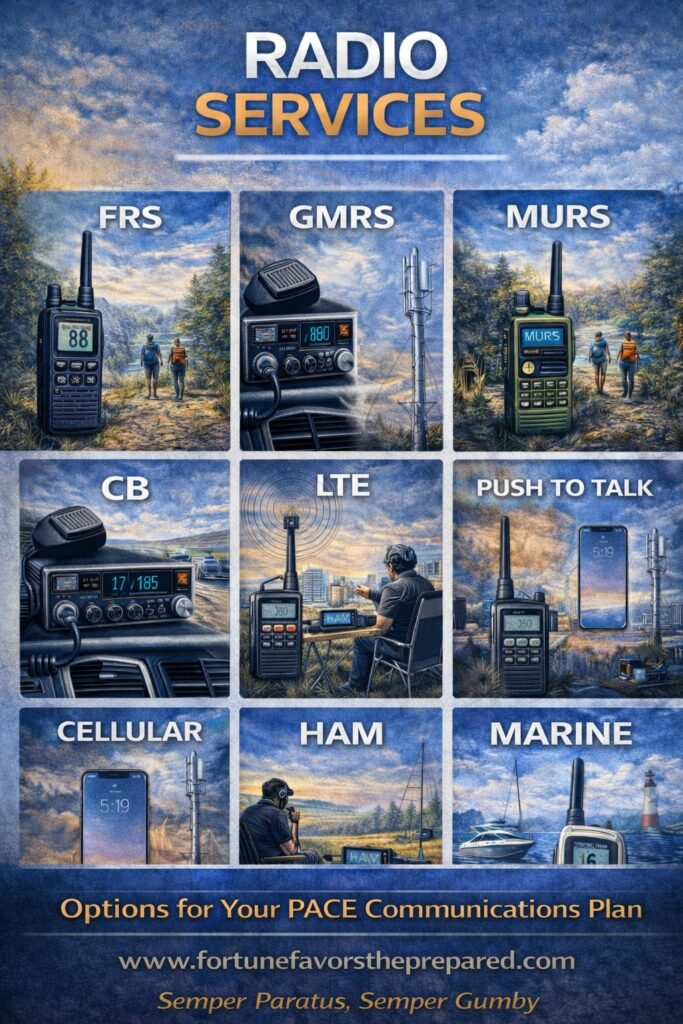

Start With the Right Questions

Before buying anything, answer these honestly:

Who do you need to talk to?

  • Household only
  • A local group or MAG
  • Other locals you don’t control
  • Regional, national, or worldwide contacts

How far away are they likely to be?

  • Same building/street
  • A few miles
  • Across a county or region
  • Hundreds or thousands of miles

What scenarios are you preparing for?

  • Local, short-term (tornado, winter storm, power outage)
  • Regional (hurricane, wildfire, earthquake)
  • Extended/systemic (grid-down, supply-chain disruption)

For more help on determining what scenarios are likely where you like read this article.

What infrastructure are you willing to rely on?

  • Cellular networks
  • Internet-linked systems
  • Radio repeaters
  • Nothing beyond your own equipment

How much money and time will you actually commit?

  • Up-front cost, antennas, power
  • Training and practice
  • Programming and maintenance

Preparedness assumes infrastructure may fail. Anything that works is a bonus—not a guarantee.


Radio Systems Explained (Plain Language)

FRS (Family Radio Service)

  • Best for: family, kids, immediate proximity
  • Range: ~0.5–2 miles
  • Infrastructure: none | License: none
  • Role: convenience and redundancy
  • Limit: very short range; crowded channels

GMRS (General Mobile Radio Service)

  • Best for: families, local groups, MAGs
  • Range: 1–5 miles (50+ with repeaters)
  • Infrastructure: optional repeaters | License: required (no test)
  • Role: local group coordination
  • Limit: repeater reliance if not planned carefully

MURS (Multi-Use Radio Service)

  • Best for: rural/homestead, low density
  • Range: 1–5 miles
  • Infrastructure: none | License: none
  • Role: quiet local comms where VHF helps
  • Limit: power-limited; no repeaters

CB (Citizen Band)

  • Best for: vehicles, travelers, monitoring
  • Range: 5–25 miles (SSB farther)
  • Infrastructure: none | License: none
  • Role: situational awareness, convoys
  • Limit: noisy, unstructured, no privacy

LTE Push-to-Talk Radios (Cellular)

  • Best for: wide-area comms when networks work
  • Range: effectively unlimited (network-dependent)
  • Infrastructure: cellular + internet | License: none (subscription)
  • Role: convenience, rapid coordination pre-/mid-event
  • Limit: total failure when cellular/internet fails; tracking/OPSEC risks

Satellite Radio

  • Best for: Emergency signaling and long-distance check-ins when terrestrial systems fail
  • Range: Global with clear sky access
  • Infrastructure: Satellite constellation and vendor support; no local infrastructure required
  • Role: Strategic redundancy and last-resort communications layer
  • Limit: Subscription-dependent with limited bandwidth and coordination capability

Amateur (Ham) VHF/UHF

  • Best for: organized MAGs, local–regional ops
  • Range: 10–100+ miles
  • Infrastructure: optional repeaters | License: required (exam)
  • Role: primary comms for trained groups
  • Limit: requires training, practice, discipline

Amateur (Ham) HF

  • Best for: regional, national, worldwide comms
  • Range: 300–3,000+ miles
  • Infrastructure: none | License: required (exam)
  • Role: infrastructure-independent reach
  • Limit: steep learning curve; antenna planning

Preparedness Radio Decision Matrix

Use this matrix to match mission needs to radio capabilities.

Radio SystemWho You Can ReachDistanceInfras NeededCostLearning TimeResilience
FRSFamily/kidsVery shortNone$MinimalLow
GMRSFamily/MAGShort–mediumOptional repeaters$$LowMedium
MURSRural localsShort–mediumNone$$LowMedium
CBLocals/travelersMediumNone$$Very lowMedium
LTE PTTAnyone on networkNationwideCellular + internet$$–$$$Very lowLow
Ham VHF/UHFMAGs/regionsMedium–longOptional repeaters$$$ModerateHigh
Ham HFRegional/globalVery longNone$$$$HighVery High
Satellite RadioDesignated contacts / emergency servicesGlobalSatellite constellation$$$–$$$$LowHigh (vendor-dependent)

Resilience reflects performance when infrastructure degrades.
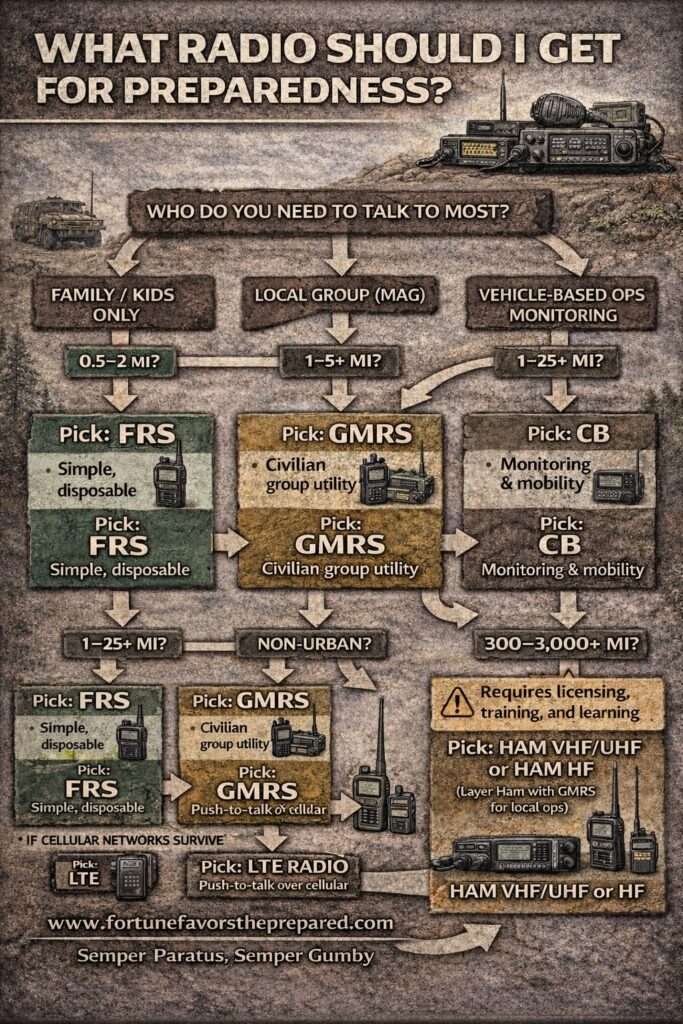

OPSEC & Tracking Considerations (Read This)

Communications create signatures—what you say, when you say it, and how it’s carried.

Key OPSEC Risks by System

  • LTE PTT / Cellular:
    • Location data, account identifiers, and metadata exist by design
    • Centralized servers; subscription ties identity to traffic
    • Only those in your group can hear you
    • Encrypted
    • Excellent convenience; poor deniability
  • FRS/GMRS/MURS/CB:
    • Open, unencrypted; anyone nearby can listen
    • Direction finding possible with motivated listeners
    • Mitigate with brevity, codes for logistics (not secrecy), and discipline
  • Ham (VHF/UHF/HF):
    • Open by regulation; no encryption
    • Traffic analysis is real; patterns reveal intent
    • Mitigate with schedules, brevity, net discipline, and emissions control

Practical OPSEC Rules

  • Say only what’s necessary; avoid names, locations, and plans
  • Assume someone is listening
  • Use brevity codes for routine logistics (not sensitive content) – but not while systems are “normal”
  • Prefer short transmissions; avoid chatter
  • Separate convenience nets (LTE/GMRS) from operations nets (ham)

Doctrine takeaway:

Convenience systems trade resilience and OPSEC for reach and ease. Plan accordingly.


Infrastructure Reality Check

  • Works without infrastructure: FRS, MURS, CB, Ham HF
  • Stronger with infrastructure: GMRS, Ham VHF/UHF
  • Fails completely without infrastructure: LTE PTT

Plan for simplex first (radio-to-radio). Treat repeaters and internet links as enhancements, not dependencies.


Budget & Time Reality

  • Low budget / low time: FRS, CB, LTE
  • Moderate investment: GMRS, MURS
  • Serious commitment: Ham VHF/UHF
  • Long-term resilience: Ham HF

Antennas, power, and training often matter more than the radio body.


Build It as a PACE Communications Plan

Prepared groups don’t pick one radio—they plan PACE:

  • Primary: What you expect to use (e.g., GMRS or Ham VHF/UHF)
  • Alternate: Works if Primary degrades (e.g., simplex ham or GMRS)
  • Contingency: Different band/assumptions (e.g., CB or MURS)
  • Emergency: Infrastructure-independent last resort (e.g., Ham HF)

Use a PACE communications decision tree to map which system activates as conditions change—who switches when, to what, and why.


A Practical Preparedness Stack (Example)

  • FRS – family/kids
  • GMRS or MURS – local coordination
  • CB – monitoring and vehicles
  • LTE PTT – convenience while networks exist
  • Ham VHF/UHF – organized group ops
  • Ham HF – regional/national reach

You don’t need everything—but you must understand what fails first.


Bottom Line

Choose radios based on:

  • Who you must reach
  • How far they are
  • What infrastructure you trust
  • How much time and money you’ll commit

Preparedness communications aren’t about owning radios—they’re about maintaining capability when convenience disappears.


See also

Starter Radio Paths by Preparedness Scenario
How Communications Fail: and Why Prepared Groups Plan for Silence


Fortune Favors the Prepared

Semper Paratus, Semper Gumby

Login with Patreon

Login with Patreon

Search Site

Products

  • Workbook Bundle - Patreon Workbook Bundle - Patreon $87.80 Original price was: $87.80.$74.95Current price is: $74.95.
  • Workbook Bundle Workbook Bundle $109.80 Original price was: $109.80.$92.95Current price is: $92.95.
  • Family Emergency Plan and Household Recovery Workbooks - Patreon Family Emergency Plan and Household Recovery Workbooks - Patreon $34.95
  • Family Emergency Plan and Household Recovery Workbooks Family Emergency Plan and Household Recovery Workbooks $54.90 Original price was: $54.90.$49.95Current price is: $49.95.
  • Household Recovery Workbook Household Recovery Workbook $29.95
  • The Continuity Chronicles Seal Decal The Continuity Chronicles Seal Decal $5.00 Original price was: $5.00.$3.00Current price is: $3.00.
  • Family Emergency Plan Workbook - Patreon Family Emergency Plan Workbook - Patreon $19.95
  • Personal Preparedness Assessment Workbook - Patreon Personal Preparedness Assessment Workbook - Patreon $19.95
  • The Next of Kin Workbook - Patreon The Next of Kin Workbook - Patreon $23.95
  • Personal Preparedness Assessment Report Personal Preparedness Assessment Report $179.95
  • Family Emergency Plan + Next of Kin Workbooks Family Emergency Plan + Next of Kin Workbooks $59.95 Original price was: $59.95.$49.95Current price is: $49.95.
  • The Next of Kin Workbook The Next of Kin Workbook $29.95
  • ASAR — 50 Mile Radius ASAR — 50 Mile Radius $139.95
  • ASAR 50-MILE + FAMILY EMERGENCY PLAN WORKBOOK ASAR 50-MILE + FAMILY EMERGENCY PLAN WORKBOOK $169.95
  • ASAR — 50 Mile Radius - Patreon ASAR — 50 Mile Radius - Patreon $39.95
  • THE COMPLETE LIBRARY BUNDLE THE COMPLETE LIBRARY BUNDLE $109.38 Original price was: $109.38.$85.00Current price is: $85.00.
  • THE SERIES STARTER BUNDLE THE SERIES STARTER BUNDLE $29.98 Original price was: $29.98.$22.49Current price is: $22.49.
  • THE GATEWAY BUNDLE THE GATEWAY BUNDLE $38.94 Original price was: $38.94.$30.95Current price is: $30.95.
  • The Brush - paperback The Brush - paperback $15.99
  • The Meadow Protocol - paperback The Meadow Protocol - paperback $13.95

Product categories

Cart

©2026 Fortune Favors the Prepared | Built using WordPress and Responsive Blogily theme by Superb