Skip to content

Fortune Favors the Prepared

Semper Paratus, Semper Gumby

Menu
  • The Continuity Chronicles
  • Intelligence Reports
        • DAILY THREAT REPORT
        • DAILY THREAT REPORT – LITE
        • DAILY PREPAREDNESS BRIEF
        • Analytical Standards and Tradecraft
        • Acronym & Abbreviations Glossary
        • Source Registry
        • FLASH & SPECIAL REPORTS
        • Area-Specific Assessment Report
        • SOFT TARGET SECURITY BRIEF
        • THE HOUSEHOLD BRIEF
        • COMMS WATCH
        • FINANCE SECTOR
        • HEALTHCARE SECTOR
        • TRANSPORTATION & LOGISTICS SECTOR
        • AI, DATA CENTER & INFRASTRUCTURE REPORT
        • CONSTRUCTION & MANUFACTURING SECTOR
        • Water and Wastewater Security Report
        • Energy Sector Report
        • Strategic Intelligence Supplement
  • WATCH DESK
  • About
        • The Why
        • Vision and Mission
        • Services
          • Business Resiliency
        • Testimonials
        • Insider
        • Friends
          • Patriot Volunteer Examiner (VE) Team
          • Angery American
          • Signal Stuff
          • Forward Observer
  • Communications
        • Stump Knocker
          • SOI
          • STUMP KNOCKER DMR UPDATES
          • MMDVM Hotspot
        • Preparedness Communications
          • What Radio Should I Get for Preparedness?
            • What Radio to Buy?
              • What Radio to Buy? – video
              • Ham Radio on a Budget
              • Live – What Radio to Buy?
              • Portable Radio Kit
              • Mobile Communications
          • Emergency Communications Principles
          • Communications Options
          • Starter Radio Paths by Preparedness Scenario
          • How Communications Fail
          • HF Communications
            • SHTF HF Communications
            • Simple Antenna Builds for HF – video
            • NVIS in Amateur Radio
        • Amateur (HAM) Radio
          • Why Do I Need a Ham License?
            • How to Obtain Your Amateur Radio License
              • Amateur Radio Learning Resources
              • Finding a Ham Exam
                • HAM Exam Accommodation
              • Getting Into Ham Radio – Video
            • Are You Expired?
            • Why You Should Upgrade to a General Ham License
          • HAM Simplex Frequency Card
          • Analog versus Digital
          • Analog vs Digital Voice: A Preparedness-Focused Comparison
          • CTCSS and DCS
          • Programming Radios with Software
          • ARES, RACES, ACS and AUXCOMM
          • Ham Radio Beyond Line-of-Sight
            • Linked Analog Repeaters
            • EchoLink and IRLP
            • AllStarLink
            • Yaesu System Fusion & WIRES-X
            • D-STAR
            • Digital Mobile Radio (DMR)
            • P25 in Amateur Radio
            • NXDN in Amateur Radio
            • Amateur Radio Satellites (AMSAT)
            • The 60-Meter Band (5 MHz)
          • Meshtastic
          • HAM VoIP
        • Personal Radio Services
          • FCC Rules for Personal Radio Services
          • Family Radio Service (FRS)
          • General Mobile Radio Service (GMRS)
            • GMRS Repeaters
            • Getting a GMRS License
            • FRS / GMRS / MURS Frequency Card
          • Multi-Use Radio Service (MURS)
          • Citizen Band (CB) Radio
            • CB Frequency Card
        • Other Radio Services
          • Communications Continuity Programs and Capabilities
          • Marine Communications
        • Cell Sites and Their Services
          • When Cell Service Fails
          • Radio over LTE and Rapid Radios
            • LTE Radio Comparison
        • Satellite Communications
          • America’s Secret Eyes
          • The Commercial Eye
          • Seeing Through Everything (SAR)
            • Remote Area Emergency Communication Devices
            • Which Beacon Should You Carry?
          • Personal Satellite Communications
        • Wired Communications
          • MAG Phone System
          • TA-312/PT Field Telephone and SB-22/PT Switchboard
          • Understanding Telephone Wiring
          • The AT&T Long Lines Program
        • Communications Planning
          • Communications Plan Annex
            • Communications P.A.C.E.
            • Finding Information for Your Communications Plan
            • Area-Specific Assessment Report
          • Automatic Link Establishment (ALE)
          • Understanding Communications Resiliency
        • Communications Resiliency Programs
          • ARES, RACES and ACS
          • Auxiliary Communications (AUXCOMM)
          • Military Auxiliary Radio System (MARS)
          • U.S. Coast Guard Auxiliary Communications
          • Civil Air Patrol Communications
          • The 60-Meter Band (5 MHz)
            • Understanding the 60-Meter Band
        • Government Communications Continuity Programs
          • Government Emergency Telecommunications Service (GETS) and Wireless Priority Service (WPS)
          • National Warning System (NAWAS)
          • National Interoperable Frequencies
          • The FEMA National Net (FNARS)
          • National Emergency Communications Network (NECN)
          • The SHARES Program
          • State Emergency Capability Using Radio Effectively (Operation SECURE)
          • The High Frequency Global Communications System (HFGCS)
          • Satellite Mutual Aid Radio Talkgroup (SMART)
          • The AT&T Long Lines Program
        • Communications & Emissions Discipline
          • Communications Security (COMSEC)
            • Book Cipher
            • One Time Pads (OTP)
              • Decrypting One Time Pad Message
              • One Time Pads (OTP) Live Video
              • One Time Pad Training
          • Cryptographic Security (CRYPTOSEC)
          • Transmission Security (TRANSEC)
          • Communications Transmission Discipline (TRANSDISC)
          • Emissions Control (EMCON)
          • Communications & Emissions Training Framework
        • DMR Programming
          • DMR Programming – Talk Groups
          • DMR Programming - Roaming
          • MMDVM and Yaesu System Fusion (YSF)
          • Encryption in DMR Radios
        • Digital Mobile Radio (DMR) Networks
          • WR3IRS Interstate DMR Network
            • South Central PA (SC PA)
            • North East PA (NE PA)
            • Washington-Baltimore (W-B)
            • West Central Florida (WCF)
          • Florida Digital Amateur Radio Network (F-DARN)
          • Southeast Florida DMR Repeater Network W2GGI
          • Virginia DMR (DMRVA)
          • NC PRN DMR Network
          • SC Hospital Emergency Amateur Radio Team (SCHEART)
          • HEARS – Hospital Emergency Amateur Radio System
          • New England Digital Emergency Communications Network (NEDECN)
        • Baofeng/BTECH Radios Quick Guide
          • Manually Programming a Baofeng Radio – Video
          • A User’s User Manual for Baofeng Radios
        • MESSAGES & REPORTS
          • Phonetics
          • Procedure Words (Prowords)
          • Date Time Group (DTG)
          • NTS Radiogram Form
            • ARL Numbered Radiograms
          • SALUTE, SPOT, and SALT Reports
          • ACE/LACE Reports
          • GOTWA Report
          • CASREP (Casualty Report) Format
          • MEDEVAC Request Report
          • Formatted Messages (downloads)
        • Communications Knowledge Library
          • Communications Resiliency
          • Radio Etiquette, Jargon, and Best Practices
          • AmRRON RESOURCES & REFERENCES
          • Anytone Programmable Keys
          • Phonetics
          • Amateur Radio Colorado
            • Colorado Linked Repeater Systems
        • COMMUNICATIONS REFERENCES
  • Planning
        • Family Emergency Plan – The Basics
          • Family Emergency Plan
            • Area-Specific Assessment Report
          • Why Every Family Needs an Emergency Plan
        • Family Contingency Binder
          • Family Contingency Binder MindMap
        • Triggers
          • Preparedness Conditions – PREP-CON
            • Preparedness Conditions (PREP-CON) MindMap
          • Space Weather
        • Family Emergency Plan Workbook
          • Family Emergency Plan Workbook - owner resources
            • Area-Specific Assessment Report
            • Family Emergency Planning Form
            • Communications Plan
              • P.A.C.E.
            • Emergency Evacuation
            • Emergency Food Supplies
            • Family Contingency Binder
            • Message Drops
            • Get Home Bag
            • Bug Out Bag & Bins
            • Miscellaneous
        • Household Recovery Workbook
          • Disaster Debris — What to Do at the Curb
          • Dealing With Grief
        • Next of Kin Workbook
        • METT-TC: Decision Discipline
          • METT-TC - tactical planning
        • Planning Your Preps
          • Charity in Planning
        • Mutual Assistance Group
          • Mutual Assistance Groups (MAGs): Skills, Vetting, and Building Real Resilience
          • Mutual Assistance Group (MAG): Recruitment Code of Conduct
          • MAG: Private Vetting & Intake Process
          • Compartmentalization in Mutual Assistance Groups (MAGs)
          • Resiliency Index
          • Continuity of Government & Application to MAGs
  • Threat Assessment
        • Personal Preparedness Assessment Workbook
          • Personal Preparedness Assessment Report
          • Personal Preparedness Assessment Workbook - owner resources
        • Readiness Conditions for Preparedness
          • PREP-CON - Preparedness Conditions
          • COMCON – Communications Readiness Condition
          • WX-CON Weather Conditions
          • SWX-CON Space Weather Condition
          • CONCON – Civilian Continuity Conditions
        • Readiness Conditions – Hierarchy and Relationships
          • LERTCON – Alert Condition
          • DEFCON – Defense Readiness Condition
          • COGCON - Continuity of Government
          • INFOCON – Information Operations Condition
          • FPCON – Force Protection Condition
          • EMERCON – Emergency Condition
          • CYBERCON – Cyber Readiness Conditions
          • CPCON – Cyberspace Protection Condition
          • WATCHCON – Watch Condition
          • SIPRNet – Secret Internet Protocol Router Network
          • REDCON – Readiness Condition
          • NC3CON – Nuclear Command, Control, and Communications
        • Readiness Conditions in The Conspiracy Chronicles
          • CERCON – Cerberus Readiness Condition
          • COMCON – Communications Readiness Condition
          • C-OPS – CERBERUS Operational Status Conditions
          • CONCON – Civilian Continuity Conditions
        • Being Prepared for Civil Unrest
          • Civil Unrest – Area Intelligence
          • Civil Unrest – Be Prepared
          • Civil Unrest – Defense
          • Civil Unrest – Defense (part 2)
        • Staying Informed Before, During and After Emergencies
          • Weather Awareness
            • Weather Event Codes
            • Weather Radio Comparison
        • Cascade Analysis & Infrastructure
          • Cascade Effects
          • Community Lifelines
          • Area Intelligence
          • Area-Specific Assessment Report
          • National Power Grid
  • Intelligence
        • ANALYSIS, TRADECRAFT & REPORTING
          • Analytical Standards and Tradecraft
          • Analytical Tradecraft: A Guide to OSINT Analysis
            • OSINT Analysis Study & Reference Guide
          • Understanding Intelligence Analysis Tools
            • Understanding Analysis of Competing Hypotheses (ACH)
              • ANALYSIS OF COMPETING HYPOTHESES (ACH) - TRAINING CURRICULUM
            • Understanding MDCOA
            • Understanding OAKOC
        • Operations Security (OPSEC)
          • OPSEC for Teens
          • OPSEC for Kids
          • The Gray Man
          • OPSEC: Don't Become the Target
          • Counterintelligence Tradecraft for the Prepared
        • Community Intelligence
          • Area Intelligence – Now!
            • Area-Specific Assessment Report
          • Community SITREP
          • Radio Traffic Situational Analysis During Emergencies
            • Radio Traffic Situational Analysis (RTSA) -TRAINING CURRICULUM
          • SALUTE, SPOT, and SALT Reports
        • ELECTRONIC THREAT & SURVEILLANCE
          • Staying Informed Before, During and After Emergencies
          • Integrated Public Alert and Warning System (IPAWS)
          • Communications Continuity Programs and Capabilities
          • Short Wave Scanning
          • America’s Secret Eyes
          • The Five Eyes Satellite Intelligence Network
          • Seeing Through Everything (SAR)
            • Which Beacon Should You Carry?
          • Wireless Recon Devices
        • INTELLIGENCE DISCIPLINES
          • Communications Intelligence (COMINT)
          • Electronic Intelligence (ELINT)
          • Tactical Electronic Intelligence (TACELINT)
          • Signals Intelligence (SIGINT) – the basics (2020)
          • Signals Intelligence – Information Gathering Basics (2022)
          • Signals Intelligence (SIGINT)
          • Technical & Infrastructure Intelligence (TECHINT)
          • Electronic Counter-Surveillance
          • Open-Source Intelligence (OSINT)
            • How to Conduct a Daily Threat Analysis Using OSINT
          • Measurement and Signature Intelligence (MASINT)
          • Electronic Surveillance (ES)
          • Overhead Imagery & Geospatial Intelligence (IMINT / GEOINT)
        • INTELLIGENCE REFERENCES
  • Medical
        • Medical Training
          • Patient Assessment & Casualty Management
            • MARCH-PAWS Rapid Assessment
              • MARCH-PAWS TRAINING CURRICULUM
            • DCAP-BTLS – Secondary Trauma Assessment
            • SAMPLE + OPQRST Secondary Assessment
              • Medical History as a Preparedness Skill
                • Medical History as a Preparedness Skill – TRAINING CURRICULUM
            • START Triage
            • MEDEVAC Request Report
            • Patient Assessment – Documentation
              • Patient Care Report Forms
              • CASREP (Casualty Report) Format
        • Medical Kits
          • Individual First Aid Kit (IFAK)
          • BooBoo and IFAK Kits Video
          • BooBoo & IFAK Kit Mind Map
          • Large Kit - video
        • Medical Myths
          • Medical Myths – Tampons
          • Medical Myths – Ingested Poisoning
        • MEDICAL REFERENCES
  • Transportation
    • Transportation Plan B
    • Improvised Transportation
    • Preparedness For Winter Travel
  • Animals
    • Preparedness for Pets
  • Food
        • Why You Should Start a Food Storage Plan
        • Food Storage Quick Start
        • Buying in Bulk
        • Inventory Tracking
        • FOOD PRESERVATION RESOURCES
  • Water
  • Power
        • Power Grid
        • UPS
  • Bags etc.
        • Bug Out versus Get Home Bags
        • Get Home Bag – Contents
          • Get Home Bag – video
          • Get Home and Bug Out Bags - video from live 2-10
  • Navigation & Signalling
        • Practitioners Guide to GPS
          • Quick Instruction Sets
        • Emergency Signaling
        • Covert Signals
        • Which Emergency Beacon Should You Carry?
        • Sketched Strip Map
  • References
        • PLANNING & OPERATIONS
        • SECURITY OPERATIONS
        • INTELLIGENCE
        • CRYPTOLOGY
        • COMMUNICATIONS
        • REPORTING FORMATS
        • GENERAL/MISC
        • MEDICAL
        • FOOD PRESERVATION
        • CRITICAL INFRASTRUCTURE
        • SURVIVAL MANUALS
        • OPSEC
        • COUNTER INSURGENCY & CIVIL DISTURBANCE
        • EMP / CME
        • Training
          • Training Videos
          • One Time Pad (OTP) Exercises
            • 45662
            • 222135ZDEC22
  • Blog
    • Boomer
      • Day 1 – The Journey Home
      • Day 2 – First Day in the New Home
      • Day 3 – More Training
      • Day 4 – Dad Goes Back to Work
      • Day 5 – A Day at Home with More Training with Dad (Boomer’s version)
      • Day 6 – More Training with Dad at Home
      • Day 7 – Dad Goes Back to Work, Boring Day
    • Mountain Readiness Fallout Workshops
    • Mapping DMR Repeaters
    • COMMUNICATIONS RESILIENCY
    • Getting The Message Through
    • What are you preparing for?
    • Never Let an Opportunity Go To Waste
    • Cascade Effects and the Perfect Storm
    • DO NOT REPLY
    • Space Weather Warning
    • Good, and Sad, News
    • Necessity vs. Luxury
    • Don’t Put off Until Tomorrow
    • No Plan Survives First Contact
    • Threat and Hazard Identification and Risk Assessment (THIRA)
    • Live – What Radio to Buy?
    • Big Daddy Unlimited Affiliate
    • Food – Tue 16th 7pm MST
    • Live from 2021-2-3
    • Live 2021-01-26
    • FLASH SALE
    • Live 2021-01-11
    • What Is Freedom?
    • Preparedness for Pets
    • What If The Lights Go Out?
    • Hoarding or Prepping?
    • Why Do I Need a Ham License?
    • How Bad is the SolarWinds Orion Issue?
    • How To Begin Prepping
    • Members Only Live Videos
    • Live 11/24
    • Ham Radio VoIP Phone
    • Training Calendar
    • A Chat (with some whisky)
    • Blog 2020 11 02
    • Live with Charlie Hogwood
    • EARTH EX 2020
    • A Live with Angery American
    • Have You Woken Up Yet?
    • BUG OUT READY
    • The Gray Man
    • Area Intelligence – Now!
    • Being Prepared for Civil Unrest
    • It Depends
    • The Art of Being Prepared – The New Prepper
    • Get Home versus Bug Out Bags
    • Why You Need an IFAK AND Training
  • Training Curriculum
  • Shop
  • Contact
    • Mailing List
  • Media and Press
Menu

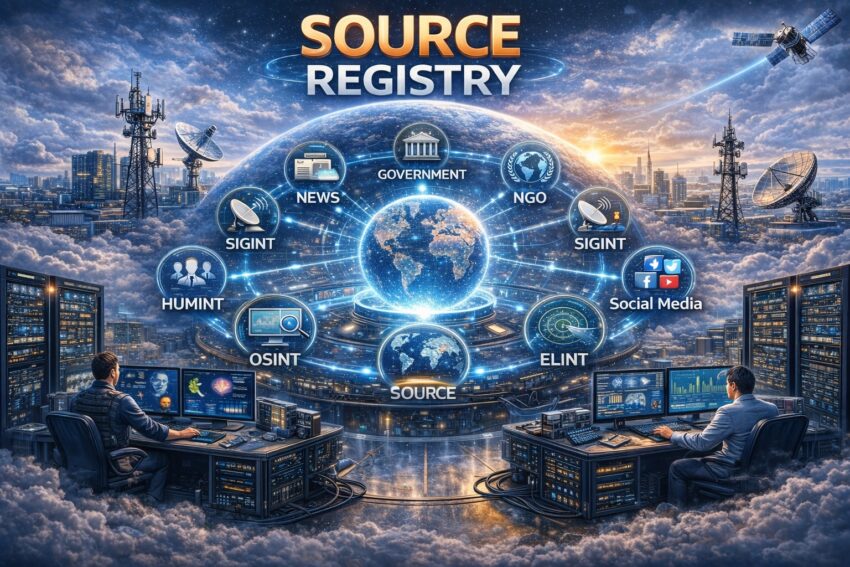
Source Registry

DTR COLLECTION BASELINE – PUBLIC EDITION

Verified Open-Source Intelligence Collection Framework
Version 2.22 · 05 Jun 2026

This page describes the intelligence collection framework that underpins the Daily Threat Report (DTR), DTR Lite, the Daily Preparedness Brief, COMMS Watch, and the full suite of sector-specific products from Fortune Favors the Prepared. It identifies the threat areas monitored, the source tier structure applied, the analytical standards that govern how sources are used, and the general categories of sources drawn on in each area.

Specific source selections, collection cadences, operational sweep parameters, mandatory-source lists, and subscription-tier source details are not included in this public edition. Licensed subscribers and enterprise partners receive the full Master Source Registry as part of their product documentation.

Collection baseline at a glance

35+Threat & Monitoring Areas
490Sources in DTR Baseline
292Tier 1 Authoritative
194Tier 2 Established
4Tier 3 Supplemental
629Suite-Wide Sources

Counts reflect the Daily Threat Report collection set as of registry v2.22 (05 Jun 2026). The FFTP product suite draws on 629 unique sources across all products – 367 Tier 1, 253 Tier 2, and 9 Tier 3. 49 sources carry mandatory daily-sweep status in the DTR build. 21 sources carry a standing framing caveat (adversary state media and editorially-aligned outlets).

Products built on this baseline

The Master Source Registry underpins the following published products. Each product draws on a product-specific subset of the suite-wide collection:

Daily Threat Report (DTR Full)
Practitioner tier – subscriber distribution
Full-format intelligence product covering all monitored threat areas. 490 sources in the DTR baseline; 49 carry mandatory daily sweep status. 20-27 pages per issue.
DTR Lite
Executive snapshot – subscriber distribution
Executive-tier condensation of the DTR Full built on the same collection baseline. Prioritized for speed-to-insight. Approximately 6 pages per issue.
Daily Preparedness Brief (DPB)
Household edition – subscriber distribution
Household-facing distillation of the DTR cycle. Actionable preparedness context drawn from the same source baseline, oriented toward household decision-makers.
COMMS Watch
Communications infrastructure monitoring
Dedicated monitoring of communications infrastructure – internet routing, GPS/GNSS integrity, satellite status, HF propagation, spectrum, and undersea cable. 81 sources; 39 Tier 1, 36 Tier 2, 6 Tier 3.
Soft Target Security Brief (STSB)
Physical security – sector distribution
Threat intelligence oriented toward soft-target physical security – commercial facilities, government facilities, schools, houses of worship, and venues.
AI & Infrastructure Threat Brief (AITB)
Emerging technology and infrastructure threat monitoring
AI-specific threats, capability developments, and governance events with national security and infrastructure implications. DC source set absorbed 02-JUN-2026; AITB now covers both AI threat and data center infrastructure on its bi-weekly cycle.
DTR Business – Healthcare
Sector-specific practitioner brief
Threat and operational intelligence for healthcare operators. Federal health authorities, international drug regulators, pharmaceutical supply chain monitors, and health sector trade bodies. Wastewater disease surveillance layer added v2.21.
DTR Business – Banking & Finance
Sector-specific practitioner brief
Threat and market intelligence for financial sector operators. US and international financial regulators, central banks, trade associations, payment-system monitors, and financial sector threat intelligence. Daily financial stress index layer added v2.21.
DTR Business – Construction & Manufacturing
Sector-specific practitioner brief
Supply chain, materials-cost, and operational intelligence for construction and manufacturing operators. Leading and coincident indicators, trade-association data, and global production-input monitoring.
DTR Business – Transportation & Logistics
Sector-specific practitioner brief
Freight, maritime, aviation, and port intelligence for logistics operators. Chokepoint status, carrier conditions, and intergovernmental maritime and aviation advisories. Maritime editorial, cargo crime intelligence, and freight rate benchmarking added v2.21.
Energy Security Brief (ESB)
Energy sector – weekly practitioner brief
Weekly intelligence for utilities, independent power producers, energy traders, and large industrial consumers. Grid reliability, petroleum and natural gas supply, pipeline safety, FERC and NERC developments, energy market pricing, and geopolitical energy supply disruption.
Water & Wastewater Security Brief (WWSB)
Water sector – weekly practitioner brief
Weekly intelligence for water and wastewater utility operators, municipal public works directors, and water infrastructure investors. CISA advisories, ICS/OT threats, EPA enforcement, drought monitoring, and regulatory developments.
Data Center & Infrastructure Brief (DC)
RETIRED 02-JUN-2026 – Merged into AITB
Data center and infrastructure content is now covered inside the AITB bi-weekly cycle. The DC source set has been absorbed into the AITB collection. The standalone DCIB is no longer a separate publication.
Area-Specific Assessment Report (ASAR)
Commissioned – by engagement
Fixed-resource inventory of a geographic area: standing infrastructure, facilities, and contacts a household would use – 9-1-1 dispatch, hospitals, pharmacies, utilities, shelters, food banks, faith communities, schools. Produced at 50, 100, or 300-mile radius.
Personal Preparedness Assessment Report (PPAR)
Commissioned – by engagement
Address-specific, analyst-scored threat-and-hazard assessment. Scores 59 hazards across natural, technological, and human-caused categories using a weighted Probability / Impact / Spatial-Extent / Warning-Time / Duration methodology.

Collection scope – why we monitor international sources

The collection baseline is deliberately not US-only. It draws on US federal and regulatory sources, allied and partner government channels, adversary government channels, intergovernmental organizations, international and regional media, humanitarian and non-governmental crisis-monitoring organizations, and official open-source feeds – all graded and handled under the tier and source-handling rules below.

This is a requirement of the analysis, not a preference. A threat picture built only from US-domestic sources is structurally incomplete:

  • The threat originates abroad. Conflict, chokepoint disruption, disease outbreaks, pharmaceutical supply chain failures, export controls, and currency events begin outside US borders. The authoritative first report is almost always a foreign government, a foreign regulator, an intergovernmental body, or regional media – not a US agency. Waiting for a US source to restate it adds a lag the practitioner cannot afford.
  • Corroboration requires more than one vantage point. A claim carried only by one government – including the US government – is a single-source claim. Independent foreign and international sourcing is what allows a finding to be confirmed rather than carried at low confidence.
  • Adversary and allied channels are read for positioning. Official statements from adversary and allied governments are collected to assess intent, messaging, and posture – never adopted as fact without corroboration, always framed.
  • Supply chains and infrastructure are global. Active pharmaceutical ingredients, semiconductor components, fertilizer feedstocks, and energy commodities move through foreign producers, foreign ports, and foreign regulatory regimes. The disruption signal is almost always foreign-origin. Monitoring it at source is the only way to provide meaningful lead time.

How international sourcing feeds the sector reports

Sector reportWhy international sources are required
Construction & ManufacturingInputs, components, and finished goods move through foreign producers, foreign ports, and foreign export-control regimes. A plant-floor or materials-cost picture built only from US sources misses the upstream disruption already in motion abroad.
Transportation & LogisticsMaritime chokepoints, foreign port status, foreign carrier actions, and intergovernmental maritime and aviation advisories are core inputs. The disruption signal is almost always foreign-origin and reaches US logistics on a lag.
Banking & FinanceSanctions regimes, foreign central-bank actions, sovereign and currency events, and cross-border payment-system status are set outside the US. Foreign and intergovernmental sourcing is required to see the exposure before it lands domestically.
HealthcareDisease outbreaks, foreign drug-manufacturing and active-ingredient supply, and international health-body declarations drive the sector. International health organizations and foreign drug regulators are routinely the first authoritative source. Pharmaceutical supply chain monitoring extends to upstream active-ingredient geography and manufacturing concentration risk.
COMMS WatchGPS/GNSS interference events, internet routing disruptions, and satellite communications failures are global phenomena. Regional Internet Registries, European aviation authorities, and maritime AIS monitoring platforms provide ground-truth data on denial events with no US-domestic equivalent.

In every case the same tiering and the same framing-caveat and aggregator-stripping rules apply. International scope widens the aperture; it does not lower the evidentiary bar.

Source tier definitions

TierDefinition
Tier 1 – PrimaryAuthoritative and official sources: federal agencies, regulatory bodies, government databases, intergovernmental organizations, allied-government press services, and Fortune Favors the Prepared proprietary condition assessments (PREP-CON, COMCON). Highest evidentiary weight. Cited directly whenever available. 367 Tier 1 sources suite-wide.
Tier 2 – SecondaryEstablished media organizations, vetted industry bodies, commercial data providers, and professional monitoring services with demonstrated accuracy records. Used for corroboration and coverage of gaps not addressed by Tier 1 sources. 253 Tier 2 sources suite-wide.
Tier 3 – SupplementalCrowdsourced data, open modeling tools, and community-generated feeds. Never cited as standalone sources. Used only to supplement Tier 1 and Tier 2 findings. Entries resting on single Tier 3 data receive an UNCONFIRMED confidence rating. 9 Tier 3 sources suite-wide.

Source-handling standards

Four standing rules govern how sources are used across all FFTP products, regardless of tier. These rules are part of the broader Analytical Standards and Tradecraft framework.

Framing caveat for state and partisan media

Adversary state media and opposition-aligned or partisan outlets are never cited standalone for factual claims about events, casualties, damage, or impact. They are used only for official positioning and messaging, leadership intent and rhetoric, or as one side of a dual-source check against an independent Tier 1 or Tier 2 source. 21 sources in the registry carry a standing framing caveat.

Aggregator stripping

Sources that republish primary reporting without original analysis cannot be cited as the basis for an entry. Reporting is traced back to, and cited from, the original primary source. Where a primary source cannot be confirmed, the entry is marked UNCONFIRMED.

Mandatory sweep requirement

49 sources in the DTR baseline carry mandatory daily-sweep status. These sources must be individually checked and dispositioned at every build cycle regardless of whether they have produced new intelligence. The sweep produces a per-source disposition record – CLEAR, NSTR, or flagged for inclusion – retained as the evidentiary audit trail. No DTR product may be delivered without this sweep completed and reconciled.

ICD 206 and ICD 203 compliance

The tier structure, framing-caveat rule, aggregator-stripping policy, and named-source requirement are the FFTP implementation of Intelligence Community Directive 206 (Sourcing Requirements for Disseminated Analytic Products). Confidence calibration – HIGH, MODERATE, LOW – is calibrated against source tier per ICD 203 (Analytic Standards).

ICD 206 – Sourcing Requirements ICD 203 – Analytic Standards 49 Mandatory Daily Sources 21 Framing-Caveat Sources

Coverage domains

The DTR collection baseline spans the following domains. Each domain draws on a dedicated set of Tier 1 and Tier 2 sources. Sub-domains without current activity receive an NSTR (Nothing Significant To Report) disposition at each cycle rather than being omitted – this distinguishes a quiet period from a monitoring gap.

Geopolitical & Conflict
Global conflict monitoring, state actor positioning, diplomatic developments, military posture signals, and US government official statements. Allied and adversary government channels with appropriate framing. Daily conflict tracking covering active theaters including the ongoing Iran conflict.
Defense Industrial Base
Defense acquisition programs, contractor security, foreign ownership and control threats, personnel security, and defense-sector supply chain risks.
Cyber & Information Security
Vulnerability disclosures, known-exploited CVE tracking, ICS/OT advisories, nation-state TTPs, ransomware campaigns, data breaches, and critical infrastructure cyber threats. EU law enforcement cyber threat intelligence and professional cybersecurity journalism added v2.21.
Soft-Target & Public-Venue Security
Active-shooter and targeted-violence research and incident studies, behavioral threat-assessment methodology, federal active-shooter and school-safety preparedness guidance, federal-facility physical-security standards, houses-of-worship and faith-community security, healthcare-facility security, and global terrorism-incident base rates.
Information Operations
Foreign influence operations, disinformation campaign tracking, platform manipulation, and adversary information environment monitoring.
Severe Weather, Wildfire & Natural Hazards
Convective and severe-storm outlooks, NWS alerts and tropical cyclone tracking, river and flood forecasting, drought and seasonal climate outlooks including ENSO probability forecasting, volcano alert levels, earthquake feeds, tsunami warning centers, avalanche danger forecasts, wildfire incident and smoke data, marine warnings, and a global multi-hazard warning aggregator. Multi-model ENSO forecasting and interagency drought information layers added v2.21.
Space Weather & GPS/GNSS
Solar activity, geomagnetic storm monitoring, HF radio impact, GPS/GNSS constellation status, and GNSS interference event tracking with HF propagation data.
Public Health & Disease Surveillance
Disease outbreak monitoring, WHO disease outbreak news, CDC health alerts, drug shortage tracking, blood supply status, and international health emergency assessments including PHEIC declarations. Automated real-time outbreak detection, wastewater epidemiology surveillance, EU health crisis management, and global disease eradication program monitoring added v2.21.
Pharmaceutical Supply Chain
Active pharmaceutical ingredient supply monitoring, upstream structural shortage risk, US and international drug shortage databases, European and Asia-Pacific regulatory shortage alerts, and pharmaceutical supply chain disruption from geopolitical events.
Nuclear Nonproliferation & Radiological Monitoring
Nuclear weapons program tracking, arms control treaty compliance, fissile material security, WMD nonproliferation analysis, and global atmospheric radionuclide monitoring. Treaty-body verification networks, nonproliferation research institutions, and international monitoring system coverage added v2.21.
Energy, Markets & Commodities
Grid reliability alerts, petroleum and natural gas supply data, electricity disturbance reports, oil and commodity price tracking, OPEC production data, and energy infrastructure incident monitoring.
Aviation & Airspace
NOTAM monitoring, conflict zone information bulletins, airspace closures, FAA system status, international GNSS interference advisories, significant aviation safety events, and global aviation industry safety and security standards. International aviation industry standards body added v2.21.
Maritime & Undersea Cable
Maritime security advisories, vessel tracking, chokepoint status, AIS anomaly monitoring, undersea cable fault tracking, port operational status, energy cargo intelligence, and sanctions-evasion dark-fleet monitoring. Maritime editorial press, energy cargo intelligence, and near-real-time chokepoint transit tracking added v2.21.
Telecommunications & Internet Infrastructure
Carrier network outage monitoring, BGP routing integrity, internet shutdown and disruption tracking, DNS health, 9-1-1 reliability, and major platform availability. Coverage spans US carriers and global routing infrastructure.
Internet Outage Detection
Active measurement of macroscopic internet outages and government-directed shutdowns using BGP monitoring, active probing, network traffic analysis, and application-level interference detection across 200+ countries.
Satellite & Space Situational Awareness
GPS constellation status, satellite tracking, conjunction assessments, orbital debris monitoring, commercial satellite service status, and GNSS interference event documentation.
Financial Services & Sanctions
OFAC sanctions designations, payment system status, bank regulatory actions, FinCEN advisories, financial sector cyber threats, international financial stability monitoring, and daily financial system stress indicators. Real-time financial stress index and structural vulnerability monitoring added v2.21.
Agriculture & Food Supply
Crop production estimates, global supply and demand assessments, commodity futures, food security early warning, famine risk tracking, and agricultural supply chain disruption monitoring. Global food crisis synthesis and humanitarian food security early warning added v2.21.
Supply Chain & Transportation
Freight market conditions, port throughput, pipeline safety incidents, hazmat transport events, carrier capacity, logistics disruption signals, cargo crime intelligence, and supply chain diffusion indices. Cargo theft intelligence, motor carrier safety authority data, and logistics conditions early-warning index added v2.21.
Water & Chemical Safety
Water sector cyber advisories, utility security, streamflow and water resource monitoring, chemical incident notifications, and pipeline hazmat reporting.
Physical Security & Soft Target Threat
DHS terrorism advisories, FBI public threat bulletins, domestic extremism monitoring, venue and institutional security, and campus/K-12 threat environment.
Commercial Facilities & Retail Crime
ATF federal firearms theft and loss tracking for licensed dealers, organized retail crime monitoring across sporting goods and preparedness retailers, FBI incident-based commercial burglary data by location type, local police agency alert distribution, real-time public safety radio monitoring, and systematic local news aggregation. Addresses criminal targeting of firearms retailers, tactical and outdoor outfitters, and preparedness supply locations.
Energy Infrastructure Security
Regional grid operator status and emergency alerts across US ISO/RTO footprints, natural gas production and storage monitoring, pipeline safety incidents, nuclear plant event notifications, FERC and NERC reliability enforcement, energy market pricing, and geopolitical energy supply disruption tracking.
Water & Wastewater Security
CISA water sector cyber and physical security advisories, WaterISAC threat intelligence, EPA water system enforcement and compliance tracking, utility security standards from primary US drinking water and wastewater trade associations, streamflow and water resource monitoring, and ICS/OT vulnerability tracking for water treatment control systems.
Insider Threat & Counterintelligence
DOJ national security prosecutions, FBI counterintelligence reporting, NCSC assessments, foreign intelligence threat tracking, and export control enforcement actions.
AI Threat & Governance
AI capability developments with national security implications, adversarial machine learning threats, AI regulatory developments, frontier model safety assessments, and empirical AI capability and governance benchmarking. Annual AI capability and investment index added v2.21.
Travel Advisories
US State Department and allied-government travel advisory updates, destination-specific security changes, and health-related travel restrictions.
Humanitarian & Crisis Monitoring
Conflict-zone humanitarian conditions, NGO access reporting, civilian impact monitoring, international humanitarian organization situation assessments, and global humanitarian funding gap tracking. Humanitarian financial tracking and food crisis synthesis added v2.21.
Emergency Services & Nuclear
Emergency services sector advisories, 9-1-1 infrastructure status, nuclear plant event notifications, radiological incident reporting, and fire and life safety code developments. National fire and life safety standards body added v2.21.
Systemic & Catastrophic Risk
Global systemic risk horizon-scanning, catastrophic risk probability assessment across nuclear, climate, pandemic, and AI vectors, and long-horizon scenario analysis. Annual expert-survey-based systemic risk assessment and quantitative catastrophic risk modeling added v2.21.
Address & Household Hazard Assessment
Location-specific natural, technological, and human-caused hazard scoring for commissioned assessment products. Draws on federal hazard mapping (flood, seismic, wildfire), historical event records, nuclear and dam infrastructure data, rail and fixed-site HAZMAT corridors, county hazard mitigation plans, and the local public-safety threat environment. Trauma-center designations verified against authoritative state registry on every build.
Emergency Management & Crisis Coordination
National and international emergency-management and crisis-response authorities – the EU civil-protection coordination centre, allied-nation national alert systems (Australia, UK, Canada), global hazard-specific monitoring for volcanism, tsunami, and landslide, and structured global crisis-risk indexing. Coverage spans US, Five Eyes, and intergovernmental disaster-response bodies.
Global Trade & Shipping Economics
World trade volume direction and forecasts, container and dry-bulk freight-rate indices, maritime chokepoint transit (Suez and Panama canal authorities), container-line schedule reliability and blank-sailing capacity, ocean and air freight rate benchmarking, and forward economic indicators including global manufacturing PMI and composite leading indicators. Air freight rate intelligence layer added v2.21.

Source categories by domain

The table below identifies the general categories of sources used in each major domain. Individual source selections are not disclosed in this public edition.

DomainTier 1 source categoriesTier 2 source categories
Cyber & ICS SecurityFederal cyber agencies, PSIRT advisories from major infrastructure vendors, vulnerability databases, national cybersecurity authorities (US and allied), military cyber commands, EU law enforcement cyber intelligence bodiesSpecialist cyber threat intelligence firms, ICS/OT security research, investigative cybersecurity journalism, internet exposure monitoring services, commercial threat intelligence platforms, vulnerability exploitation tracking platforms
Geopolitical & ConflictUS executive branch and military commands, allied foreign ministries, intergovernmental organizations, UN bodies, official conflict-zone maritime advisoriesInternational wire services, foreign policy research institutes, conflict event databases, regional specialist journalism, open-source conflict mapping, daily foreign policy news briefs from major research institutions
Soft-Target & Public-Venue SecurityFederal active-shooter incident studies and safety resources, the national behavioral-threat-assessment research center, federal active-shooter and school-safety preparedness programs, the interagency federal-facility physical-security standards body, and federal counter-insider-threat program standardsFaith-community and interfaith information-sharing organizations, healthcare-facility security associations, and the academic global terrorism-incident database
Public HealthUS federal public health authorities, WHO, regional international health organizations (Americas, Europe, Africa), foreign drug and health regulators (EU, UK, Canada, Japan, Australia), international harmonization bodies, EU health security crisis management portal, wastewater epidemiology surveillance networks, global disease eradication program authoritiesAcademic infectious disease centers, pre-publication genomic sharing platforms, specialist health trade press, medical journals, humanitarian medical organizations, automated global outbreak detection platforms, international scientific early-warning advisory networks
Pharmaceutical Supply ChainUS Pharmacopeia supply chain intelligence, US and international drug shortage databases (US, EU, Australia), European drug quality authority, Pan-American health organization, Brazilian health regulatorGlobal pharmaceutical industry associations, EU critical medicines stakeholder bodies, specialist health trade press
Nuclear Nonproliferation & Radiological MonitoringInternational treaty verification monitoring networks (global seismic, hydroacoustic, infrasound, and radionuclide detection), nuclear nonproliferation research institutions with primary research mandates, arms control policy and treaty-compliance bodiesAcademic proliferation research centers, open-source nuclear analysis organizations using satellite imagery and technical data
Internet & Comms InfrastructureRegional Internet Registries (BGP routing authority), European GNSS interference NOTAMs, GPS program authorities, space situational awareness databases, US telecom regulators, maritime trade operations centersCommercial BGP analysis platforms, internet outage detection research (active probing + darknet), open network interference measurement (245 countries), internet shutdown aggregation platforms, commercial network intelligence platforms, carrier status pages
Energy & GridDOE disturbance reporting, NERC reliability, EIA petroleum/gas/grid data, NRC event notifications, OPEC secretariat, International Energy Agency, pipeline safety authorityReal-time grid status aggregators, outage data aggregators, utility trade press, commodity analysis services
Severe Weather, Wildfire & Natural HazardsNOAA/NWS alerts, Storm Prediction Center, Weather Prediction Center, National Hurricane Center, Joint Typhoon Warning Center, Climate Prediction Center, multi-model ENSO probability forecasting, interagency national drought information system, National Water Prediction Service, USGS earthquake and volcano programs, NOAA tsunami warning centers, US Forest Service national avalanche center, NIFC and federal wildfire data, NOAA marine and ocean prediction, FEMA alert systems, and the World Meteorological Organization global severe-weather warning aggregatorGlobal and European flood-awareness modeling, European wildfire information system, wildfire-smoke air-quality mapping, the European-Mediterranean seismological centre, NASA satellite fire detection and global landslide modeling, incident information systems
Maritime & AviationIMO safety circulars, MARAD advisories, FAA NOTAMs and system status, EASA conflict zone bulletins, ICAO advisories, TSA security directives, EUROCONTROL GNSS NOTAMs, international aviation industry standards and safety bodiesVessel tracking platforms, flight tracking platforms, conflict zone airspace monitoring, specialist maritime intelligence, maritime editorial press, energy cargo intelligence platforms, sanctions-evasion vessel tracking databases, near-real-time chokepoint transit monitoring
Financial ServicesFDIC, OCC, Federal Reserve, FINRA, FinCEN, SEC, OFAC, SWIFT advisories, US and international financial regulators (ECB, EBA, FCA, Bank of Japan, and others), international standard-setting bodies (BIS, FSB, IOSCO), daily financial system stress index and quarterly structural vulnerability monitorFinancial sector ISAC, specialist banking and securities trade press, financial threat intelligence platforms
Supply Chain & LogisticsBureau of Industry and Security, Port of Los Angeles/Long Beach, Bureau of Transportation Statistics, PHMSA pipeline safety, USDA supply and demand reports, federal motor carrier safety authorityFreight market intelligence platforms, maritime cargo tracking, trade logistics press, cargo crime and asset protection intelligence bodies (Americas and EMEA), logistics conditions diffusion index, ocean and air freight rate benchmarking platforms
Global Trade & Shipping EconomicsWorld Trade Organization, UN Trade and Development, the Baltic Exchange dry-bulk index authority, and the Suez and Panama canal operating authorities; global manufacturing and services PMI compilers and the OECD composite-leading-indicator seriesContainer freight-rate index providers, Asia-origin container-rate exchanges, container-line schedule-reliability analysts, ocean and air freight rate benchmarking platforms, and global cement and concrete industry data
Commercial Facilities & Retail CrimeFederal firearms theft and loss tracking (ATF FFL program), FBI incident-based crime reporting by location type, local law enforcement agency public alert platformsOrganized retail crime research bodies, retail industry crime tracking associations, real-time public safety radio aggregators, systematic local news aggregation platforms, firearms industry trade alert networks
Energy Infrastructure SecurityDOE electric disturbance reporting, NERC reliability standards and enforcement, regional grid operators (Midwest and Southwest), EIA petroleum, natural gas, and production data, NRC nuclear event notifications, FERC regulatory orders, International Energy AgencyReal-time grid status aggregators, utility trade press, commodity pricing and market analysis services, power market intelligence
Water & Wastewater SecurityCISA water sector advisories, WaterISAC threat intelligence, EPA water security and enforcement database, US Geological Survey water resources, NOAA National Water Prediction Service, primary drinking water and wastewater utility trade associations (US-based)Water sector security research and regional utility networks
Humanitarian & Food SecurityUN humanitarian coordination and financial tracking bodies, global food security early warning and famine monitoring authorities, interagency global food crisis assessment networks, global disease eradication authoritiesHumanitarian medical organizations, specialist food security and famine monitoring press
AI Threat & GovernanceNational AI safety institutes, annual empirical AI capability and governance benchmark reports from major research universities, academic AI safety research centersSpecialist AI safety and governance research bodies, AI incident monitoring platforms, specialist technology policy press
Systemic & Catastrophic RiskAnnual systemic and global risk horizon assessments drawing on large expert panelsCatastrophic and existential risk research institutes, global challenge quantitative risk modeling bodies
Data Center & InfrastructureUS and international grid reliability authorities (North American and European), wholesale electricity market operators and independent market monitors, DOE disturbance reporting, FERC orders, EIA generator inventory, energy regulators in major data center markets (UK, EU, Ireland, Singapore), Lawrence Berkeley National Laboratory data center energy analysis, US and EU telecom and submarine cable bodies, Congressional Research ServiceData center industry standards and research bodies, specialist data center trade press, real-time grid status and outage aggregators, energy and power industry trade press, commercial energy market analysis, policy research institutes covering technology infrastructure and climate-grid interaction

Analytical standards applied to sources

Sourcing discipline is the foundation of the analytical standards framework. The rules below govern every entry in every FFTP product – they are not aspirational; they are mechanically enforced at the build level.

StandardWhat it means in practice
Named-source requirementEvery claim in a published entry carries an attribution. Unnamed “reports suggest” or “sources indicate” phrasing is prohibited.
Source-symmetric skepticismThe same evidentiary bar is applied to claims from US government sources as to claims from allied governments, international organizations, and media. Official US source status does not reduce the confirmation requirement.
Dual-source confirmationSignificant factual claims are confirmed by at least two independent sources before being reported at confirmed confidence. Single-source entries are clearly marked and carry reduced confidence.
Operator-supplied data primacyWhere the operator has supplied primary data (NWS snapshots, official rosters, direct agency output), that data is authoritative over any summary or compacted version of it. Re-verification against the operator’s original data is required before each delivery.
No carryover without justificationItems from prior cycles are not carried into the current cycle without current-cycle data to support them. Carryover without justification is a build error; the pre-delivery audit explicitly checks for it.
Estimative language disciplineForward-looking judgments use a fixed probability ladder (almost no chance / very unlikely / unlikely / roughly even chance / likely / very likely / almost certain) and separate likelihood from confidence (HIGH / MODERATE / LOW) – never collapsed into a single term. Every judgment carries alternative hypotheses with supporting and disconfirming evidence.
Anti-padding auditA mandatory pre-delivery audit checks for entries that restate without adding new information, calendar items elevated to intelligence entries, and entries that duplicate coverage already handled in a dedicated section. Items failing the audit are cut, not softened.
Pre-delivery gateEvery DTR cycle must pass three mechanical gate checks before delivery: (A) per-source sweep reconciliation with individual dispositions recorded for all mandatory sources; (B) dead-carryover and padding audit with kept/cut decisions recorded; (C) compaction-recovery verification confirming key figures against original operator data. No product ships without passing all three.

Recent framework activity

Current edition – v2.21 (02 Jun 2026): 40 new sources added across four comprehensive collection-gap sweeps, bringing the suite-wide total to 629 (367 Tier 1, 253 Tier 2, 9 Tier 3). This edition closes six previously identified monitoring gaps and extends three existing domains. Nuclear nonproliferation and radiological monitoring: a five-source layer added covering international treaty verification networks, nonproliferation research institutions, arms control policy bodies, and open-source nuclear analysis – filling a structural gap previously covered only by safety and event-notification sources. Public health early-warning: three sources added providing automated real-time global outbreak detection, CDC operational wastewater epidemiology (1,200+ sites, 120 million people monitored), and EU health security crisis management. These operate as pre-notification signal layers that precede formal WHO and CDC alert channels by days to weeks. Global disease eradication program monitoring added for poliovirus environmental surveillance coverage. Financial system stress indicators: a daily financial stress index and quarterly structural vulnerability monitor added to the financial services domain – the first real-time stress-signal layer in a domain previously covered primarily by regulatory and after-the-fact reporting. Maritime expansion: maritime editorial press, energy cargo intelligence, near-real-time Hormuz transit tracking, and sanctions-evasion dark-fleet monitoring added, particularly relevant to the ongoing Iran conflict and Strait of Hormuz conditions. Ocean and air freight rate benchmarking added, filling the prior absence of an air freight rate source. Supply chain intelligence: cargo crime and asset protection intelligence bodies (North America and EMEA), federal motor carrier safety authority, and logistics conditions diffusion index added, providing cargo theft intelligence and a 30-60 day leading indicator of freight market conditions. Systemic risk domain formalized: a new Systemic and Catastrophic Risk domain drawing on annual expert-panel horizon assessments and quantitative risk modeling from dedicated research institutes. PRIOR v2.20 (02 Jun 2026): DCIB/AITB merge – the standalone Data Center and Infrastructure Brief (DC product code) retired; source set absorbed into AITB. Commercial facilities and retail crime, energy infrastructure security, and water and wastewater security layers expanded. Two new standing products (ESB, WWSB) launched. PRIOR v2.18 (30 May 2026): natural-disaster and destructive-weather monitoring, soft-target and public-venue security, global trade and economic indicators, emergency-management and crisis-response authorities, and cyber, AI-incident, insider-threat, and data-center-resilience frameworks expanded. The framework is reviewed and expanded on a continuing basis; this page reflects the current edition.

Related references

The Source Registry describes what Fortune Favors the Prepared collects and how each source is graded. Two companion references describe how that material is then used:

  • Analytical Standards and Tradecraft – the operational, anti-bias, and tradecraft rules that govern every FFTP analytical product, including source-symmetric skepticism, the named-source requirement, estimative-language discipline, and the primary-source sweep. These standards implement Intelligence Community Directive 203 (Analytic Standards) and Directive 206 (Sourcing Requirements for Disseminated Analytic Products).
  • Daily Threat Report – the flagship product built on this collection baseline, published in Full, Lite, and Daily Preparedness Brief editions.
  • COMMS Watch – the dedicated communications infrastructure monitoring product drawn from the 81-source COMMS baseline.
  • Area-Specific Assessment Report (ASAR) – the commissioned area resource inventory. Saves roughly 15 hours of research; a tailored intelligence assessment of the infrastructure and contacts serving a specific home, business, or facility.
  • Personal Preparedness Assessment Report (PPAR) – the commissioned address-specific hazard assessment, scoring 59 hazards for one location and narrating the elevated risks.
Fortune Favors the Prepared · Intelligence That Keeps You Ready
DTR Source Registry – Public Edition · v2.21 · 02 Jun 2026

Login with Patreon

Login with Patreon

Search Site

Products

  • Family Emergency Plan and Household Recovery Workbooks - Patreon Family Emergency Plan and Household Recovery Workbooks - Patreon $34.95
  • Bundle - Family Emergency Plan and Household Recovery Workbooks Bundle - Family Emergency Plan and Household Recovery Workbooks $46.95
  • Household Recovery Workbook Household Recovery Workbook $29.95
  • The Continuity Chronicles Seal Decal The Continuity Chronicles Seal Decal $5.00 Original price was: $5.00.$3.00Current price is: $3.00.
  • Family Emergency Plan Workbook - Patreon Family Emergency Plan Workbook - Patreon $19.95
  • Personal Preparedness Assessment Workbook - Patreon Personal Preparedness Assessment Workbook - Patreon $19.95
  • The Next of Kin Workbook - Patreon The Next of Kin Workbook - Patreon $23.95
  • Personal Preparedness Assessment Report Personal Preparedness Assessment Report $179.95
  • Bundle - Family Emergency Plan + Next of Kin Workbooks Bundle - Family Emergency Plan + Next of Kin Workbooks $46.95
  • The Next of Kin Workbook The Next of Kin Workbook $29.95
  • ASAR — 50 Mile Radius ASAR — 50 Mile Radius $139.95
  • ASAR 50-MILE + FEP WORKBOOK ASAR 50-MILE + FEP WORKBOOK $169.95
  • ASAR — 50 Mile Radius - Patreon ASAR — 50 Mile Radius - Patreon $39.95
  • Bundle - The Series Starter (Paperback) Bundle - The Series Starter (Paperback) $29.98
  • The Brush (Paperback) The Brush (Paperback) $15.99
  • The Meadow Protocol (Paperback) The Meadow Protocol (Paperback) $13.99
  • Cards (4x6) - Brevity Cards for OTP Cards (4x6) - Brevity Cards for OTP $24.95
  • Communications Card bundle (13 cards) Communications Card bundle (13 cards) $41.95
  • Personal Preparedness Assessment Workbook Personal Preparedness Assessment Workbook $24.95
  • Family Emergency Plan Workbook Family Emergency Plan Workbook $24.95

Product categories

Cart

©2026 Fortune Favors the Prepared | Built using WordPress and Responsive Blogily theme by Superb