Skip to content

Fortune Favors the Prepared

Semper Paratus, Semper Gumby

Menu
  • The Continuity Chronicles
    • THE RANCH
    • Inside the Meadow
      • LONG LINES
    • GlobalTec – Company Profile
      • GlobalTec Network
    • 3C’s COMMUNICATIONS
    • Alex’s Demolition & Construction
    • McAllister Outfitting
    • High Country Air
    • Pikie’s Perfect Cast
  • Daily Threat Reports
        • DAILY THREAT REPORT
        • DAILY THREAT REPORT – LITE
        • DAILY PREPAREDNESS BRIEF
        • Acronym & Abbreviations Glossary
        • DTR Source Registry
        • Area-Specific Assessment Report
        • COMMS WATCH
        • THE HOUSEHOLD BRIEF
        • FLASH REPORTS
        • SOFT TARGET SECURITY BRIEF
        • FINANCE SECTOR
        • HEALTHCARE SECTOR
        • TRANSPORTATION & LOGISTICS SECTOR
        • AI, DATA CENTER & INFRASTRUCTURE REPORT
        • CONSTRUCTION & MANUFACTURING SECTOR
        • Strategic Intelligence Supplement
  • About
        • The Why
        • Vision and Mission
        • Services
          • Business Resiliency
        • Testimonials
        • Insider
        • Friends
          • Patriot Volunteer Examiner (VE) Team
          • Angery American
          • Signal Stuff
          • Forward Observer
  • Communications
        • Stump Knocker
          • SOI
          • STUMP KNOCKER DMR UPDATES
          • MMDVM Hotspot
        • Preparedness Communications
          • What Radio Should I Get for Preparedness?
            • What Radio to Buy?
              • What Radio to Buy? – video
              • Ham Radio on a Budget
              • Live – What Radio to Buy?
              • Portable Radio Kit
              • Mobile Communications
          • Emergency Communications Principles
          • Communications Options
          • Starter Radio Paths by Preparedness Scenario
          • How Communications Fail
          • HF Communications
            • SHTF HF Communications
            • Simple Antenna Builds for HF – video
            • NVIS in Amateur Radio
        • Amateur (HAM) Radio
          • Why Do I Need a Ham License?
            • How to Obtain Your Amateur Radio License
              • Amateur Radio Learning Resources
              • Finding a Ham Exam
                • HAM Exam Accommodation
              • Getting Into Ham Radio – Video
            • Are You Expired?
            • Why You Should Upgrade to a General Ham License
          • HAM Simplex Frequency Card
          • Analog versus Digital
          • Analog vs Digital Voice: A Preparedness-Focused Comparison
          • CTCSS and DCS
          • Programming Radios with Software
          • ARES, RACES, ACS and AUXCOMM
          • Ham Radio Beyond Line-of-Sight
            • Linked Analog Repeaters
            • EchoLink and IRLP
            • AllStarLink
            • Yaesu System Fusion & WIRES-X
            • D-STAR
            • Digital Mobile Radio (DMR)
            • P25 in Amateur Radio
            • NXDN in Amateur Radio
            • Amateur Radio Satellites (AMSAT)
            • The 60-Meter Band (5 MHz)
          • Meshtastic
          • HAM VoIP
        • Personal Radio Services
          • FCC Rules for Personal Radio Services
          • Family Radio Service (FRS)
          • General Mobile Radio Service (GMRS)
            • GMRS Repeaters
            • Getting a GMRS License
            • FRS / GMRS / MURS Frequency Card
          • Multi-Use Radio Service (MURS)
          • Citizen Band (CB) Radio
            • CB Frequency Card
        • Other Radio Services
          • Communications Continuity Programs and Capabilities
          • Marine Communications
        • Cell Sites and Their Services
          • When Cell Service Fails
          • Radio over LTE and Rapid Radios
            • LTE Radio Comparison
        • Satellite Communications
          • America’s Secret Eyes
          • The Commercial Eye
          • Seeing Through Everything (SAR)
            • Remote Area Emergency Communication Devices
            • Which Beacon Should You Carry?
          • Personal Satellite Communications
        • Wired Communications
          • MAG Phone System
          • TA-312/PT Field Telephone and SB-22/PT Switchboard
          • Understanding Telephone Wiring
          • The AT&T Long Lines Program
        • Communications Planning
          • Communications Plan Annex
            • Communications P.A.C.E.
            • Finding Information for Your Communications Plan
            • Area-Specific Assessment Report
          • Automatic Link Establishment (ALE)
          • Understanding Communications Resiliency
        • Communications Resiliency Programs
          • ARES, RACES and ACS
          • Auxiliary Communications (AUXCOMM)
          • Military Auxiliary Radio System (MARS)
          • U.S. Coast Guard Auxiliary Communications
          • Civil Air Patrol Communications
          • The 60-Meter Band (5 MHz)
            • Understanding the 60-Meter Band
        • Government Communications Continuity Programs
          • Government Emergency Telecommunications Service (GETS) and Wireless Priority Service (WPS)
          • National Warning System (NAWAS)
          • National Interoperable Frequencies
          • The FEMA National Net (FNARS)
          • National Emergency Communications Network (NECN)
          • The SHARES Program
          • State Emergency Capability Using Radio Effectively (Operation SECURE)
          • The High Frequency Global Communications System (HFGCS)
          • Satellite Mutual Aid Radio Talkgroup (SMART)
          • The AT&T Long Lines Program
        • Communications & Emissions Discipline
          • Communications Security (COMSEC)
            • Book Cipher
            • One Time Pads (OTP)
              • Decrypting One Time Pad Message
              • One Time Pads (OTP) Live Video
              • One Time Pad Training
          • Cryptographic Security (CRYPTOSEC)
          • Transmission Security (TRANSEC)
          • Communications Transmission Discipline (TRANSDISC)
          • Emissions Control (EMCON)
          • Communications & Emissions Training Framework
        • DMR Programming
          • DMR Programming – Talk Groups
          • DMR Programming - Roaming
          • MMDVM and Yaesu System Fusion (YSF)
          • Encryption in DMR Radios
        • Digital Mobile Radio (DMR) Networks
          • WR3IRS Interstate DMR Network
            • South Central PA (SC PA)
            • North East PA (NE PA)
            • Washington-Baltimore (W-B)
            • West Central Florida (WCF)
          • Florida Digital Amateur Radio Network (F-DARN)
          • Southeast Florida DMR Repeater Network W2GGI
          • Virginia DMR (DMRVA)
          • NC PRN DMR Network
          • SC Hospital Emergency Amateur Radio Team (SCHEART)
          • HEARS – Hospital Emergency Amateur Radio System
          • New England Digital Emergency Communications Network (NEDECN)
        • Baofeng/BTECH Radios Quick Guide
          • Manually Programming a Baofeng Radio – Video
          • A User’s User Manual for Baofeng Radios
        • MESSAGES & REPORTS
          • Phonetics
          • Procedure Words (Prowords)
          • Date Time Group (DTG)
          • NTS Radiogram Form
            • ARL Numbered Radiograms
          • SALUTE, SPOT, and SALT Reports
          • ACE/LACE Reports
          • GOTWA Report
          • CASREP (Casualty Report) Format
          • MEDEVAC Request Report
          • Formatted Messages (downloads)
        • Communications Knowledge Library
          • Communications Resiliency
          • Radio Etiquette, Jargon, and Best Practices
          • AmRRON RESOURCES & REFERENCES
          • Anytone Programmable Keys
          • Phonetics
          • Amateur Radio Colorado
            • Colorado Linked Repeater Systems
        • COMMUNICATIONS REFERENCES
  • Planning
        • Family Emergency Plan – The Basics
          • Family Emergency Plan
          • Why Every Family Needs an Emergency Plan
        • Family Contingency Binder
          • Family Contingency Binder MindMap
        • Triggers
          • Preparedness Conditions – PREP-CON
            • Preparedness Conditions (PREP-CON) MindMap
          • Space Weather
        • Family Emergency Plan Workbook
          • Family Emergency Plan Workbook - owner resources
            • Area-Specific Assessment Report
            • Family Emergency Planning Form
            • Communications Plan
              • P.A.C.E.
            • Emergency Evacuation
            • Emergency Food Supplies
            • Family Contingency Binder
            • Message Drops
            • Get Home Bag
            • Bug Out Bag & Bins
            • Miscellaneous
        • Next of Kin Workbook
        • METT-TC: Decision Discipline
          • METT-TC - tactical planning
        • Planning Your Preps
          • Charity in Planning
        • Mutual Assistance Group
          • Mutual Assistance Groups (MAGs): Skills, Vetting, and Building Real Resilience
          • Mutual Assistance Group (MAG): Recruitment Code of Conduct
          • MAG: Private Vetting & Intake Process
          • Compartmentalization in Mutual Assistance Groups (MAGs)
          • Resiliency Index
          • Continuity of Government & Application to MAGs
  • Threat Assessment
        • Personal Preparedness Assessment Workbook
          • Personal Preparedness Assessment Report
          • Personal Preparedness Assessment Workbook - owner resources
        • Readiness Conditions for Preparedness
          • PREP-CON - Preparedness Conditions
          • COMCON – Communications Readiness Condition
          • CONCON – Civilian Continuity Conditions
        • Readiness Conditions – Hierarchy and Relationships
          • LERTCON – Alert Condition
          • DEFCON – Defense Readiness Condition
          • COGCON - Continuity of Government
          • INFOCON – Information Operations Condition
          • FPCON – Force Protection Condition
          • EMERCON – Emergency Condition
          • CYBERCON – Cyber Readiness Conditions
          • CPCON – Cyberspace Protection Condition
          • WATCHCON – Watch Condition
          • SIPRNet – Secret Internet Protocol Router Network
          • REDCON – Readiness Condition
          • NC3CON – Nuclear Command, Control, and Communications
        • Readiness Conditions in The Conspiracy Chronicles
          • CERCON – Cerberus Readiness Condition
          • COMCON – Communications Readiness Condition
          • C-OPS – CERBERUS Operational Status Conditions
          • CONCON – Civilian Continuity Conditions
        • Being Prepared for Civil Unrest
          • Civil Unrest – Area Intelligence
          • Civil Unrest – Be Prepared
          • Civil Unrest – Defense
          • Civil Unrest – Defense (part 2)
        • Staying Informed Before, During and After Emergencies
          • Weather Awareness
          • Space Weather
        • Area Intelligence
          • Area-Specific Assessment Report
        • National Power Grid
  • Intelligence
        • Community Intelligence
          • Area Intelligence – Now!
            • Area-Specific Assessment Report
          • Community SITREP
          • Radio Traffic Situational Analysis During Emergencies
            • Radio Traffic Situational Analysis (RTSA) -TRAINING CURRICULUM
        • Operations Security (OPSEC)
          • OPSEC for Teens
          • OPSEC for Kids
          • The Gray Man
          • OPSEC: Don't Become the Target
          • Counterintelligence Tradecraft for the Prepared
        • Intelligence Gathering & Analysis
          • Signals Intelligence (SIGINT) – the basics (2020)
          • Signals Intelligence – Information Gathering Basics (2022)
          • Signals Intelligence (SIGINT)
            • Communications Intelligence (COMINT)
              • Short Wave Scanning
              • Communications Continuity Programs and Capabilities
              • Staying Informed Before, During and After Emergencies
              • Integrated Public Alert and Warning System (IPAWS)
            • Electronic Intelligence (ELINT)
            • Tactical Electronic Intelligence (TACELINT)
          • Open-Source Intelligence (OSINT)
            • How to Conduct a Daily Threat Analysis Using OSINT
          • Measurement and Signature Intelligence (MASINT)
          • Overhead Imagery & Geospatial Intelligence (IMINT / GEOINT)
            • America’s Secret Eyes
            • Seeing Through Everything (SAR)
              • Which Beacon Should You Carry?
          • Technical & Infrastructure Intelligence (TECHINT)
          • Electronic Surveillance (ES)
          • Electronic Counter-Surveillance
          • The Five Eyes Satellite Intelligence Network
          • SALUTE, SPOT, and SALT Reports
        • Understanding Intelligence Analysis Tools
          • Understanding Analysis of Competing Hypotheses (ACH)
            • ANALYSIS OF COMPETING HYPOTHESES (ACH) - TRAINING CURRICULUM
          • Understanding MDCOA
          • Understanding OAKOC
        • INTELLIGENCE REFERENCES
  • Medical
        • Medical Training
          • Patient Assessment & Casualty Management
            • MARCH-PAWS Rapid Assessment
              • MARCH-PAWS TRAINING CURRICULUM
            • DCAP-BTLS – Secondary Trauma Assessment
            • SAMPLE + OPQRST Secondary Assessment
              • Medical History as a Preparedness Skill
                • Medical History as a Preparedness Skill – TRAINING CURRICULUM
            • START Triage
            • MEDEVAC Request Report
            • Patient Assessment – Documentation
              • Patient Care Report Forms
              • CASREP (Casualty Report) Format
        • Medical Kits
          • Individual First Aid Kit (IFAK)
          • BooBoo and IFAK Kits Video
          • BooBoo & IFAK Kit Mind Map
          • Large Kit - video
        • Medical Myths
          • Medical Myths – Tampons
          • Medical Myths – Ingested Poisoning
        • MEDICAL REFERENCES
  • Transportation
    • Transportation Plan B
    • Improvised Transportation
    • Preparedness For Winter Travel
  • Animals
    • Preparedness for Pets
  • Food
        • Why You Should Start a Food Storage Plan
        • Food Storage Quick Start
        • Buying in Bulk
        • Inventory Tracking
        • FOOD PRESERVATION RESOURCES
  • Water
  • Power
        • Power Grid
        • UPS
  • Bags etc.
        • Bug Out versus Get Home Bags
        • Get Home Bag – Contents
          • Get Home Bag – video
          • Get Home and Bug Out Bags - video from live 2-10
  • Navigation & Signalling
        • Sketched Strip Map
        • Emergency Signaling
        • Covert Signals
        • Which Emergency Beacon Should You Carry?
  • References
        • PLANNING & OPERATIONS
        • SECURITY OPERATIONS
        • INTELLIGENCE
        • CRYPTOLOGY
        • COMMUNICATIONS
        • REPORTING FORMATS
        • GENERAL/MISC
        • MEDICAL
        • FOOD PRESERVATION
        • CRITICAL INFRASTRUCTURE
        • SURVIVAL MANUALS
        • OPSEC
        • COUNTER INSURGENCY & CIVIL DISTURBANCE
        • EMP / CME
        • Training
          • Training Videos
          • One Time Pad (OTP) Exercises
            • 45662
            • 222135ZDEC22
  • Blog
    • Boomer
      • Day 1 – The Journey Home
      • Day 2 – First Day in the New Home
      • Day 3 – More Training
      • Day 4 – Dad Goes Back to Work
      • Day 5 – A Day at Home with More Training with Dad (Boomer’s version)
      • Day 6 – More Training with Dad at Home
      • Day 7 – Dad Goes Back to Work, Boring Day
    • Mountain Readiness Fallout Workshops
    • Mapping DMR Repeaters
    • COMMUNICATIONS RESILIENCY
    • Getting The Message Through
    • What are you preparing for?
    • Never Let an Opportunity Go To Waste
    • Consequences
    • DO NOT REPLY
    • Space Weather Warning
    • Good, and Sad, News
    • Necessity vs. Luxury
    • Don’t Put off Until Tomorrow
    • No Plan Survives First Contact
    • Threat and Hazard Identification and Risk Assessment (THIRA)
    • Live – What Radio to Buy?
    • Big Daddy Unlimited Affiliate
    • Food – Tue 16th 7pm MST
    • Live from 2021-2-3
    • Live 2021-01-26
    • FLASH SALE
    • Live 2021-01-11
    • What Is Freedom?
    • Preparedness for Pets
    • What If The Lights Go Out?
    • Hoarding or Prepping?
    • Why Do I Need a Ham License?
    • How Bad is the SolarWinds Orion Issue?
    • How To Begin Prepping
    • Members Only Live Videos
    • Live 11/24
    • Ham Radio VoIP Phone
    • Training Calendar
    • A Chat (with some whisky)
    • Blog 2020 11 02
    • Live with Charlie Hogwood
    • EARTH EX 2020
    • A Live with Angery American
    • Have You Woken Up Yet?
    • BUG OUT READY
    • The Gray Man
    • Area Intelligence – Now!
    • Being Prepared for Civil Unrest
    • It Depends
    • The Art of Being Prepared – The New Prepper
    • Get Home versus Bug Out Bags
    • Why You Need an IFAK AND Training
  • Shop
  • Contact
    • Mailing List
  • Media and Press
Menu

Communications & Emissions Discipline

Controlling What You Emit — and Understanding What Others Emit

Communications and emissions discipline is about control—not just of what you say, but of what you reveal by existing at all.

This discipline governs:

  • How you communicate
  • When you communicate
  • What you unintentionally emit
  • How you detect and interpret emissions from others

In preparedness, resilience, and contested environments, the goal is twofold:

Reduce your own detectability
Increase your awareness of others

Both are inseparable.


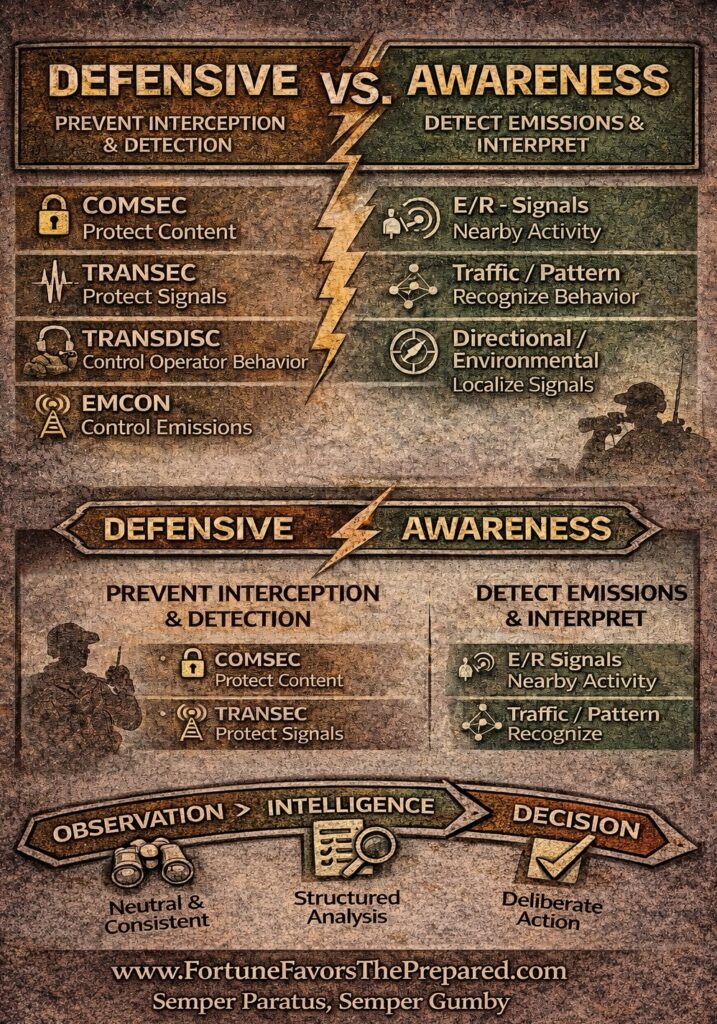
The Two Sides of Communications Discipline

Most people focus only on securing their own communications. That’s only half the problem.

A complete communications posture includes:

  1. Emission & Interception Prevention
    How to avoid being detected, intercepted, or exploited
  2. Detection & Awareness
    How to recognize, interpret, and respond to emissions from others

Ignoring either side creates blind spots.


I. Preventing Detection & Interception (Defensive Control)

This side answers the question:

“How do we communicate without becoming a target?”

Communications Security (COMSEC)

COMSEC protects the content and integrity of communications.

It ensures that even if a transmission is intercepted:

  • The message cannot be understood
  • The message cannot be altered
  • The sender cannot be impersonated

COMSEC includes:

  • Encryption
  • Authentication
  • Key management
  • Anti-spoofing measures

Limitation: COMSEC does not hide that communication occurred.


Transmission Security (TRANSEC)

TRANSEC reduces exploitation through signal characteristics and traffic analysis.

Focus areas include:

  • Frequency hopping
  • Spread spectrum techniques
  • Timing variability
  • Anti–direction-finding measures

TRANSEC reduces how useful a signal is to an interceptor—but does not eliminate detectability.


Transmission Discipline (TRANSDISC)

TRANSDISC governs operator behavior during every transmission.

It controls:

  • Brevity
  • Message structure
  • Emotional tone
  • Repetition
  • Timing

TRANSDISC is the human bridge between COMSEC and EMCON.

You can have encryption and still fail TRANSDISC.
You can enforce silence and still lose discipline when you finally transmit.


Emissions Control (EMCON)

EMCON controls the existence, timing, and detectability of emissions.

This includes:

  • RF silence or restriction
  • Scheduled communications windows
  • Power reduction
  • Directional transmission

EMCON answers the most important question first:

“Should we emit at all?”


Signature Management (Beyond Radios)

Not all emissions are communications.

Signature management includes:

  • Thermal output (generators, cooking, occupied buildings)
  • Acoustic noise (engines, voices, machinery)
  • Visual indicators (lighting, screens, movement)
  • Electronic leakage (power supplies, inverters, digital devices)
  • Behavioral patterns tied to communications

EMCON is a subset of signature management—not the whole picture.


II. Detecting Others (Awareness & Counter-Detection)

This side answers the question:

“What can we learn from what others emit?”

Detection is not espionage—it is situational awareness.


Emissions Awareness

Even basic awareness can reveal:

  • That someone is nearby
  • That activity has increased
  • That coordination is occurring
  • That resources are present

Detection cues include:

  • Unexpected RF activity
  • Repeated transmission timing
  • Power cycling patterns
  • Audible or visual emissions tied to schedules

You don’t need to decode content to learn something useful.


Traffic & Pattern Recognition

By observing when, how often, and how long emissions occur, it is possible to infer:

  • Group size
  • Organization level
  • Stress or urgency
  • Movement or task cycles

This is the same method adversaries use—and it works in reverse.


Directional & Environmental Awareness

Understanding:

  • Where signals are strongest
  • When emissions spike
  • How terrain affects propagation

allows you to distinguish:

  • Random noise
  • Environmental interference
  • Intentional activity

Detection is not about constant monitoring—it’s about recognizing change.


III. The Role of Planning & Discipline

Communications discipline is not a technical setting—it is a practice.

Supporting structures include:

  • P.A.C.E. Planning (Primary, Alternate, Contingency, Emergency)
  • Comms windows and schedules
  • Out-of-band coordination
  • Pre-formatted messages
  • Pattern-of-life management

Planning allows emissions to fail gracefully, rather than forcing risky transmissions under stress.


How It All Fits Together

  • COMSEC protects what you say
  • TRANSEC protects how signals behave
  • TRANSDISC protects how humans transmit
  • EMCON controls whether emissions exist
  • Signature management controls everything detectable
  • Detection & awareness close the loop

This is not redundancy—it is layering.

Key Takeaway

Communications & emissions discipline is not about talking less.
It is about talking intentionally—and listening intelligently.

Groups that master this discipline:

  • Are harder to detect
  • Are harder to map
  • Are harder to exploit
  • See change sooner than others

Silence, when chosen deliberately, is not absence.
It is control.


Why Communications & Emissions Discipline Matters to Preparedness

Preparedness is not only about supplies and tools—it is about awareness, restraint, and decision advantage.

In unstable environments, the first groups to be exploited are not always the weakest. They are often the loudest, most predictable, or most observable. Communications and emissions discipline reduces that risk while simultaneously improving a group’s ability to understand what is happening around them.

This discipline matters because it directly affects:

  • Whether you are noticed
  • How quickly others can locate or profile you
  • How early you detect changes in your environment
  • How well your group can coordinate without exposure

In short:

Preparedness without communications discipline creates visibility without awareness.


From Preparedness to Advantage

Well-disciplined communications and emissions practices provide three critical advantages:

1. Reduced Targetability

Groups that control emissions:

  • Reveal less about size, location, and intent
  • Avoid advertising resources or organization
  • Appear uninteresting or indistinct to casual observers

This alone lowers risk during disasters, shortages, or unrest.


2. Improved Situational Awareness

Every emission—radio, electronic, thermal, acoustic, or behavioral—is information.

By learning to recognize emissions from others, a group can:

  • Detect nearby activity
  • Notice changes in normal patterns
  • Identify coordination, movement, or escalation

This awareness often comes before official alerts or visible events.


3. Better Decision Timing

Prepared groups don’t need perfect information—they need early indicators.

Communications and emissions discipline helps answer:

  • Is something changing?
  • Is activity increasing or decreasing?
  • Is coordination occurring?

Early recognition allows:

  • Earlier movement
  • Earlier concealment
  • Earlier disengagement

Timing is often more important than strength.


Practical Application in Preparedness Groups

This discipline does not require constant monitoring or complex systems. It starts with intentional habits.

Applying the Discipline Day to Day

  • Treat communications as purposeful, not conversational
  • Establish normal silence as the default
  • Use communications when they add value—not reassurance
  • Observe changes in your environment before acting

Preparedness communications should feel boring most of the time.


Communications as an Observation Tool

Prepared groups don’t just transmit—they listen and observe.

Observations may include:

  • Unusual radio activity
  • Repeating signals or schedules
  • Increased electronic noise
  • Changes in normal ambient sound or light
  • Behavioral shifts in nearby communities

None of this requires decoding content to be useful.


Skills That Support Communications & Emissions Discipline

This discipline is skill-heavy and gear-light.

Core Skills

  • Message discipline – knowing what not to say
  • Observation & pattern recognition – noticing changes over time
  • Reporting discipline – separating observation from interpretation
  • Emissions awareness – recognizing non-obvious signatures
  • Emotional control under stress – avoiding chatter and speculation

These skills improve with training, not technology.


Equipment That May Support (But Not Replace) Discipline

Equipment should support awareness—not create dependency.

Common supporting tools include:

  • Basic radios (used deliberately)
  • Receivers or scanners for awareness
  • Directional antennas (for control and observation)
  • Logs or notebooks for recording observations
  • Timekeeping tools for pattern tracking

The most important “equipment” is a shared standard for behavior.


Observation, Reporting, and Intelligence Flow

Preparedness groups often fail not at observation—but at using what they observe.

Raw observations are only useful when they are:

  • Consistently reported
  • Clearly described
  • Shared responsibly

This is where structured reporting matters.


Structured Reporting (SALUTE and Similar Formats)

Formats like SALUTE exist to turn observation into usable information.

SALUTE captures:

  • Size – How much or how many
  • Activity – What is happening
  • Location – Where (described, not broadcast)
  • Unit/Type – What kind of activity or group
  • Time – When it occurred
  • Equipment – What was observed being used

The value of SALUTE is not the acronym—it is discipline.

It forces observers to:

  • Report facts, not assumptions
  • Separate observation from interpretation
  • Use consistent structure

Other structured formats can work just as well if they enforce clarity.


Feeding an Intelligence Network (Responsibly)

In preparedness contexts, “intelligence” does not mean espionage—it means shared awareness.

A healthy intelligence flow looks like this:

  1. Observation
    • Neutral, factual, limited to what was actually seen or heard
  2. Structured Reporting
    • Using agreed formats
    • No speculation or conclusions
  3. Aggregation
    • Multiple reports compared over time
    • Patterns identified centrally, not by individuals
  4. Assessment
    • Decisions made by designated leaders or coordinators
    • Not every observer acts independently

This prevents:

  • Rumor escalation
  • Emotional decision-making
  • Overreaction to single data points

Discipline Is What Makes Intelligence Work

The greatest intelligence failures are rarely technical—they are behavioral.

Common failures include:

  • Reporting assumptions as facts
  • Over-communicating minor observations
  • Failing to record time and context
  • Letting fear or excitement drive reporting

Communications and emissions discipline protects the intelligence process itself.


Final Thought

Preparedness is not about knowing everything.
It is about knowing enough, early enough, quietly enough.

Communications & emissions discipline:

  • Keeps you from being unnecessarily seen
  • Helps you see what others miss
  • Turns observation into shared understanding

In uncertain environments, this discipline often determines who reacts—and who is reacted to.


See also

Communications & Emissions Discipline
Communications Security (COMSEC)
Cryptographic Security (CRYPTOSEC)
Emissions Control (EMCON)
Electronic Intelligence (ELINT)
Transmission Discipline (TRANSDISC)

Transmission Security (TRANSEC)
Basic Principles of Direction Finding
Communications Intelligence (COMINT)

Electronic Counter-Surveillance (ECS)
Electronic Surveillance
Measurement and Signature Intelligence (MASINT)
Signals Intelligent (SIGINT)

Tactical Electronic Intelligence (TACELINT)

Login with Patreon

Login with Patreon

Search Site

Products

  • The Continuity Chronicles Seal Decal The Continuity Chronicles Seal Decal $5.00 Original price was: $5.00.$3.00Current price is: $3.00.
  • Family Emergency Plan Workbook - Patreon Family Emergency Plan Workbook - Patreon $19.95
  • Personal Preparedness Assessment Workbook - Patreon Personal Preparedness Assessment Workbook - Patreon $19.95
  • The Next of Kin Workbook - Patreon The Next of Kin Workbook - Patreon $23.95
  • Personal Preparedness Assessment Report Personal Preparedness Assessment Report $179.95
  • Family Emergency Plan + Next of Kin Workbooks Family Emergency Plan + Next of Kin Workbooks $59.95 Original price was: $59.95.$49.95Current price is: $49.95.
  • The Next of Kin Workbook The Next of Kin Workbook $29.95
  • ASAR — 50 Mile Radius ASAR — 50 Mile Radius $139.95
  • ASAR 50-MILE + FAMILY EMERGENCY PLAN WORKBOOK ASAR 50-MILE + FAMILY EMERGENCY PLAN WORKBOOK $169.95
  • ASAR — 50 Mile Radius - Patreon ASAR — 50 Mile Radius - Patreon $39.95
  • THE COMPLETE LIBRARY BUNDLE THE COMPLETE LIBRARY BUNDLE $109.38 Original price was: $109.38.$85.00Current price is: $85.00.
  • THE SERIES STARTER BUNDLE THE SERIES STARTER BUNDLE $29.98 Original price was: $29.98.$22.49Current price is: $22.49.

Cart

©2026 Fortune Favors the Prepared | Built using WordPress and Responsive Blogily theme by Superb