Skip to content

Fortune Favors the Prepared

Semper Paratus, Semper Gumby

Menu
  • The Continuity Chronicles
  • Intelligence Reports
        • DAILY THREAT REPORT
        • DAILY THREAT REPORT – LITE
        • DAILY PREPAREDNESS BRIEF
        • Analytical Standards and Tradecraft
        • Acronym & Abbreviations Glossary
        • Source Registry
        • FLASH & SPECIAL REPORTS
        • Area-Specific Assessment Report
        • SOFT TARGET SECURITY BRIEF
        • THE HOUSEHOLD BRIEF
        • COMMS WATCH
        • FINANCE SECTOR
        • HEALTHCARE SECTOR
        • TRANSPORTATION & LOGISTICS SECTOR
        • AI, DATA CENTER & INFRASTRUCTURE REPORT
        • CONSTRUCTION & MANUFACTURING SECTOR
        • Water and Wastewater Security Report
        • Energy Sector Report
        • Strategic Intelligence Supplement
  • WATCH DESK
  • About
        • The Why
        • Vision and Mission
        • Services
          • Business Resiliency
        • Testimonials
        • Insider
        • Friends
          • Patriot Volunteer Examiner (VE) Team
          • Angery American
          • Signal Stuff
          • Forward Observer
  • Communications
        • Stump Knocker
          • SOI
          • STUMP KNOCKER DMR UPDATES
          • MMDVM Hotspot
        • Preparedness Communications
          • What Radio Should I Get for Preparedness?
            • What Radio to Buy?
              • What Radio to Buy? – video
              • Ham Radio on a Budget
              • Live – What Radio to Buy?
              • Portable Radio Kit
              • Mobile Communications
          • Emergency Communications Principles
          • Communications Options
          • Starter Radio Paths by Preparedness Scenario
          • How Communications Fail
          • HF Communications
            • SHTF HF Communications
            • Simple Antenna Builds for HF – video
            • NVIS in Amateur Radio
        • Amateur (HAM) Radio
          • Why Do I Need a Ham License?
            • How to Obtain Your Amateur Radio License
              • Amateur Radio Learning Resources
              • Finding a Ham Exam
                • HAM Exam Accommodation
              • Getting Into Ham Radio – Video
            • Are You Expired?
            • Why You Should Upgrade to a General Ham License
          • HAM Simplex Frequency Card
          • Analog versus Digital
          • Analog vs Digital Voice: A Preparedness-Focused Comparison
          • What are CTCSS and DCS
          • Programming Radios with Software
          • ARES, RACES, ACS and AUXCOMM
          • Ham Radio Beyond Line-of-Sight
            • Linked Analog Repeaters
            • EchoLink and IRLP
            • AllStarLink
            • Yaesu System Fusion & WIRES-X
            • D-STAR
            • Digital Mobile Radio (DMR)
            • P25 in Amateur Radio
            • NXDN in Amateur Radio
            • Amateur Radio Satellites (AMSAT)
            • The 60-Meter Band (5 MHz)
          • Meshtastic
          • HAM VoIP
        • Personal Radio Services
          • FCC Rules for Personal Radio Services
          • Family Radio Service (FRS)
          • General Mobile Radio Service (GMRS)
            • GMRS Repeaters
            • Getting a GMRS License
            • FRS / GMRS / MURS Frequency Card
          • Multi-Use Radio Service (MURS)
          • Citizen Band (CB) Radio
            • CB Frequency Card
        • Other Radio Services
          • Communications Continuity Programs and Capabilities
          • Marine Communications
        • Cell Sites and Their Services
          • When Cell Service Fails
          • Radio over LTE and Rapid Radios
            • LTE Radio Comparison
        • Satellite Communications
          • America’s Secret Eyes
          • The Commercial Eye
          • Seeing Through Everything (SAR)
            • Remote Area Emergency Communication Devices
            • Which Beacon Should You Carry?
          • Personal Satellite Communications
        • Wired Communications
          • MAG Phone System
          • TA-312/PT Field Telephone and SB-22/PT Switchboard
          • Understanding Telephone Wiring
          • The AT&T Long Lines Program
        • Communications Planning
          • Communications Plan Annex
            • Communications P.A.C.E.
            • Finding Information for Your Communications Plan
            • Area-Specific Assessment Report
          • Automatic Link Establishment (ALE)
          • Understanding Communications Resiliency
        • Communications Resiliency Programs
          • ARES, RACES and ACS
          • Auxiliary Communications (AUXCOMM)
          • Military Auxiliary Radio System (MARS)
          • U.S. Coast Guard Auxiliary Communications
          • Civil Air Patrol Communications
          • The 60-Meter Band (5 MHz)
            • Understanding the 60-Meter Band
        • Government Communications Continuity Programs
          • Government Emergency Telecommunications Service (GETS) and Wireless Priority Service (WPS)
          • National Warning System (NAWAS)
          • National Interoperable Frequencies
          • The FEMA National Net (FNARS)
          • National Emergency Communications Network (NECN)
          • The SHARES Program
          • State Emergency Capability Using Radio Effectively (Operation SECURE)
          • The High Frequency Global Communications System (HFGCS)
          • Satellite Mutual Aid Radio Talkgroup (SMART)
          • The AT&T Long Lines Program
        • Communications & Emissions Discipline
          • Communications Security (COMSEC)
            • Book Cipher
            • One Time Pads (OTP)
              • Decrypting One Time Pad Message
              • One Time Pads (OTP) Live Video
              • One Time Pad Training
          • Cryptographic Security (CRYPTOSEC)
          • Transmission Security (TRANSEC)
          • Communications Transmission Discipline (TRANSDISC)
          • Emissions Control (EMCON)
          • Communications & Emissions Training Framework
        • DMR Programming
          • DMR Programming – Talk Groups
          • DMR Programming - Roaming
          • MMDVM and Yaesu System Fusion (YSF)
          • Encryption in DMR Radios
        • Digital Mobile Radio (DMR) Networks
          • WR3IRS Interstate DMR Network
            • South Central PA (SC PA)
            • North East PA (NE PA)
            • Washington-Baltimore (W-B)
            • West Central Florida (WCF)
          • Florida Digital Amateur Radio Network (F-DARN)
          • Southeast Florida DMR Repeater Network W2GGI
          • Virginia DMR (DMRVA)
          • NC PRN DMR Network
          • SC Hospital Emergency Amateur Radio Team (SCHEART)
          • HEARS – Hospital Emergency Amateur Radio System
          • New England Digital Emergency Communications Network (NEDECN)
        • Baofeng/BTECH Radios Quick Guide
          • Manually Programming a Baofeng Radio – Video
          • A User’s User Manual for Baofeng Radios
        • MESSAGES & REPORTS
          • Phonetics
          • Procedure Words (Prowords)
          • Date Time Group (DTG)
          • NTS Radiogram Form
            • ARL Numbered Radiograms
          • SALUTE, SPOT, and SALT Reports
          • ACE/LACE Reports
          • GOTWA Report
          • CASREP (Casualty Report) Format
          • MEDEVAC Request Report
          • Formatted Messages (downloads)
        • Communications Knowledge Library
          • Communications Resiliency
          • Radio Etiquette, Jargon, and Best Practices
          • AmRRON RESOURCES & REFERENCES
          • Anytone Programmable Keys
          • Phonetics
          • Amateur Radio Colorado
            • Colorado Linked Repeater Systems
        • COMMUNICATIONS REFERENCES
  • Planning
        • Family Emergency Plan – The Basics
          • Family Emergency Plan
            • Area-Specific Assessment Report
          • Why Every Family Needs an Emergency Plan
        • Family Contingency Binder
          • Family Contingency Binder MindMap
        • Triggers
          • Preparedness Conditions – PREP-CON
            • Preparedness Conditions (PREP-CON) MindMap
          • Space Weather
        • Family Emergency Plan Workbook
          • Family Emergency Plan Workbook - owner resources
            • Area-Specific Assessment Report
            • Family Emergency Planning Form
            • Communications Plan
              • P.A.C.E.
            • Emergency Evacuation
            • Emergency Food Supplies
            • Family Contingency Binder
            • Message Drops
            • Get Home Bag
            • Bug Out Bag & Bins
            • Miscellaneous
        • Household Recovery Workbook
          • Household Recovery Workbook Updates
          • Disaster Debris — What to Do at the Curb
          • Dealing With Grief
        • Next of Kin Workbook
          • Next of Kin Workbook Updates
        • METT-TC: Decision Discipline
          • METT-TC - tactical planning
        • Planning Your Preps
          • Charity in Planning
        • Mutual Assistance Group
          • Mutual Assistance Group Workbook
            • MAG Workbook Forms & Updates
          • Mutual Assistance Groups (MAGs): Skills, Vetting, and Building Real Resilience
          • Mutual Assistance Group (MAG): Recruitment Code of Conduct
          • MAG: Private Vetting & Intake Process
          • Compartmentalization in Mutual Assistance Groups (MAGs)
          • Resiliency Index
          • Continuity of Government & Application to MAGs
  • Threat Assessment
        • Personal Preparedness Assessment Workbook
          • Personal Preparedness Assessment Report
          • Personal Preparedness Assessment Workbook - owner resources
        • Readiness Conditions for Preparedness
          • PREP-CON - Preparedness Conditions
          • COMCON – Communications Readiness Condition
          • WX-CON Weather Conditions
          • SWX-CON Space Weather Condition
          • CONCON – Civilian Continuity Conditions
        • Readiness Conditions – Hierarchy and Relationships
          • LERTCON – Alert Condition
          • DEFCON – Defense Readiness Condition
          • COGCON - Continuity of Government
          • INFOCON – Information Operations Condition
          • FPCON – Force Protection Condition
          • EMERCON – Emergency Condition
          • CYBERCON – Cyber Readiness Conditions
          • CPCON – Cyberspace Protection Condition
          • WATCHCON – Watch Condition
          • SIPRNet – Secret Internet Protocol Router Network
          • REDCON – Readiness Condition
          • NC3CON – Nuclear Command, Control, and Communications
        • Readiness Conditions in The Conspiracy Chronicles
          • CERCON – Cerberus Readiness Condition
          • COMCON – Communications Readiness Condition
          • C-OPS – CERBERUS Operational Status Conditions
          • CONCON – Civilian Continuity Conditions
        • Being Prepared for Civil Unrest
          • Civil Unrest – Area Intelligence
          • Civil Unrest – Be Prepared
          • Civil Unrest – Defense
          • Civil Unrest – Defense (part 2)
        • Staying Informed Before, During and After Emergencies
          • Weather Awareness
            • Weather Event Codes
            • Weather Radio Comparison
        • Cascade Analysis & Infrastructure
          • Cascade Effects
          • Community Lifelines
          • Area Intelligence
          • Area-Specific Assessment Report
          • National Power Grid
        • Near Earth Object / End of Life Event (ELE)
  • Intelligence
        • ANALYSIS, TRADECRAFT & REPORTING
          • Analytical Standards and Tradecraft
          • Analytical Tradecraft: A Guide to OSINT Analysis
            • OSINT Analysis Study & Reference Guide
          • Understanding Intelligence Analysis Tools
            • Understanding Analysis of Competing Hypotheses (ACH)
            • Understanding MDCOA
            • Understanding OAKOC
        • Operations Security (OPSEC)
          • OPSEC for Teens
          • OPSEC for Kids
          • The Gray Man
          • OPSEC: Don't Become the Target
          • Counterintelligence Tradecraft for the Prepared
        • Community Intelligence
          • Area Intelligence – Now!
            • Area-Specific Assessment Report
          • Community SITREP
          • Radio Traffic Situational Analysis During Emergencies
          • SALUTE, SPOT, and SALT Reports
        • ELECTRONIC THREAT & SURVEILLANCE
          • Staying Informed Before, During and After Emergencies
          • Integrated Public Alert and Warning System (IPAWS)
          • Communications Continuity Programs and Capabilities
          • Short Wave Scanning
          • Seeing Through Everything (SAR)
            • Which Beacon Should You Carry?
          • Wireless Recon Devices
        • The Architecture of Intelligence
        • Intelligence Gathering & Analysis
        • INTELLIGENCE DISCIPLINES
          • Communications Intelligence (COMINT)
          • Electronic Intelligence (ELINT)
          • Tactical Electronic Intelligence (TACELINT)
          • Signals Intelligence (SIGINT) – the basics (2020)
          • Signals Intelligence – Information Gathering Basics (2022)
          • Signals Intelligence (SIGINT)
          • Technical & Infrastructure Intelligence (TECHINT)
          • Electronic Counter-Surveillance
          • Open-Source Intelligence (OSINT)
            • How to Conduct a Daily Threat Analysis Using OSINT
          • Measurement and Signature Intelligence (MASINT)
          • Electronic Surveillance (ES)
          • Overhead Imagery & Geospatial Intelligence (IMINT / GEOINT)
        • INTELLIGENCE REFERENCES
  • Medical
        • Medical Training
          • Patient Assessment & Casualty Management
            • MARCH-PAWS Rapid Assessment
              • MARCH-PAWS TRAINING CURRICULUM
            • DCAP-BTLS – Secondary Trauma Assessment
            • SAMPLE + OPQRST Secondary Assessment
              • Medical History as a Preparedness Skill
            • START Triage
            • MEDEVAC Request Report
            • Patient Assessment – Documentation
              • Patient Care Report Forms
              • CASREP (Casualty Report) Format
        • Medical Kits
          • Individual First Aid Kit (IFAK)
          • BooBoo and IFAK Kits Video
          • BooBoo & IFAK Kit Mind Map
          • Large Kit - video
        • Medical Myths
          • Medical Myths – Tampons
          • Medical Myths – Ingested Poisoning
        • MEDICAL REFERENCES
  • Transportation
    • Transportation Plan B
    • Improvised Transportation
    • Preparedness For Winter Travel
  • Animals
    • Preparedness for Pets
  • Food
        • Why You Should Start a Food Storage Plan
        • Food Storage Quick Start
        • Buying in Bulk
        • Inventory Tracking
        • FOOD PRESERVATION RESOURCES
  • Water
  • Power
        • Power Grid
        • UPS
  • Bags etc.
        • Bug Out versus Get Home Bags
        • Get Home Bag – Contents
          • Get Home Bag – video
          • Get Home and Bug Out Bags - video from live 2-10
  • Navigation & Signalling
        • Practitioners Guide to GPS
          • Quick Instruction Sets
        • Emergency Signaling
        • Covert Signals
        • Which Emergency Beacon Should You Carry?
        • Sketched Strip Map
  • References
        • PLANNING & OPERATIONS
        • SECURITY OPERATIONS
        • INTELLIGENCE
        • CRYPTOLOGY
        • COMMUNICATIONS
        • REPORTING FORMATS
        • GENERAL/MISC
        • MEDICAL
        • FOOD PRESERVATION
        • CRITICAL INFRASTRUCTURE
        • SURVIVAL MANUALS
        • OPSEC
        • COUNTER INSURGENCY & CIVIL DISTURBANCE
        • EMP / CME
        • Training
          • Training Videos
          • One Time Pad (OTP) Exercises
            • 45662
            • 222135ZDEC22
  • Blog
    • Boomer
      • Day 1 – The Journey Home
      • Day 2 – First Day in the New Home
      • Day 3 – More Training
      • Day 4 – Dad Goes Back to Work
      • Day 5 – A Day at Home with More Training with Dad (Boomer’s version)
      • Day 6 – More Training with Dad at Home
      • Day 7 – Dad Goes Back to Work, Boring Day
    • Mountain Readiness Fallout Workshops
    • Mapping DMR Repeaters
    • COMMUNICATIONS RESILIENCY
    • Getting The Message Through
    • What are you preparing for?
    • Never Let an Opportunity Go To Waste
    • Cascade Effects and the Perfect Storm
    • DO NOT REPLY
    • Space Weather Warning
    • Good, and Sad, News
    • Necessity vs. Luxury
    • Don’t Put off Until Tomorrow
    • No Plan Survives First Contact
    • Threat and Hazard Identification and Risk Assessment (THIRA)
    • Live – What Radio to Buy?
    • Big Daddy Unlimited Affiliate
    • Food – Tue 16th 7pm MST
    • Live from 2021-2-3
    • Live 2021-01-26
    • FLASH SALE
    • Live 2021-01-11
    • What Is Freedom?
    • Preparedness for Pets
    • What If The Lights Go Out?
    • Hoarding or Prepping?
    • Why Do I Need a Ham License?
    • How Bad is the SolarWinds Orion Issue?
    • How To Begin Prepping
    • Members Only Live Videos
    • Live 11/24
    • Ham Radio VoIP Phone
    • Training Calendar
    • A Chat (with some whisky)
    • Blog 2020 11 02
    • Live with Charlie Hogwood
    • EARTH EX 2020
    • A Live with Angery American
    • Have You Woken Up Yet?
    • BUG OUT READY
    • The Gray Man
    • Area Intelligence – Now!
    • Being Prepared for Civil Unrest
    • It Depends
    • The Art of Being Prepared – The New Prepper
    • Get Home versus Bug Out Bags
    • Why You Need an IFAK AND Training
  • Training Curriculum
  • Shop
  • Contact
    • Mailing List
  • Media and Press
Menu

Near Earth Object / End of Life Event (ELE)


Fortune Favors the Prepared • Intelligence & Analysis

The Sky Is Being Watched: What Actually Happens If Something Is Coming

Hollywood has been telling this story for almost fifty years. The real version, the actual math, the real notification chain, and who is really watching, is less cinematic and more useful to know.

Bottom Line Up Front

There is no secret government program keeping a planet killing asteroid quiet. There is a real, documented, international detection and notification system, and it has already been tested once, in public, in 2025. The system has known gaps: a blind spot toward the sun, an overall first detection success rate estimated around one percent, and no binding international agreement on what any government would actually do once a threat was confirmed. Understanding those gaps, not the movie version, is what actually matters for preparedness planning.

1. The Version Hollywood Sold Us

The genre is nearly fifty years old. Meteor (1979) set the template: a large object on collision course, a scramble to build a response, a government slow to act. Nineteen years later, two studios released competing versions in the same summer. Armageddon gave audiences a Texas sized asteroid and a team of oil drillers turned astronauts. Deep Impact, released first, told a quieter and arguably more realistic story: a comet, a years long lead time, and a government that tells the public early, then manages the fallout of that disclosure. That contrast between the two 1998 films, spectacle versus disclosure, is really the whole debate in miniature.

More recent films have moved further from rescue fantasy. Greenland (2020) centers the public’s experience of evacuation and breakdown rather than the mission to stop the impact. Don’t Look Up (2021) is a direct satire of political and media failure to act on a confirmed, dated extinction level threat. The genre’s trend line is instructive on its own: the newer films trust institutions less, not more.

None of this is prediction. It is worth naming because it shapes what people expect a real event to look like, and the real system does not resemble either the 1998 spectacle model or the 2021 satire. It is slower, more bureaucratic, and more transparent than both.

2. The Actual Math

Object size drives everything. A rough scale, drawn from current planetary defense research:

Object Size Approximate Frequency Consequence
About 3 meters About once a year Burns up in atmosphere, no threat
18 to 20 meters (Chelyabinsk class) Decades scale Regional injury and damage if over a populated area
140 meters and larger Roughly once every 11,000 years Significant regional to sub continental damage
Several kilometers (extinction class) Roughly once every 10 million years Global, civilization altering

The 11,000 year figure for 140 meter and larger objects comes from a 2025 Planetary Science Journal study that modeled simulated near-Earth object populations against JPL’s Horizons ephemeris data. It is a statistical average across the whole population, not a countdown clock, which is exactly where public understanding tends to break down.

The 2024 YR4 case is the best recent example of how badly a raw percentage can be misread. Its estimated impact probability climbed from roughly one percent at first detection in January 2025 to a peak of 3.1 percent in mid February, then collapsed to 0.004 percent within days, and later fell below 0.00001 percent as more observations narrowed the object’s orbital uncertainty. Nothing about the asteroid changed in that window. Only the precision of the tracking data changed. Any single probability number reported early in an event should be read as provisional by default, not as a verdict.

3. Would They Actually Tell Us: The Real Notification Chain

There is a documented, if imperfect, answer to this question, and it does not involve a cover up. The International Asteroid Warning Network (IAWN), established following a 2013 United Nations Committee on the Peaceful Uses of Outer Space action and formally endorsed by UN resolution in 2023, exists specifically as the notification clearinghouse. Its threshold for issuing a warning is an impact probability greater than 1 percent within the next 20 years, for an object larger than roughly 10 meters. That threshold has been reached exactly once since IAWN’s founding: during the 2024 YR4 event, when the United Nations Office for Outer Space Affairs formally notified national stakeholders including the United States Space Force.

On the domestic side, the United States has an actual written playbook: the federal Report on Near-Earth Object Impact Threat Emergency Protocols, developed under the National Science and Technology Council. It describes a flow that starts with an initial coordination call among federal emergency management officials, proceeds through Emergency Support Function 15 (public affairs) for the first public messaging, and separately tasks the Department of State and NASA with a priority list of foreign governments to notify. The same document is candid about the honest limitation in this entire system: there are no firm, binding commitments from any spacefaring nation as to what response would actually be mounted against a confirmed threat. The process for finding out exists. The guarantee of a coordinated response does not.

The overarching federal policy tying all of this together is the 2023 NSTC National Preparedness Strategy and Action Plan for Near-Earth Object Hazards and Planetary Defense, which explicitly folds interstellar objects into the same detection, modeling, and interagency coordination goals as ordinary near-Earth asteroids.

One more structural point worth understanding: as of the most recent published estimate, only about 44 percent of near-Earth objects in the 140 meter and larger size class have actually been found. A notification system can only notify on what has been detected. That gap is the subject of the next section.
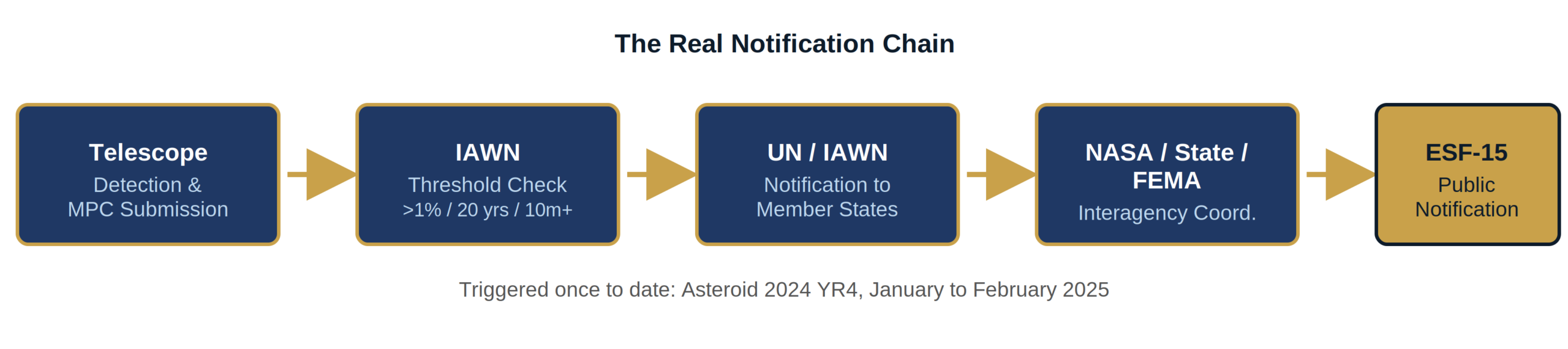
The Real Notification Chain: Telescope Detection to IAWN Threshold Check to UN Notification to NASA State FEMA to ESF-15 Public Notification

4. Who Is Actually Watching

It is a common assumption that a threat like this would first surface inside a classified government channel. In practice, the detection and cataloging backbone is largely non-governmental and international by design. IAWN itself is not a government agency. It is a UN endorsed collaboration of more than 60 signatory observatories, universities, and space institutions worldwide, pooling ground and space based detection assets.

The actual global clearinghouse for confirming a new discovery is the International Astronomical Union’s Minor Planet Center, an independent scientific body, not a national defense agency. Any observatory, including well equipped amateur trackers, can submit observations into that same pipeline. This is precisely how the interstellar object 3I/ATLAS was handled in 2025: discovered by the NASA funded but independently operated ATLAS survey telescope in Chile, it triggered the first IAWN monitoring campaign ever run against an interstellar visitor, and prompted a large scale planetary defense communication drill even though officials confirmed early on that there was no collision risk. The system, in other words, has already had a live dress rehearsal, on an actual object, with the public watching in real time.

The newest asset in this network came online in 2025 and 2026: the Vera C. Rubin Observatory in Chile, jointly funded by the National Science Foundation and the Department of Energy. In its earliest, pre-survey data alone, Rubin submitted more than 11,000 new asteroid detections to the Minor Planet Center, including 33 previously unknown near-Earth objects. None of the objects found so far pose a threat. The significance is capability, not any specific finding: Rubin surveys at roughly six times the sensitivity of prior asteroid search systems, and its planned ten year survey is expected to nearly double the known population of hazardous sized (140 meter plus) near-Earth objects, pushing the known catalog from about 44 percent complete toward something closer to 70 percent.

5. The Detection Gap, Told Through One Real Night

The honest weak point in the entire system is geometry, not competence. Ground based telescopes cannot see objects approaching from the direction of the sun; the glare defeats them. Current systems also only achieve final approach detection in an estimated one percent of cases overall, a figure that gets worse for smaller objects. The overall population of known near-Earth objects has an estimated 89 to 99 percent completeness for anything a kilometer or larger, but completeness drops sharply as object size drops.

February 15, 2013 is the case study that makes this concrete. Astronomers were closely tracking a known 40 meter asteroid, 367943 Duende, on a well predicted, non threatening close approach to Earth that same day, a genuine planetary defense success story at the time. Sixteen hours before Duende’s flyby, an entirely separate and completely undetected 18 meter object entered the atmosphere over Chelyabinsk, Russia, arriving from the sun’s direction where no telescope was looking. It injured roughly 1,500 people and damaged more than 7,000 buildings. The tracked object and the striking object were unrelated, and the one that actually hit was the one nobody saw coming, arriving from the exact blind spot every ground based system shares. That juxtaposition, a success and a miss on the same day, is a more honest planetary defense story than anything a studio has produced.
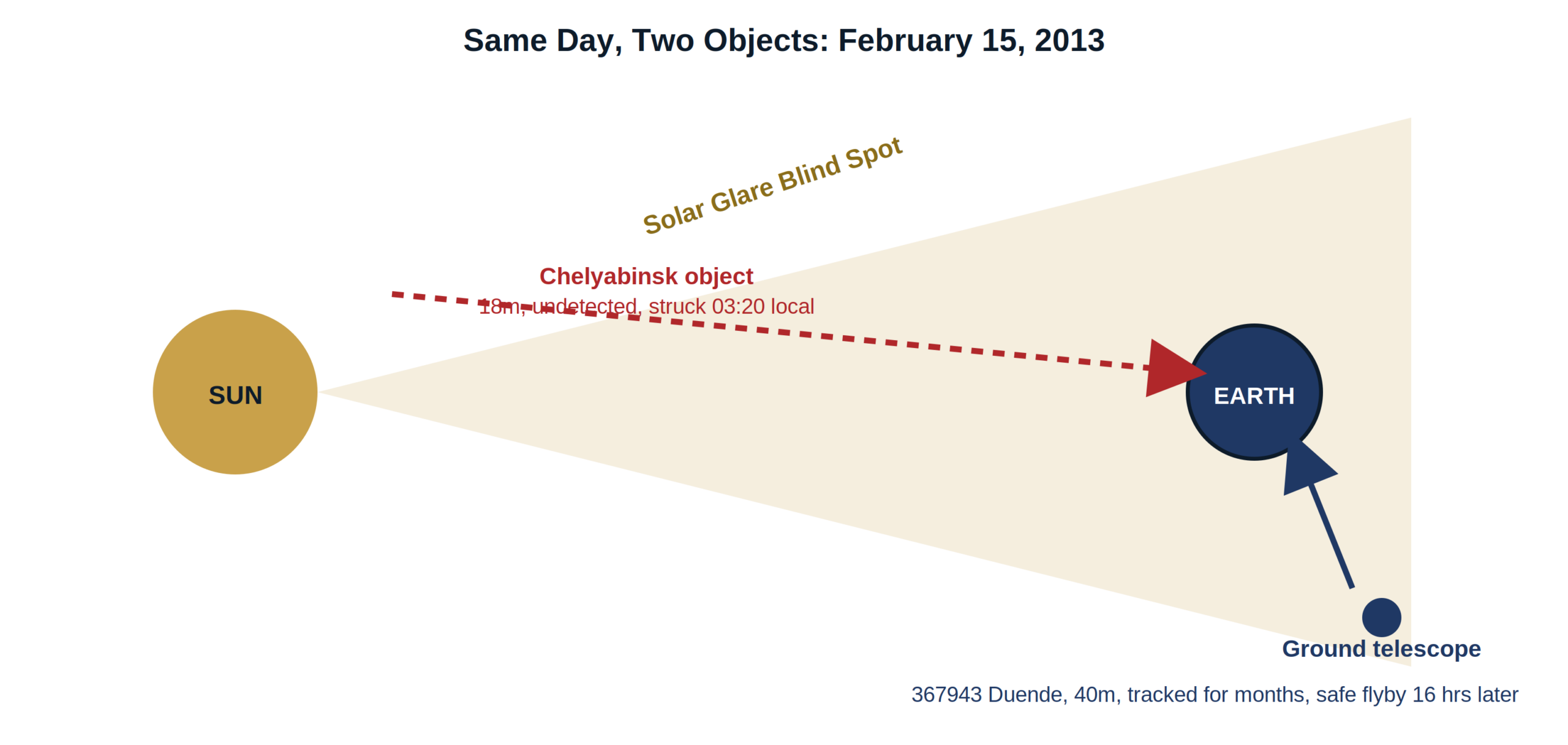
Same Day, Two Objects, February 15 2013: the Solar Glare Blind Spot diagram showing the undetected Chelyabinsk object versus the tracked asteroid 367943 Duende

6. Why You Need to Know This

A fair question at this point is why a low probability hazard, once every 11,000 years for anything regionally significant, deserves a place in a personal preparedness plan at all. The honest answer is that probability is only half the risk equation. The other half is consequence, and for this specific hazard the consequence side is about as high as it gets: a regional strike removes infrastructure, food supply chains, and communications across an area the size of a state or larger, with no local mutual aid to draw on because the surrounding region is affected too. Low frequency, high consequence events are exactly the category that conventional planning tends to under-weight, because the low frequency number is easier to remember than the consequence number.

This is also precisely why the hazard belongs inside your existing plan rather than a separate one built just for it. The failure modes an NEO strike produces, loss of communications, disrupted supply chains, mass displacement, regional infrastructure damage, are the same failure modes produced by a major hurricane, a large scale grid failure, or a significant earthquake. The response actions are largely the same too. The value of reading about this hazard is not memorizing an asteroid specific checklist. It is confirming that your general all hazards plan actually holds up against a scenario with a longer warning window but a wider blast radius than most people plan for.

If you have not run a structured assessment of your own household’s readiness against low frequency, high consequence scenarios like this one, that is the right next step, not researching asteroid trivia. Start with the Personal Preparedness Assessment to establish where your actual gaps are before layering in any hazard specific planning on top.
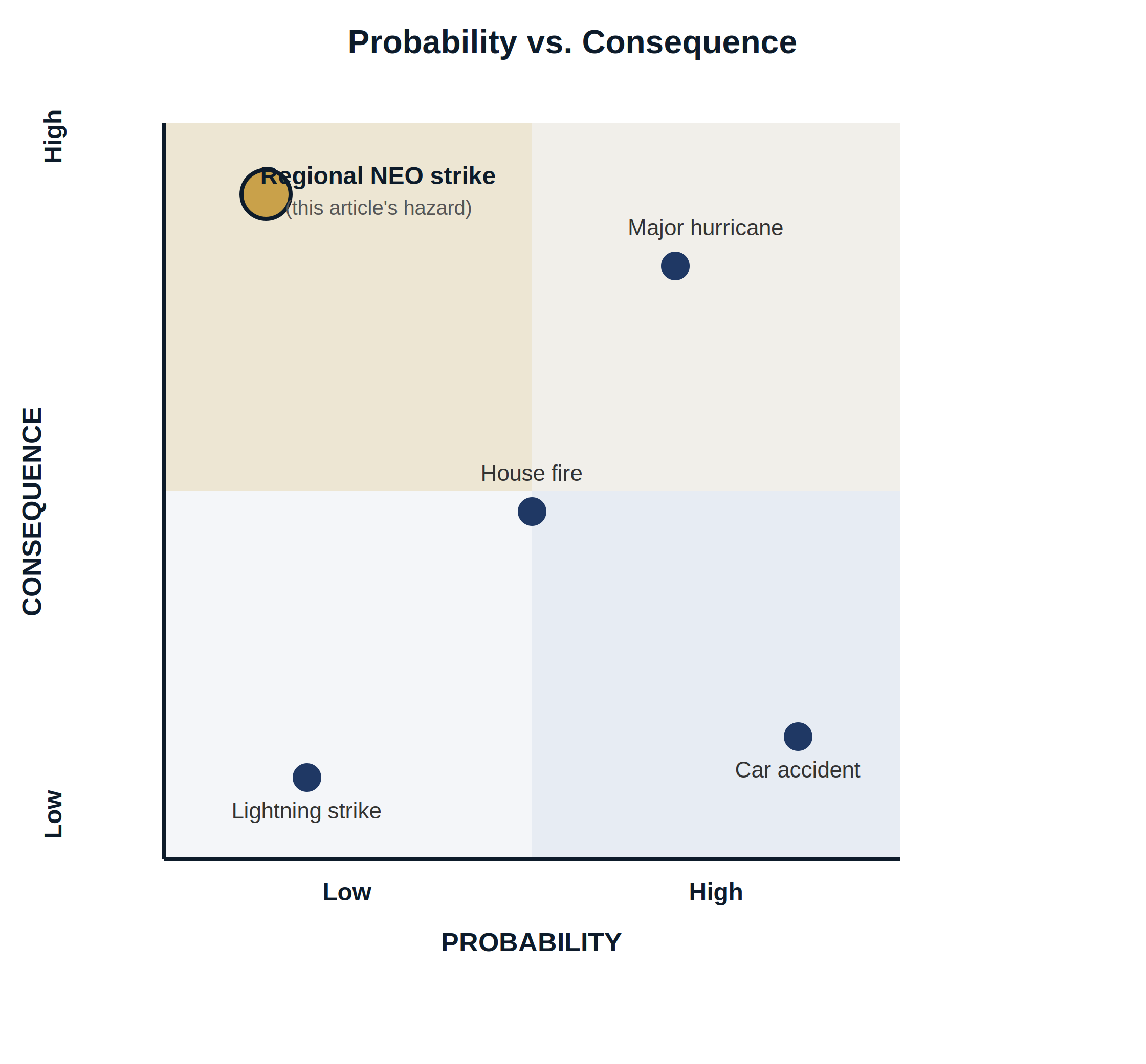
Probability versus Consequence matrix showing a regional NEO strike in the low probability high consequence quadrant, compared to lightning strikes, car accidents, house fires, and major hurricanes

7. Reading This Through the FFTP Standing Conditions Framework

Regular readers of the Daily Threat Report already track a set of standing conditions each cycle: DEFCON, COGCON, FPCON, CYBERCON, and two conditions proprietary to this platform, COMCON and PREP-CON. A near-Earth object notification does not map onto any single one of those, but it is worth understanding how it would move through a framework readers already use.

An IAWN notification functions much like a DTR standing condition escalation: it is issued only when a defined, numeric threshold is crossed, in this case an impact probability above 1 percent within a 20 year window for an object 10 meters or larger, exactly the kind of hard trigger this platform uses for its own COMCON and PREP-CON escalation criteria rather than a subjective judgment call. The core discipline is the same one this platform applies every cycle: report the threshold that was actually crossed, not the worst case headline number.

For household level planning purposes, an NEO notification event should be read against your own PREP-CON posture rather than treated as a standalone crisis category. A confirmed IAWN threshold crossing, on an object with a multi year or longer warning window, is realistically a PREP-CON 4 (Elevated Watch) level input at most, informational and worth monitoring, not an immediate action trigger. It would only justify moving toward PREP-CON 3 (Elevated) or below if follow up observations increased both the probability and the confidence in a short warning window, which, per the Torino Impact Hazard Scale used by astronomers internationally, would itself be publicly visible as the event moved into that scale’s yellow or orange categories. The Family Emergency Plan Workbook actions already tied to each PREP-CON level, communications continuity, supply posture, evacuation readiness, apply here without modification. This is a category of hazard best absorbed into existing all hazards planning, not a reason to build a separate plan.

From the Continuity Chronicles

Readers of The Continuity Chronicles techno-thriller series, The Meadow Protocol, The Brush, Unassigned Authority, and the fourth book now in development, will recognize this same pattern: real institutional machinery that is slower, more procedural, and more transparent than fiction usually allows, with the actual risk sitting quietly in the gaps between agencies rather than in any single dramatic failure. Explore the series at thecontinuitychronicles.net.

Sources: NASA’s Center for Near-Earth Object Studies; the 2023 NSTC National Preparedness Strategy and Action Plan for Near-Earth Object Hazards and Planetary Defense; the Report on Near-Earth Object Impact Threat Emergency Protocols; the International Asteroid Warning Network; the IAU Minor Planet Center; NSF-DOE Vera C. Rubin Observatory public releases; and the Planetary Science Journal (2025).

Semper Paratus, Semper Gumby.

Login with Patreon

Login with Patreon

Search Site

Products

  • Family Emergency Plan and Household Recovery Workbooks - Patreon Family Emergency Plan and Household Recovery Workbooks - Patreon $34.95
  • Bundle - Family Emergency Plan and Household Recovery Workbooks Bundle - Family Emergency Plan and Household Recovery Workbooks $46.95
  • Household Recovery Workbook Household Recovery Workbook $29.95
  • The Continuity Chronicles Seal Decal The Continuity Chronicles Seal Decal $5.00 Original price was: $5.00.$3.00Current price is: $3.00.
  • Family Emergency Plan Workbook - Patreon Family Emergency Plan Workbook - Patreon $19.95
  • Personal Preparedness Assessment Workbook - Patreon Personal Preparedness Assessment Workbook - Patreon $19.95
  • The Next of Kin Workbook - Patreon The Next of Kin Workbook - Patreon $23.95
  • Personal Preparedness Assessment Report Personal Preparedness Assessment Report $179.95
  • Bundle - Family Emergency Plan + Next of Kin Workbooks Bundle - Family Emergency Plan + Next of Kin Workbooks $49.95
  • The Next of Kin Workbook The Next of Kin Workbook $29.95
  • ASAR — 50 Mile Radius ASAR — 50 Mile Radius $139.95
  • ASAR 50-MILE + FEP WORKBOOK ASAR 50-MILE + FEP WORKBOOK $169.95
  • ASAR — 50 Mile Radius - Patreon ASAR — 50 Mile Radius - Patreon $39.95
  • Bundle - The Series Starter (Paperback) Bundle - The Series Starter (Paperback) $29.98
  • The Brush (Paperback) The Brush (Paperback) $15.99
  • The Meadow Protocol (Paperback) The Meadow Protocol (Paperback) $13.99
  • Cards (4x6) - Brevity Cards for OTP Cards (4x6) - Brevity Cards for OTP $24.95
  • Communications Card bundle (13 cards) Communications Card bundle (13 cards) $41.95
  • Personal Preparedness Assessment Workbook Personal Preparedness Assessment Workbook $24.95
  • Family Emergency Plan Workbook Family Emergency Plan Workbook $24.95

Product categories

Cart

©2026 Fortune Favors the Prepared | Built using WordPress and Responsive Blogily theme by Superb