Community Lifelines
Why FEMA’s Framework Matters to You, Your Family, and Your Neighborhood
THE SHORT VERSION
When the next disaster hits your area, the people running the response will be tracking eight things: Safety & Security, Food / Hydration / Shelter, Health & Medical, Energy, Communications, Transportation, Hazardous Materials, and Water Systems. These are the FEMA Community Lifelines.
If you understand the same eight buckets, you can: organize your household, organize your neighborhood, speak the same language as the EOC, and know exactly where you fit in the priority order. That is a force multiplier.
If you do not understand them, you will be a passenger in your own emergency.
1. What is a Community Lifeline?
A Community Lifeline is one of eight essential services that, when stabilized, allow everything else in a community to function. Think of them as the load-bearing walls of daily life. If even one collapses for long enough, the rest of the structure starts coming down with it.
FEMA built the framework after a hard lesson: in disaster after disaster, response was being measured in motion rather than in outcome. Crews were being deployed, trucks were rolling, press conferences were being held, and somewhere in the middle of the activity people were still without power, water, food, or medical care. The lifelines construct was created to force the question back to where it belongs: are the survivors actually getting their basic needs met yet, or are we just busy?
A Brief History
The framework was developed in 2018 in response to the 2017 hurricane season (Harvey, Irma, Maria), which exposed gaps in how federal, state, and local responders measured progress against impact. The first version had seven lifelines. After hard testing through Hurricanes Michael, Florence, and Dorian, the Alaska earthquake, Super Typhoon Yutu, the Kilauea eruption, and ultimately the COVID-19 response, the construct was refined.
The current eight-lifeline version was finalized with the Community Lifelines Implementation Toolkit 2.1 in July 2023. Water Systems was promoted from a subcomponent of Food / Water / Shelter to its own standalone lifeline in August 2023, after years of advocacy from the water sector and the public health community. The reasoning was simple: drinking water for survival is different from the infrastructure that delivers it, and the latter needed its own attention.
The framework is now used by FEMA, by every FEMA region, by most state EOCs, by an increasing number of county and city EOCs, and by private-sector resilience programs. It is the standard language for talking about disaster impact in the United States.
That last point is the one that matters for households and preppers. If the people responding to your disaster speak Community Lifelines, you need to speak Community Lifelines too. Not because you have to fit into their bureaucracy, but because the framework is genuinely useful for thinking about your own preparedness, and because it is the channel your information will travel through if you want anyone to act on it.
The Eight Lifelines at a Glance
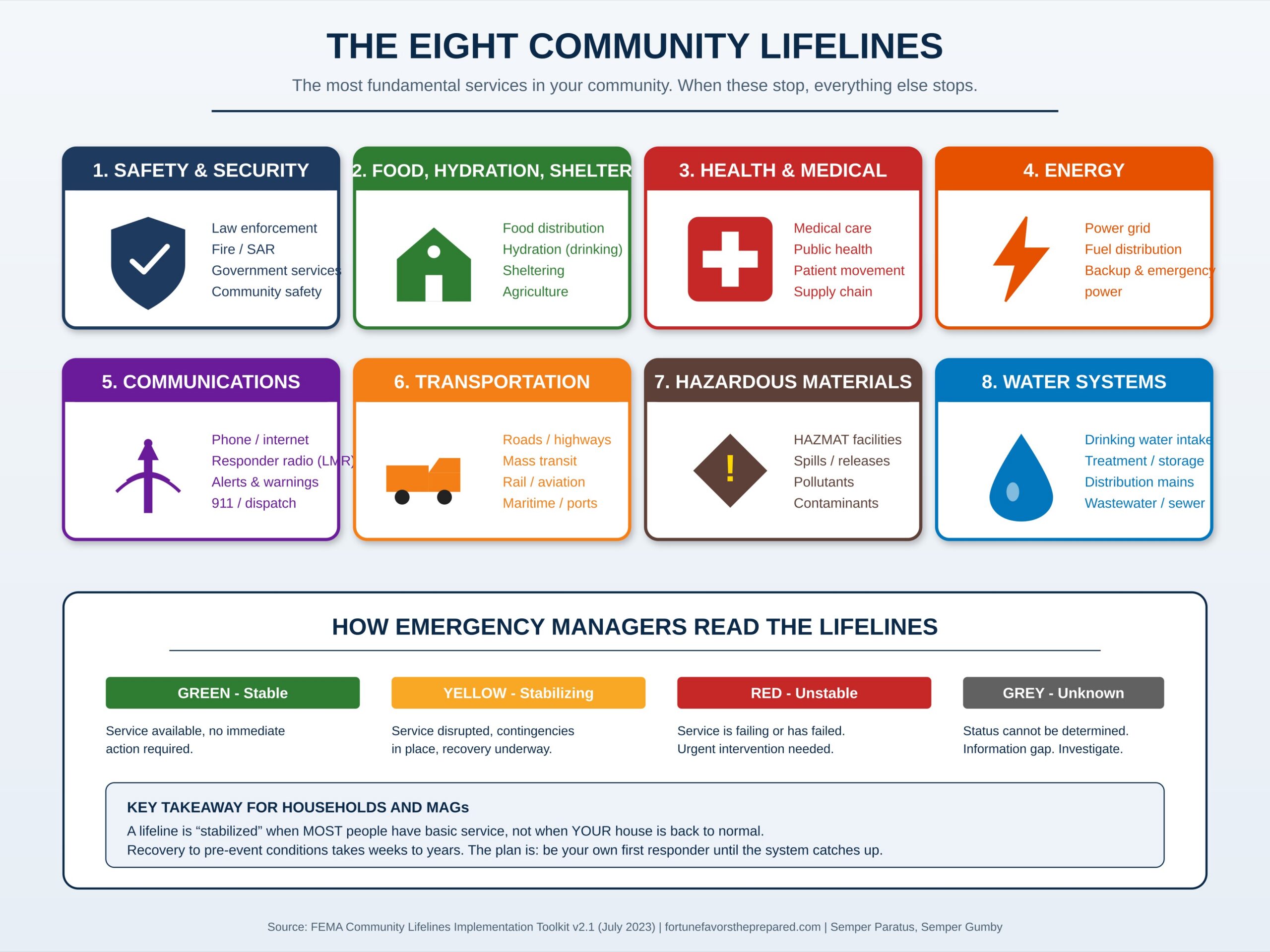
The eight FEMA Community Lifelines and the status color scheme used by emergency managers. Source: FEMA Community Lifelines Implementation Toolkit v2.1, July 2023.
The Status Color Code
The framework is not just a list. Every lifeline is rated using a four-color status code that is consistent across all FEMA, state, and local reporting:
- GREEN (Stable): The service is available and no immediate intervention is needed. Pre-disaster normal, or post-disaster restored.
- YELLOW (Stabilizing): The service has been disrupted but contingencies are in place and recovery is underway. Survivors have access to the service, even if it is not from the primary source. Example: drinking water disrupted but PODs are distributing bottled water on a known schedule.
- RED (Unstable): The service has failed or is failing. Survivors do not have access. Urgent intervention is required. Example: hospital evacuated, no other facility within 60 minutes accepting patients.
- GREY (Unknown): Status cannot be determined. This is an information gap, not an absence of impact. A grey lifeline is a tasking for someone to go find out.
Each lifeline is rated at the component level (the sub-elements that make it up) and the ratings roll up into a jurisdiction-wide picture that the EOC uses to prioritize resources. A lifeline can be GREEN overall while one component inside it is RED. That granularity is important: it means the EOC can see exactly which piece of the system to fix without losing the big picture.
The Eight Lifelines, Translated for Households and MAGs
The technical FEMA definitions are written for emergency managers. Below is the same information translated into questions a household or Mutual Assistance Group (MAG) should be asking and reporting on, after a disaster. The full deep-dive on each lifeline follows the summary table.
| # | Lifeline | What It Covers | What Your MAG Reports |
|---|---|---|---|
| 1 | Safety & Security | Law enforcement, fire, search and rescue, government services, community safety. | Are roads passable? Looting or unauthorized people? Are 911 calls being answered? Are fire calls being responded to? |
| 2 | Food, Hydration, Shelter | Food, drinking water, sheltering, agriculture. (Water for drinking is here; water infrastructure is Lifeline 8.) | Who in the block needs food in the next 24 hours? Who has no drinkable water? Whose house is uninhabitable tonight? |
| 3 | Health & Medical | Medical care, public health, patient movement, medical supply chain, fatality management. | Any injuries? Anyone oxygen-dependent, on dialysis, insulin-dependent, on critical medications? Pregnancies near term? |
| 4 | Energy | Power grid and fuel distribution. Both electrical power and the gasoline, diesel, propane, and natural gas that move it. | Power out? Estimated duration? Who has generators? How much fuel on the block? Any gas leaks or downed lines? |
| 5 | Communications | Phone, internet, responder radio (LMR), alerts and warnings, 911 and dispatch, financial transactions. | Cell up? Internet? 911 working? Ham repeater on the air? Anyone monitoring NOAA weather radio? Cash-only at stores? |
| 6 | Transportation | Roads, mass transit, rail, aviation, maritime. All the ways people and supplies move. | Which roads are blocked? Trees, debris, flooding, bridge damage? Are gas stations open? Buses running? |
| 7 | Hazardous Materials | Industrial facilities, HAZMAT spills, pollutants, contaminants. Includes household-scale releases. | Any chemical smells? Visible spills? Pool chemicals washed out by flood? Pesticide drift? Damaged propane tanks? |
| 8 | Water Systems | Drinking water infrastructure (intake, treatment, storage, distribution) and wastewater (sewer, treatment, discharge). | Tap working? Pressure low? Boil order issued? Sewer backing up into homes? Manhole covers overflowing? |
Note the right-hand column. Those are not random observations. They are exactly what an EOC needs to hear to assess your neighborhood’s lifeline status. Every question maps to a FEMA reporting field.
Deep Dive: The Eight Lifelines
The summary table above tells you what each lifeline is. The next section tells you what each one really means, what its subcomponents are, what fails first when it’s under stress, what you can do as a household, and what the EOC is doing in parallel. Read this once, and the next time you hear “water lifeline is yellow” on a local broadcast, you will know exactly what that does and does not mean.
Lifeline 1Safety & Security
Subcomponents: Law Enforcement · Fire Service · Search and Rescue (SAR) · Government Service · Community Safety
This is the lifeline most people think of first when they hear “disaster response.” It is also the lifeline that fails in the most visible ways and the one where civilian organization makes the most immediate difference.
In a normal day, Safety & Security operates on a roughly 5-minute response standard for emergencies. After a major disaster, that standard collapses. 911 call volume can increase by 10x or 20x in the first hour. Patrol officers are tied up at major scenes. Fire crews are committed to active fires. SAR teams are pre-positioning. The result: routine calls get parked.
Government Service includes the courthouse, the tax office, the records bureau, the social services office, and the bureaucratic continuity that makes recovery possible. People often forget this subcomponent until they need to replace a driver’s license, get a death certificate, or apply for benefits. Community Safety is the catch-all for everything else — crowd control at distribution sites, anti-looting measures, traffic control around damaged areas.
What fails first: 911 dispatch saturation, followed by patrol availability, followed by fire response times. SAR doesn’t “fail” in a routine sense — it just gets prioritized for the worst cases.
What your MAG can do: Reduce the call volume the system has to absorb. If a neighbor has a chimney fire and your MAG has the gear and training to handle it before it spreads, you have just freed an engine for the structure fire two blocks over. If a confused elderly resident is wandering, your MAG can return them home without a missing-person call going out. If a downed power line is taped off by your MAG before someone touches it, you have prevented an electrocution and a 911 call.
Lifeline 2Food, Hydration, Shelter
Subcomponents: Food · Hydration · Shelter · Agriculture
This is the lifeline most preppers have already thought through, although usually in households rather than community terms. Food is the easy one to visualize. Hydration is drinking water specifically — not the water that runs through pipes, but the water people put into their bodies. Shelter is where people sleep tonight. Agriculture is what makes the food in the first place — farms, ranches, food processing, supply chain.
The framework separates Hydration (drinking water for survival) from Water Systems (infrastructure) because the responses are different. Hydration can be addressed with bottled water trucks and PODs in the short term. Water Systems requires utility crews, contractors, and weeks of repair work. A community can be GREEN on Hydration and RED on Water Systems simultaneously: people are drinking from bottles while the city repairs the broken main.
What fails first: Drinking water from the tap (assumed contaminated until proven otherwise), then commercial food retail (refrigeration loss when power fails, supply trucks blocked from delivery), then shelter (homes damaged or destroyed).
What your MAG can do: Pre-position bulk dry goods and water for the block (rotating stock through normal use). Identify which homes have functional refrigeration that could host neighbors’ medications. Identify the homes that can shelter additional families if some homes are unlivable. Run a quick post-event water audit to know whose taps are working, who is on bottled, and who needs delivery.
Lifeline 3Health & Medical
Subcomponents: Medical Care · Public Health · Patient Movement · Medical Supply Chain · Fatality Management
This is the most consequential lifeline for the most vulnerable people in your neighborhood. Most lifelines have a tolerance window measured in days. Health and Medical has a tolerance window measured in hours for some people.
Medical Care covers hospitals, urgent care, primary care, dialysis centers, mental health, dental. Public Health covers disease surveillance, environmental health, water-quality monitoring, sanitation oversight, mass vaccination capacity. Patient Movement covers ambulances, air evac, transfers between hospitals, evacuating ICUs when hospitals lose power. Medical Supply Chain covers pharmaceuticals, oxygen, blood products, dialysis fluid. Fatality Management is exactly what it sounds like — the medical examiner, mortuary affairs, the dignified recovery and identification of the deceased.
What fails first: Routine prescription refills (pharmacies close, supply chains stall), followed by elective and chronic-care visits (cancelled), followed by hospital surge capacity, followed by oxygen and dialysis supply chains. Trauma care holds the longest because hospitals are designed around it.
The hidden critical population: Every neighborhood has people who are 48 hours away from a life-threatening crisis if their care chain breaks. They are not always obvious. Oxygen-dependent. Dialysis patients (typically every other day). Insulin-dependent diabetics. Cardiac patients on rhythm-control meds. Transplant recipients on immunosuppressants. Anyone on chemotherapy. Pregnant women near term. These people are why pre-event MAG planning matters so much — a knock on the door at hour 6 is dramatically better than a 911 call at hour 36.
What your MAG can do: Maintain a (privately held) list of medical vulnerabilities by household with consent. Identify which MAG members have medical credentials. Pre-position trauma kits and stop-the-bleed gear. Know where the nearest urgent care is and which hospitals are typical receiving facilities for your area. For the most vulnerable, pre-plan transport options if standard emergency transport is overwhelmed.
Lifeline 4Energy
Subcomponents: Power Grid · Fuel
Energy is the lifeline most likely to be the trigger for cascading failures across the other seven. When the power goes out, everything starts a countdown. Cell towers run on battery backup, typically 4 to 8 hours. Water treatment plants run on generator power, typically with 24 to 72 hours of stored fuel. Hospitals run on generator power, typically 72 to 96 hours of stored fuel. Refrigeration runs on power. Traffic signals run on power. Gas station pumps run on power — meaning the fuel that runs the generators that run everything else cannot be dispensed once those pumps fail.
The Fuel subcomponent is doing a lot of heavy lifting in this lifeline. It covers gasoline, diesel, propane, natural gas, and increasingly heating oil and aviation fuel. Fuel is what powers the response. When a region runs short, the EOC starts rationing — first-responder fuel only, then critical-infrastructure fuel only, then nothing.
What fails first: Traffic signals (immediately), cell tower service (4 to 24 hours into the outage), refrigerated food (24 to 48 hours), water and wastewater pumping (after generator fuel runs out), then everything generator-dependent in a cascading sequence.
What your MAG can do: Build collective generator and fuel capacity across the block. (Not every household needs a generator, but the block should be able to run a few of them.) Maintain rotating fuel stocks — rotate gasoline through your vehicles, keep propane bottles full, maintain a few days of household heating fuel above your normal usage. Coordinate which freezers can be consolidated to keep the most-needed food (especially insulin) cold the longest. Know where the manual override is on your garage door, the manual shutoff is on your gas, and the breaker box is in your house and your neighbors’.
Lifeline 5Communications
Subcomponents: Infrastructure · Responder Communications · Alerts, Warnings, and Messages · Finance · 911 and Dispatch
The Communications lifeline is the framework for “can the system talk to itself?” If it cannot, none of the other lifelines can be effectively coordinated. Communications failure does not produce a single visible crisis — it produces a slow degradation of every other response.
Infrastructure is the cell network, the internet, the public switched telephone network. Responder Communications is the land-mobile radio (LMR) systems that police, fire, and EMS use — the trunked radio networks (P25, DMR), the simplex tactical channels, the interoperability channels (VTAC, UTAC, the National Interoperability Field Operations Guide channels). Alerts, Warnings, and Messages is the system that pushes information to the public — IPAWS, WEA, EAS, NOAA Weather Radio, NIXLE, social media. Finance is the surprisingly fragile network of ATMs, point-of-sale, credit card networks, and banks — when this fails, cash becomes king fast. 911 and Dispatch is the call-takers, the dispatchers, and the CAD systems behind them.
What fails first: Cell capacity (overload before outage) within hours, then cell tower battery backup, then internet uplinks. Responder LMR is engineered to be more robust but is still vulnerable to tower damage. 911 systems are usually the most resilient because they are deliberately overbuilt, but they can be overwhelmed by call volume.
What your MAG can do: Build a real PACE plan (Primary, Alternate, Contingency, Emergency) for the group. Primary might be cell phone or text. Alternate might be GMRS handhelds. Contingency might be ham radio on a local repeater. Emergency might be ham radio simplex or HF. Make sure at least one MAG member is licensed for ham (Technician minimum, General preferred) and one is on the local RACES / ACS / ARES roster. Subscribe to local alerting tools (county NIXLE, state alerts, NOAA weather radio with SAME programming). Keep cash on hand — small bills, separated.
Lifeline 6Transportation
Subcomponents: Highway / Roadway / Motor Vehicle · Mass Transit · Railway · Aviation · Maritime
Everything moves on transportation. People, supplies, responders, patients, equipment, fuel. When transportation fails, the response slows to whatever speed people can walk and whatever cargo people can carry. This is why “the roads are open” is the single most consequential good-news data point in the first hours after a disaster.
Highway and Roadway is the most relevant subcomponent at the household level — can you drive out, can responders drive in. Mass Transit affects everyone who doesn’t own a vehicle, which in dense urban areas is a substantial fraction of the population. Railway is mostly relevant for cargo (the food supply chain runs on rail more than people realize) but in some metros it’s commuter. Aviation is critical for medevac, supply, and reconnaissance. Maritime matters in port cities, riverine cities, and anywhere with significant water-based commerce.
What fails first: Local roads (trees down, flooding, debris), then arterials and major intersections (especially when signals fail and intersections become uncontrolled). Highways are usually the last to fail because they have the most state DOT attention, but bridges, overpasses, and elevated sections fail catastrophically when they fail.
What your MAG can do: Map your neighborhood’s ingress and egress routes including secondary and tertiary alternatives. Identify the choke points (single bridges, low-water crossings, narrow underpasses). Pre-stage chainsaws, tow straps, jacks, and the training to use them — the road your MAG clears in the first hour is the road that ambulances use for the next week. Coordinate vehicle fueling and consolidation so that if PODs require a drive, one or two vehicles can do the runs for the block.
Lifeline 7Hazardous Materials
Subcomponents: Facilities · HAZMAT · Pollutants · Contaminants
This lifeline gets less attention from the general public, partly because it’s framed in industrial terms. But Hazardous Materials issues are surprisingly common in disaster aftermath, and they affect households directly.
Facilities covers fixed industrial sites — chemical plants, refineries, propane terminals, sewage treatment plants, hazardous waste storage. HAZMAT is the broad category for releases — spills, leaks, vapor clouds, contaminated runoff. Pollutants are typically airborne. Contaminants are typically in water or soil.
At the household scale, the most common HAZMAT scenarios are: damaged propane tanks (residential or commercial), pool chemicals washed out by floodwater (chlorine compounds reacting violently), pesticide and herbicide contamination of yards and surfaces, oil and antifreeze leaking from damaged vehicles, sewage backflow, mold colonization in damaged structures, asbestos and lead exposure from older damaged building materials. None of these will make the national news. All of them can hurt or kill someone in your neighborhood.
What fails first: Containment of small commercial and residential hazards (pool chemicals, propane, fuel) right at the moment of impact. Major industrial releases tend to be relatively rare and well-managed because those facilities have their own emergency plans.
What your MAG can do: Identify the nearest fixed HAZMAT sites and know what they store. (LEPC — Local Emergency Planning Committees — publish this information.) Pre-stage household-scale spill response gear: absorbent material, oil-dri or kitty litter, a few bags of sand, heavy-duty trash bags, N95 and N100 respirators. Train members on basic HAZMAT recognition — what a vapor cloud looks like, what unusual chemical smells mean, when to evacuate vs shelter in place. After flood events especially, treat every container without a clear label as suspect.
Lifeline 8Water Systems
Subcomponents: Potable Water Infrastructure (intake, treatment, storage, distribution) · Wastewater Management (collection, storage, treatment, discharge)
Water Systems was added as the eighth lifeline in 2023 after years of advocacy from the water sector. Before then, water issues were split between Lifeline 2 (Food, Water, Shelter) for drinking water and infrastructure-adjacent lifelines for the pipes. Treating it as its own lifeline forced EOCs to track water as the complex industrial system it actually is.
Potable Water covers the intake at the river or reservoir, the treatment plant, the storage tanks (those silver bulbs you see by highways), and the distribution mains. Wastewater covers the collection system (the sewers under your street), the lift stations that move sewage uphill, the treatment plant, and the discharge back to a waterway. Both halves are critical, and both fail in characteristic ways.
What fails first: Pressure in the distribution system (when pumps lose power), followed by a boil-water advisory (when the EOC can no longer guarantee that treated water has stayed safe in the mains), followed by wastewater backflow (when lift stations stop running and the system fills back up), followed by treatment plant capacity. A serious water event can take a community offline for weeks — one of the longest tails of any lifeline failure.
What your MAG can do: Pre-stage stored water far beyond “a gallon per person per day for three days.” (That federal recommendation is the bare minimum, not a target.) Identify alternative drinking-water sources within walking and driving range — springs, wells, water buffaloes that may be staged. Pre-stage water purification capacity: gravity filters, chlorine drops, UV systems, in stockpile and known-good condition. For sanitation, pre-plan how the block handles toilet failure (5-gallon bucket systems, twin-bucket separation, agreed waste disposal sites) before it happens. The single fastest way to lose neighborhood cohesion in a long-duration event is to have sewage backing up into houses.
2. Why This Matters to Preppers and Households
If you have done any prepping at all, you have already been thinking in lifelines. You just may not have called them that.
Stored water? You were prepping for Water Systems failure. A generator? Energy. Ham radio license? Communications. Bug-out bag? Food, Hydration, Shelter plus Safety & Security. First aid kit? Health & Medical. A way to stop a chemical leak from the neighbor’s broken propane line? Hazardous Materials. The fact that you know which roads are likely to flood? Transportation. Sidearm and a plan to verify visitors at the door? Safety & Security.
The framework gives a structured way to check your own preparedness. Instead of asking the vague question “am I prepared,” you can ask eight specific ones — and the answers stop being subjective. Either you can sustain that lifeline at your household for the specified window, or you cannot. There is no in-between.
The Eight-Lifeline Self-Audit
Ask yourself these eight questions, honestly, against three different timeframes: 72 hours, 7 days, and 30 days. The 72-hour answer is the federal baseline for personal preparedness. The 7-day answer is the realistic baseline for any moderate regional disaster. The 30-day answer is the baseline for serious events — protracted utility outages, regional supply chain disruption, anything that makes the news for more than a week.
- Can my household sustain Safety & Security for those timeframes? Physical security of the home. Knowing who is in the neighborhood and who shouldn’t be. Pre-established communication with neighbors. Ability to verify visitors at the door without opening it. Ability to defend yourself if defense becomes necessary.
- Can my household sustain Food, Hydration, Shelter? Calories per person per day. Drinkable water (separate from the next question). A roof that will keep working, or a backup plan if it does not. Pets and any guests you may absorb (a serious event will likely put extended family on your doorstep).
- Can my household sustain Health & Medical? Routine medications stocked beyond “the next refill.” Trauma supplies and the training to use them. Mental health and emotional resilience for an extended event. Pediatric or geriatric needs if relevant. Pet medical needs.
- Can my household sustain Energy? Power for refrigeration, communications, medical devices, heating or cooling, lighting, well pumps if you have one. Fuel for the generator, the vehicle, the heating system, the cooking system. (Note that no household sustains 30 days of energy independence cheaply. The honest answer here is usually 3 to 7 days, with planning beyond that.)
- Can my household sustain Communications? Inside the household, between household members in different locations, with the MAG, with neighbors, with extended family out of region, with emergency services if needed. PACE plan in place and recently tested.
- Can my household sustain Transportation? Vehicles fueled and maintained. Alternate routes known. Bug-out and get-home plans rehearsed. A vehicle bag in each car for unplanned emergency. Walking and cycling options for short-range work if roads are blocked or fuel is out.
- Can my household contain or avoid Hazardous Materials? Spill kit. ABC fire extinguishers (more than one, in the right places). N95 / N100 respirators. Awareness of nearby industrial risks. Knowledge of your own utility shutoffs (gas, water, electric main).
- Can my household sustain Water Systems independence? Stored water for drinking, cooking, hygiene, and (the often-forgotten one) flushing toilets. Purification capability for raw water. Alternative source identified within walking distance. Sanitation plan if the sewer is out for more than 48 hours.
If any of those answers is “no” or “not for very long,” you have just identified a gap. That is exactly what the FFTP Personal Preparedness Assessment Workbook is designed to find and close. The Lifelines framework is the structure the assessment is built on.
Why the Lifelines Framework Beats “Just Buy More Stuff”
A lot of preparedness content collapses into product recommendations: buy this water filter, buy this generator, buy these MREs. None of that is wrong, but it is not a strategy. It is a shopping list without a plan.
The Lifelines framework reverses the order. Start with the question — can I sustain this service for this period — and let the answer drive the purchase. If you can already filter all the water you need with the gear you have, you do not need another filter. If you cannot sustain refrigeration for medications more than 24 hours, that is the priority before another rifle.
The other benefit: the framework forces you to look at gaps you would not have seen otherwise. Most people overinvest heavily in two or three lifelines (typically Food and Safety) and underinvest in the others. The framework makes that obvious. A household with 90 days of food, a year of ammunition, and no plan for sanitation if the sewer is out for a week is not actually well prepared. That household is gambling on which lifelines fail.
The Lifelines Framework Is Built Into Every FFTP Workbook
Personal Preparedness Assessment Workbook (PPAW): Lifeline Descriptions section and the Lifelines Damage Assessment worksheet (Table 9) are direct applications of this framework. The PPAW walks you through a gap analysis lifeline by lifeline.
Family Emergency Plan Workbook (FEP): Every section maps to a lifeline. PACE comms, rally points, school and pet annexes, bag checklists. All eight lifelines, planned in advance.
Household Recovery Workbook (HRW): Recovery is the long tail of lifeline restoration. Insurance, FEMA IA, contractor vetting, debris management, document recovery.
Next of Kin Workbook (NOK): What happens to your household if you do not come home. Critical info organized so survivors can act on it.
Together the four workbooks cover the full cycle: assess (PPAW), plan (FEP), recover (HRW), continuity (NOK). All organized around the same eight lifelines.
3. Using Lifelines in a MAG or Neighborhood
A Mutual Assistance Group (MAG) is a small network of like-minded households who have agreed in advance to help each other through emergencies. A good MAG is the single highest-return preparedness investment most people can make, dollar for dollar and hour for hour. The PPAW covers MAG formation in detail; this section covers what the MAG should actually do with the Lifelines framework once it exists.
Why MAGs Beat Solo Prepping
Three reasons, in order of weight:
- You cannot store every capability. Even a well-stocked household has gaps. The MAG fills them. The household with the woodstove pairs with the household with the medical training pairs with the household with the bulldozer pairs with the household with the ham radio. None of them, alone, would survive a long event as well as the group does together.
- You cannot be awake 24 hours a day. Sustained operations require shift coverage. Security watch, generator monitoring, MAG comms, child care. A single household trying to do all of this collapses within 48 hours. A group of five to fifteen households can rotate through realistically for weeks.
- You cannot stay sane alone. The Disillusionment Phase that hits two to six weeks into a long recovery hits isolated households the hardest. Social support is not a soft skill in disaster operations. It is a life-saving intervention.
Pre-Event: Map Your MAG by Lifeline
Before anything happens, build a simple table that shows which MAG members bring which capabilities to which lifeline. You do not need every household to be strong on every lifeline. You need the MAG, as a whole, to be strong on every lifeline.
Safety & Security
Who has firearms training, locksmithing, CCW, prior LE / military, working dogs? Who has the temperament to stand a security shift without overreacting?
Food, Hydration, Shelter
Who has bulk food storage, cooking skills, hunting / fishing / gardening, large freezers, RV or trailer for shelter expansion? Who can feed 20 people from a camp stove?
Health & Medical
Medical training (RN, paramedic, EMT, military medic, dentist, veterinarian)? Who stores extra meds? Who has the trauma kit? Who is comfortable handling a real injury?
Energy
Generator, solar, battery bank, propane reserve, woodstove? Who can wire and repair them? Who has the fuel transfer pump?
Communications
Ham licenses (Tech / General / Extra), GMRS, satellite messengers, knowledge of local repeaters and nets? Who knows how to set up a portable antenna in the rain?
Transportation
4WD, trailers, motorcycles, mechanical skills, bicycles, boats? Who maps and updates routes? Who can do roadside repairs with what is in the back of the truck?
Hazardous Materials
Spill kits, HAZWOPER training, knowledge of nearby industrial sites? Who can recognize and respond to a propane leak, a fuel spill, a downed transformer?
Water Systems
Water filtration (counter-top, gravity, well water tested), rainwater capture, stored sanitation gear? Who knows how to set up a sanitation latrine that does not kill the group?
This is a gap analysis. The gaps tell you what to recruit for, train for, or buy in common. Do not panic about gaps; they are common. The point of the exercise is to know what they are so you can fill them before you need them.
Roles and Responsibilities in a MAG
Roles within a MAG do not need to be elaborate. A useful minimum is:
- MAG Coordinator: The one person who runs the meeting, calls the check-in, and makes the no-kidding decision when something has to be decided fast. This is not a dictator. It is the person who keeps the group moving when it would otherwise mill around.
- Communications Lead: Owns the PACE plan, the frequencies and callsigns, the radio nets, the integration with CERT / RACES / ACS / AUXCOMM. Trains the other MAG members in radio basics.
- Medical Lead: Owns the consolidated medical info for the MAG, the shared trauma kit, the training schedule. Coordinates with any medically dependent members and their families.
- Logistics Lead: Maintains the capability map (who has what), tracks shared supplies, coordinates resource pooling decisions. Often also handles fuel reserve management.
- Security Lead: Owns the threat picture, watches the broader environment, runs the shift schedule if security watch becomes necessary. Trains others in OPSEC and verification protocols.
Most households will fill more than one role. That is fine for a small MAG. As the MAG grows, the roles separate.
Post-Event: Run a Lifeline Sweep
Within the first hours of any significant event, your MAG should be capable of running a simple block-by-block or household-by-household sweep against the eight lifelines. This is sometimes called a welfare check or a damage assessment, but framed as a lifeline sweep, it produces output that is immediately useful to the EOC.
The output of one sweep should be a one-page document or radio report that answers: status of each of the eight lifelines on this block, with a color code (GREEN / YELLOW / RED / GREY), a one-line basis for the rating, and an immediate list of people who need help in the next 24 hours.
Sweep Methodology
A practiced sweep follows a predictable rhythm. The sweeper or sweeper team carries a clipboard, the MAG’s sweep template (one row per household), a portable radio, a flashlight, and basic PPE. They knock at every household in the MAG and any adjacent households that have opted in. At each door they ask a fixed sequence of questions:
- Is everyone here accounted for and uninjured? (Safety & Security, Health & Medical)
- Do you have a safe place to sleep tonight? (Food, Hydration, Shelter)
- Do you have drinkable water and enough food for 24 hours? (Food, Hydration, Shelter; Water Systems)
- Is anyone in your house medically dependent on something we should know about? (Health & Medical)
- Power, fuel, or generator concerns? (Energy)
- Phone, internet, or radio working? (Communications)
- Roads passable, vehicle operational, gas available? (Transportation)
- Any chemical smells, gas leaks, sewage backup, or contamination? (Hazardous Materials; Water Systems)
Each household takes between 90 seconds and 4 minutes depending on how much is wrong. A MAG of 10 households can be fully swept in 30 to 45 minutes. The sweep then consolidates into one report.
Example: A Neighborhood Lifeline SitRep (one block, one radio call)
“K3XXX, K3YYY. Lifeline sweep, Maple Street, 100-200 block. 7 homes occupied, 14 adults, 4 children, 2 pets. Time of report: 0815.”
“Safety: GREEN. No fire, no SAR, no security issues.”
“Food: GREEN. Hydration: YELLOW, three homes lost water pressure. Shelter: GREEN.”
“Health: YELLOW. One oxygen-dependent resident, 8 hours of cylinder remaining, address 142 Maple. Needs concentrator power or O2 resupply.”
“Energy: RED. Power out at 0247, no estimate, no homes with generators on this block.”
“Comms: YELLOW. Cell down. Internet down. Operating on simplex 146.520 and to repeater K3ZZZ.”
“Transportation: YELLOW. Maple at Oak blocked by large tree, vehicles impassable, pedestrians can pass.”
“HAZMAT: GREEN.”
“Water: YELLOW. Pressure low to nil, three homes confirmed dry. No boil order announced yet.”
“Most urgent need: oxygen patient at 142 Maple. Will report again at 1015.”
Compare that to what the EOC normally gets in the first 12 hours of an event: scattered phone calls saying “my power is out” and “can you send someone, my mother is sick.” The structured report tells the EOC exactly what they need to allocate resources. The scattered calls do not.
Sweep Cadence
The first sweep happens as soon as the MAG can muster safely after the event. After that, sweeps repeat on a cadence appropriate to the disaster phase:
- Hours 0 to 12 (acute phase): Sweep every 2 hours. The picture changes fast.
- Hours 12 to 72 (stabilization phase): Sweep every 4 to 6 hours. Track new issues, escalations, recoveries.
- Days 3 to 14 (extended response): Sweep once per day at minimum. Track utility restorations, supply distributions, medical needs.
- Week 2 onward (early recovery): Sweep two or three times per week. Now you are tracking who needs help with insurance, debris, contractors, mental health.
What the MAG Does Beyond Sweeps
Sweeps generate intelligence. Most of what a MAG does is the work that the intelligence drives. A non-exhaustive list:
- Resource pooling. If three households have generators and four households need them, set up rotation. If one household has a chainsaw and another has the tractor, they clear roads together.
- Skills sharing. The medic checks on the diabetic neighbor. The ham operator runs the radio net. The carpenter helps tarp roofs.
- Security watch. Once Safety & Security goes YELLOW or RED, the MAG runs visible-presence patrols on the block. Not vigilantes. Not armed standoffs. Lights, people, conversation, eyes on doors.
- Communications relay. Households without working comms relay through MAG members who do. The MAG becomes the de-facto communications hub for the block.
- Outside coordination. Designated MAG members are the interface with CERT, RACES, ACS, the local EOC, the utility company, the church, the school, anyone with information or resources to offer.
- Mental health watch. Within the MAG, look for the household that is going quiet, the parent who is losing patience faster than yesterday, the elder who is becoming confused. The MAG catches these and intervenes early, when intervention is still cheap.
Start Your MAG This Week — Five Concrete Steps
You do not need a charter, a committee, or a formal launch. You need to start. Pick three or four households you trust, and do these in order:
- Get the conversation started. Invite the households over for coffee or dinner. Tell them you want to talk about helping each other in emergencies. Most people will say yes.
- Build the capability map. One sheet of paper. Eight lifelines down the left, households across the top. Mark who has what. The gaps are obvious within 20 minutes.
- Lock in PACE communications. Phone, text, GMRS radio, ham radio. Test all four within the first month. The PACE plan you have not tested is a PACE plan that will not work.
- Run a paper sweep. Walk the block together. Identify the special-needs neighbors, the medically dependent, the elderly living alone. Build the no-kidding contact list now.
- Set the next meeting. Quarterly minimum. The MAG that meets exists. The MAG that does not meet does not.
4. How Information Flows From You to the EOC
The Lifelines framework is the bridge between the household and the EOC. The flow is not magic. It has a structure, and you can plug into it deliberately.
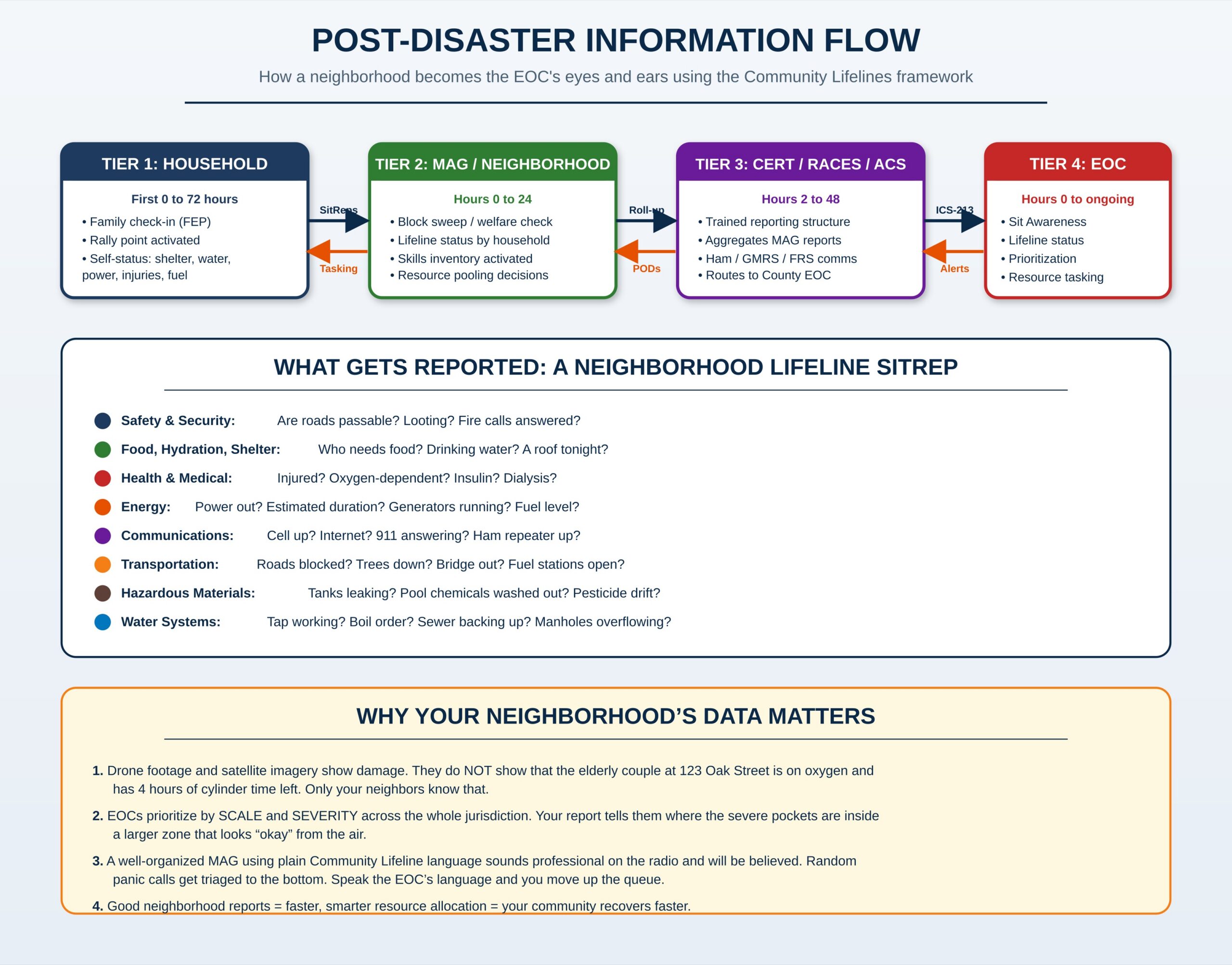
The four-tier information flow from individual household through MAG to organized volunteer comms cadres to the local EOC.
The Four Tiers
Tier 1: The Household
Within the first minutes to hours, every household runs an internal lifeline self-assessment. The Family Emergency Plan (FEP) is the working document. PACE communications (Primary, Alternate, Contingency, Emergency) are activated. Family members are accounted for at the primary rally point or on the route to it. Household status — injuries, structural integrity, utility status, immediate needs — is captured. The household is now ready to be a data source for the next tier up.
The most useful thing a household can do at this tier is to be honest about its own status. Underreporting (“we’re fine” when there’s a real medical issue) is a leading cause of preventable deaths in extended disasters. Overreporting (“we need rescue” when you need a tarp) clogs the system. Accurate status matters.
Tier 2: The MAG or Block
Within hours, the MAG or organized block runs the lifeline sweep covered in Section 3. One or two designated people compile the results. The reporting structure is decided in advance, before the disaster, so nobody is figuring it out under stress.
A MAG operates somewhere between a household and a formal volunteer organization. It is small enough to know everyone by name. It is big enough to have specialized roles. It is the level at which lifeline status becomes useful aggregated data — one household’s status is noise; a block’s status is signal.
Tier 3: CERT, RACES, ACS, AUXCOMM, ARES, or Equivalent
This tier is where volunteer organization meets formal emergency management. The major players:
- CERT (Community Emergency Response Teams). FEMA-supported, locally administered. Trains civilian volunteers in light search and rescue, basic disaster medicine, fire suppression, and incident organization. The CERT chain reports through the local emergency management agency.
- RACES (Radio Amateur Civil Emergency Service). A long-established program in which licensed amateur radio operators are activated by government agencies for emergency communications. RACES operators are sworn in or formally enrolled with their jurisdiction. RACES nets are reserved for emergency traffic.
- ACS (Auxiliary Communications Service). Used by some states (Pennsylvania notably). Similar to RACES in function but administered differently. Members are pre-enrolled volunteers integrated into the state EMA’s communications operations.
- AUXCOMM. A FEMA / DHS training and credentialing program for auxiliary emergency communications. Often the unifying training framework that CERT / RACES / ACS / ARES members hold individually.
- ARES (Amateur Radio Emergency Service). Sponsored by the ARRL. Volunteer amateur radio operators organized for emergency communications support, including but not limited to government activations.
These organizations have pre-established radio nets, frequencies, and reporting templates that interface directly with the local EOC. Your MAG’s sweep report enters this tier through a member who is enrolled in one of these programs, or through your local CERT lead. If your MAG has no Tier 3 connection, you should fix that — it is one of the highest-leverage gaps to close.
In Pennsylvania, the state RACES net runs on 3.997 and 7.260 LSB and 14.334 USB; the PEMA ACS net runs on 3.9935 LSB with DMR talkgroup 31420. Other states publish their own frequencies through their state EMA. If you operate ham radio and live in PA, those frequencies should be programmed into your handheld and your base before anything happens.
Tier 4: The Local Emergency Operations Center
The EOC takes all this incoming data and aggregates it by Community Lifeline. They build a picture of which lifelines are stable, which are stabilizing, which are unstable, and which are unknown across the whole jurisdiction. They then make prioritization decisions based on that picture.
A modern EOC during a major event is a noisy, focused, sometimes chaotic place. Multiple boards on the wall — one for incidents, one for lifelines, one for resources, one for political and media tracking. Section chiefs working their pieces of the puzzle. Radio traffic in the background. Coffee everywhere. The job is not to do the response. The job is to coordinate, prioritize, and support the response that other people are doing.
Why The Whole Picture Matters: Cascading Impacts
Lifelines are interconnected. The EPA and FEMA both publish dependency maps showing how one failure cascades into others. The cascades are predictable, which means they can be anticipated. A few examples worth memorizing:
- Energy fails. Within hours: water treatment plants run out of pumping capacity (Water Systems), cell towers exhaust their backup batteries (Communications), traffic signals fail (Transportation, Safety), fuel pumps stop dispensing fuel (Energy and Transportation simultaneously), refrigerated food spoils (Food, Health). A single Energy failure cascades into five other lifelines within 24 hours.
- Communications fails. Within minutes: 911 calls cannot reach dispatch (Safety, Health), responder coordination collapses, situational awareness for the EOC degrades, financial transactions stop, people cannot summon medical help. Communications failure is a force multiplier on every other failure.
- Water Systems fails. Within hours: hydration crisis (Food / Hydration), sanitation crisis with sewer backup (Water and Health), hospitals lose pressure for sterilization (Health), firefighting capacity reduced (Safety). Within days: gastrointestinal disease and the public health cliff.
- Transportation fails. Within hours: supply chains stop (Food, Health, Energy fuel), responders cannot reach scenes (Safety, Health), HAZMAT teams blocked (Hazardous Materials), evacuation impossible. Transportation failure removes the ability to respond to any other failure.
- Safety & Security fails. Looting and disorder make every other lifeline harder to deliver. Utility crews refuse to enter unsafe areas. Trucks don’t roll. Medical teams demand security escorts. The whole system slows.
This is why the EOC cares about the whole picture, not just one urgent call from one block. They are constantly weighing where the next failure is going to happen and trying to prevent it. Your neighborhood report contributes to that picture.
It also explains why the EOC’s priorities can look strange from your driveway. The crew that should be clearing the tree in front of your house is repairing a substation that powers the regional water plant. The right thing for them to do, the thing that helps the most people the fastest, is to stay on the substation. The tree is still there because the system is working as designed.
5. Why You Might Not Be a Priority (And Why That Is Okay)
This is the section most preparedness articles avoid because the message is uncomfortable. We will not avoid it. The honest reality:
In the first 12 to 72 hours of any meaningful disaster, professional emergency response is saturated. They are working off a priority list. Your house, your driveway, and your stuff are at the bottom of that list. So is your block. So is your neighborhood. This is not a failure of the system. This is the system functioning as designed.
EOC Priority Order When Resources Are Limited
Top priority is served first. Resources flow down the list only as they free up.
- 1.LIFE SAFETYImmediate threat to life. Active SAR, trapped victims, medical evacuations, fires, mass casualty.
- 2.INCIDENT STABILIZATIONStop the situation getting worse. Contain HAZMAT, suppress fires, secure damaged structures, stop floodwater spread.
- 3.CRITICAL LIFELINE NODESRestore infrastructure. Hospitals, EOCs, comms towers, water treatment plants, lift stations, key bridges.
- 4.SURVIVOR LIFELINESBasic services for the affected population. Bulk food / water / fuel, shelters, mass care, commodity points (PODs).
- 5.PROPERTY & ENVIRONMENTConserve what can still be saved. Tarping, damage limitation, environmental containment, debris reduction.
- 6.INDIVIDUAL RECOVERYGet individual households back to normal. Your house. Your driveway. Your stuff. Insurance, FEMA IA, SBA.
THE 72-HOUR GAP (AND BEYOND)
In a small local disaster, professional responders are saturated for the first 12 to 72 hours.
In a regional disaster (hurricane, earthquake, ice storm, prolonged blackout), the gap stretches to 5 to 14 days, sometimes longer.
In a black-sky event, professional response may not arrive at scale for weeks or months.
During the gap, the only people responding inside your neighborhood are the people who live there.
You are not abandoned. You are simply not yet at the top of the list. That is by design, not by accident.
Reading the Priority Cascade
The six-tier priority cascade above is universally used across emergency management, though the labels vary by jurisdiction. The pattern always holds: life safety beats stabilization, stabilization beats critical infrastructure, infrastructure beats survivor support, survivor support beats property, and property beats individual recovery.
The reason for the order is not bureaucratic. It is moral arithmetic. A finite pool of responders cannot do everything at once. They have to choose. The cascade is the formalization of choices that human beings have to make about who lives and who waits.
That means in a serious event:
- Helicopters and SAR teams go to people trapped in attics or on rooftops first. They are not going to your house to clear the tree off your driveway.
- Fire engines and ambulances respond to active fires, active medical emergencies, and HAZMAT releases first. They are not going to your house to check on you because your phone is dead.
- Utility crews restore power to hospitals, water plants, EOCs, comms towers, and 911 centers first. Your street is on the schedule, but maybe not until day 3, 7, 14, or 30.
- Bulk distribution of food, water, and fuel through Points of Distribution (PODs) is for the affected population at large. It is not delivered to your door. You have to go get it.
- FEMA Individual Assistance, SBA disaster loans, and insurance settlements come after the immediate response stabilizes. That can take weeks or months.
“You Are Your Own First Responder”
This phrase circulates in preparedness circles and it is sometimes presented as if it were grim or paranoid. It is neither. It is simply the system stating its own design honestly.
The system is not built to deliver individual rescue to every household in a serious disaster. It cannot be. The math does not work. A county with 100,000 households and 200 professional first responders cannot deliver a personal response to each household in any timeframe. So the system delivers personal response to whoever is in the worst trouble, restores the lifelines that keep the population alive, and lets households take care of themselves in the gap.
The gap is where you live. The gap is what you prep for. The gap is what your MAG handles together.
What This Actually Means For You
Translating the priority cascade into household action is straightforward once you accept the premise:
- Self-sufficiency is not extreme. It is rational. If the system is not coming for you in the first 72 hours of a local disaster, or the first two weeks of a regional disaster, the only sensible response is to be capable of taking care of yourself for that long. The PPAW walks you through how much depth is appropriate for your particular risk environment.
- Sustainment matters more than dramatic preparation. Most preppers over-invest in dramatic capability (firearms, fortifications) and under-invest in mundane sustainment (water, food, fuel, medication, sanitation). The cascade reminds you that the dramatic stuff matters far less than whether you can simply last.
- Capability without sustainment is theater. A household with the perfect bug-out bag and a 3-day food supply that runs out on day 4 is in worse shape than a household with no bug-out bag and a 30-day food supply.
- Cluster up. The single biggest force multiplier you can build is a working MAG. Going from a solo household to a 10-household MAG roughly multiplies your effective sustainment capability by 5 to 8 times, because the gaps in each member’s prep are filled by the strengths of others.
- Be useful to the system, not a drain on it. The MAGs that produce structured reports, do their own welfare checks, and stabilize themselves are the MAGs that get help fastest when help becomes available. Help flows to places where it has the highest marginal effect, and places that have already done the basic work attract more help than places that are still completely dependent.
Tying It to PREP-CON
6. Putting the Lifelines to Work
Here is a concrete operational sequence using the Lifelines framework, from blue-sky to long-tail recovery. This is the rhythm a well-prepared household and MAG should be moving through. Each phase has specific actions, and the actions are organized so that work done in one phase enables work in the next.
Blue-Sky Day (right now)
Blue-sky work is the work nobody sees in a disaster because it was all done in advance. It is also the work that determines whether you are useful or a liability when the disaster arrives. Almost everything that matters in the first 72 hours of a response was set up months or years before the event.
- Complete the PPAW assessment. Identify your gaps lifeline by lifeline.
- Complete the FEP. Make sure PACE communications, rally points, and contacts are recorded and shared with every household member.
- Identify or form a MAG of 5 to 15 households.
- Build the MAG capability matrix lifeline by lifeline. Find your gaps.
- Train one or more MAG members in ham radio, CERT, first aid / CPR / Stop-the-Bleed, and Incident Command basics (IS-100, IS-200, IS-700, IS-800; all free, online, FEMA EMI).
- Identify how your MAG’s reports will reach your local EOC. Get on the local RACES / ACS / AUXCOMM / ARES net schedule. Know the local CERT chain.
- Practice a lifeline sweep on a quiet weekend. It feels silly until it feels essential.
- Build a 30-day medication buffer, a 14-day water reserve, a 30-day food supply, a vehicle bag, and a household go-bag. None of those numbers are aspirational; they are minimums for credible preparedness.
- Walk and drive your evacuation routes. Time them. Identify chokepoints. Note the bridges, the hills that flood, the underpasses that fail.
Gray-Sky Day (threat developing or impact imminent)
This is the window when good preparedness pays compound interest. You have hours to a few days to get ready. The household that did the blue-sky work now executes a clean pre-impact sequence. The household that did not is buying the last three cases of bottled water at a sold-out store.
- PREP-CON 3 or 2. Pre-impact actions. Vehicles fueled, water containers filled, generators tested, batteries charged.
- MAG check-in: confirm everyone is reachable and in position. Run a comms test on each layer of the PACE plan.
- Monitor official alerts (Lifeline 5 subcomponent: Alerts, Warnings, Messages). NOAA Weather Radio, EAS, IPAWS, local NIXLE.
- Confirm the family knows the rally point sequence and the comms plan.
- Bring outdoor furniture in, secure projectiles, clear gutters, fill propane tanks, freeze water bottles for ice (and post-event drinking water).
- Document the house and contents on video. Walk every room, every closet, every garage. This is for insurance and FEMA IA after the event.
- Top off prescriptions if possible.
- Cash on hand. ATMs and card readers fail with comms or power.
Hour Zero (impact)
The impact phase is short, sometimes only minutes. The work here is to survive the event and account for everyone. Decisions about response come immediately after.
- Household safety first. Stay put if safe. Move to rally point if not.
- Family check-in by PACE. Account for everyone.
- Once family is accounted for, check on immediate neighbors. (The door knocks that take 10 minutes save lives.)
- If you are CERT or MAG-trained, begin the lifeline sweep on your designated area.
- Do NOT exit your home blindly. Smell for gas. Look for downed power lines. Check structural integrity at the threshold before stepping out.
First 24 Hours
The first 24 hours are where the prepared household pulls dramatically ahead of the unprepared one. The MAG that has practiced runs a sweep, generates a structured report, and starts coordinating actions while the surrounding neighborhoods are still figuring out what just happened.
- MAG lifeline sweep completed and consolidated.
- First structured report transmitted to CERT / RACES / EOC channel.
- Most urgent needs (medical, oxygen, trapped) escalated immediately.
- MAG schedule established for ongoing sweeps every 2 to 4 hours.
- Household begins logging damage and decisions in a paper journal. Time, date, observation. This becomes evidence later.
- Power, fuel, food, water inventory taken honestly. Compare against 30-day target. Identify the first deficit that will hit.
- HRW Part III (Respond) opened: documenting damage before touching anything, hazard-specific re-entry checks, food and water safety after power loss.
- If the disaster is regionally significant, expect a federal declaration to follow. Be ready to register for FEMA Individual Assistance when it opens.
Days 1 to 14 (Stabilization)
This is the longest stretch of pure response work. The acute danger is past for most households, but the long unrelenting grind of survival without normal infrastructure is just beginning. Most household and MAG failures happen in this phase, not in the acute event.
- MAG sustains lifeline reporting on a regular cadence.
- Begin the HRW Part IV (Recovery Operational): insurance claim filing, FEMA registration if a disaster is declared, contractor vetting, documentation, debris streams.
- Watch for the Disillusionment Phase: when adrenaline fades and the long recovery becomes visible, mental health declines sharply. The MAG provides social support that prevents isolation.
- Monitor lifeline status reports from the EOC (often public via local government social media, IPAWS, or local broadcast).
- Manage fuel like the rationed resource it is. Track generator runtime, vehicle trips, propane consumption. Make the reserve last to the next resupply.
- Manage hygiene and sanitation aggressively. The post-disaster public health failures (gastroenteritis, hepatitis A, skin infections) all come from this phase.
- Document everything before cleaning. Every damaged surface. Every spoiled appliance. Every ruined box of belongings. Insurance and FEMA IA both require pre-cleanup evidence.
- Watch the kids. Watch the elderly. Watch the chronically ill. The mortality during the Disillusionment Phase comes from the marginal, not the immediately injured.
Weeks 2 to 12 and Beyond (Recovery)
Recovery is the longest and least dramatic phase. It is also where most disaster losses are decided, because this is where insurance claims are won or lost, where FEMA and SBA applications succeed or fail, where contractor fraud either gets caught or gets cashed, and where households either rebuild stronger or rebuild back to the same vulnerability.
- Insurance claims, public adjuster decisions, mortgage company endorsement of insurance checks, contractor selection. (HRW Part IV: contractor vetting worksheet, public adjusters section.)
- FEMA Individual Assistance, SBA disaster loans, Disaster Unemployment Assistance. (HRW Part IV: FEMA IA walkthrough, SBA section, DUA section.)
- Replacing vital documents lost in the event. (HRW Part IV: vital records replacement section.)
- Mitigation upgrades during the rebuild (Hazard Mitigation Grant Program, build-back-better choices). (HRW Part IV: mitigation upgrade worksheet, HMGP section.)
- MAG debrief and lessons learned. Update PPAW and FEP based on what you actually saw in the event.
- Tax considerations for casualty losses, particularly in federally declared disaster areas.
- Long-term medical follow-up for any injuries sustained during the event, including delayed onset issues like mold exposure or PTSD.
Do These Five Things This Week — Household Edition
If the article moved you and you do not know where to start, start here. None of these require a single purchase. All of them move you out of the noise and into the prepared cohort.
- Take stock honestly. Count your stored water in gallons. Count your stored food in days. Count your medication in days. Write the numbers down. Do not estimate.
- Pick your top three lifeline gaps. Of the eight lifelines, which three are you weakest on? Those are your priorities for the next 90 days. Not the most expensive ones. The weakest ones.
- Have the family conversation. One meal. Rally points. PACE communications. Who picks up the kids if you cannot. What happens if you do not come home. Twenty minutes.
- Walk your block. Identify the three to five households you would trust in an emergency. Wave hello. Introduce yourself if you have not. You are scouting your future MAG.
- Subscribe to one signal source. NOAA Weather Radio, NIXLE, the local OEM social feed, or the FFTP Daily Threat Report. Pick one. Read it daily for a week. Notice what changes in your awareness.
7. Closing Thought
The Community Lifelines framework was designed by federal emergency managers for federal emergency managers. The bureaucratic origin sometimes makes preppers and self-reliance-oriented people instinctively suspicious of it. That is a mistake.
The framework is just a clean, accurate map of the eight things that keep a community alive. It works just as well at the household scale as at the federal scale. It works as a planning tool, as an assessment tool, as a reporting tool, and as a recovery roadmap. It works whether you trust the government or not. It works whether you ever interact with an EOC or not.
More importantly, it is the language the people responding to your disaster will be speaking. If you, your family, and your MAG speak the same language, you become a force multiplier for the system. If you do not, you become noise the system has to filter through.
There are people in your neighborhood right now who think they are prepared because they own a generator and 30 cases of MREs. They have not thought through their water plan for week 2. They have not built a relationship with a single neighbor. They have no ham radio operator within their reach. They have no plan for what happens when the sewer system backs up. They have not opened a workbook. They have not run a drill. They have not had a conversation with their family about rally points and PACE communications. They are gambling on a small event being the only event that ever finds them. That gamble has historically been a bad one.
Do not be that person. Do not let your neighbors be that person.
Speak Community Lifelines. Build your household to be resilient against all eight. Cluster up with neighbors who do the same. Practice the sweep. Get the report up the chain. Know where you sit on the priority list and why. Bridge the gap with what you have built.
That is preparedness. That is community resilience. That is what Fortune Favors the Prepared is built to support.
The next event is already inbound somewhere. The only question is whether it finds you ready.
Make Threat Awareness Part of Your Daily Routine
The Lifelines framework is most useful when you can see disruptions coming, not just when you respond to them. The FFTP daily intelligence products give households, MAGs, and small businesses a structured read on the threat environment every single day.
Daily Threat Report (DTR): Full daily intelligence brief covering geopolitical, cyber, infrastructure, weather, public health, supply chain, and HAZMAT signals. The professional-grade version.
Daily Preparedness Brief (DPB): The short-form version. The signals that matter, distilled into a quick daily read.
The FFTP Household Resilience Suite
Four workbooks, organized around the same eight Community Lifelines you just read about. Together they cover the full disaster cycle.
- PPAW — Personal Preparedness Assessment. Identify your gaps lifeline by lifeline.
- FEP — Family Emergency Plan. PACE comms, rally points, contacts, child and pet annexes.
- HRW — Household Recovery. The day after, through months of recovery.
- NOK — Next of Kin. What happens if you do not come home.
Practitioner background: Nick Meacher, MEP, MCP, C.M. AAAE. Over thirty years in emergency management, incident command, COOP, and federal alerting.
The Continuity Chronicles
Same Operational World as the DTR. Different Lens.
The Meadow Protocol · The Brush · Unassigned Authority
Book 4 in development
thecontinuitychronicles.net