Skip to content

Fortune Favors the Prepared

Semper Paratus, Semper Gumby

Menu
  • The Continuity Chronicles
  • Daily Threat Reports
        • DAILY THREAT REPORT
        • DAILY THREAT REPORT – LITE
        • DAILY PREPAREDNESS BRIEF
        • Acronym & Abbreviations Glossary
        • DTR Source Registry
        • Area-Specific Assessment Report
        • COMMS WATCH
        • THE HOUSEHOLD BRIEF
        • FLASH REPORTS
        • SOFT TARGET SECURITY BRIEF
        • FINANCE SECTOR
        • HEALTHCARE SECTOR
        • TRANSPORTATION & LOGISTICS SECTOR
        • AI, DATA CENTER & INFRASTRUCTURE REPORT
        • CONSTRUCTION & MANUFACTURING SECTOR
        • Strategic Intelligence Supplement
  • About
        • The Why
        • Vision and Mission
        • Services
          • Business Resiliency
        • Testimonials
        • Insider
        • Friends
          • Patriot Volunteer Examiner (VE) Team
          • Angery American
          • Signal Stuff
          • Forward Observer
  • Communications
        • Stump Knocker
          • SOI
          • STUMP KNOCKER DMR UPDATES
          • MMDVM Hotspot
        • Preparedness Communications
          • What Radio Should I Get for Preparedness?
            • What Radio to Buy?
              • What Radio to Buy? – video
              • Ham Radio on a Budget
              • Live – What Radio to Buy?
              • Portable Radio Kit
              • Mobile Communications
          • Emergency Communications Principles
          • Communications Options
          • Starter Radio Paths by Preparedness Scenario
          • How Communications Fail
          • HF Communications
            • SHTF HF Communications
            • Simple Antenna Builds for HF – video
            • NVIS in Amateur Radio
        • Amateur (HAM) Radio
          • Why Do I Need a Ham License?
            • How to Obtain Your Amateur Radio License
              • Amateur Radio Learning Resources
              • Finding a Ham Exam
                • HAM Exam Accommodation
              • Getting Into Ham Radio – Video
            • Are You Expired?
            • Why You Should Upgrade to a General Ham License
          • HAM Simplex Frequency Card
          • Analog versus Digital
          • Analog vs Digital Voice: A Preparedness-Focused Comparison
          • CTCSS and DCS
          • Programming Radios with Software
          • ARES, RACES, ACS and AUXCOMM
          • Ham Radio Beyond Line-of-Sight
            • Linked Analog Repeaters
            • EchoLink and IRLP
            • AllStarLink
            • Yaesu System Fusion & WIRES-X
            • D-STAR
            • Digital Mobile Radio (DMR)
            • P25 in Amateur Radio
            • NXDN in Amateur Radio
            • Amateur Radio Satellites (AMSAT)
            • The 60-Meter Band (5 MHz)
          • Meshtastic
          • HAM VoIP
        • Personal Radio Services
          • FCC Rules for Personal Radio Services
          • Family Radio Service (FRS)
          • General Mobile Radio Service (GMRS)
            • GMRS Repeaters
            • Getting a GMRS License
            • FRS / GMRS / MURS Frequency Card
          • Multi-Use Radio Service (MURS)
          • Citizen Band (CB) Radio
            • CB Frequency Card
        • Other Radio Services
          • Communications Continuity Programs and Capabilities
          • Marine Communications
        • Cell Sites and Their Services
          • When Cell Service Fails
          • Radio over LTE and Rapid Radios
            • LTE Radio Comparison
        • Satellite Communications
          • America’s Secret Eyes
          • The Commercial Eye
          • Seeing Through Everything (SAR)
            • Remote Area Emergency Communication Devices
            • Which Beacon Should You Carry?
          • Personal Satellite Communications
        • Wired Communications
          • MAG Phone System
          • TA-312/PT Field Telephone and SB-22/PT Switchboard
          • Understanding Telephone Wiring
          • The AT&T Long Lines Program
        • Communications Planning
          • Communications Plan Annex
            • Communications P.A.C.E.
            • Finding Information for Your Communications Plan
            • Area-Specific Assessment Report
          • Automatic Link Establishment (ALE)
          • Understanding Communications Resiliency
        • Communications Resiliency Programs
          • ARES, RACES and ACS
          • Auxiliary Communications (AUXCOMM)
          • Military Auxiliary Radio System (MARS)
          • U.S. Coast Guard Auxiliary Communications
          • Civil Air Patrol Communications
          • The 60-Meter Band (5 MHz)
            • Understanding the 60-Meter Band
        • Government Communications Continuity Programs
          • Government Emergency Telecommunications Service (GETS) and Wireless Priority Service (WPS)
          • National Warning System (NAWAS)
          • National Interoperable Frequencies
          • The FEMA National Net (FNARS)
          • National Emergency Communications Network (NECN)
          • The SHARES Program
          • State Emergency Capability Using Radio Effectively (Operation SECURE)
          • The High Frequency Global Communications System (HFGCS)
          • Satellite Mutual Aid Radio Talkgroup (SMART)
          • The AT&T Long Lines Program
        • Communications & Emissions Discipline
          • Communications Security (COMSEC)
            • Book Cipher
            • One Time Pads (OTP)
              • Decrypting One Time Pad Message
              • One Time Pads (OTP) Live Video
              • One Time Pad Training
          • Cryptographic Security (CRYPTOSEC)
          • Transmission Security (TRANSEC)
          • Communications Transmission Discipline (TRANSDISC)
          • Emissions Control (EMCON)
          • Communications & Emissions Training Framework
        • DMR Programming
          • DMR Programming – Talk Groups
          • DMR Programming - Roaming
          • MMDVM and Yaesu System Fusion (YSF)
          • Encryption in DMR Radios
        • Digital Mobile Radio (DMR) Networks
          • WR3IRS Interstate DMR Network
            • South Central PA (SC PA)
            • North East PA (NE PA)
            • Washington-Baltimore (W-B)
            • West Central Florida (WCF)
          • Florida Digital Amateur Radio Network (F-DARN)
          • Southeast Florida DMR Repeater Network W2GGI
          • Virginia DMR (DMRVA)
          • NC PRN DMR Network
          • SC Hospital Emergency Amateur Radio Team (SCHEART)
          • HEARS – Hospital Emergency Amateur Radio System
          • New England Digital Emergency Communications Network (NEDECN)
        • Baofeng/BTECH Radios Quick Guide
          • Manually Programming a Baofeng Radio – Video
          • A User’s User Manual for Baofeng Radios
        • MESSAGES & REPORTS
          • Phonetics
          • Procedure Words (Prowords)
          • Date Time Group (DTG)
          • NTS Radiogram Form
            • ARL Numbered Radiograms
          • SALUTE, SPOT, and SALT Reports
          • ACE/LACE Reports
          • GOTWA Report
          • CASREP (Casualty Report) Format
          • MEDEVAC Request Report
          • Formatted Messages (downloads)
        • Communications Knowledge Library
          • Communications Resiliency
          • Radio Etiquette, Jargon, and Best Practices
          • AmRRON RESOURCES & REFERENCES
          • Anytone Programmable Keys
          • Phonetics
          • Amateur Radio Colorado
            • Colorado Linked Repeater Systems
        • COMMUNICATIONS REFERENCES
  • Planning
        • Family Emergency Plan – The Basics
          • Family Emergency Plan
            • Area-Specific Assessment Report
          • Why Every Family Needs an Emergency Plan
        • Family Contingency Binder
          • Family Contingency Binder MindMap
        • Triggers
          • Preparedness Conditions – PREP-CON
            • Preparedness Conditions (PREP-CON) MindMap
          • Space Weather
        • Family Emergency Plan Workbook
          • Family Emergency Plan Workbook - owner resources
            • Area-Specific Assessment Report
            • Family Emergency Planning Form
            • Communications Plan
              • P.A.C.E.
            • Emergency Evacuation
            • Emergency Food Supplies
            • Family Contingency Binder
            • Message Drops
            • Get Home Bag
            • Bug Out Bag & Bins
            • Miscellaneous
        • Household Recovery Workbook
          • Disaster Debris — What to Do at the Curb
        • Next of Kin Workbook
        • METT-TC: Decision Discipline
          • METT-TC - tactical planning
        • Planning Your Preps
          • Charity in Planning
        • Mutual Assistance Group
          • Mutual Assistance Groups (MAGs): Skills, Vetting, and Building Real Resilience
          • Mutual Assistance Group (MAG): Recruitment Code of Conduct
          • MAG: Private Vetting & Intake Process
          • Compartmentalization in Mutual Assistance Groups (MAGs)
          • Resiliency Index
          • Continuity of Government & Application to MAGs
  • Threat Assessment
        • Personal Preparedness Assessment Workbook
          • Personal Preparedness Assessment Report
          • Personal Preparedness Assessment Workbook - owner resources
        • Readiness Conditions for Preparedness
          • PREP-CON - Preparedness Conditions
          • COMCON – Communications Readiness Condition
          • CONCON – Civilian Continuity Conditions
        • Readiness Conditions – Hierarchy and Relationships
          • LERTCON – Alert Condition
          • DEFCON – Defense Readiness Condition
          • COGCON - Continuity of Government
          • INFOCON – Information Operations Condition
          • FPCON – Force Protection Condition
          • EMERCON – Emergency Condition
          • CYBERCON – Cyber Readiness Conditions
          • CPCON – Cyberspace Protection Condition
          • WATCHCON – Watch Condition
          • SIPRNet – Secret Internet Protocol Router Network
          • REDCON – Readiness Condition
          • NC3CON – Nuclear Command, Control, and Communications
        • Readiness Conditions in The Conspiracy Chronicles
          • CERCON – Cerberus Readiness Condition
          • COMCON – Communications Readiness Condition
          • C-OPS – CERBERUS Operational Status Conditions
          • CONCON – Civilian Continuity Conditions
        • Being Prepared for Civil Unrest
          • Civil Unrest – Area Intelligence
          • Civil Unrest – Be Prepared
          • Civil Unrest – Defense
          • Civil Unrest – Defense (part 2)
        • Staying Informed Before, During and After Emergencies
          • Weather Awareness
          • Space Weather
        • Area Intelligence
          • Area-Specific Assessment Report
        • National Power Grid
  • Intelligence
        • ANALYSIS, TRADECRAFT & REPORTING
          • Understanding Intelligence Analysis Tools
            • Understanding Analysis of Competing Hypotheses (ACH)
              • ANALYSIS OF COMPETING HYPOTHESES (ACH) - TRAINING CURRICULUM
            • Understanding MDCOA
            • Understanding OAKOC
        • Operations Security (OPSEC)
          • OPSEC for Teens
          • OPSEC for Kids
          • The Gray Man
          • OPSEC: Don't Become the Target
          • Counterintelligence Tradecraft for the Prepared
        • Community Intelligence
          • Area Intelligence – Now!
            • Area-Specific Assessment Report
          • Community SITREP
          • Radio Traffic Situational Analysis During Emergencies
            • Radio Traffic Situational Analysis (RTSA) -TRAINING CURRICULUM
          • SALUTE, SPOT, and SALT Reports
        • ELECTRONIC THREAT & SURVEILLANCE
          • Staying Informed Before, During and After Emergencies
          • Integrated Public Alert and Warning System (IPAWS)
          • Communications Continuity Programs and Capabilities
          • Short Wave Scanning
          • America’s Secret Eyes
          • The Five Eyes Satellite Intelligence Network
          • Seeing Through Everything (SAR)
            • Which Beacon Should You Carry?
          • Wireless Recon Devices
        • INTELLIGENCE DISCIPLINES
          • Communications Intelligence (COMINT)
          • Electronic Intelligence (ELINT)
          • Tactical Electronic Intelligence (TACELINT)
          • Signals Intelligence (SIGINT) – the basics (2020)
          • Signals Intelligence – Information Gathering Basics (2022)
          • Signals Intelligence (SIGINT)
          • Technical & Infrastructure Intelligence (TECHINT)
          • Electronic Counter-Surveillance
          • Open-Source Intelligence (OSINT)
            • How to Conduct a Daily Threat Analysis Using OSINT
          • Measurement and Signature Intelligence (MASINT)
          • Electronic Surveillance (ES)
          • Overhead Imagery & Geospatial Intelligence (IMINT / GEOINT)
        • INTELLIGENCE REFERENCES
  • Medical
        • Medical Training
          • Patient Assessment & Casualty Management
            • MARCH-PAWS Rapid Assessment
              • MARCH-PAWS TRAINING CURRICULUM
            • DCAP-BTLS – Secondary Trauma Assessment
            • SAMPLE + OPQRST Secondary Assessment
              • Medical History as a Preparedness Skill
                • Medical History as a Preparedness Skill – TRAINING CURRICULUM
            • START Triage
            • MEDEVAC Request Report
            • Patient Assessment – Documentation
              • Patient Care Report Forms
              • CASREP (Casualty Report) Format
        • Medical Kits
          • Individual First Aid Kit (IFAK)
          • BooBoo and IFAK Kits Video
          • BooBoo & IFAK Kit Mind Map
          • Large Kit - video
        • Medical Myths
          • Medical Myths – Tampons
          • Medical Myths – Ingested Poisoning
        • MEDICAL REFERENCES
  • Transportation
    • Transportation Plan B
    • Improvised Transportation
    • Preparedness For Winter Travel
  • Animals
    • Preparedness for Pets
  • Food
        • Why You Should Start a Food Storage Plan
        • Food Storage Quick Start
        • Buying in Bulk
        • Inventory Tracking
        • FOOD PRESERVATION RESOURCES
  • Water
  • Power
        • Power Grid
        • UPS
  • Bags etc.
        • Bug Out versus Get Home Bags
        • Get Home Bag – Contents
          • Get Home Bag – video
          • Get Home and Bug Out Bags - video from live 2-10
  • Navigation & Signalling
        • Sketched Strip Map
        • Emergency Signaling
        • Covert Signals
        • Which Emergency Beacon Should You Carry?
  • References
        • PLANNING & OPERATIONS
        • SECURITY OPERATIONS
        • INTELLIGENCE
        • CRYPTOLOGY
        • COMMUNICATIONS
        • REPORTING FORMATS
        • GENERAL/MISC
        • MEDICAL
        • FOOD PRESERVATION
        • CRITICAL INFRASTRUCTURE
        • SURVIVAL MANUALS
        • OPSEC
        • COUNTER INSURGENCY & CIVIL DISTURBANCE
        • EMP / CME
        • Training
          • Training Videos
          • One Time Pad (OTP) Exercises
            • 45662
            • 222135ZDEC22
  • Blog
    • Boomer
      • Day 1 – The Journey Home
      • Day 2 – First Day in the New Home
      • Day 3 – More Training
      • Day 4 – Dad Goes Back to Work
      • Day 5 – A Day at Home with More Training with Dad (Boomer’s version)
      • Day 6 – More Training with Dad at Home
      • Day 7 – Dad Goes Back to Work, Boring Day
    • Mountain Readiness Fallout Workshops
    • Mapping DMR Repeaters
    • COMMUNICATIONS RESILIENCY
    • Getting The Message Through
    • What are you preparing for?
    • Never Let an Opportunity Go To Waste
    • Consequences
    • DO NOT REPLY
    • Space Weather Warning
    • Good, and Sad, News
    • Necessity vs. Luxury
    • Don’t Put off Until Tomorrow
    • No Plan Survives First Contact
    • Threat and Hazard Identification and Risk Assessment (THIRA)
    • Live – What Radio to Buy?
    • Big Daddy Unlimited Affiliate
    • Food – Tue 16th 7pm MST
    • Live from 2021-2-3
    • Live 2021-01-26
    • FLASH SALE
    • Live 2021-01-11
    • What Is Freedom?
    • Preparedness for Pets
    • What If The Lights Go Out?
    • Hoarding or Prepping?
    • Why Do I Need a Ham License?
    • How Bad is the SolarWinds Orion Issue?
    • How To Begin Prepping
    • Members Only Live Videos
    • Live 11/24
    • Ham Radio VoIP Phone
    • Training Calendar
    • A Chat (with some whisky)
    • Blog 2020 11 02
    • Live with Charlie Hogwood
    • EARTH EX 2020
    • A Live with Angery American
    • Have You Woken Up Yet?
    • BUG OUT READY
    • The Gray Man
    • Area Intelligence – Now!
    • Being Prepared for Civil Unrest
    • It Depends
    • The Art of Being Prepared – The New Prepper
    • Get Home versus Bug Out Bags
    • Why You Need an IFAK AND Training
  • Shop
  • Contact
    • Mailing List
  • Media and Press
Menu

Inventory Tracking

While this article was originally written to address food storage the principles apply to any and all of our preparedness supplies.
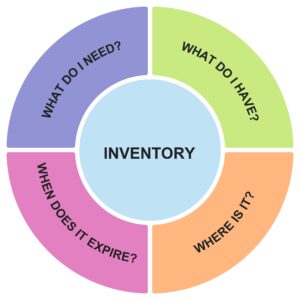
If you have already started a food storage program then you probably know that after a short time you lose track of what you have, what expires when, and what you need to get.  Heck, most of us, if we don’t go to the store with a shopping list, forget at least one item – some of us forget what we go into another room for!  Others, especially if you go to one of the bulk stores, come out with more than we planned to get!  Well, one is none right?   At least that what we tell our significant other when we come home from the gun show with two new guns ?

There are a lot of different ways to keep inventory.  You need to figure out what information you want to keep track of.  Some of this is going to depend on the types of food you store.  For example; do you have all pre-packaged food, do you buy bulk and repack into your own mylar bags, do you use all the same size bags or different ones, do you can your own foods?  You obviously want to be able to quickly see how much inventory you have of an item.

Note Book or Binder

Your inventory system can be as simple as a note book, perhaps with a page for each type of food, a column for when you add something, and the expiration date, or expected shelf life.  You could use a 3-ring binder with tabs, which makes it easy to add pages as it fills up. Obviously the larger your inventory the more difficult, or at least labor intensive, this is to start.  If you have supplies at different locations you want to keep track of what is where, so this adds another layer of complexity to your organization.

Excel Spread Sheets

Another method is to use a spread sheet, such as Excel.  If you have a basic understanding of Excel it is easy to create a column for a different packaging, date packaged, expected expiration, etc.  A simple formula can keep your total inventory, using a negative number when you use a package.  You could use a tab for different categories of items, such as grains, beans, legumes, etc.  You could use another tab for each different location or use a column in the current sheet, which would give you total supplies by location within each tab.  The advantage with an Excel spread sheet is that you can incorporate it with a goal list of items (different food types, etc.) based on some of the recommended quantities you can find on sites like Provident Living and Survival Mom, most of which are based on recommendations from The Church of Latter-Day Saints.

There are some ready-made spread sheet inventory programs in Excel available on the web at such sites like Prepared Housewives (has a review of a number of different spread sheet inventory programs) and Seniors Mess.  The advantage is that someone has done the development work for you, the disadvantage is that it’s someone else’s way to inventory.  If you have a basic understanding of Excel I’d encourage you to look at how other people are doing it, see if you like it, or take the ideas that you like and make your own.  This has advantages especially if you can food as most of the ones I’ve seen don’t account for canning or gardens. 

The list at Food Storage Made Easy is premised on a 3-month supply and recipes. It shows how much you have and how much you need.  It doesn’t appear to account for expiration dates or different storage locations.  They have another spread sheet at http://foodstoragemadeeasy.net/babysteps/step-4-long-term-food-storage-planning/  that is designed for long term storage.

Obviously, you should print out your sheets and put them in a binder, so you have a hard copy.  If you have different locations, then you should have a copy of what is at each location at that location.

Out of the Box Solutions

There are a number of inventory programs on the market, most are designed for restaurant inventory’s.  These is one that I’ve found that was designed for personal preparedness, Survival Stores by www.419systems.com.  From what I understand the program was originally designed to encourage people to create a family emergency plan.  The program comes with a basic database of supplies and categories.  You can add to this.  The program allows you to create an item together with it’s expiration.  You can also add a new item as you are adding it to inventory.  You can add multiple locations and indicate when various quantities of each item are stored, whether various locations in your house, or different locations.  The program also allows you to use a bar code scanner, which you can find one on Amazon and similar stores for about $25.  You scan the items bar code in the inventory database and thereon you can scan an item to add to inventory.  You can also save a picture in the inventory database.  The program also runs off a USB, so you are not limited to a single computer installation.  There is the ability to print inventories but I’m a little disappointed with that feature of the program, it could use some work, such as a csv output format.  However, for only $35 it’s not bad.  When you first get the program you do need to take some time to figure out how the various databases and lists work together, then how you want to list items and create the item database before you start adding inventory.

One of the first things you need to modify or update are the basic database lists, seen in the drop down box, such as address types, list types, location types.

I’ve only used this program for about 12 months but I do have some friends how have used this program for a number of years.  If you spend a little time setting it up before you start inventorying it’s a useful way to keep track of a large quantity of supplies, when you stored them, their storage life and where you have them stored.

Then you update item types.  Such as; canning supplies, medical, books, etc.

Then each one of the item types can have sub types.

I point these out because if you don’t give some thought to this before you start adding items you can create yourself a mess which takes some work to undo (yup I learnt the hard way!).

I would STRONGLY recommend NOT using any app on your smart phone to maintain an inventory with.

It’s Not Just Beans

While we are primarily talking about tracking inventory for food we should remember there are other items a good prepper should have in stock, such as fuel, toilet paper, batteries, candles, toilet paper, hands tools, first aid and medical supplies, toilet paper, radios, seeds, ammunition and toilet paper, etc.

We should have a list of the quantities of each we think we should have and what we have. 

I’m working on an Excel inventory tracking program and I’ll share with Patrons once it is finished.

Groups

If you are part of a group you might have individual inventories or you might have a couple of people who are your ‘logistics specialists’ who keep a master inventory, or an inventory of group items, like large water filtration systems, generators, solar kits, group kitchen/cooking equipment, etc.

Final Thoughts

If you are serious about being prepared you need to know what you need, you also need to know what you have, otherwise you don’t know what you need to get.  Keeping an inventory should be part of your preparedness planning so you can be smart at what you buy and need.

I served 7 years on an Incident Management Team in the logistics section. I’m an instructor for the FMEA Logistics Section Chief as well as the Supply Unit Leader programs. I’m in the process of writing another article on logistics and tracking supplies and equipment.

Remember, Fortune Favors the Prepared

Login with Patreon

Login with Patreon

Search Site

Products

  • Workbook Bundle - Patreon Workbook Bundle - Patreon $87.80 Original price was: $87.80.$74.95Current price is: $74.95.
  • Workbook Bundle Workbook Bundle $109.80 Original price was: $109.80.$92.95Current price is: $92.95.
  • Family Emergency Plan and Household Recovery Workbooks - Patreon Family Emergency Plan and Household Recovery Workbooks - Patreon $34.95
  • Family Emergency Plan and Household Recovery Workbooks Family Emergency Plan and Household Recovery Workbooks $54.90 Original price was: $54.90.$49.95Current price is: $49.95.
  • Household Recovery Workbook Household Recovery Workbook $29.95
  • The Continuity Chronicles Seal Decal The Continuity Chronicles Seal Decal $5.00 Original price was: $5.00.$3.00Current price is: $3.00.
  • Family Emergency Plan Workbook - Patreon Family Emergency Plan Workbook - Patreon $19.95
  • Personal Preparedness Assessment Workbook - Patreon Personal Preparedness Assessment Workbook - Patreon $19.95
  • The Next of Kin Workbook - Patreon The Next of Kin Workbook - Patreon $23.95
  • Personal Preparedness Assessment Report Personal Preparedness Assessment Report $179.95
  • Family Emergency Plan + Next of Kin Workbooks Family Emergency Plan + Next of Kin Workbooks $59.95 Original price was: $59.95.$49.95Current price is: $49.95.
  • The Next of Kin Workbook The Next of Kin Workbook $29.95
  • ASAR — 50 Mile Radius ASAR — 50 Mile Radius $139.95
  • ASAR 50-MILE + FAMILY EMERGENCY PLAN WORKBOOK ASAR 50-MILE + FAMILY EMERGENCY PLAN WORKBOOK $169.95
  • ASAR — 50 Mile Radius - Patreon ASAR — 50 Mile Radius - Patreon $39.95
  • THE COMPLETE LIBRARY BUNDLE THE COMPLETE LIBRARY BUNDLE $109.38 Original price was: $109.38.$85.00Current price is: $85.00.
  • THE SERIES STARTER BUNDLE THE SERIES STARTER BUNDLE $29.98 Original price was: $29.98.$22.49Current price is: $22.49.
  • THE GATEWAY BUNDLE THE GATEWAY BUNDLE $38.94 Original price was: $38.94.$30.95Current price is: $30.95.
  • The Brush - paperback The Brush - paperback $15.99
  • The Meadow Protocol - paperback The Meadow Protocol - paperback $13.95

Cart

©2026 Fortune Favors the Prepared | Built using WordPress and Responsive Blogily theme by Superb