General Mobile Radio Service (GMRS): The Complete Guide
The General Mobile Radio Service (GMRS) sits in a sweet spot for households and Mutual Assistance Groups (MAGs): more power and range than a Family Radio Service (FRS) radio, a license that’s cheap and covers your whole family, and a growing network of repeaters that can turn a five-mile radio into a fifty-mile one. This guide pulls together everything you need to get licensed, understand the rules, pick your channels, and think seriously about repeaters — including the legal limits most people get wrong.
- What Is GMRS, and Who Can Use It
- Getting Your GMRS License
- Rules of the Road: Prohibited Uses & Identification
- Equipment Certification: What’s Actually Legal to Use
- GMRS Channels, Frequencies & Power Limits
- Repeaters: Building Real Range
- The Repeater-Linking Question (and Why It’s Illegal)
- Building GMRS Into Your Comms Plan
- OPSEC & COMSEC on GMRS
- Reference Downloads
1. What Is GMRS, and Who Can Use It
GMRS is regulated under 47 CFR Part 95, Subpart E, and unlike FRS it requires a license. That license is inexpensive by ham-radio standards: $35, valid for 10 years, no test required. You must be 18 years old to hold one.
The best part for a household or MAG is who the license covers. Under §95.1705(c)(2), a single GMRS license authorizes the licensee’s immediate family to operate under it — spouse, children, grandchildren, stepchildren, parents, grandparents, stepparents, brothers, sisters, aunts, uncles, nieces, nephews, and in-laws. One license, one $35 fee, and everyone under that definition can key up legally.
GMRS was built around the household, not the individual operator — which is exactly why it fits so well into a family or MAG communications plan. If your MAG spans multiple households, remember that GMRS licensing only extends to immediate family as defined above; it does not cover unrelated neighbors or MAG members outside that definition. Each household should hold its own license.
2. Getting Your GMRS License
Getting licensed is a paperwork exercise, not a test. Here’s the process:
- Get an FCC Registration Number (FRN). If you already hold an Amateur Radio license, you already have one and can skip this step. If not, go to the FCC’s Registration System (CORES) and click Register.
- Log in to the FCC License Manager. Once you have your FRN, log in at the FCC License Manager. You’ll see any licenses already tied to your FRN.
- Apply for a new license. Click “New License” in the upper left.
- Select GMRS. Scroll the service drop-down to the bottom for ZA – General Mobile Radio Service, then click Continue.
- Answer the qualifying questions. For nearly everyone these are all “No.” Click Continue.
- Complete the information screen and pay the fee. Your call sign is issued once payment clears.
Once you have your call sign, every person transmitting under your license identifies with that call sign, and it’s good practice to add a unit designator after it — “unit 1,” “unit 2” — when more than one person in the household is using it.
3. Rules of the Road: Prohibited Uses & Identification
GMRS shares the same baseline prohibitions as the other Personal Radio Services under §95.333, plus a GMRS-specific set under §95.1733(a). Between the two, you may not:
- Use the service in connection with any activity that violates federal, state, or local law
- Transmit advertisements or broadcast-style program material
- Transmit messages for hire or operate as a common carrier
- Intentionally interfere with another station’s communications
- Transmit obscene, profane, or indecent language
- Transmit false or deceptive communications
- Use coded messages or messages with hidden meaning — though the rule explicitly carves out “10 codes” as permissible
That last point matters for MAG planning: brevity codes and prowords are fine; anything designed to conceal the meaning of a message from a listener is not. If your group needs genuine message security, that’s a COMSEC problem, not a GMRS problem — see the callout below.
Station Identification (§95.1751)
Every GMRS station identifies with its FCC-assigned call sign:
- At the end of a single transmission or a series of transmissions
- At least once every 15 minutes during a transmission or series of transmissions running longer than 15 minutes
- Using voice in English, or international Morse code with an audible tone
A repeater itself doesn’t need to identify separately, provided the users keying through it are identifying properly — the obligation lives with the operator, not the box on the hill.
4. Equipment Certification: What’s Actually Legal to Use
Every GMRS transmitter must be certified for GMRS use under §95.1761, and this is one of the clearest, most explicit equipment rules in Part 95. The regulation doesn’t just require certification in the abstract — it names the specific problem:
“No GMRS transmitter will be certified for use in the GMRS if it is equipped with the capabilities to operate in services that do not require equipment certification, such as the Amateur Radio Service.” — §95.1761(c)
That sentence exists specifically because of radios like the ones below. It means a radio with amateur-band transmit capability cannot be certified for GMRS, ever, by definition — not “usually isn’t,” not “depends on the model.” If it can transmit on the ham bands, it is disqualified from GMRS certification as a matter of rule text, independent of anything else about the radio.
Radios That Can Transmit on Multiple Services ≠ Radios That Are Authorized to
A specific, common class of radio sits at the center of this: wide-band amateur handhelds and mobiles built around true VFO tuning rather than a locked channel list. The Baofeng UV-5R is the best-known example; AnyTone’s popular DMR/analog radios (the AT-D878UV and similar) work the same way, as do a number of other imports. That flexibility means the hardware is physically capable of transmitting on MURS, FRS/GMRS, and a wide range of Part 90 land-mobile and business-band frequencies — including the nationally-designated interoperability calling channels public safety agencies use for mutual aid, documented in the National Interoperability Field Operations Guide (NIFOG).
Selling a radio built this way is its own violation, separate from the certification problem. 47 CFR §2.803, backed by 47 U.S.C. §302(b) of the Communications Act, bars anyone from manufacturing, importing, shipping, marketing, selling, or offering to sell a radio frequency device that isn’t properly authorized for the services it’s capable of reaching. Part 95 makes this explicit for these services specifically: §95.591 bars selling any hand-held capable of operating under FRS and any other licensed or licensed-by-rule service, and §95.1791 specifically bars manufacturing, importing, or selling any radio capable of operating under both GMRS and FRS. The FCC has real enforcement history under the general §2.803 rule in this exact product family: in 2018 it cited Baofeng’s US importer (DA-18-801) for marketing UV-5R-series radios “capable of operating outside the scope of its equipment authorization” — in that case, beyond the frequency range and power limits of the radio’s own Part 90 grant. Different specific violation than an FRS/GMRS combo sale, same general principle: marketing a radio beyond what it’s actually authorized for is a seller/importer violation in its own right, on top of whatever the end user later does with it.
AnyTone and Baofeng get to the same problem by different roads. AnyTone’s own U.S. distributor is explicit that the AT-D878UV/868/578 series is one hardware platform sold in exactly two authorized configurations: a Part 97 amateur version and a separate Part 90 commercial version — “Part 97 compliant and Part 90 certified.” Moving between them requires connecting the radio to AnyTone’s CPS programming software and deliberately changing its “Band Mode”; it isn’t something that happens from the keypad, and it isn’t accidental. The broader frequency reach comes from the fact that it’s the same radio sold as a certified Part 90 commercial unit — the hardware has to cover Part 90’s wider land-mobile allocation, and the amateur-only firmware is simply the narrower of the two official configurations. Baofeng-type radios are frequently the opposite: many units, especially older or non-U.S.-authorized imports, transmit across that same wide range with no unlock step, no official software, and no deliberate reconfiguration required at all — wide open out of the box. Different path, same result: a radio capable of transmitting outside its authorized service, and using it there is a violation regardless of which path got it there.
Radios built for Part 90 commercial and public-safety use commonly include voice encryption (AES, DES, or similar) as a standard, legal feature for eligible business and agency licensees. That capability doesn’t carry over onto GMRS, FRS, MURS, or the amateur bands just because it’s built into the same physical radio — using it there is a separate, explicit violation on each service:
- GMRS: §95.381 bars certifying any Personal Radio Service transmitter with voice-scrambling or obscuring features (for applications filed on or after December 27, 2017). Separately, §95.1733(a)(3) prohibits coded messages or messages with hidden meaning on GMRS, with only “10-codes” carved out.
- FRS and MURS: the same §95.381 certification bar applies across all Personal Radio Services, not just GMRS, and the general §95.333 prohibition on coded or hidden-meaning messages (10-codes excepted) applies to both.
- Amateur (ham) radio: §97.113(a)(4) separately and explicitly bars “messages in codes or ciphers intended to obscure the meaning thereof.” The FCC has already considered and rejected adding an emergency-services exception to this rule (2013, RM-11699), so there’s no carve-out for MAG or disaster-response use.
Turning on a commercial radio’s encryption while operating on any of these services isn’t a gray area or an acceptable “just for our group” workaround — it’s a distinct violation on top of anything else already covered in this section.
Two Part 97 (amateur radio) provisions get cited as blanket permission to use any frequency in a genuine emergency: §97.403 (“Safety of life and protection of property”) and §97.405 (“Station in distress”). Both allow “any means of radiocommunication at its disposal” for immediate life-safety or distress communication when normal systems aren’t available. Read carefully, neither says what it’s commonly assumed to say.
- Who it covers: both sections say “an amateur station” — not “any person,” licensed or not. An unlicensed person gets no cover from either rule, in any emergency, on any frequency.
- What it most defensibly authorizes: the strongest reading of the text, and of how the FCC actually enforces Part 97, is that this relaxes ordinary operating restrictions (permitted modes, message content, procedure) for an already-licensed amateur station during a genuine emergency — not a grant of authority to transmit outside the amateur bands entirely, and not authority to exceed your own license class’s frequency privileges (a Technician using an Extra-only sub-band, for example). The FCC and ARRL’s Volunteer Monitor Program actively enforce license-class band-segment violations as a standalone infraction, with no documented emergency carve-out.
- The FCC’s own informal guidance has been inconsistent: one field response on record reportedly supported using a modified amateur radio on non-amateur frequencies in extremis, while another directly contradicted it, stating Part 97 only covers amateur frequencies. Conflicting informal statements from individual staff aren’t a reliable legal foundation to plan around.
- Part 95 (FRS, GMRS, MURS) has no equivalent provision at all. Whatever leniency exists there in a genuine emergency is a matter of FCC enforcement discretion, not a codified right.
Treat §97.403/405 as a narrow safety valve for a licensed amateur operating within the amateur service during a genuine, immediate emergency — not as a general “any frequency, any radio, any operator” emergency exception. It doesn’t cover unlicensed operators, and it doesn’t reliably cover leaving your license class’s privileges or the amateur allocation altogether.
None of the above makes these radios a bad choice — used inside their actual authorization, they’re genuinely useful, for reasons that have nothing to do with the multi-service capability discussed above:
- As amateur radios, for licensed operators. If a household or MAG member holds an amateur license, the wide-band VFO, digital (DMR) support, and dual-band coverage are real, fully legal capabilities on the ham bands — simplex, repeaters, and coordinated digital networks. For a group with several licensed hams, this is often the actual backbone of an Alternate or Contingency comms tier under a PACE plan.
- For monitoring, not transmitting. Receiving is not restricted the way transmitting is. Broad receive coverage lets a household or MAG maintain situational awareness across FRS/GMRS/MURS, weather, and other traffic on a single set — entirely legal, right up until someone keys the mic, at which point every certification and licensing rule above applies in full.
- As a standardized platform across a MAG’s amateur fleet. Shared batteries, accessories, and programming software across a group’s amateur radios is a legitimate logistics and training win. Pair them with separate, properly GMRS-certified radios (see the sourcing guidance above) for GMRS use rather than asking one radio to cover both.
- Through the actual Part 90 path, where it applies. An organization that genuinely qualifies as an eligible Part 90 entity can apply for that license and buy the manufacturer’s separately-certified Part 90 commercial configuration — the legitimate version of the same hardware platform discussed above, rather than the amateur-certified one.
The common thread: the radio’s flexibility earns its keep when it’s used inside the lane it’s actually certified and licensed for, and the rest of the kit includes a properly certified radio for each other service rather than asking one device to cover all of them.
Being able to enter a frequency into a radio’s VFO and key the mic does not mean you are authorized to transmit there. This is true across every service discussed on this site, not just GMRS:
- GMRS: requires GMRS-certified equipment and a GMRS license. An amateur-certified radio fails the certification requirement outright under §95.1761(c), regardless of whether the operator also holds a GMRS license.
- FRS: requires FRS-certified equipment under §95.561; no license, but certification is not optional and a ham-capable radio does not qualify.
- MURS: requires MURS-certified equipment under §95.2761; see the MURS Complete Guide for the same rule applied there.
- Part 90 (land mobile, business band, and public-safety interoperability channels): requires a Part 90 license tied to an eligible entity. This is not licensed-by-rule and not open to the general public. The nationally-designated interoperability calling channels in particular exist so that different agencies can reach each other during real incidents; transmitting on them without authorization isn’t just a paperwork violation, it risks stepping on communications that responders are actively relying on.
None of this means these radios are unusual or specifically suspect — wide-band VFO capability is a normal, useful feature of the amateur and commercial radios they’re actually certified for. The point is narrower and more important than any one brand: the radio’s ability to reach a frequency and the operator’s authorization to transmit on it are two completely separate questions, and a household or MAG communications plan should never treat the first as answering the second. Plan around equipment actually certified for the service you intend to operate under — see the sourcing guidance in the repeaters section below for GMRS-certified options.
5. GMRS Channels, Frequencies & Power Limits
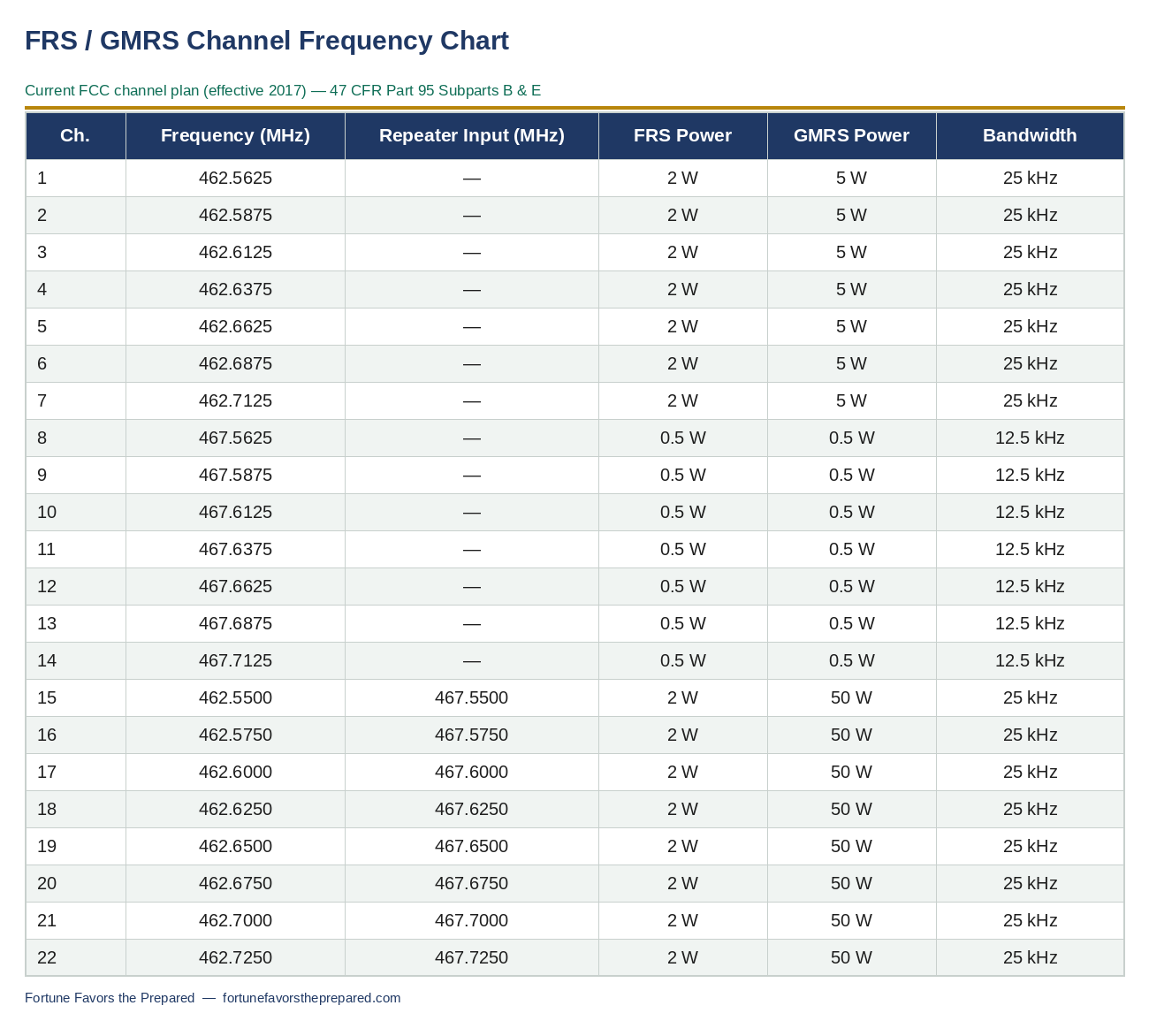
Most GMRS channels are shared with FRS; the difference is how much power you’re allowed to run and whether a channel supports a repeater.
- Channels 1–7: simplex only, up to 5 W, 25 kHz bandwidth
- Channels 8–14: simplex only, up to 0.5 W, 12.5 kHz (narrowband)
- Channels 15–22: simplex or repeater output, up to 50 W, 25 kHz bandwidth
- Eight additional repeater input frequencies pair with channels 15–22, offset +5 MHz from the output
The full channel-by-channel table — frequency, FRS power, GMRS power, and bandwidth for every channel — is in the reference downloads below, sized for printing and posting near your radio bench.
6. Repeaters: Building Real Range
A GMRS repeater is the single biggest range multiplier available to a licensed household, but it’s also the easiest project to over- or under-invest in. Budget realistically: a proper installation runs around $2,000 once you account for the repeater itself, antenna, duplexer, feedline, and mounting hardware.
The variable that actually matters is location, not gear. If you don’t have a genuinely good high site — not just your roof, but real elevation and clear line of sight — you’ll get roughly the same coverage as a simplex radio, and the project isn’t worth the money. If a good site gets you 20+ miles of coverage, it’s worth it. If it doesn’t, it isn’t.
Sourcing Equipment
Used GMRS repeater gear shows up regularly on eBay and similar marketplaces. For new equipment, several vendors sell purpose-built, Part 95E-certified GMRS repeaters:
Motorola and Vertex commercial repeaters also turn up secondhand and work well if you can find them.
Handheld radios are engineered around an 80/20 or 90/10 receive-to-transmit duty cycle and have no heat sink to shed the heat a repeater generates during extended transmit. Use a handheld as the core of a repeater and you will burn it up. Buy a radio designed for continuous duty, or a purpose-built repeater.
You’ll also need a good antenna — arguably the single most important component — and a duplexer, which lets one antenna handle transmit and receive simultaneously. Without a duplexer, run two antennas with transmit mounted above receive; since both radiate outward rather than up and down, this reduces the interference you’d otherwise get from a single co-located pair.
Off-the-Shelf “Repeater in a Box”
Midland and Retevis both sell prepackaged repeater units, typically 10 W and around $400. For comparison, a 50 W BTECH GMRS mobile radio runs about $210, and on simplex a 50 W signal simply travels farther than a 10 W one. Location still decides the outcome — a significant site advantage can close that gap — but all else equal, more power wins.
Finding & Programming Repeaters in Your Area
Load all the GMRS simplex frequencies into your radios first and use them on a rotating basis for direct communication. Then search for GMRS repeaters covering every place you and your family spend meaningful time — home, work, school, and anywhere else you go regularly.
- Create a free account at mygmrs.com. This lets you see public repeater PL (CTCSS) tones and request access to private ones.
- Program every candidate repeater into your radios.
- Test from each location you’ll actually need it — repeater owners’ estimated coverage is only an estimate, since real performance depends on terrain, whether you’re on a handheld or mobile radio, and your antenna.
- Build a simple matrix of repeater × location × result, and fold the winners into your written comms plan.
If you find yourself using someone’s repeater regularly, it’s good practice — and good community relations — to offer the owner a contribution toward its upkeep.
GMRS is also a reasonable stepping stone toward an Amateur Radio license. Teaching a family member good radio discipline on a GMRS simplex channel before they touch a repeater, and eventually a ham rig, builds habits that carry forward.
7. The Repeater-Linking Question (and Why It’s Illegal)
Some GMRS repeaters are linked to each other, and a few are bridged into Zello channels over the internet. This has been discussed in prepper and radio circles for a while, and the FCC has now weighed in directly: at an ARRL luncheon, an FCC representative was asked this exact question and answered that linking GMRS repeaters is not permitted, citing §95.1749 and §95.349 — and specifically stating that the FCC treats an IP or internet connection the same as a telephone or public switched network connection.
§95.1749 prohibits a GMRS station from connecting to a telephone line, though a repeater, base, or fixed station may connect to the public switched network solely for remote-control purposes under §95.1745.
§95.349 prohibits any Personal Radio Service station from connecting to the public switched network unless a specific service’s rules allow it.
§95.345 prohibits remote control of Personal Radio Services stations unless specifically allowed.
§95.347 prohibits automatic control of Personal Radio Services stations unless specifically allowed.
Read together, a linked repeater setup — where a “source” repeater controls a receiving repeater over an IP connection — looks a lot like remote control under §95.345, on top of the network-connection prohibition. The same logic applies to a repeater bridged through Zello: several exist, and the same rules apply to them.
The practical takeaway: don’t build your plan around linked GMRS repeaters or Zello bridges as a load-bearing part of your communications architecture. Plan your PACE structure — see COM-01 PACE Planning — around standalone, properly licensed repeaters and simplex, and treat internet-dependent options as exactly what they are: infrastructure-dependent, and not something you can count on when the infrastructure is the thing that’s down.
8. Building GMRS Into Your Comms Plan
GMRS earns a real slot in a household or MAG PACE plan — often as the Alternate or Contingency layer behind a primary method, with simplex channels as the fallback beneath a repeater. If you haven’t built that framework yet, start with COM-01 PACE Planning; it walks through how to structure Primary, Alternate, Contingency, and Emergency methods so GMRS has a defined, tested role rather than being “the radio we grabbed.”
Once you’ve identified your repeaters, tested coverage, and settled on channel and tone assignments, write it down. COM-05 ICS-205 Communications Plan covers how to document frequencies, tones, call signs, and net schedules in a standard ICS-205 format that any household member — or any MAG you’re coordinating with — can pick up and use correctly without guessing.
9. OPSEC & COMSEC on GMRS
In blue-sky, day-to-day use, nobody is trying to direction-find your repeater or your handheld. That calculus changes in a gray- or black-sky posture, and it’s worth understanding before you need it.
- Simplex is easier to DF. A direct radio-to-radio transmission gives a direction-finder a clean signal straight from your location.
- A repeater can mask your position. Since the repeater’s retransmission is normally the stronger signal, a DF operator who doesn’t know to specifically listen for the weaker repeater input may locate the repeater instead of you — and if the repeater isn’t at your primary location, that’s a useful decoy.
- Discipline still matters. In a degraded posture, use the minimum power needed and keep transmissions short, on any channel, repeater or not.
Two existing courses go deeper here. COM-04 EMCON covers minimizing your transmission signature in the first place — the discipline of when not to transmit. COM-03 COMSEC covers protecting the content of what you do transmit, which is a distinct problem from EMCON’s focus on hiding that you’re transmitting at all; GMRS privacy tones (CTCSS/DCS) do neither — they only reduce the chatter you hear, not who can hear you.
When and how far a household or MAG should shift its communications posture — from routine use toward tighter discipline — is a locally applied decision, not a fixed rule. PLN-04 PREP-CON and PLN-05 COMCON outline the general framework and reference readings; the specific triggers for your household or MAG are yours to set.
Reference Downloads
Full reference sheet (recommended): the complete channel and privacy-code tables, all manufacturers, all quirks noted — compiled by N0TFU as the official COM-05 reference sheet.
Quick-view charts for the same data, sized for a media library download or a spot on the wall next to the radio:
- FRS/GMRS Channel Frequency Chart — every current channel, frequency, FRS/GMRS power limit, repeater input, and bandwidth.
 frs-gmrs-channel-frequency-chart.png
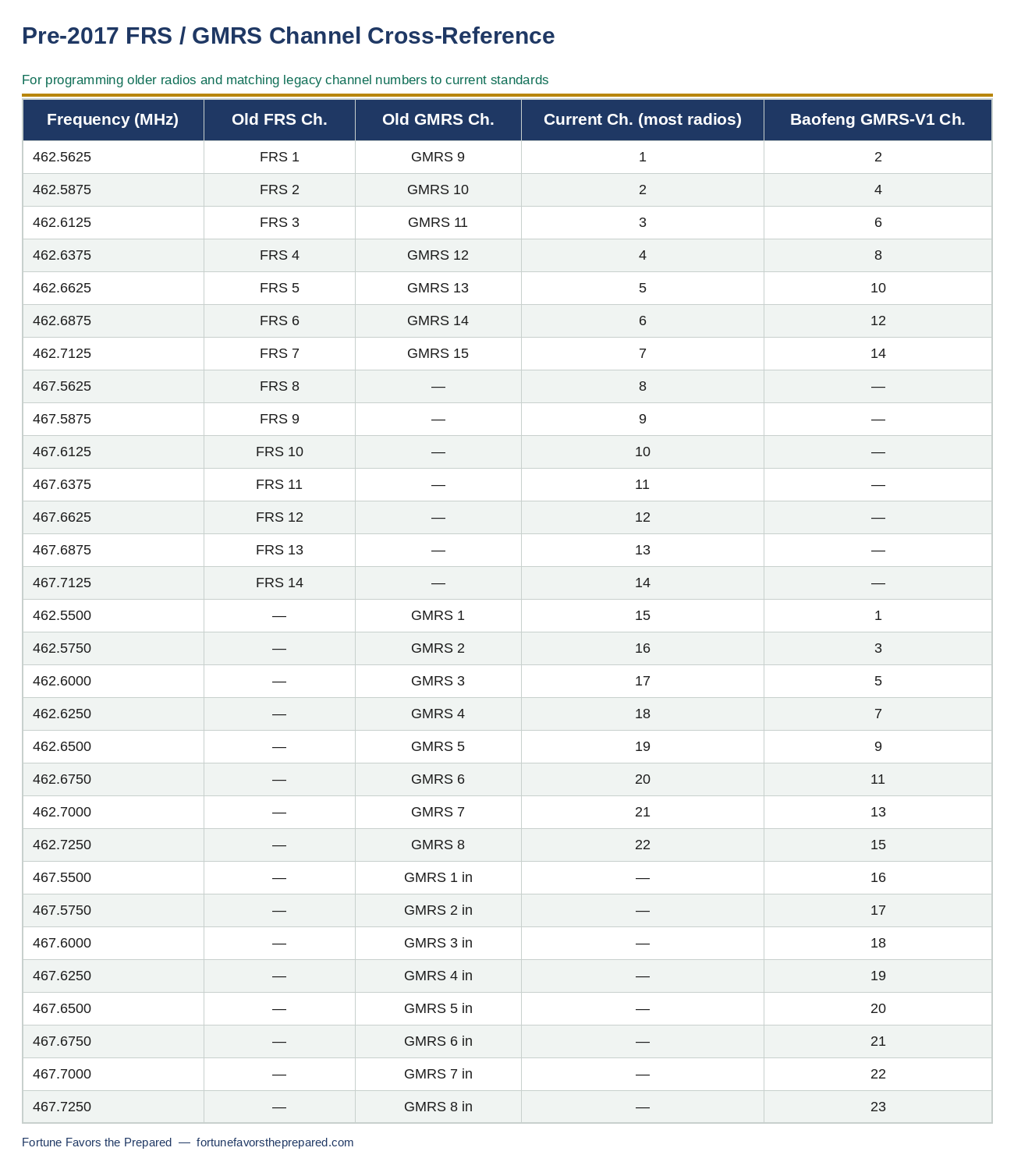
 - Pre-2017 FRS/GMRS Channel Cross-Reference — for programming older radios against current channel numbers.
 pre2017-frs-gmrs-crossreference.png
 - CTCSS & DCS Privacy Code Charts — see the FRS Complete Guide, which carries the full privacy-code tables since they apply identically to FRS and GMRS radios.
COM-01 PACE Planning · COM-03 COMSEC · COM-04 EMCON · COM-05 ICS-205 Communications Plan
Sources: 47 CFR Part 95 Subpart E; FCC ARRL luncheon remarks on GMRS repeater linking; FRS/GMRS Frequencies and Privacy Codes, compiled by N0TFU (June 2026 revision), reference sheet for FFTP COM-05. This article consolidates and updates three prior Fortune Favors the Prepared posts on GMRS rules, licensing, and repeaters.
Semper Paratus, Semper Gumby