|
FORTUNE FAVORS THE PREPARED / OPSEC & COMMUNITY RESILIENCE / JULY 2026
|

|
The Cameras
on Your Route Home
and what to ask before your town signs
There are two wrong answers to this topic. One is that you have nothing to hide. The other is that they are tracking everyone. The truth is narrower than both, and considerably more useful if you intend to do anything about it.
Odds are good there is at least one automated license plate reader between your driveway and your grocery store. Nationwide the count is above 113,000 across all vendors, with roughly 100,000 of those on a single platform operating in 49 states and more than 12,000 customer agencies. Small towns have them. Rural county roads have them. Homeowner associations buy them.
Most of the public argument about them is being fought on privacy ground. That is a legitimate fight, but it is not the only one, and it is not the one most people are actually equipped to win at a Tuesday night council meeting.
The preparedness questions are narrower and more answerable. What does the system actually collect about my household? Does it make my community measurably more resilient? What new dependencies does it create? And what happens to it under the exact conditions we are supposed to be planning for?
This piece works outward from your driveway to your town hall. Everything here comes from public reporting, court filings, academic evaluations, state and municipal audits, and the vendor's own published material. Where a claim comes from the vendor, it is labeled. Where the independent evidence is thin, that is said plainly.
What one drive-by actually creates
Start with mechanics, because a lot of the argument on both sides runs on assumption. These are solar powered, cellular connected cameras on poles. They are not recording continuous video of the street. A passing vehicle triggers a capture, and that capture becomes a record in cloud storage. The record is more detailed than most people expect and less detailed than the worst rumors.
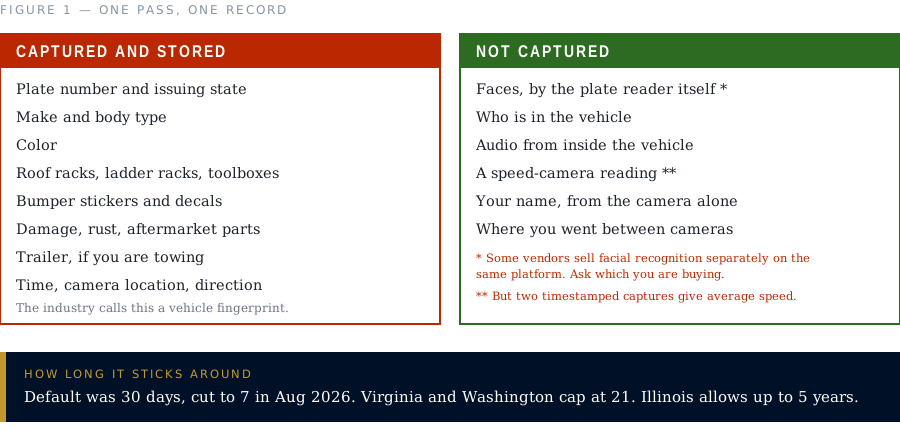
FIG 1 Check your own state. Retention is the single variable that changes everything downstream.
Two of those exclusions deserve an asterisk, and both are in the figure. A plate reader is not a speed camera, but two timestamped captures at two known locations give you an average speed by arithmetic, and filings in the Norfolk litigation describe these networks as capable of revealing how fast and in what direction a person travelled. And whether the system does facial recognition depends on whose it is, which is Section 06.
From storage, that record does three things. It gets checked against hotlists, which push real time alerts to officers for stolen vehicles, AMBER and Silver alerts, and outstanding warrants. It sits available for an authorized local user to search after the fact. And, depending entirely on how the system is configured, it may be searchable by agencies well outside your town. Hold onto that third one. Nearly every documented failure of the last two years happened there.
The real issue is not one photo
A single capture tells almost nothing. Thirty of them tell your schedule. This is what the intelligence world calls pattern of life, and it is the part a preparedness minded person should actually care about, because it accrues automatically, to everyone, without anyone deciding to look at you.
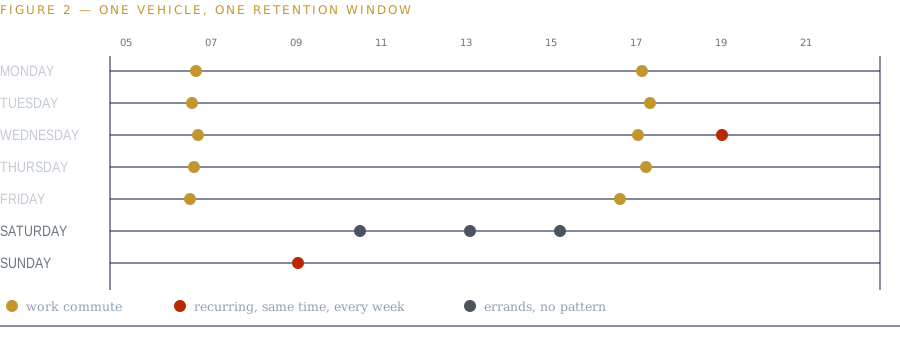
FIG 2 Illustrative, based on how these systems aggregate. The red dots are the ones that disclose something specific.
Look at what the red dots imply. Somebody has a Wednesday evening commitment and a Sunday morning commitment, both at fixed times, both reliable. That could be a church, a range night, a support group, a union meeting, a shift at a clinic, or a second job. The system does not know which and does not need to. The pattern alone is the disclosure.
None of this is unique to plate readers. Your phone gives up far more, far faster, and you carry it voluntarily. But your phone you can leave at home. Your vehicle you cannot, and the vehicle record is the one that persists in a searchable database owned by somebody else.
Does it work? Depends what you mean by work
Here is where marketing and literature diverge, and this matters whether you are weighing your own privacy or listening to a vendor pitch at a council meeting. Peer reviewed evaluation has not kept pace with deployment. The most rigorous work available says roughly this:
- Koper and Lum's study of the Charlotte Mecklenburg fixed reader network found clearance improvements for auto theft and robbery, but those improvements were not statistically significant in multivariate analysis, and other factors may have driven the change.
- A quasi randomized hot spot patrol trial found little clear evidence that readers enhance the deterrent effect of patrol presence.
- An evaluation of a major expansion in Atlantic City, New Jersey, a barrier island where every entrance and exit could be covered and therefore close to a best case deployment, concluded that evidence for crime reduction remains scant.
- Reviews of real time crime center technology consistently find gains in coordination and situational awareness, but no established causal link to crime reduction.
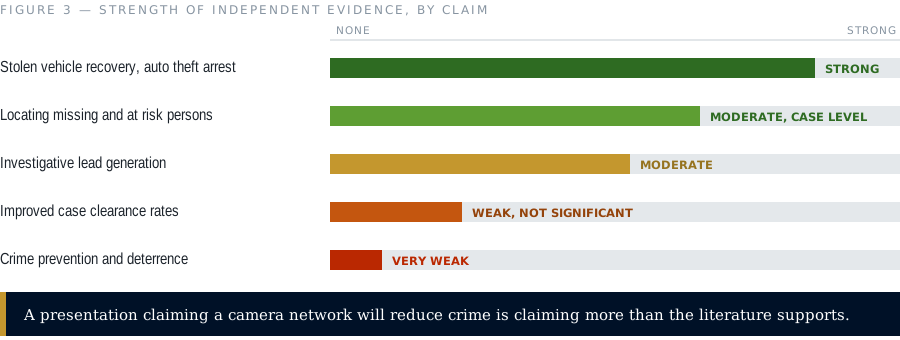
FIG 3 Ratings reflect peer reviewed and government evaluation literature, not vendor commissioned studies.
Worth stating plainly, because it cuts both ways: the strong end of that chart is real. If somebody takes your truck with your tools and recovery gear in the bed, this is the tool most likely to get it back. If an aging parent with dementia drives off, or a newly licensed kid does not come home, this is the system that would be looking for that vehicle. The vendor reports its technology contributed to reuniting more than 10,000 missing people in 2025, a self reported figure, but the individual cases behind it are verifiable and numerous.
What has actually gone wrong
Preparedness work is failure mode analysis. So set aside what could theoretically happen and look at what has been documented, because the record is now substantial enough to reason from.
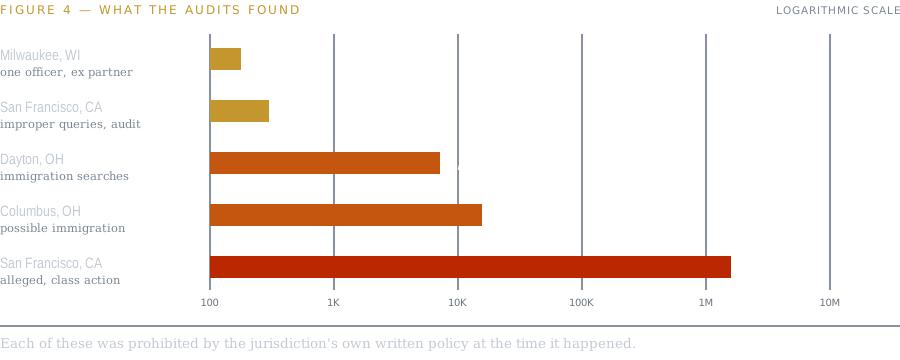
FIG 4 Log scale, so bars are not visually proportional. The 1.6 million figure is an allegation in pending litigation, not a finding.
Sharing beyond what anyone approved
Dayton, Ohio audited its own system in May 2026 and found its camera data had been searched more than 7,100 times for immigration enforcement purposes, which its own written policy prohibited. Unable to exit the contract immediately, city workers put trash bags over 72 cameras. Columbus found up to 15,577 possible immigration related searches. Mountain View, California discovered a statewide lookup setting had been switched on for 29 of its 30 cameras since installation, and terminated unanimously. Illinois, auditing after Texas investigators used Illinois data to search for a woman who had obtained abortion care, found federal access running through a pilot program the vendor said its own leadership did not know about, and stripped 47 agencies of access.
Insider misuse
Access controls fail at the human layer. A former Milwaukee officer was criminally charged after searching the system 179 times to track an ex girlfriend, and a second officer was later investigated. A former Georgia police chief was arrested on charges including stalking and six counts of illegal use of plate reader data. Five Albany, Georgia officers were terminated and arrested in July 2026 after an internal audit documented searches unrelated to any legitimate investigation. Reporting has confirmed at least eighteen such cases nationally. Note the double edge in Albany: the audit trail is what caught them, and the vendor is right to say so. But an audit trail only works if somebody runs it, and in most of these cases the trigger was a complaint rather than routine review.
Bad data, real consequences
A Colorado man with no warrants has been repeatedly pulled over because a county data entry error involving the letter O and the numeral zero attached a warrant flag to his truck. He reports being unable to get himself removed from the statewide hotlist and now avoids driving with family in the vehicle. A Colorado woman was wrongly charged with package theft on misread camera data, and the case was dropped only after she assembled the exculpatory video herself. At national scan volume, a tiny error rate still produces a steady stream of these, and each one is a high risk stop on somebody who did nothing.
Scope creep, and the platform underneath it
In December 2025, Georgia State Patrol cited a motorcyclist for holding a phone, with the citation itself referencing capture on a Flock camera. Whatever you think of distracted driving enforcement, that is not the use case sold to the public. The platform has also expanded well past plate readers: acoustic detection, drone as first responder and drone as automated security programs following a 2024 acquisition, natural language search that can query descriptions of people rather than only vehicles, and a 911 integration product. A council that approved plate readers has not approved a microphone network or an autonomous aircraft program. It has approved the vendor relationship that carries them.
In fairness, public objection does work as a brake. The vendor reversed course in July 2026 and ended a pilot that would have had acoustic sensors flag sounds of human distress. On 13 August 2026 it announced a substantial package: default retention cut from 30 days to 7, its Audit Assistance misuse detection made mandatory for every law enforcement customer by year end, case codes required on every search, offense filtering so one agency can open cameras to another for stolen vehicle, missing person, or violent crime searches while blocking immigration related ones, and automatic lockouts for abnormal activity.
That is a real change and worth acknowledging. The criticism is equally real. The ACLU called it a thinly veiled effort to answer genuine concerns with largely hollow promises, noted its own recommended default is 48 hours, and pointed out that no independent evaluator has verified the audit tool. The EFF put the structural objection most simply: nothing stops a user from entering a false case number. A text field is not a warrant. And every one of these controls arrived after the violations, which is the point. Anyone signing today is trusting that the next gap has already been found.
But is it even legal?
You will hear two confident answers at a council meeting, and both are wrong. Supporters will say courts have repeatedly upheld this. Opponents will say the Supreme Court just made it unconstitutional. The accurate answer is that the Supreme Court has never ruled on plate readers, that more than thirty lower courts have upheld warrantless use, and that the ground under those rulings shifted hard in June.
Worth knowing before you walk in, because being the person in the room who can say precisely what a case did and did not hold is worth more than any amount of conviction.
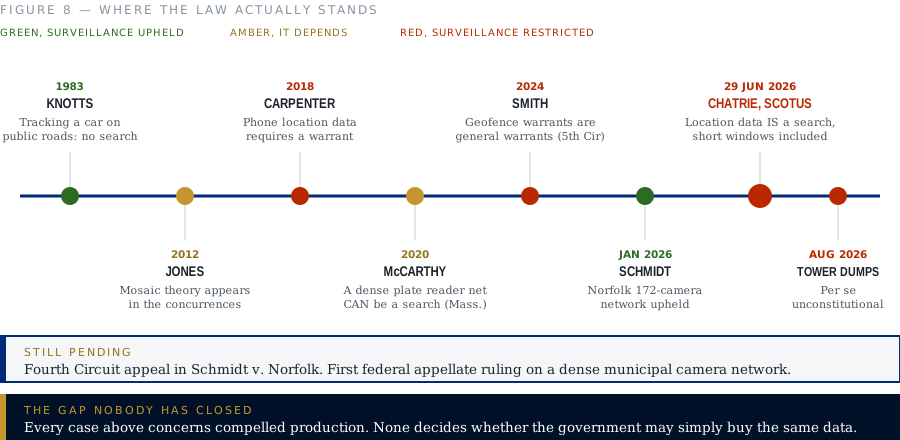
FIG 8 Not legal advice. Verify any citation before relying on it in a filing or a presentation.
What Chatrie actually held
On 29 June 2026 the Supreme Court decided Chatrie v. United States 6 to 3, Justice Kagan writing. The Court held that acquiring a person's cell phone location history is a Fourth Amendment search: even for short periods, even though a third party holds the data, and regardless of how small a slice of the database is ultimately produced. It rejected the argument that a couple of hours is too little to matter, noting that even a short window can reveal a visit to a psychiatrist or a clinic.
The decisions that matter
| Case | Court, year | What it held |
|---|---|---|
| Knotts | U.S. Supreme Court, 1983 | Tracking a vehicle on public roads is not a search. Still good law, and still the backbone of every defense of plate readers. |
| Jones | U.S. Supreme Court, 2012 | GPS tracking was a search on trespass grounds. Five justices separately endorsed the mosaic theory: lawful individual observations can become a search in aggregate. |
| Carpenter | U.S. Supreme Court, 2018 | Seven days of cell site location data required a warrant. Written deliberately narrowly and expressly reserved tower dumps and conventional cameras. |
| McCarthy | Mass. SJC, 2020 | First appellate ruling anywhere on plate readers. Widespread use can be a search, but four cameras were not. Rests on the state constitution, so it binds only Massachusetts. |
| Smith | 5th Circuit, 2024 | Geofence warrants are general warrants, categorically prohibited. Goes further than the Supreme Court later did, and survives Chatrie untouched. |
| Martin | E.D. Va., 2024 | Declined to suppress a Flock query and rejected the mosaic theory as applied to a roughly 188 camera regional network. |
| Porter | 5th Circuit, 2026 | The only federal circuit holding on plate readers I could locate. Predates Chatrie by three months. |
| Schmidt v. Norfolk | E.D. Va., Jan 2026 | Norfolk's 172 camera network upheld: gaps in coverage meant it did not capture the whole of a person's movements. Now on appeal to the Fourth Circuit. |
| Simonson | Wash. Ct. App., Jan 2026 | A Flock image of a plate on a public road did not disturb protected private affairs under the state constitution. |
| Chatrie | U.S. Supreme Court, Jun 2026 | Location data acquisition is a search regardless of how short the window. Left probable cause and particularity to the lower courts. |
| Tower dumps | S.D. Miss., Aug 2026 | Tower dumps are per se unconstitutional. A district ruling binding nobody else, but it shows how fast Chatrie is being extended. |
Why Norfolk got harder to defend
Norfolk's defense leaned on a 2024 Fourth Circuit panel opinion in Chatrie holding that geofence collection was not a search. That opinion was vacated when the case went en banc, and the en banc ruling was then displaced by the Supreme Court. The precedent no longer exists in any form, and what replaced it cuts the other way. Chatrie also shifts the focus toward what a system is capable of collecting rather than what officers happened to retrieve, and it rejected the argument that taking a small slice of a large database changes the analysis. Norfolk's win rests substantially on gaps and partial coverage, which is a structurally similar argument.
None of which means Norfolk loses. Chatrie is a cell phone case that never mentions plate readers, Knotts remains directly on point for vehicles, and sixteen states plus the District of Columbia filed in support of the city. But the Fourth Circuit ruling, expected late 2026 or early 2027, will be the first federal appellate decision on a dense municipal camera network, and it will matter more than anything else on this page.
State law is moving faster than the courts
There is no federal statute governing plate readers at all. Congress has left the field to litigation and to the states, and roughly sixteen states now regulate them in some form. Retention limits range from three minutes in New Hampshire, the strictest regime in the country, to 21 days in Virginia, Maine and Washington, to five years in Illinois for records tied to an investigation.
Washington's Driver Privacy Act, SB 6002, signed 30 March 2026, is the current model: a 21 day retention limit, a prohibition on use for immigration enforcement, and a bar on cameras near schools, places of worship, and courts. Oregon's SB 1516 followed a day later with a 30 day cap and logged limits on interagency sharing.
It is not just one company
Almost everything above uses one vendor's system as the worked example, because that is where the audits, the lawsuits, and the public record are. That is a fair way to examine the category and a bad way to decide what to do about it, because the obvious conclusion, cancel this contract and buy a different brand, does not follow.
Plate reading is an industry, not a product. Agencies also buy from Motorola Solutions, which sells under the Vigilant, PIPS and Avigilon brands, from Axon, Genetec, Rekor, Verkada, Leonardo's ELSAG line, Neology, PlateSmart, Jenoptik and others. They differ in hardware, deployment model, where the data lives, and which networks they connect to. What they do not differ in is the underlying capability.
The comparison that actually matters
| Vendor | Deployment model | Where data lives | Cross agency sharing | Commercial data blend | Beyond plates |
|---|---|---|---|---|---|
| Flock Safety | Subscription. Solar and cellular pole cameras. Vendor owns the hardware and removes it at contract end. | Vendor cloud. No local copy. | Opt in statewide and national lookup. This is the design, and the source of most documented failures. | No. Agency captured data only. | Acoustic detection, drone programs, natural language person search, 911 integration. |
| Motorola Solutions (Vigilant, PIPS, Avigilon) | Purchase or enterprise contract. Fixed and heavy patrol vehicle mounts. Roughly $40,000 to $250,000 per deployment. | Agency systems or vendor hosted, configurable. | Configurable, and integrates across jurisdictions at enterprise scale. | Yes. Sister company DRN feeds a commercial database into law enforcement search. See below. | Facial recognition products, radio and CAD integration. |
| Axon | Subscription, bundled with body camera and evidence ecosystem. Winning larger citywide contracts. | Vendor cloud, Axon evidence ecosystem. | Configurable sharing policies. | No. | Body cameras, tasers, real time crime centre, drone as first responder. |
| Genetec AutoVu | Purchase, integrator installed. Fixed and mobile. Heavier infrastructure and trained operators. | Commonly on premises within Security Center. | Configurable. Local control is the selling point. | No. | Video management, access control, forensic search. |
| Rekor | Software first. Camera agnostic, runs on existing IP cameras. Low per camera cost. | Cloud or on premises components. | Configurable. No vendor run national database of the same kind. | Sells vehicle data products commercially. | Highway and transit analytics, traffic and tolling. |
| ELSAG (Leonardo) | Purchase. Older, rugged, long running state agency and highway patrol deployments. | Agency systems. | Varies by agency configuration. | No. | Primarily plates. |
| Buy to own and software only (PlateSmart, Coram, others) | Purchase hardware outright, or add recognition to cameras you already have. | Local, agency controlled. | Whatever the agency configures. No vendor network by default. | No. | Varies. |
Public product positioning as of August 2026, not every configuration. The facial recognition question below cuts across this table. Deployments vary enormously, and only your town's contract and written policy describe what your residents actually live under.
Does any of this do faces?
This is the question residents ask most often, and the one most often answered imprecisely in both directions. Start by separating three different things. The distinction comes from Axon's own ethics board and is worth borrowing at a meeting.
| Face detection | Noticing that a human face is present in an image. Used for redaction and blurring, and also for indexing. |
| Face re-identification | Recognising the same face again across footage, without knowing whose it is. |
| Face matching | Putting a name to a face by comparing it against a database. This is what people mean by facial recognition, and it is the one that matters. |
On the plate reader itself, the answer is generally no. These cameras are aimed at plates, and agencies deploying them routinely state that the images do not capture identifiable faces and that no facial recognition is applied. One department put it plainly: there is no angle at which you would be able to see someone's face. Flock Safety states across its published material that its readers do not use facial recognition, cannot identify individuals, and search on vehicle characteristics only. Take that at face value for the plate reader.
Axon shows how fast a position can move. In 2019 its independent ethics board recommended against face matching and the company agreed not to commercialise it, limiting its face work to detection and re-identification for redaction. In December 2025 it began a proof of concept putting facial recognition on body worn cameras with a Canadian police department, roughly fifty officers, the first deployment of its kind. Its chief executive said the company was proceeding because it believed the public was accepting of it. A vendor commitment not to build something is a statement about today, not a contract term.
The practical risk is the integration layer, not the pole. Real time crime centre platforms exist to pull many feeds onto one screen: plate readers, municipal cameras, private cameras, drones, body cameras. Your plate reader may do nothing but plates and still sit one tab away from a system that does faces. So the question to ask is not "do these cameras have facial recognition", which invites a technically true no. It is: does any product from this vendor, or anything connected to this platform, perform face matching, and does this vote authorise it?
Most of this data was never collected by any government
The biggest single contributor is the repossession industry. Cameras are fitted to repo trucks and, less obviously, to ordinary looking cars, and they scan every plate they pass, not only the vehicle they are hunting. That feeds a commercial database sold to insurers, lenders, private investigators and law enforcement.
|
15 billion
vehicle sightings reported in one commercial database
|
250 million
added every month
|
Zero
council votes, records requests or local audits reaching any of it
|
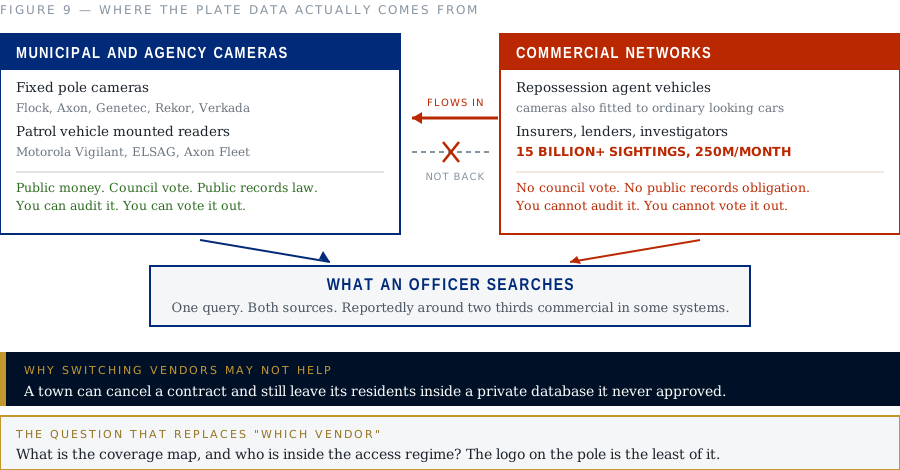
FIG 9 Commercial data is shared into law enforcement systems. Agency captured data is not shared back out into the commercial pool.
Three things follow, and they matter more than any vendor comparison.
Your town never voted on it. A private database is not procured by a council, is not subject to public records law, and cannot be audited by your municipality. Every governance control in Section 12 applies to the municipal half of this picture and to none of the commercial half.
Cancelling a contract does not remove you from it. A town that switches vendors, or drops plate readers entirely, has changed the municipal half only. Residents remain in the commercial database either way.
The switch can go backwards. A jurisdiction that leaves a shared municipal network for an enterprise vendor whose sister company runs a commercial plate database may end up with fewer cameras, less transparency, and a broader reach. Denver moved to a competitor in March 2026 and got fewer cameras, shorter retention, and no vendor run national database, which is a genuine improvement. But the camera count fell and the surveillance continued. State law, not vendor choice, is what survives a procurement cycle.
Which vendor is a procurement question. Which coverage map, and who is inside the access regime, is the question that determines what your residents actually live under.
Two towns running identical hardware from the same company can have completely different privacy realities depending on retention, sharing configuration, audit practice, and who holds an account. Two towns running different brands can be functionally identical. The logo on the pole is the least informative fact available to you.
Rank it honestly
Preparedness discipline means ranking threats by likelihood and consequence rather than by how much they alarm you. Applied here, the picture is not the one either camp expects. For an ordinary household, the thing most likely to cause you a bad afternoon is not surveillance. It is a clerical error.
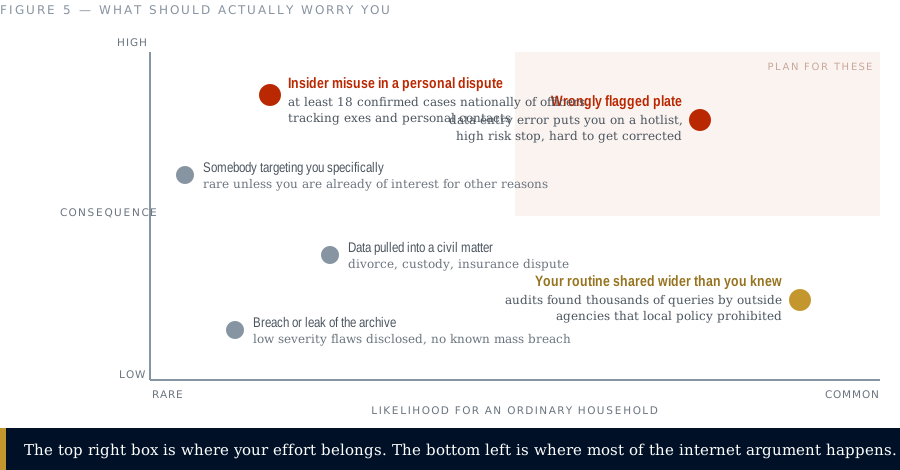
FIG 5 Placement reflects documented incidents through July 2026, not speculation.
The countermeasures that make things worse
Search this topic and you will find a cottage industry selling plate covers, reflective sprays, tilt brackets, and infrared emitters. Let me save you the money and the court date.
Obscuring, altering, or defeating the legibility of a license plate is illegal in every state. That is not a gray area and not a technicality. The plate is required to be plainly visible, and in most jurisdictions a cover or coating is its own citable offense before anyone asks why you installed it. These cameras also use infrared illumination, so most of what is sold as an anti-ALPR product does not do what the sales page claims in the first place.
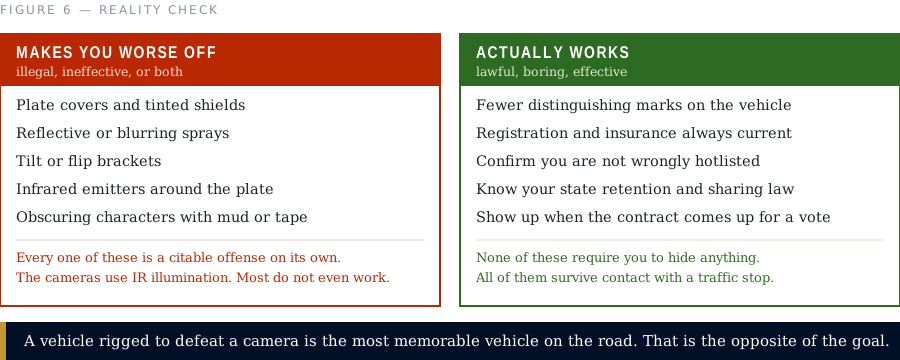
FIG 6 Not legal advice. Check your own state vehicle code, but expect the answer to be no.
The deeper problem with the gadget approach is that it inverts the entire logic of the gray man. The point of low profile is to be unremarkable. A truck with a flip bracket on the plate has traded a database entry for a memorable traffic stop, a citation, an officer who now recognizes the vehicle, and a story that gets told at shift change. You did not reduce your signature. You raised it, and you did it in the one context where a human being is looking directly at you.
You cannot stop the plate from being read. You can decide how much your vehicle says about you before the plate is even resolved.
Every sticker is a data point that survives the retention window and travels with the vehicle description. Political affiliation, firearms interest, unit patches, kids' schools, gym memberships, the church, the club, the state you moved from. None of it is illegal and none of it is anybody's business, which is exactly why it is worth asking whether it needs to be on the tailgate. Same discipline you would apply to a go-bag that screams tactical from fifty yards. Capability you advertise is capability somebody else gets to plan around.
What happens when it actually matters
This is the part almost nobody on either side of the argument raises, and it is the part that belongs in a plan rather than a feed.
The resilience selling point is solar plus cellular: no trenching, no municipal fiber, no grid dependency. That is a genuine advantage over conventional traffic cameras and it is why these get pitched to emergency managers as an evacuation monitoring asset. But solar plus cellular plus vendor cloud is also the dependency chain. In a regional event, cell networks congest and then fail, usually within hours. The cameras go blind, the archive becomes unreachable, and any agency that folded plate reader counts into its evacuation picture is suddenly working from nothing.
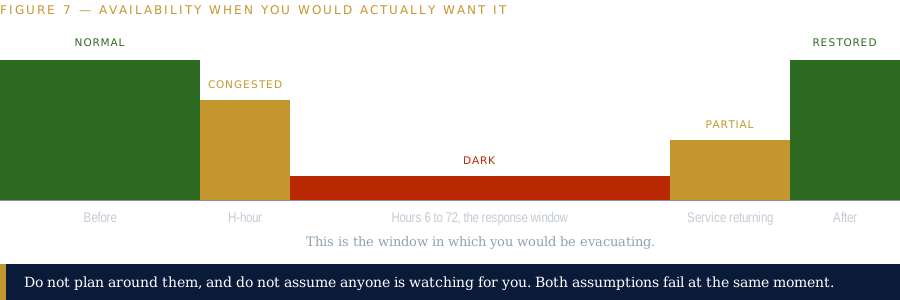
FIG 7 Planning estimate for a regional event, not a vendor specification. Local results vary with tower hardening and generator coverage.
That cuts two ways, and both belong in your planning. If you sit on the government side of this, a jurisdiction that has written plate reader counts into its evacuation concept of operations without a documented degraded mode has built a single point of failure into a disaster function. Ask what the system does when the tower is down and who counts vehicles manually. If nobody has an answer, that capability does not belong in the plan as a primary method.
If you sit on the household side, resist the temptation to route your evacuation around camera coverage. Understand the trade. Cameras cluster on primary routes, which are also the routes that get plowed, cleared, patrolled, and reopened first. Routing around them means secondary roads with worse surfaces, fewer services, less traffic to help if you break down, and no cell coverage. That is a real risk accepted to avoid a database entry which, in the scenario you are planning for, probably is not being written anyway.
A shelter that half the neighborhood will not enter is not a shelter, and a registry that mixed status families will not sign is a planning document with a hole in it.
Everything above this line is about what you control. Here is why the town level decision is the higher leverage one, and it is an argument that belongs to emergency managers specifically.
Preparedness runs on voluntary participation. Functional needs registries, shelter intake, evacuation compliance, damage self reporting, calls to 911, and neighborhood mutual aid all depend on residents believing that engaging with local government is safe. Whole community doctrine is built on that assumption. When a segment of the population comes to believe local infrastructure feeds outside enforcement, participation drops, and that effect does not distinguish between the police department and the emergency management office. Whatever position a jurisdiction takes on the underlying policy, the operational fact stands, and nobody else at the table is going to raise it.
Pros and cons at a glance
The whole assessment on one screen. Print this one if you are going to a meeting.
| Dimension | Pro | Con |
|---|---|---|
| Missing persons | Strongest documented benefit. Integrates AMBER, Silver, and at risk alerts. Verified recoveries including dementia wandering and child abduction. | Aggregate totals are vendor reported and not independently audited. |
| Crime outcomes | Solid support for stolen vehicle recovery and auto theft arrests. Useful lead generator. | Clearance gains not statistically significant. Little to no evidence of prevention or deterrence. |
| Evacuation support | Ingress and egress counts inform shelter demand, barricade placement, and search prioritization. | Depends on cellular and cloud that degrade early in exactly the events that trigger evacuation. |
| Infrastructure | Solar and cellular, so no trenching and no grid dependency. Deployable in days. | Single vendor cloud dependency. No local copy. Degraded mode usually undocumented. |
| Cost | Predictable subscription. Low IT burden. Fast to stand up. | Roughly $2,500 to $3,000 per camera per year, recurring forever. The town never owns the asset, and the vendor removes it at contract end. |
| Data governance | Every query generates an audit record. August 2026 reforms cut default retention to 7 days, made misuse detection mandatory, and require case codes on every search. | Multiple audits found large volumes of sharing that violated the jurisdiction's own policy, undetected until audited. Safeguards have been reactive, and a case code field is not a warrant. |
| Insider risk | Audit logs have identified misuse and supported prosecution. | At least eighteen confirmed cases nationally of officers tracking personal contacts. Detection usually followed a complaint, not routine review. |
| Accuracy | Objective vehicle data reduces reliance on incomplete witness descriptions. | Documented wrongful charges and repeated high risk stops from misreads. Errors are hard for citizens to get corrected. |
| Scope control | Local administrators set user permissions and sharing configuration. | Documented creep into minor traffic enforcement. Platform now carries acoustic sensors, drones, and person description search. |
| Legal exposure | More than thirty state and federal courts have held fixed readers are not a Fourth Amendment search. No federal appellate court has decided the question. | Norfolk is on appeal, the 2026 Chatrie decision undercuts its reasoning, and 16 states now regulate plate readers. Multi year terms carry compliance risk. |
| Community trust | Transparency portals and published policies build confidence where they are actually maintained. | Perceived outside enforcement linkage suppresses use of registries, shelters, and 911. A direct and unbudgeted preparedness loss. |
What you do this weekend
Seven things. None require buying anything or breaking any law.
| Find out what is actually in your area. Volunteer mapping projects track reader locations and many departments publish a transparency portal. Ten minutes tells you whether this is a live question where you live. | |
| Look up your state law on retention and sharing. Several states changed theirs in 2026. Retention length and whether federal sharing requires a warrant are the two numbers that matter. | |
| Keep registration, inspection, and insurance current. Unglamorous, and the highest value item on this list. Almost every bad interaction starts with a hotlist hit, and expired paperwork is the most common legitimate reason to be on one. | |
| If you have been stopped for no reason you understood, ask why. Repeated stops with no cause is the signature of a wrongly entered hotlist record. Request the basis in writing and pursue a correction. These do not fix themselves. | |
| Do a tailgate audit. Walk behind your vehicle and read it the way a stranger would. Decide deliberately what stays. Some of it is worth keeping. Make it a choice rather than an accumulation. | |
| Photograph your vehicle and record the VIN and plate. Front, rear, both sides, and any distinguishing damage. If it is ever stolen, that description is what makes the system work for you instead of about you. | |
| Do not route your evacuation plan around cameras. Route on road quality, fuel, water crossings, and traffic. Those will hurt you. A database entry will not. |
What your town should have in writing
This is the higher leverage tier and it costs you one evening. These contracts are approved and renewed in public meetings almost nobody attends. Two or three residents asking specific questions has repeatedly changed the terms, and in a few towns the outcome. Every control below is already in writing somewhere else, so none of it is an unreasonable ask.
| Policy before purchase. Written, council adopted, publicly posted use policy in place before any signature. | |
| Retention cap in the contract, stated in days, not only in a settings panel a vendor can change. | |
| Default deny on external sharing. No statewide lookup, no national lookup, no federal access unless individually authorized by name and documented. | |
| Documented purpose for every query, drawn from a controlled list rather than a free text box. Free text is how improper searches hide. | |
| Mandatory quarterly audit, published. Not available on request. Published, with query counts by agency and by stated purpose. This one control would have caught every failure described above. | |
| Human verification required before any stop or enforcement action based on an alert, written into department policy. | |
| A correction process with a named owner and a deadline for residents wrongly flagged on a hotlist. | |
| Sunset clause. Automatic expiration at two years requiring an affirmative vote and a published outcomes report to renew. | |
| Separate authorization for each sensor class. Plate readers, audio, drones, and person description search are four different decisions. | |
| Exit and deletion terms. What it costs to leave early, how fast cameras come down, and written confirmation that all data including anonymized derivatives is destroyed. | |
| A warrant, or at minimum a supervisor sign off, for retrospective database searches. Real time hotlist alerts are a different thing from trawling weeks of history. No court requires this yet, and several states are moving toward it. A town can simply adopt it. | |
| A no purchased data clause. The town will not buy plate or location data from a commercial broker to do what a warrant would otherwise require. No court has closed that gap, so close it locally. | |
| Degraded mode annex. If plate readers appear anywhere in the emergency operations plan or evacuation annex, the plan documents what happens when the network is down and who does the counting manually. |
Awareness, not avoidance
These are a genuinely capable investigative and locating tool with a narrow, well supported evidence base and a broad, poorly supported marketing claim set. The technology is not the primary risk. The governance is.
The recurring failure across every jurisdiction that has had to walk this back is identical. The local policy was fine. The actual data flow did not match it. Nobody found out until an outside party forced an audit. That is a preparedness failure of the most ordinary kind, which is to say a plan that was never exercised.
You are not going to opt out of this by buying a gadget, and you do not need to. What you can control is how much your vehicle volunteers before anyone runs a query, whether your own record is clean, and whether the people who bought the system in your town have ever checked what it is actually doing. That last one is the highest leverage item on the entire page and it asks the least of you.
Preparedness has never been about hiding. It is about knowing your terrain, keeping your paperwork straight, and not being surprised. This is one more piece of terrain, and now you know what is on it.
Town Meeting Question Sheet
Two printable pages. Thirty questions covering cost, retention, outside sharing, accuracy, oversight, contract exit, scope creep, and emergency management, each paired with the answer that should concern you. Includes public records request language. Print it, take it, ask two of them.
- Koper and Lum, large scale license plate reader deployment and criminal investigations, National Institute of Justice
- Evaluation of a major ALPR expansion, Atlantic City Police Department, 2025
- Policing Institute multi site ALPR evaluation
- Municipal audit disclosures: Dayton, Columbus, San Francisco, Mountain View, 2026
- Illinois Secretary of State plate reader audit findings, 2025 and 2026
- Chatrie v. United States, 609 U.S. ___, 146 S. Ct. 2193 (2026), decided 29 June 2026
- Carpenter v. United States, 585 U.S. 296 (2018); United States v. Jones, 565 U.S. 400 (2012); United States v. Knotts, 460 U.S. 276 (1983)
- Schmidt v. City of Norfolk, No. 2:24-cv-00621 (E.D. Va. Jan. 27, 2026), on appeal to the Fourth Circuit
- United States v. Smith, 110 F.4th 817 (5th Cir. 2024); United States v. Porter, No. 25-60163 (5th Cir. Mar. 17, 2026)
- Commonwealth v. McCarthy, 484 Mass. 493 (2020); State v. Simonson, No. 40732-2-III (Wash. Ct. App. Jan. 29, 2026); United States v. Martin, 753 F. Supp. 3d 454 (E.D. Va. 2024)
- In re Four Applications for Search Warrants (S.D. Miss. Aug. 5, 2026), tower dumps held per se unconstitutional
- Congressional Research Service LSB11274 and R48852 on geofence and reverse warrants; CRS IF13068 on plate readers
- Policing Project at NYU School of Law, fifty state plate reader grading, August 2026
- Washington SB 6002 (Driver Privacy Act); Oregon SB 1516; California SB 34 and Civ. Code 1798.90.5; Illinois 625 ILCS 5/2-130
- Institute for Justice plate reader litigation, Norfolk VA and San Jose CA
- Electronic Frontier Foundation ALPR investigations and Atlas of Surveillance
- Flock Safety published material: transparency documentation, federal sharing statements, security disclosures, customer outcome studies
SEMPER PARATUS, SEMPER GUMBY
INFORMATIONAL ONLY | NOT LEGAL ADVICE | CHECK YOUR OWN STATE VEHICLE CODE