What Still Works and How Networks Are Restored
What happens with the digital services when service is limited?
When a cell tower has limited capabilities, certain phone apps that use data may still work, depending on the specific limitations and available bandwidth. Here are some apps that are more likely to function in such scenarios:
Messaging apps:
- Signal
- Telegram
- Facebook Messenger (text only)
- iMessage (for iOS devices)
These apps typically require less bandwidth for text messages and can often function even with limited data connectivity.
Voice over IP (VoIP) apps:
- Skype (voice calls)
- Viber
- Google Voice
VoIP apps may work for voice calls if there’s enough bandwidth, but video calls might not be possible.
Push-to-talk apps:
- Zello
- Voxer
These apps simulate walkie-talkie functionality and can often work with minimal data connectivity. (see also the Radio over LTE Rapid Radios article)
Email apps:
- Gmail
- Outlook
- Apple Mail
Basic email functionality may work, but large attachments might not download.
Light versions of social media apps:
- Facebook Lite
- Twitter Lite
These stripped-down versions are designed to work in areas with poor connectivity.
Offline-capable apps:
- Google Maps (with pre-downloaded offline maps)
- Pocket (for saved articles)
- Spotify (with downloaded playlists)
These apps can function without an active data connection if content is pre-downloaded.
It’s important to note that the actual functionality will depend on the specific limitations of the cell tower and the minimum requirements of each app. In severely limited conditions, only the most basic data services (like SMS) may work reliably.
Does airplane mode stop all data going to a cell tower?
Yes, enabling airplane mode on a smartphone does stop all data transmission to cell towers. Here’s how it works:
- Radio signals: Airplane mode turns off all radio transmissions from your device, including cellular, Wi-Fi, and Bluetooth.
- Cellular connection: This mode completely disconnects your phone from cellular networks, preventing any data exchange with cell towers.
- Location services: GPS may still function in airplane mode on some devices, but it won’t send or receive data from cell towers.
- No calls or messages: You won’t be able to make or receive calls, send texts, or use mobile data while in airplane mode.
- Other functions: Your phone will still work for tasks that don’t require a network connection, like using offline apps, playing downloaded music, etc.
- Quick toggle: Airplane mode can be easily turned on and off, usually from the quick settings menu.
It’s important to note that while airplane mode stops all communication with cell towers, it also means your phone won’t be able to receive important calls or emergency alerts. It should be used judiciously, especially in situations where you might need to be reachable.
How is Starlink a Game Changer for Personal and Emergency Communications?
Starlink, in collaboration with T-Mobile, received emergency special temporary authority from the FCC to activate its direct-to-cell satellite capabilities. This allowed Starlink satellites to provide coverage directly to cell phones in regions impacted by Hurricane Helene. The satellites were enabled to broadcast emergency alerts to all cell phones across all networks in North Carolina and to test basic texting (SMS) capabilities for T-Mobile users in the state. This was not a deployment of physical “cell sites” on the ground but rather the use of satellites already in orbit to beam signals directly to existing mobile devices. Since the direct-to-cell constellation was not fully deployed at the time, these services were provided on a best-effort basis. Starlink and T-Mobile are planning a phased rollout of full services through 2025.
Additionally, Starlink deployed thousands of satellite internet kits (over 10,000, according to SpaceX) to the areas affected by Hurricane Helene. These kits, which include a receiver dish, were used to provide high-speed internet access to residents, emergency responders, and organizations in regions where traditional communication infrastructure (like fiber optic lines and cell towers) was severely damaged or destroyed. For example, FEMA utilized 40 Starlink units for responder communications in North Carolina, with an additional 140 units shipped to further restore connectivity. These deployments were ground-based satellite terminals, not traditional cellular sites, and were critical in re-establishing internet access in “blackout zones” like Asheville. Each Starlink terminal has its own WiFi, so if your phone is enabled for WiFi calling you are able to make calls through the Starlink satellites.
What Else is Deployed During a Disaster to Restore Cellular Service?
One of the most widely used assets is the Cell on Wheels (COW). These are mobile cell towers mounted on trailers that can be towed to disaster-stricken areas. COWs are equipped with antennas, transceivers, and power generators, allowing them to provide temporary cellular coverage within hours. For example, companies like Verizon, AT&T, and T-Mobile have fleets of COWs that can be deployed to restore service after events like hurricanes. They’re particularly useful because they can be set up in areas where roads are still accessible, and they can handle significant call and data traffic—though their range is typically smaller than a permanent tower, depending on terrain.
A similar but more heavy-duty option is the Cell on Light Trucks (COLT), often referred to as Satellite COLTs (SatCOLTs). These are larger vehicles, like semi-trucks, equipped with retractable masts (up to 60 feet or more) and satellite backhaul to connect to the network when local fiber or wireless links are down. AT&T, for instance, uses SatCOLTs extensively as part of its Network Disaster Recovery (NDR) program, which also supports FirstNet—a dedicated network for first responders. SatCOLTs can be operational within an hour of arrival and are self-sufficient with onboard generators, making them ideal for areas without power. FirstNet’s fleet includes over 100 SatCOLTs, which have been used in disasters like wildfires and hurricanes to provide LTE coverage.
For more compact and portable solutions, companies deploy Compact Rapid Deployables (CRDs). These are smaller, often suitcase-sized units that can be carried by a single person and set up in minutes. FirstNet offers CRDs as part of its deployable fleet, providing cellular, Wi-Fi, and wired internet access in remote or hard-to-reach areas. They’re particularly useful for smaller-scale incidents or when larger assets like COWs or COLTs can’t access the site due to damaged infrastructure. CRDs often use satellite backhaul and can create a local hotspot, supporting critical operations like search-and-rescue missions.
Another innovative asset is the Flying Cell on Wings (Flying COW), which involves drones or tethered aerostats (blimps) equipped with cellular equipment. AT&T has pioneered this with its FirstNet One aerostat, a blimp that can fly up to 1,000 feet and provide LTE coverage over a wide area—replacing multiple ground-based units. FirstNet also uses Flying COWs, which are drones that can hover at 400 feet, delivering coverage in challenging terrains like mountainous regions during wildfires. Verizon has also experimented with drones carrying femtocells (small cell sites) to provide temporary service, as seen in tests after Hurricane Irma. These aerial solutions are game-changers because they can bypass ground obstacles like flooded roads or debris, though they’re limited by battery life (drones) or weather conditions (both drones and aerostats can’t operate in high winds).
Communications Vehicles (CVs) are another asset, often used as mobile command centers. These vehicles provide LTE and Wi-Fi connectivity, but also include workspaces for first responders, with monitors, charging stations, and even amenities like air conditioning and rest areas. FirstNet has deployed CVs across the U.S., using them for both emergency response and planned events like training exercises. They’re equipped with generators and can operate independently for days, making them a hub for coordination during prolonged disasters.
Some companies also use micro cell sites or picocells, which are smaller than traditional towers and can be deployed to extend coverage in specific areas. For example, Virtual Network Communications’ GreenCell, a scalable LTE picocell, has been tested on drones to create ad hoc networks during disasters. These are lightweight and can provide coverage over a few kilometers, making them suitable for filling gaps in urban or rural settings where larger assets might be overkill.
Cellular Repeaters on Wheels (CROWs) and Generators on a Trailer (GOATs) are additional tools. CROWs amplify existing signals to boost coverage, while GOATs provide power to other assets or damaged infrastructure. Verizon’s Frontline Crisis Response Team, for instance, uses these alongside COWs and COLTs to support emergency crews, as seen during the Marshall Fire in Colorado, where they deployed multiple assets to restore connectivity.
Finally, cell companies often integrate satellite backhaul into their deployable assets to ensure connectivity when terrestrial networks fail. This is a critical feature of SatCOLTs, CRDs, and even some COWs, allowing them to function independently of local infrastructure. T-Mobile, for example, has pre-located COWs with satellite capabilities to provide additional capacity in hard-hit areas, as part of its disaster response strategy.
These assets are often supported by broader initiatives like the FCC’s Mandatory Disaster Response Initiative, which requires wireless providers to share resources, provide roaming, and coordinate with each other during emergencies. Companies also conduct readiness drills year-round to ensure rapid deployment—AT&T’s NDR team, for instance, has invested over $650 million in its disaster response capabilities, including a fleet of over 300 assets available to FirstNet users.
While these technologies are impressive, they’re not without limitations. COWs and COLTs rely on accessible roads, which can be a challenge in flooded or debris-filled areas. Aerial solutions like Flying COWs are weather-dependent—high winds or heavy rain can ground them. And even with satellite backhaul, bandwidth can be a bottleneck during massive traffic spikes, as seen after Hurricane Ian, where data usage surged by 70% in some areas. Still, these deployable assets have proven vital in restoring communication, saving lives, and supporting recovery efforts when disasters strike.
Bottom Line
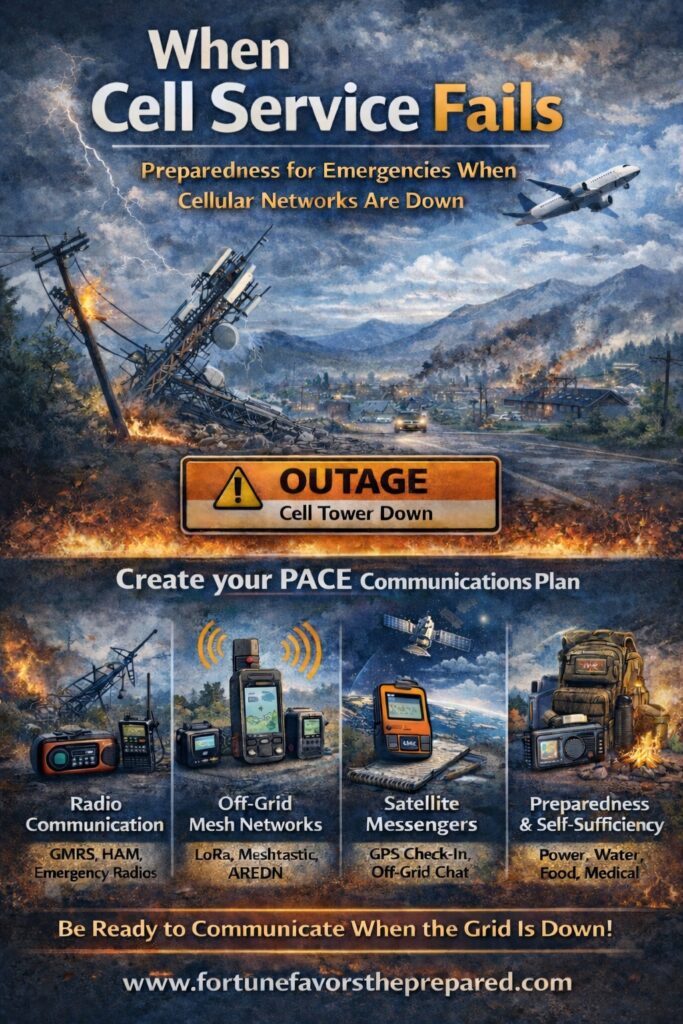
Knowing the capabilities and limitations of your primary communications tool is essential to your Family Emergency Plan and your communications plan. Even with all the tools available restoration of cellular service can take time after a disaster. You MUST have other means of communications, both to receive emergency messages, such as a NOAA Weather, communicate with neighbors, such as GMRS, or friends and family further away, such as ham radio. You could, if finances allow, have your own Starlink. If you have it fixed on your house for daily use consider removing it in severe weather so it doesn’t get damaged. There are other emergency devices such as the Garmin Inreach which allow texting over satellite (more information on satellite services and capabilities in this article).
The Family Emergency Plan workbook gives you a section to building your communications plan. There are also articles on GMRS, ham radio and other capabilities under the communications tab.