Skip to content

Fortune Favors the Prepared

Semper Paratus, Semper Gumby

Menu
  • The Continuity Chronicles
  • Intelligence Reports
        • DAILY THREAT REPORT
        • DAILY THREAT REPORT – LITE
        • DAILY PREPAREDNESS BRIEF
        • Analytical Standards and Tradecraft
        • Acronym & Abbreviations Glossary
        • Source Registry
        • FLASH & SPECIAL REPORTS
        • Area-Specific Assessment Report
        • SOFT TARGET SECURITY BRIEF
        • THE HOUSEHOLD BRIEF
        • COMMS WATCH
        • FINANCE SECTOR
        • HEALTHCARE SECTOR
        • TRANSPORTATION & LOGISTICS SECTOR
        • AI, DATA CENTER & INFRASTRUCTURE REPORT
        • CONSTRUCTION & MANUFACTURING SECTOR
        • Water and Wastewater Security Report
        • Energy Sector Report
        • Strategic Intelligence Supplement
  • WATCH DESK
  • About
        • The Why
        • Vision and Mission
        • Services
          • Business Resiliency
        • Testimonials
        • Insider
        • Friends
          • Patriot Volunteer Examiner (VE) Team
          • Angery American
          • Signal Stuff
          • Forward Observer
  • Communications
        • Stump Knocker
          • SOI
          • STUMP KNOCKER DMR UPDATES
          • MMDVM Hotspot
        • Preparedness Communications
          • What Radio Should I Get for Preparedness?
            • What Radio to Buy?
              • What Radio to Buy? – video
              • Ham Radio on a Budget
              • Live – What Radio to Buy?
              • Portable Radio Kit
              • Mobile Communications
          • Emergency Communications Principles
          • Communications Options
          • Starter Radio Paths by Preparedness Scenario
          • How Communications Fail
          • HF Communications
            • SHTF HF Communications
            • Simple Antenna Builds for HF – video
            • NVIS in Amateur Radio
        • Amateur (HAM) Radio
          • Why Do I Need a Ham License?
            • How to Obtain Your Amateur Radio License
              • Amateur Radio Learning Resources
              • Finding a Ham Exam
                • HAM Exam Accommodation
              • Getting Into Ham Radio – Video
            • Are You Expired?
            • Why You Should Upgrade to a General Ham License
          • HAM Simplex Frequency Card
          • Analog versus Digital
          • Analog vs Digital Voice: A Preparedness-Focused Comparison
          • What are CTCSS and DCS
          • Programming Radios with Software
          • ARES, RACES, ACS and AUXCOMM
          • Ham Radio Beyond Line-of-Sight
            • Linked Analog Repeaters
            • EchoLink and IRLP
            • AllStarLink
            • Yaesu System Fusion & WIRES-X
            • D-STAR
            • Digital Mobile Radio (DMR)
            • P25 in Amateur Radio
            • NXDN in Amateur Radio
            • Amateur Radio Satellites (AMSAT)
            • The 60-Meter Band (5 MHz)
          • Meshtastic
          • HAM VoIP
        • Personal Radio Services
          • FCC Rules for Personal Radio Services
          • Family Radio Service (FRS)
          • General Mobile Radio Service (GMRS)
            • GMRS Repeaters
            • Getting a GMRS License
            • FRS / GMRS / MURS Frequency Card
          • Multi-Use Radio Service (MURS)
          • Citizen Band (CB) Radio
            • CB Frequency Card
        • Other Radio Services
          • Communications Continuity Programs and Capabilities
          • Marine Communications
        • Cell Sites and Their Services
          • When Cell Service Fails
          • Radio over LTE and Rapid Radios
            • LTE Radio Comparison
        • Satellite Communications
          • America’s Secret Eyes
          • The Commercial Eye
          • Seeing Through Everything (SAR)
            • Remote Area Emergency Communication Devices
            • Which Beacon Should You Carry?
          • Personal Satellite Communications
        • Wired Communications
          • MAG Phone System
          • TA-312/PT Field Telephone and SB-22/PT Switchboard
          • Understanding Telephone Wiring
          • The AT&T Long Lines Program
        • Communications Planning
          • Communications Plan Annex
            • Communications P.A.C.E.
            • Finding Information for Your Communications Plan
            • Area-Specific Assessment Report
          • Automatic Link Establishment (ALE)
          • Understanding Communications Resiliency
        • Communications Resiliency Programs
          • ARES, RACES and ACS
          • Auxiliary Communications (AUXCOMM)
          • Military Auxiliary Radio System (MARS)
          • U.S. Coast Guard Auxiliary Communications
          • Civil Air Patrol Communications
          • The 60-Meter Band (5 MHz)
            • Understanding the 60-Meter Band
        • Government Communications Continuity Programs
          • Government Emergency Telecommunications Service (GETS) and Wireless Priority Service (WPS)
          • National Warning System (NAWAS)
          • National Interoperable Frequencies
          • The FEMA National Net (FNARS)
          • National Emergency Communications Network (NECN)
          • The SHARES Program
          • State Emergency Capability Using Radio Effectively (Operation SECURE)
          • The High Frequency Global Communications System (HFGCS)
          • Satellite Mutual Aid Radio Talkgroup (SMART)
          • The AT&T Long Lines Program
        • Communications & Emissions Discipline
          • Communications Security (COMSEC)
            • Book Cipher
            • One Time Pads (OTP)
              • Decrypting One Time Pad Message
              • One Time Pads (OTP) Live Video
              • One Time Pad Training
          • Cryptographic Security (CRYPTOSEC)
          • Transmission Security (TRANSEC)
          • Communications Transmission Discipline (TRANSDISC)
          • Emissions Control (EMCON)
          • Communications & Emissions Training Framework
        • DMR Programming
          • DMR Programming – Talk Groups
          • DMR Programming - Roaming
          • MMDVM and Yaesu System Fusion (YSF)
          • Encryption in DMR Radios
        • Digital Mobile Radio (DMR) Networks
          • WR3IRS Interstate DMR Network
            • South Central PA (SC PA)
            • North East PA (NE PA)
            • Washington-Baltimore (W-B)
            • West Central Florida (WCF)
          • Florida Digital Amateur Radio Network (F-DARN)
          • Southeast Florida DMR Repeater Network W2GGI
          • Virginia DMR (DMRVA)
          • NC PRN DMR Network
          • SC Hospital Emergency Amateur Radio Team (SCHEART)
          • HEARS – Hospital Emergency Amateur Radio System
          • New England Digital Emergency Communications Network (NEDECN)
        • Baofeng/BTECH Radios Quick Guide
          • Manually Programming a Baofeng Radio – Video
          • A User’s User Manual for Baofeng Radios
        • MESSAGES & REPORTS
          • Phonetics
          • Procedure Words (Prowords)
          • Date Time Group (DTG)
          • NTS Radiogram Form
            • ARL Numbered Radiograms
          • SALUTE, SPOT, and SALT Reports
          • ACE/LACE Reports
          • GOTWA Report
          • CASREP (Casualty Report) Format
          • MEDEVAC Request Report
          • Formatted Messages (downloads)
        • Communications Knowledge Library
          • Communications Resiliency
          • Radio Etiquette, Jargon, and Best Practices
          • AmRRON RESOURCES & REFERENCES
          • Anytone Programmable Keys
          • Phonetics
          • Amateur Radio Colorado
            • Colorado Linked Repeater Systems
        • COMMUNICATIONS REFERENCES
  • Planning
        • Family Emergency Plan – The Basics
          • Family Emergency Plan
            • Area-Specific Assessment Report
          • Why Every Family Needs an Emergency Plan
        • Family Contingency Binder
          • Family Contingency Binder MindMap
        • Triggers
          • Preparedness Conditions – PREP-CON
            • Preparedness Conditions (PREP-CON) MindMap
          • Space Weather
        • Family Emergency Plan Workbook
          • Family Emergency Plan Workbook - owner resources
            • Area-Specific Assessment Report
            • Family Emergency Planning Form
            • Communications Plan
              • P.A.C.E.
            • Emergency Evacuation
            • Emergency Food Supplies
            • Family Contingency Binder
            • Message Drops
            • Get Home Bag
            • Bug Out Bag & Bins
            • Miscellaneous
        • Household Recovery Workbook
          • Household Recovery Workbook Updates
          • Disaster Debris — What to Do at the Curb
          • Dealing With Grief
        • Next of Kin Workbook
          • Next of Kin Workbook Updates
        • METT-TC: Decision Discipline
          • METT-TC - tactical planning
        • Planning Your Preps
          • Charity in Planning
        • Mutual Assistance Group
          • Mutual Assistance Group Workbook
            • MAG Workbook Forms & Updates
          • Mutual Assistance Groups (MAGs): Skills, Vetting, and Building Real Resilience
          • Mutual Assistance Group (MAG): Recruitment Code of Conduct
          • MAG: Private Vetting & Intake Process
          • Compartmentalization in Mutual Assistance Groups (MAGs)
          • Resiliency Index
          • Continuity of Government & Application to MAGs
  • Threat Assessment
        • Personal Preparedness Assessment Workbook
          • Personal Preparedness Assessment Report
          • Personal Preparedness Assessment Workbook - owner resources
        • Readiness Conditions for Preparedness
          • PREP-CON - Preparedness Conditions
          • COMCON – Communications Readiness Condition
          • WX-CON Weather Conditions
          • SWX-CON Space Weather Condition
          • CONCON – Civilian Continuity Conditions
        • Readiness Conditions – Hierarchy and Relationships
          • LERTCON – Alert Condition
          • DEFCON – Defense Readiness Condition
          • COGCON - Continuity of Government
          • INFOCON – Information Operations Condition
          • FPCON – Force Protection Condition
          • EMERCON – Emergency Condition
          • CYBERCON – Cyber Readiness Conditions
          • CPCON – Cyberspace Protection Condition
          • WATCHCON – Watch Condition
          • SIPRNet – Secret Internet Protocol Router Network
          • REDCON – Readiness Condition
          • NC3CON – Nuclear Command, Control, and Communications
        • Readiness Conditions in The Conspiracy Chronicles
          • CERCON – Cerberus Readiness Condition
          • COMCON – Communications Readiness Condition
          • C-OPS – CERBERUS Operational Status Conditions
          • CONCON – Civilian Continuity Conditions
        • Being Prepared for Civil Unrest
          • Civil Unrest – Area Intelligence
          • Civil Unrest – Be Prepared
          • Civil Unrest – Defense
          • Civil Unrest – Defense (part 2)
        • Staying Informed Before, During and After Emergencies
          • Weather Awareness
            • Weather Event Codes
            • Weather Radio Comparison
        • Cascade Analysis & Infrastructure
          • Cascade Effects
          • Community Lifelines
          • Area Intelligence
          • Area-Specific Assessment Report
          • National Power Grid
        • Near Earth Object / End of Life Event (ELE)
  • Intelligence
        • ANALYSIS, TRADECRAFT & REPORTING
          • Analytical Standards and Tradecraft
          • Analytical Tradecraft: A Guide to OSINT Analysis
            • OSINT Analysis Study & Reference Guide
          • Understanding Intelligence Analysis Tools
            • Understanding Analysis of Competing Hypotheses (ACH)
            • Understanding MDCOA
            • Understanding OAKOC
        • Operations Security (OPSEC)
          • OPSEC for Teens
          • OPSEC for Kids
          • The Gray Man
          • OPSEC: Don't Become the Target
          • Counterintelligence Tradecraft for the Prepared
        • Community Intelligence
          • Area Intelligence – Now!
            • Area-Specific Assessment Report
          • Community SITREP
          • Radio Traffic Situational Analysis During Emergencies
          • SALUTE, SPOT, and SALT Reports
        • ELECTRONIC THREAT & SURVEILLANCE
          • Staying Informed Before, During and After Emergencies
          • Integrated Public Alert and Warning System (IPAWS)
          • Communications Continuity Programs and Capabilities
          • Short Wave Scanning
          • Seeing Through Everything (SAR)
            • Which Beacon Should You Carry?
          • Wireless Recon Devices
          • Flock Cameras – What You Need to Know
        • The Architecture of Intelligence
        • Intelligence Gathering & Analysis
        • INTELLIGENCE DISCIPLINES
          • Communications Intelligence (COMINT)
          • Electronic Intelligence (ELINT)
          • Tactical Electronic Intelligence (TACELINT)
          • Signals Intelligence (SIGINT) – the basics (2020)
          • Signals Intelligence – Information Gathering Basics (2022)
          • Signals Intelligence (SIGINT)
          • Technical & Infrastructure Intelligence (TECHINT)
          • Electronic Counter-Surveillance
          • Open-Source Intelligence (OSINT)
            • How to Conduct a Daily Threat Analysis Using OSINT
          • Measurement and Signature Intelligence (MASINT)
          • Electronic Surveillance (ES)
          • Overhead Imagery & Geospatial Intelligence (IMINT / GEOINT)
        • INTELLIGENCE REFERENCES
  • Medical
        • Medical Training
          • Patient Assessment & Casualty Management
            • MARCH-PAWS Rapid Assessment
              • MARCH-PAWS TRAINING CURRICULUM
            • DCAP-BTLS – Secondary Trauma Assessment
            • SAMPLE + OPQRST Secondary Assessment
              • Medical History as a Preparedness Skill
            • START Triage
            • MEDEVAC Request Report
            • Patient Assessment – Documentation
              • Patient Care Report Forms
              • CASREP (Casualty Report) Format
        • Medical Kits
          • Individual First Aid Kit (IFAK)
          • BooBoo and IFAK Kits Video
          • BooBoo & IFAK Kit Mind Map
          • Large Kit - video
        • Medical Myths
          • Medical Myths – Tampons
          • Medical Myths – Ingested Poisoning
        • MEDICAL REFERENCES
  • Transportation
    • Transportation Plan B
    • Improvised Transportation
    • Preparedness For Winter Travel
  • Animals
    • Preparedness for Pets
  • Food
        • Why You Should Start a Food Storage Plan
        • Food Storage Quick Start
        • Buying in Bulk
        • Inventory Tracking
        • FOOD PRESERVATION RESOURCES
  • Water
    • Water From Air
  • Power
        • Power Grid
        • UPS
        • The Data Center Next Door
  • Bags etc.
        • Bug Out versus Get Home Bags
        • Get Home Bag – Contents
          • Get Home Bag – video
          • Get Home and Bug Out Bags - video from live 2-10
  • Navigation & Signalling
        • Grid Coordinates and Map Reading
        • Map & Compass Land Navigation
        • Practitioners Guide to GPS
          • Quick Instruction Sets
        • Which Emergency Beacon Should You Carry?
        • Covert Signals
        • Emergency Signaling
        • Sketched Strip Map
  • References
        • PLANNING & OPERATIONS
        • SECURITY OPERATIONS
        • INTELLIGENCE
        • CRYPTOLOGY
        • COMMUNICATIONS
        • REPORTING FORMATS
        • GENERAL/MISC
        • MEDICAL
        • FOOD PRESERVATION
        • CRITICAL INFRASTRUCTURE
        • SURVIVAL MANUALS
        • OPSEC
        • COUNTER INSURGENCY & CIVIL DISTURBANCE
        • EMP / CME
        • Training
          • Training Videos
          • One Time Pad (OTP) Exercises
            • 45662
            • 222135ZDEC22
        • Media and Press
  • Blog
    • Boomer
      • Day 1 – The Journey Home
      • Day 2 – First Day in the New Home
      • Day 3 – More Training
      • Day 4 – Dad Goes Back to Work
      • Day 5 – A Day at Home with More Training with Dad (Boomer’s version)
      • Day 6 – More Training with Dad at Home
      • Day 7 – Dad Goes Back to Work, Boring Day
    • Mountain Readiness Fallout Workshops
    • Mapping DMR Repeaters
    • COMMUNICATIONS RESILIENCY
    • Getting The Message Through
    • What are you preparing for?
    • Never Let an Opportunity Go To Waste
    • Cascade Effects and the Perfect Storm
    • DO NOT REPLY
    • Space Weather Warning
    • Good, and Sad, News
    • Necessity vs. Luxury
    • Don’t Put off Until Tomorrow
    • No Plan Survives First Contact
    • Threat and Hazard Identification and Risk Assessment (THIRA)
    • Live – What Radio to Buy?
    • Big Daddy Unlimited Affiliate
    • Food – Tue 16th 7pm MST
    • Live from 2021-2-3
    • Live 2021-01-26
    • FLASH SALE
    • Live 2021-01-11
    • What Is Freedom?
    • Preparedness for Pets
    • What If The Lights Go Out?
    • Hoarding or Prepping?
    • Why Do I Need a Ham License?
    • How Bad is the SolarWinds Orion Issue?
    • How To Begin Prepping
    • Members Only Live Videos
    • Live 11/24
    • Ham Radio VoIP Phone
    • Training Calendar
    • A Chat (with some whisky)
    • Blog 2020 11 02
    • Live with Charlie Hogwood
    • EARTH EX 2020
    • A Live with Angery American
    • Have You Woken Up Yet?
    • BUG OUT READY
    • The Gray Man
    • Area Intelligence – Now!
    • Being Prepared for Civil Unrest
    • It Depends
    • The Art of Being Prepared – The New Prepper
    • Get Home versus Bug Out Bags
    • Why You Need an IFAK AND Training
  • Training Curriculum
  • Shop
  • Contact
    • Mailing List
Menu

Hyperloop

/ /   DTR-CLASS-III   / /   CONTINUITY COMPARTMENT   / /   BLACK-ABYSS   / /   NOFORN   / /
Provenance · Unverified · Received ████████

More came out of the binder. But not out of the same copy.

Every sheet in the first packet carried the same handwritten copy number in the corner — 007 of 012. These two are stamped in the distribution block, not handwritten, and they read COPY 03 OF 07. Different number. Different run. Seven copies authorized instead of twelve.

I had assumed the source was working from one physical binder and photographing it in passes. That assumption is now wrong. Whatever access this person has, it reaches across at least two separate distribution ledgers of the same compartment — and a distribution ledger is the one document in a classified program specifically designed to make that impossible. The first of these two sheets carries that ledger as a panel on its face — seven rows, six of them blacked out, and the third annotated this copy.

The draftsman is the same. S.P., in the block, bottom right, both sheets. The compartment is the same. The classification stack is the same.

The reviewer is not. T.B. — the red pen that ran through all six sheets of the first packet, the one I said you should pay attention to — does not appear on either of these. In T.B.’s place is a hand initialed MH, writing in two colors: red for the questions, green for the things that have been checked. Same handwriting, same person, two pens, two jobs.

MH is not a new name. In the first packet, MH appeared exactly once, as an attribution inside somebody else’s annotation — the red note on RGN-02 reading “NOT ON THE NETWORK — confirmed MH.” T.B. was citing MH. On these sheets MH is holding the pen.

There’s a third hand, in blue, that signs nothing and asks other people for things. Read them in order, and pay attention to the pen.

Route 901-A

Sheet Series  ·  CERB-1 / LL-06 & LL-07
OriginatorCompiledViaDateCopy03 of 07Packet2 sheets  ·  1 transmittal
PROVISIONAL
RECEIVED
Enclosure Manifest
Sheet Title Rev Pages
CERB-1 / LL-06 Continental Hyperloop Schematic C  ·  working 1 of  
CERB-1 / LL-07 Mid-Atlantic Continuity Detail A  ·  working 2 of  
On Sheet LL-06 · Continental Hyperloop Schematic

Start with the number, because the first packet asked for it. On LL-05, the reviewer wrote a small red question into the empty Pacific Northwest corner — “why no PNW node? check LL-0?” — the sheet number left as a question mark, because they didn’t know whether the next sheet existed. It does. This is it. And it answers them in a way I don’t think they expected: there is a Pacific node. It’s drawn here as a reserved coastal egress with its location deliberately unpinned.

The subtitle names the thing: Route 901-A primary artery and reserved branches. A western hub marked Cerberus / Hydra sits under Denver, annotated Meadow · sub-DIA, and a confirmed spine runs east from it to Mount Weather in Bluemont, Virginia, marked eastern terminus. Branches to Site R at Raven Rock and Camp David at Thurmont are drawn as planned, not built. A confirmed northern leg runs up through F.E. Warren AFB at Cheyenne — the 90th Missile Wing — and continues 184 miles to Copperhead at Glendo and Hartville, Wyoming. RGN-02 put Copperhead at 184 miles north with a tunnel terminus at F.E. Warren. The two sheets agree to the mile.

Hydra is now on its third sheet with its third meaning. On LL-01 it was one of two conduits that mapped to nothing I could locate. On RGN-02 it was a hyperloop spine. Here it’s a hub, sharing a node label with Cerberus. Same overload pattern as Chimera and Crowbar, third instance, in a compartment where names are supposed to be unique.

The parameters panel is specific in a way that invites checking, so check it. Cruise velocity 800 mph, which the sheet gives as Mach 1.05. Tube environment vacuum, EMP-shielded. Bore method subterrene, vitrified wall — which is not an invented word. The subterrene was a real Los Alamos program in the 1970s, a nuclear-heated borer that melted rock into a glass lining instead of cutting and hauling it. There are patents. RGN-02 described The Meadow as having a vitrified perimeter. Same method, same binder.

Then Cheyenne Mountain, drawn as a legacy node on a legacy inherited link, with the NORAD backbone absorbed rather than built. The red pen asks: “absorbed? or just tapped in?”

Here is why that matters. On RGN-02, the annotation settling this question read “NOT ON THE NETWORK — confirmed MH” — and MH is the hand holding the pen on this sheet. So MH asked the question here and answered it there, and the answer contradicts what the draftsman drew. Either this sheet predates RGN-02 and we’re looking at the reviewer’s working-out, or S.P. kept drawing a link MH kept striking. I can’t date either. Every date in this binder is blacked out. But the argument is preserved rather than resolved, which is not how documents leave a desk when someone has time to clean them.

The green pen does the arithmetic in the margin: Meadow to Hydra at 1:50 works at 800 mph only if the tube is a near-straight bore. So I did it too. One hour fifty at 800 is about 1,470 miles. Denver to Bluemont in a straight line is roughly 1,450. The margin note isn’t approximately right. It’s right.

The blue hand asks “check w/ S.P. — tunnel depth?” next to the Copperhead leg, and marks the Pacific egress “reserved — per Del, compartment BLACK-ABYSS.” Blue defers to the draftsman rather than reviewing him, and cites somebody called Del for a routing decision. Both coastal egress nodes — Pacific and Atlantic — are drawn and left unpinned, location reserved. I’ll note that LL-05 in the first packet had a redaction bar sitting on the Gulf Coast where a hypothetical node had been blacked out.

One more thing, and I want to be direct about it, because it’s the detail that makes people stop taking a document seriously. Area 51, Dulce, the Greenbrier and Pine Gap are all on this sheet — and the legend gives them their own symbol, public-lore site, distinct from network node and legacy node. Not one of them connects to anything. The Greenbrier is a real declassified continuity facility, opened to the public in 1992. Pine Gap is real and is in Australia, which on a continental sheet is a category error nobody drafting seriously makes by accident. The draftsman built a symbol category for the famous ones and then drew every one of them unconnected. A conspiracy chart adds those four sites. This one subtracts them, and made a legend entry to do it.
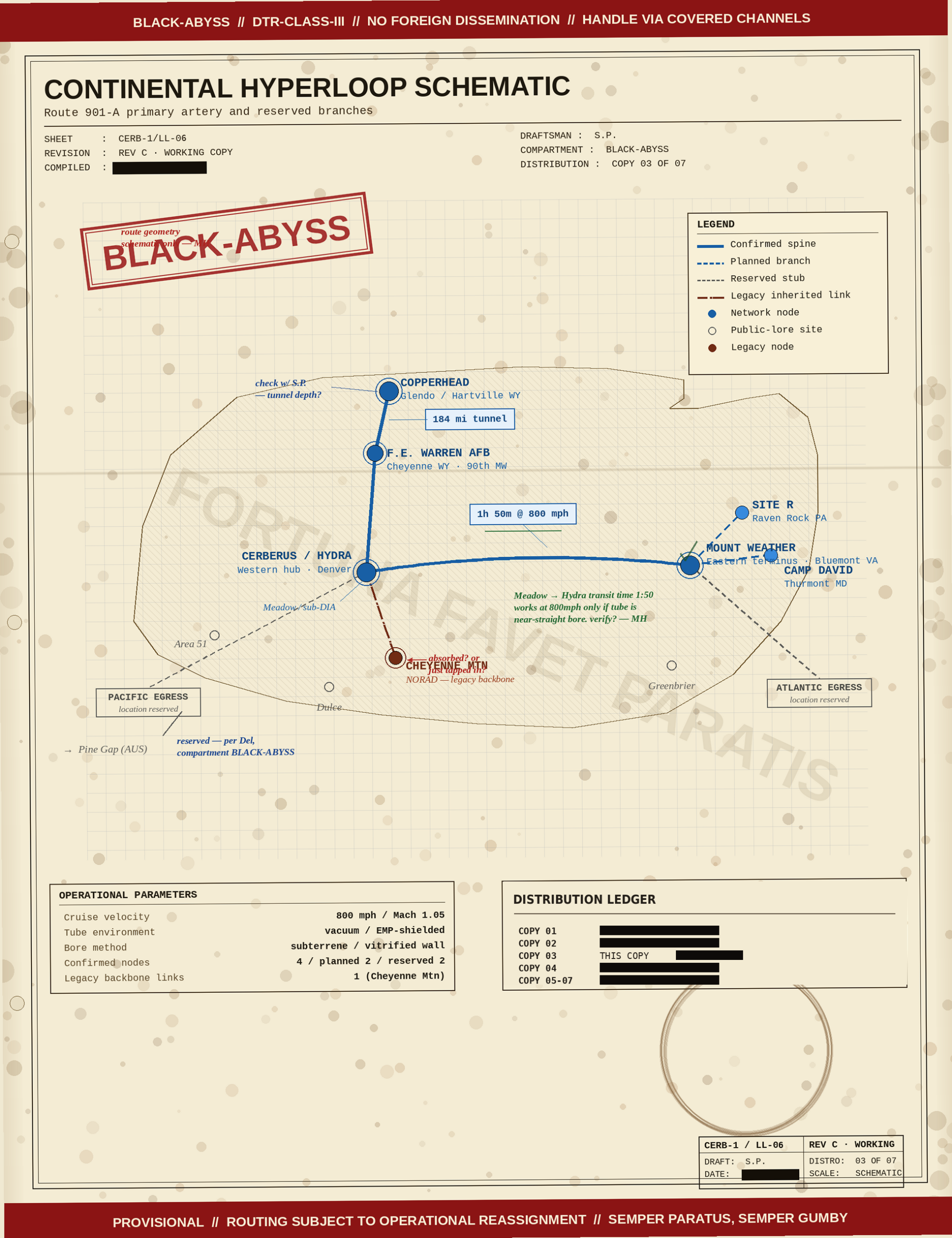
Seq. 01CERB-1 / LL-06  ·  ROUTING Copy 03
CERB-1/LL-06 — Continental Hyperloop Schematic, Route 901-A primary artery and reserved branches. Recovered working copy with BLACK-ABYSS compartment markings and three-pen annotations.
On Sheet LL-07 · Mid-Atlantic Continuity Detail

The second sheet drops out of continental scale into one corner of it — the Appalachian ridge belt across West Virginia, Pennsylvania, Virginia and Maryland, which is where Route 901-A ends.

The sheet overlays two networks on one set of ridges. The hyperloop arrives from the west — the arrow is labeled from Cerberus — and terminates at Mount Weather, with the same planned-not-built branches to Site R and Camp David that LL-06 showed. Over the top of it, in amber, sits the 1970s Presidential Emergency Facility microwave relay grid: seven hardened tower sites built under the White House Communications Agency program, with confirmed hops drawn solid and inferred hops dashed.

Three of the seven PEF sites sit directly on hyperloop terminal nodes. Crystal at Mount Weather. Cactus at Camp David. Creed at Site R. The remaining four — Cannonball at Cross Mountain PA, Cowpuncher at Roundtop Mountain WV, Corkscrew at Lamb’s Knoll MD, and Cartwheel at Fort Reno Park in Washington DC — sit along the RF backbone at independent geographies.

The red pen: “three sites overlap — NOT coincidence. MH.” The interlock panel at the foot of the sheet says the quiet part in compiler voice — that the 1970s microwave network and the subterrene bore share the same hardened facilities, in different compartments, from different eras, on the same real estate. Which is the whole thesis of this binder compressed into one line, and the draftsman put it in a box on the page.

MH also flags the name collision: Corkscrew is drawn here at Lamb’s Knoll, and appears on LL-02 as the Raven Rock corridor. A mountaintop tower on one sheet, a tunnel corridor on another, same code-name, same hand.

And there’s one MH didn’t flag. Look at Creed. On LL-02, Creed is a corridor — a tunnel branch running out of the November Tango Charlie junction. On LL-04 and again here, Creed is a relay site co-located at Site R. That’s the Chimera problem exactly: a line on one sheet, a place on another. Chimera, Crowbar, Hydra, Corkscrew, and now Creed. Five. Either this draftsman is the sloppiest person ever cleared into a compartment, or the naming convention is doing work I don’t understand yet.

The blue hand records that “Jax did the antenna work on CORKSCREW + COWPUNCHER.” No initials, no rank, no context — the only person in this entire binder referred to by what looks like a first name, and the only annotation anywhere that describes somebody physically doing a job with their hands. I don’t know who Jax is. It is the single most human mark on either sheet.

The green pen notes that Cartwheel at Fort Reno Park was transferred to the FAA, and asks whether the tower is still up. It is. That’s checkable and public. Which is the second time on these two sheets that the green pen has written down something verifiable and been correct about it, while the red pen asks questions it can’t close and the blue pen asks other people for specifications. One person, two pens, and the green one only comes out when the answer is known.
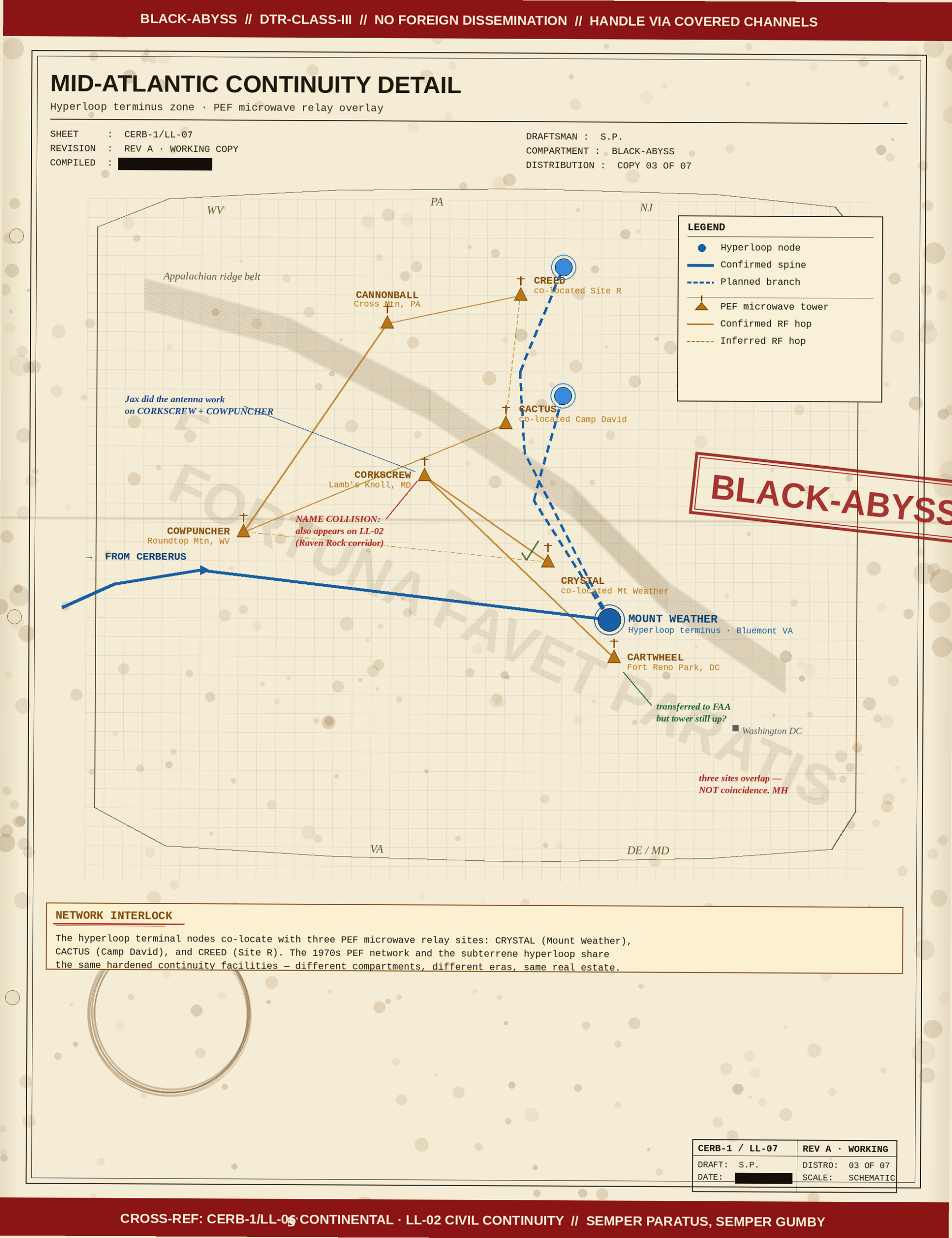
Seq. 02CERB-1 / LL-07  ·  ROUTING Copy 03
CERB-1/LL-07 — Mid-Atlantic Continuity Detail showing hyperloop terminus zone and PEF microwave relay overlay. Recovered working copy.
END  ·  OF  ·  PACKET
CERB-1 / LL series  ·  2 sheets  ·  1 transmittal
Closing · What I think we just looked at

Two sheets. One draftsman. Three pens, two of them the same person.

What the packet wants you to see is the transit layer. The first packet drew signal — fiber, microwave, tunnels carrying cable. These two draw movement: a vacuum bore running a continent’s width from a hub under Denver to a mountain in Virginia, a northern leg into the Wyoming missile fields, and a terminus in the Blue Ridge that lands directly underneath three Cold War relay towers built for a different program in a different decade. Different compartments, different eras, same real estate. Their words, not mine.

What the packet doesn’t tell you is who was arguing, and this time we can at least see that somebody was. S.P. drew a link to Cheyenne Mountain. MH questioned it here and struck it on another sheet. Working copies get cleaned before distribution. These weren’t. Whoever compiled copy 03 of 07 either had no time to clean it, or wanted the argument to travel with the map.

The questions I’m left with are worse than the ones I started with. How does one source reach two different distribution runs of the same compartment? Why does S.P. keep drawing Cheyenne Mountain onto a network MH has confirmed it isn’t on? Why do five code-names each mean two different things? Where is the sheet T.B. was looking for when they wrote check LL-0? Who is MH? Who is Del? And who is Jax, who climbed the towers?

The honest answer is the same as last time. I know what came to me. I know the installations are real, the WHCA code-names are real, the subterrene program is real, the FAA transfer at Fort Reno is real, and the arithmetic on the transit time works out. I know these two sheets are internally consistent with each other and with most of the six that came before. I know one of them isn’t. What that means is not something I can tell you.

I’m putting it where people can see it. Draw your own conclusions. Pay attention to the pen.

/ /   DTR-CLASS-III   / /   CONTINUITY COMPARTMENT   / /   BLACK-ABYSS   / /   NOFORN   / /

Narrative device from The Continuity Chronicles by Nick Meacher. Real sites named above are fact and real programs referenced are public record; the transit network linking them, and the compartment that owns it, are fiction. Area 51, Dulce, the Greenbrier and Pine Gap appear as reference landmarks only and are not represented as part of any network. fortunefavorstheprepared.com  ·  Semper paratus, semper Gumby.

Login with Patreon

Login with Patreon

Search Site

Products

  • Family Emergency Plan and Household Recovery Workbooks - Patreon Family Emergency Plan and Household Recovery Workbooks - Patreon $34.95
  • Bundle - Family Emergency Plan and Household Recovery Workbooks Bundle - Family Emergency Plan and Household Recovery Workbooks $46.95
  • Household Recovery Workbook Household Recovery Workbook $29.95
  • The Continuity Chronicles Seal Decal The Continuity Chronicles Seal Decal $5.00 Original price was: $5.00.$3.00Current price is: $3.00.
  • Family Emergency Plan Workbook - Patreon Family Emergency Plan Workbook - Patreon $19.95
  • Personal Preparedness Assessment Workbook - Patreon Personal Preparedness Assessment Workbook - Patreon $19.95
  • The Next of Kin Workbook - Patreon The Next of Kin Workbook - Patreon $23.95
  • Personal Preparedness Assessment Report Personal Preparedness Assessment Report $179.95
  • Bundle - Family Emergency Plan + Next of Kin Workbooks Bundle - Family Emergency Plan + Next of Kin Workbooks $49.95
  • The Next of Kin Workbook The Next of Kin Workbook $29.95
  • ASAR — 50 Mile Radius ASAR — 50 Mile Radius $139.95
  • ASAR 50-MILE + FEP WORKBOOK ASAR 50-MILE + FEP WORKBOOK $169.95
  • ASAR — 50 Mile Radius - Patreon ASAR — 50 Mile Radius - Patreon $39.95
  • Bundle - The Series Starter (Paperback) Bundle - The Series Starter (Paperback) $29.98
  • The Brush (Paperback) The Brush (Paperback) $15.99
  • The Meadow Protocol (Paperback) The Meadow Protocol (Paperback) $13.99
  • Cards (4x6) - Brevity Cards for OTP Cards (4x6) - Brevity Cards for OTP $24.95
  • Communications Card bundle (13 cards) Communications Card bundle (13 cards) $41.95
  • Personal Preparedness Assessment Workbook Personal Preparedness Assessment Workbook $24.95
  • Family Emergency Plan Workbook Family Emergency Plan Workbook $24.95

Product categories

Cart

©2026 Fortune Favors the Prepared | Built using WordPress and Responsive Blogily theme by Superb