The third packet is the one that frightened me, and it took me a long time to work out why.
There is nothing classified in it. Not one page. No draftsman’s initials, no reviewer’s red pen, no CERB-1 stencil. The binder that carried the first two packets carried this one too, but this one came in a plain manila envelope with a rubber band around it, and every document inside can be found by anybody with a library card and a free afternoon.
Federal Register citations. A presidential directive with a public URL. A congressional hearing that ran on live television. Two newspaper investigations. A freedom-of-information release from a presidential library. A Department of Defense instruction you can download right now without asking permission from anyone.
Here is what I think the sender was telling me, and it is the least sensational and most unsettling thing in three packets.
The architecture is not hidden. It is published. It has been published continuously since 1956. Nobody reads it.
What follows is twelve exhibits. Four of them I have been able to photograph directly — actual pages, actual typewriter, actual Government Printing Office typesetting. The rest I have transcribed as faithfully as I can. Eleven carry a source you can check without me. I want you to check them. I would rather be corrected than believed.
The eleventh came on an index card, in ballpoint, in the same hand as the address on the envelope. It has no source. It has never appeared in any public record I have been able to search.
I have left it in. You will know it when you reach it.
MATERIAL ENCLOSED
THE OPEN
FILE
RECEIVED
SOURCES ELEVEN OF TWELVE OPEN
EXCEPTIONS ONE (1)
THE INSTRUMENTS
SECTION 1. There is hereby established in the executive branch of the Government a National Defense Executive Reserve composed of persons selected from various segments of the civilian economy and from Government, for training for employment in executive positions in the Federal Government in the event of the outbreak of war or other national emergency.
SECTION 3. The Director shall provide for the maintenance of rosters of the members of the National Defense Executive Reserve, and shall establish standards for the recruitment and training thereof.
SECTION 5. No person shall, by reason of his membership in the Reserve, act or advise concerning any matter pending before any department or agency; his activity shall be limited to receiving training for mobilization assignment.
DWIGHT D. EISENHOWER · THE WHITE HOUSE · FEBRUARY 15, 1956
TRANSCRIBED FACSIMILE — NOT A SCAN. VERIFY AGAINST THE FEDERAL REGISTER.
Read Section 1 and Section 5 together and you will see the trap Eisenhower built, almost certainly without meaning to.
Section 1 creates a standing body of private citizens — bankers, engineers, logisticians, executives — selected, cleared, rostered, and trained to run departments of the United States government. Section 5 says that until the emergency arrives, they may not so much as offer an opinion on a matter before an agency.
So the reservist sits in a legal null state. Fully prepared. Entirely powerless. There is no gradient between the two conditions and no ceremony that bridges them. One day you are a civilian who has been to some briefings. The next day you are running a federal program.
Nothing changes about the person. The only thing that changes is a piece of paper.
This is the question The Continuity Chronicles has been circling since Book 1: not who has power, but who is entitled to pick it up when the people who held it are gone. Book 3 is called Unassigned Authority for a reason.
SECTION 6. Executive Reserve Units established under Executive Order No. 10660 and in existence on the date of this order shall be deemed to be Executive Reserve Units established under this order, and any person who on such date is a member of any such Unit may continue to serve as such without further designation.
LYNDON B. JOHNSON · THE WHITE HOUSE · SEPTEMBER 22, 1964
TRANSCRIBED FACSIMILE — NOT A SCAN. VERIFY AGAINST THE FEDERAL REGISTER.
If you read one thing in this file, read that clause twice.
It establishes that a designation made under one executive order, by an official whose office no longer exists, in a legal regime that has since been replaced, survives automatically into the next one. No review. No re-application. No renewal notice. The order does the carrying by itself.
And that clause has now been exercised four more times. 1979 — Carter moves the program to FEMA. 1994 — Clinton supersedes 11179 entirely. 2012 — Obama re-establishes the Reserve and hands it to the Secretary of Homeland Security, an office that did not exist when most of these designations were made.
Five administering officials in seven decades. At every handoff, the people already on the list came across.
Continuation is automatic. Termination requires somebody to actually do the paperwork. Ask yourself which of those two things a large bureaucracy is better at.
(a) There is established in the executive branch a National Defense Executive Reserve composed of persons of recognized expertise from various segments of the private sector and from Government (except full-time Federal employees) for training for employment in executive positions in the Federal Government in the event of a national defense emergency.
(d) … This authority may not be redelegated.
(e) The head of any agency may activate an NDER unit, in whole or in part, upon the written determination of the Secretary of Homeland Security that an emergency affecting the national defense exists and that the activation of the unit is necessary to carry out the emergency program functions of the agency.
(f) Prior to activating the NDER unit, the head of the agency shall notify, in writing, the Assistant to the President for Homeland Security and Counterterrorism of the impending activation.
TRANSCRIBED FACSIMILE — SECTION 501 ONLY. THE FULL ORDER AS PRINTED:
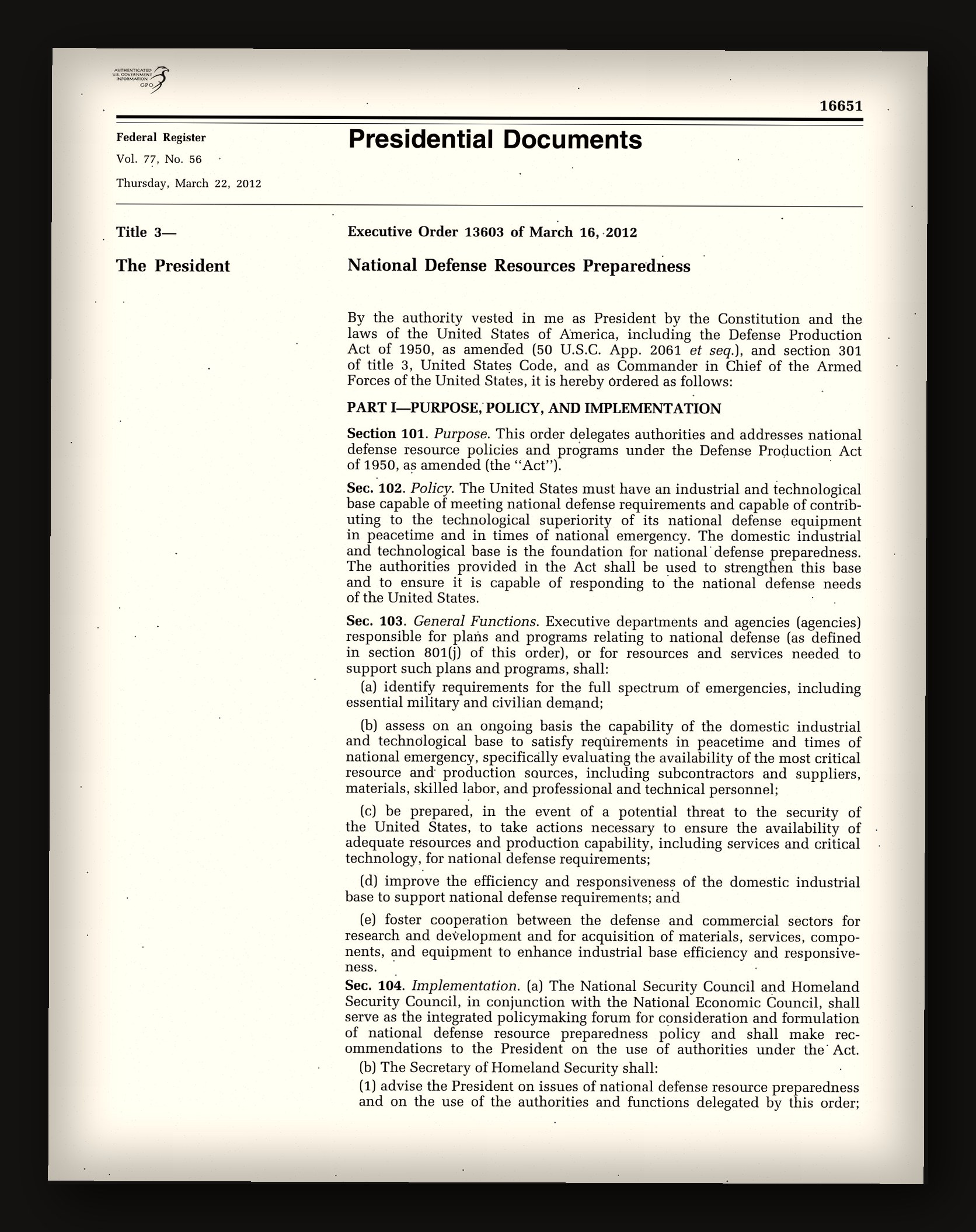
TAP TO ENLARGE ▸PHOTOGRAPHED ORIGINAL · Federal Register vol. 77 no. 56 — Presidential Documents — 22 March 2012 — page 16651. Public domain.
AMENDED BY EO 14391, 13 MAR 2026 (§203 ONLY). §501 STANDS AS PRINTED.
This is the live one. Not history. In force this morning.
Thousands of people can be fully trained, fully cleared, and fully rostered to run the government — and not one of them can lawfully begin until one named official at one desk in Washington signs one piece of paper. The authority to do it cannot be handed to a deputy. The order says so explicitly.
There is no alternate named. No successor mechanism written into the order. No paragraph describing what happens if the determination cannot be made, cannot be transmitted, or cannot be verified when it arrives.
The most consequential switch in the civil continuity architecture has exactly one hand on it — and the order never contemplates that the hand might not be there.
Readers of Book 3 will recognise the shape of this immediately — it is the civil twin of the nuclear command problem that runs through the back half of the novel. Same failure. Different letterhead. A perfectly designed chain with one link, and nothing written down about the day the link is missing.
SUBJECT National Defense Executive Reserve (NDER)
ISSUED BY Under Secretary of Defense for Personnel and Readiness
APPLIES TO OSD, Military Departments, Joint Staff, all DoD Components
3.2. NDER unit membership shall be limited to the number of executive positions that cannot be filled appropriately during a national emergency by regular full-time Federal employees.
3.4. Members are not officers or employees of the Federal Government while receiving training.
4.1. Members expected to serve no more than 130 days in any period of 365 consecutive days are special Government employees under 18 U.S.C. §202(a).
4.6. An NDER appointee may continue to receive compensation from a private employer during the period in which the appointee performs services for the Federal Government.
5.3. Components shall submit appropriate documentation to FEMA upon deactivation of an NDER unit.
CONDENSED FACSIMILE — PROVISIONS PARAPHRASED AND REORDERED FOR LENGTH. FULL TEXT IS PUBLIC.
Four lines here matter, and I want to take them in order because the order is where it gets bad.
3.2 — the size cap. The unit is sized to the gap. So if you ever learn how large an activated Reserve unit is, you have learned something else entirely: how many senior federal executives the United States no longer has. Activation at scale is not a policy decision. It is a casualty report.
4.1 — the clock. One hundred and thirty days in any three hundred and sixty-five. Past that threshold the ethics regime that governs the appointee changes. Somebody, somewhere, is supposed to be counting.
4.6 — the payroll. Read it again. An activated appointee exercising federal executive authority may keep drawing a salary from the private company that employs them. In a functioning state this is a managed conflict — disclosure forms, day limits, an ethics office. Strip those away and what remains is a corporation’s employee running a piece of the United States government, entirely lawfully.
5.3 — the exit. Getting out of the Reserve requires paperwork submitted to FEMA. Getting in is a letter. Staying in is automatic. Leaving is an errand.
A filing system does not know when it is finished.
THE REHEARSALS
THE ARMAGEDDON PLAN
Each team carried a chief of staff and a designated Cabinet member who would become president. On warning of imminent nuclear attack the teams would deploy to separate locations around the country. In succession, each one could take over the running of the United States.
The exercises ran for years. Participants disappeared for days at a stretch and told their families very little. Among them were men who were not, at the time, serving in the executive branch at all.
Broadcast interviews the same year added corroboration from a former Attorney General, a former White House chief of staff, and a former counterterrorism chief — who stated that on the morning of 11 September 2001 the entire continuity-of-government program was activated.
The chief of staff, describing that day, recalled realising as it went on that the thing they had rehearsed for twenty years was working.
SUMMARY FACSIMILE — PARAPHRASED FROM PUBLISHED REPORTING. NOT A REPRODUCTION.
Hold this against Exhibit 01 and look at what you have.
In 1956 the United States built a mechanism for placing private citizens into federal executive positions during an emergency, wrote it down, published it in the Federal Register, and left it running.
In the 1980s the United States ran, in secret, an unpublished program that did approximately the same thing at Cabinet level — and by the account of the journalist who documented it, did so with no constitutional or statutory authorisation whatsoever.
I cannot prove the two are connected. I can observe that they solve the identical problem, that they overlapped in time, and that only one of them was written down where you could read it.
And I can observe that the published one is still running.
A designated successor presidency staffed by people who were not, at the time, in government. Private citizens with a claim to federal executive authority, waiting on a signal.
If that sounds like the central argument of this series, it is because the series was built on the observation that this part is not invented.
041REP. BROOKS: Colonel, in your work at the National
042Security Council — were you not at one time assigned to
043work on plans for the continuity of government in the
044event of a major disaster?
045MR. SULLIVAN: Mr. Chairman —
046SEN. INOUYE: I believe that question touches upon a
047highly sensitive and classified area. May I request that
048you not touch upon that.
049REP. BROOKS: I was particularly concerned, Mr.
050Chairman, because I had read in the press that there had
051been a plan developed by that same agency — a
052contingency plan in the event of an emergency — that
053would suspend the American Constitution.
054SEN. INOUYE: [Directs that the matter be reserved
055for executive session. Questioning moves on.]
CONDENSED FROM THE PUBLIC RECORD. VIDEO EXISTS IN THE C-SPAN ARCHIVE — WATCH IT YOURSELF.
I want to be careful here, and being careful costs me the most sensational entry in the file. I am going to pay it anyway.
The exchange is a documented fact. It happened, on camera, in front of the country. A sitting congressman asked a question about continuity-of-government planning and was ruled out of order twice inside ninety seconds — by the chairman of his own party’s committee.
What the exchange was about is not established. The 1984 readiness exercise it points at is real and appears in the scholarly literature. The detention allegations that have attached themselves to it over four decades rest on considerably thinner ground than their circulation suggests, and I am not going to launder them by putting them next to documents that are solid.
You do not need the mythology. The footage is stronger than the mythology. A question about who runs the country after a catastrophe was ruled too sensitive to ask out loud — and that is the part nobody disputes.
SHADOW GOVERNMENT IS AT WORK IN SECRET
The arrangement was activated on the morning of the attacks and has run without interruption since. Officials rotate through the facilities on ninety-day cycles, maintaining the capacity to direct federal functions should Washington be destroyed.
Members of Congress, including senior figures in leadership, said afterward that they had not been told the program was operating.
The reporting itself used the phrase that has attached to the story ever since. Not a leak. Not an allegation. A description, on the front page, of an arrangement that was simply in effect.
SUMMARY FACSIMILE — PARAPHRASED FROM PUBLISHED REPORTING. NOT A REPRODUCTION.
Every conspiracy theory in this file borrows a phrase. That phrase entered mainstream American usage on the front page of a national newspaper, describing something that was actually happening, and the government did not deny it.
It is worth being precise about what was and was not remarkable. The facilities were not secret. The doctrine was not illegal. The program had been planned in the open for decades — Exhibits 01 through 03 are part of the same architecture.
The remarkable part is narrower and colder: the legislature was not informed that it had been switched on.
Not because anyone decided to hide it. Because no instrument anywhere required anybody to say so.
For thirty-three years a bunker for the entire United States Congress sat under a luxury resort in West Virginia, maintained under commercial cover, while guests played golf on top of it. It closed the year a newspaper printed its existence — not because it failed, because it was published.
Book 1, The Meadow Protocol, is about what happens when facilities like that are built for people who will never be on any public list.
THE UNREADABLE
NATIONAL SECURITY PRESIDENTIAL DIRECTIVE / NSPD-51
HOMELAND SECURITY PRESIDENTIAL DIRECTIVE / HSPD-20
SUBJECT: NATIONAL CONTINUITY POLICY
(1) THIS DIRECTIVE ESTABLISHES A COMPREHENSIVE NATIONAL
POLICY ON THE CONTINUITY OF FEDERAL GOVERNMENT STRUCTURES
AND OPERATIONS AND A SINGLE NATIONAL CONTINUITY COORDINATOR.
(22) REVOCATION. PRESIDENTIAL DECISION DIRECTIVE 67 OF
OCTOBER 21, 1998, INCLUDING ALL ANNEXES THERETO, IS HEREBY
REVOKED.
(23) ANNEX A AND THE CLASSIFIED CONTINUITY ANNEXES,
ATTACHED HERETO, ARE HEREBY INCORPORATED INTO AND MADE A
PART OF THIS DIRECTIVE.
(24) SECURITY. THIS DIRECTIVE SHALL BE PROTECTED FROM
UNAUTHORIZED DISCLOSURE, PROVIDED THAT, EXCEPT FOR ANNEX A,
THE ANNEXES ATTACHED HERETO ARE CLASSIFIED.
– – – – – – – – – – – – – – – – – – – – – – – – – –
ANNEX A RELEASED. CONTINUITY ANNEXES NOT RELEASED.
TRANSCRIBED FACSIMILE ABOVE. BELOW: THE DIRECTIVE ITSELF.
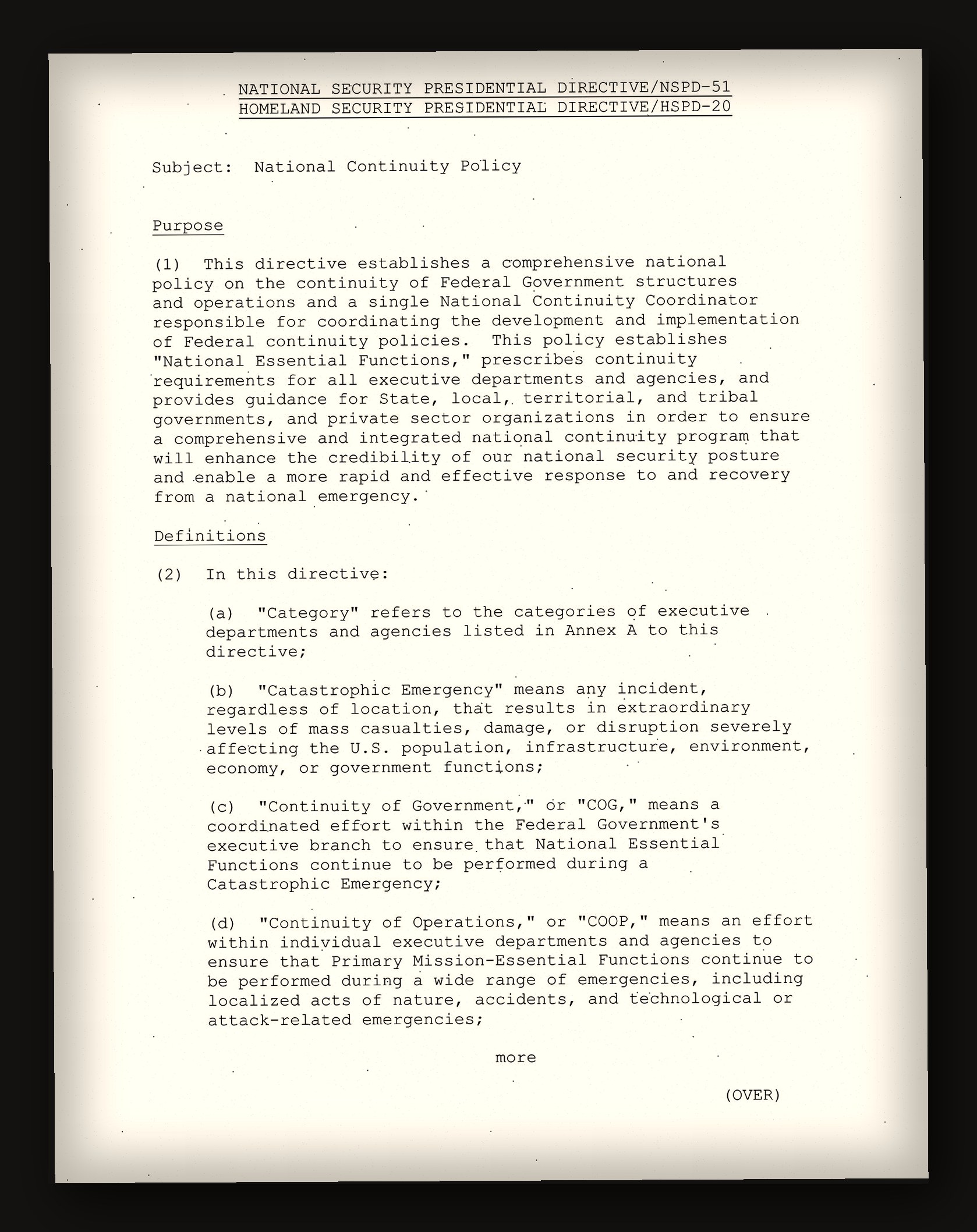
PHOTOGRAPHED ORIGINAL · NSPD-51 / HSPD-20, page 1. Typewriter face. Note “more” and “(OVER)” at the foot.
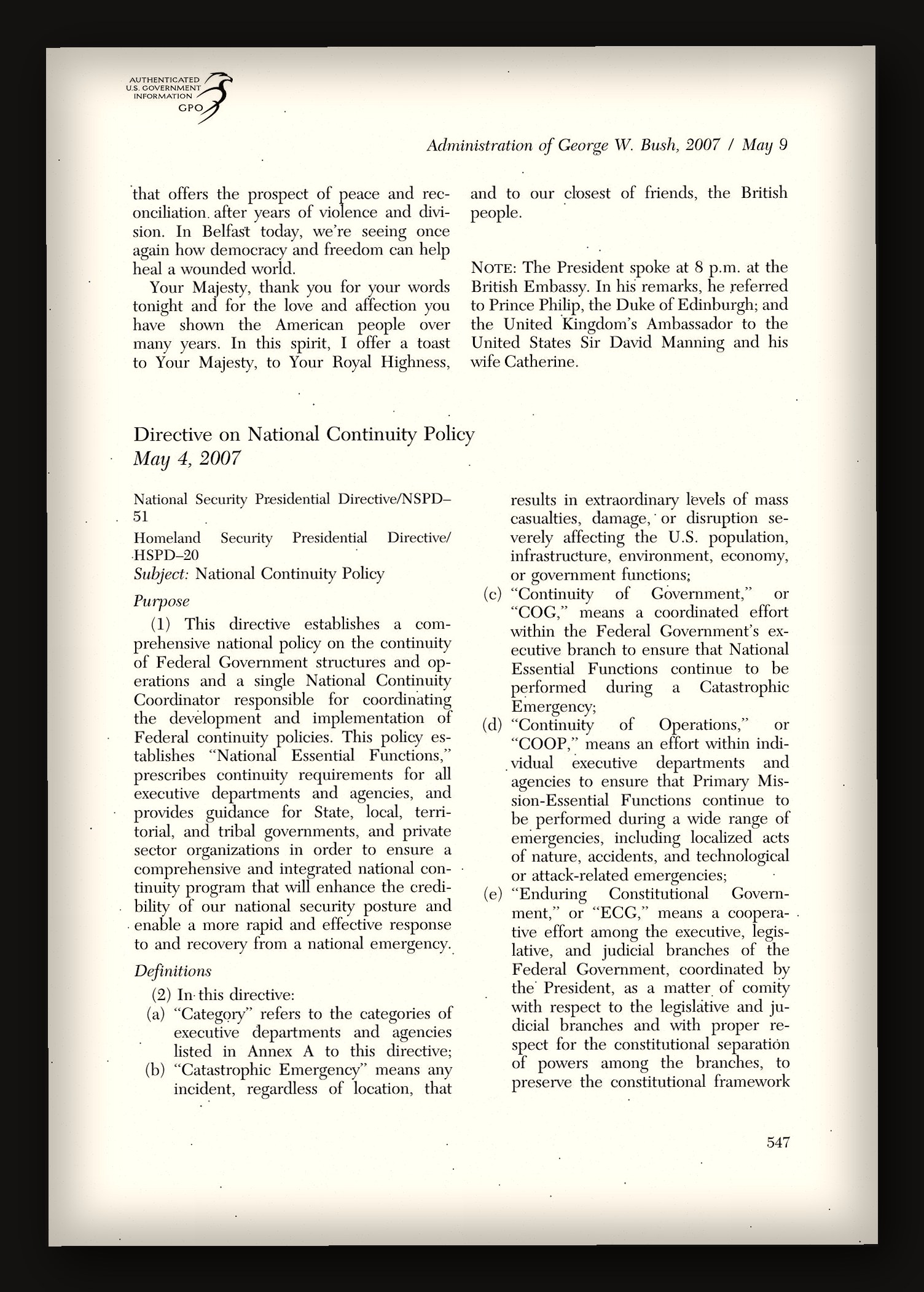
PHOTOGRAPHED ORIGINAL · The same directive as typeset for the Public Papers of the Presidents, 2007.
BOTH PAGES ARE US GOVERNMENT WORKS. PUBLIC DOMAIN. REPRODUCED UNALTERED APART FROM COPIER TREATMENT.
Paragraph 23 does something I have never seen anywhere else in federal practice, and once you notice it you cannot stop noticing it.
The public directive declares that the secret annexes are part of the directive itself. Not attachments. Not implementing guidance. Constituent text. Which means the published document you are permitted to read is, by its own admission, an excerpt.
A member of the House committee with jurisdiction over homeland security asked to see those annexes and was refused on national security grounds. He said publicly that in his career in Congress he had never before been denied access to classified material he had requested.
Even Annex A — the part they did release — is quietly remarkable. It sorts every executive department and agency into one of four categories by continuity responsibility. Somebody has already ranked the government by how much of it is required to survive.
For nine years the operative national continuity policy of the United States was a document Congress could read the introduction to.
Now hold Exhibit 08 against Exhibit 03 and watch them lock together.
The National Continuity Coordinator created by this directive is the Assistant to the President for Homeland Security and Counterterrorism. The official who must be notified before any Executive Reserve unit is activated under EO 13603 §501(f) is the Assistant to the President for Homeland Security and Counterterrorism.
Same desk. Two architectures written twenty-one years apart by administrations of opposing parties, both funnelling through one chair in the West Wing. That is either excellent design or the narrowest imaginable point of failure, and I no longer believe those are different things.
Hold that thought for exactly one exhibit.
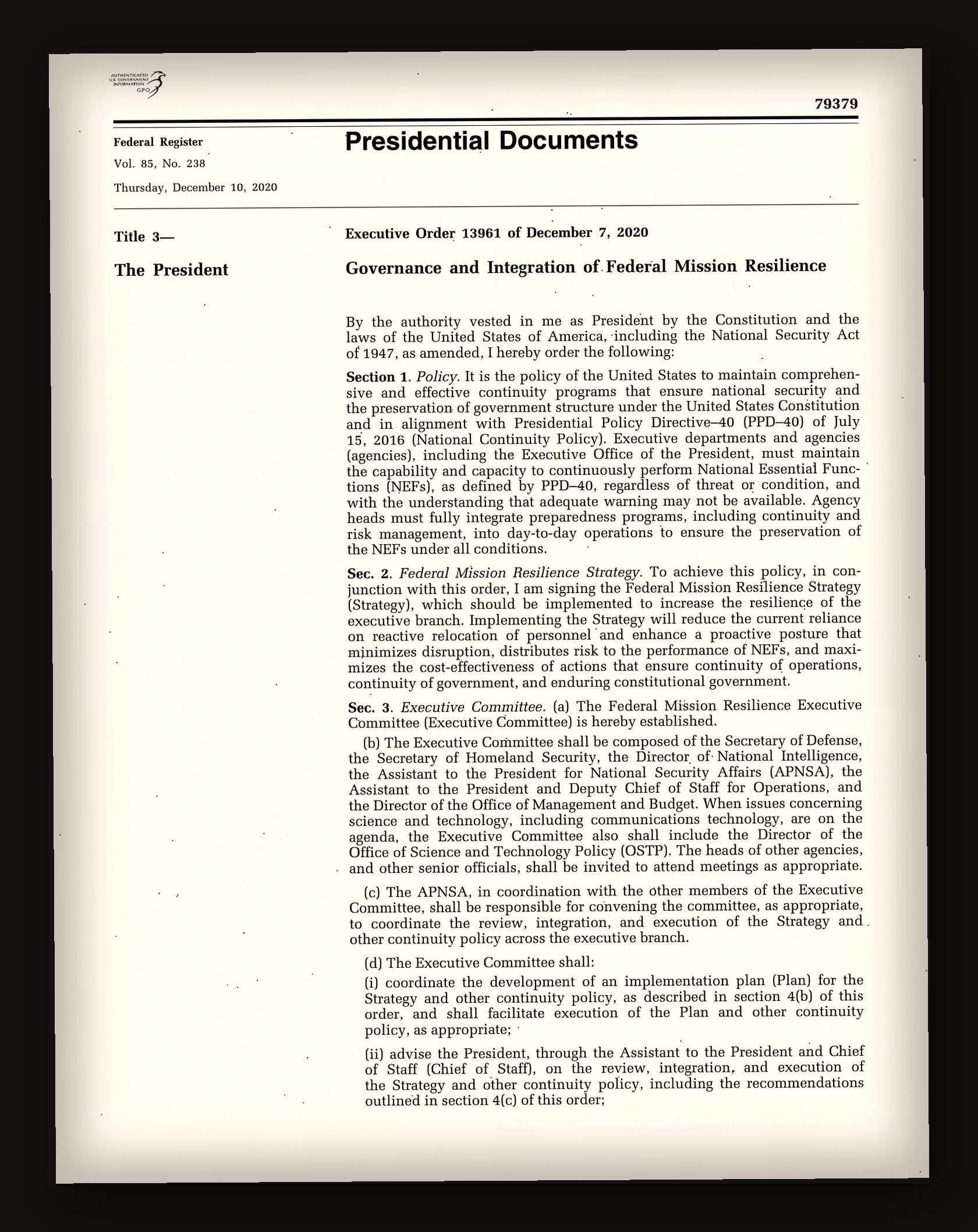
TAP TO ENLARGE ▸PHOTOGRAPHED ORIGINAL · Federal Register vol. 85 no. 238 — 10 December 2020 — page 79379. Public domain.
Sec. 5. Amendment to PPD-40. To designate a new National Continuity Coordinator (NCC), in section 6 of PPD-40, the second sentence is hereby revised to read as follows: “To advise and assist the President in that function, the Assistant to the President for National Security Affairs, or his or her designee, is designated as the NCC.”
TRANSCRIBED FROM THE PAGE ABOVE. PPD-40 ITSELF REMAINS CLASSIFIED — THIS IS THE ONLY PUBLIC WINDOW ONTO ITS TEXT.
Two things happen on this page and only one of them is obvious.
The obvious one: a classified presidential directive is being publicly amended, in the Federal Register, by quoting a sentence of it. PPD-40 has never been released. This paragraph is the only public sight anybody outside has of its actual text — one sentence, printed because you cannot revise a sentence without saying what it now reads.
The one that took me a week to see: the National Continuity Coordinator moved.
From 2007 the role sat with the Assistant to the President for Homeland Security and Counterterrorism. As of December 2020 it sits with the Assistant to the President for National Security Affairs. Different office. Different chair. Different corridor.
Now go back to Exhibit 03 and read §501(f) again. It is still in force. It has been amended once since, in March 2026, and that amendment touched a different section entirely.
It still says that before activating a National Defense Executive Reserve unit, the agency head shall notify, in writing, the Assistant to the President for Homeland Security and Counterterrorism.
The convergence I described in Exhibit 08 was real for thirteen years. Then in December 2020 one architecture moved its coordinator and the other one didn’t notice.
I want to be careful about what I am and am not claiming. This is not a scandal. It is not evidence of anything. Executive orders carry stale cross-references all the time, and there are perfectly ordinary reasons why nobody has gone back to tidy §501(f) — chiefly that nobody has needed to.
What I am claiming is narrower. The published architecture now contains a seam. On the day somebody has to activate a Reserve unit, the order will tell them to notify an official who is no longer the National Continuity Coordinator, and the person actually holding that job will be in a different office entirely, and nothing anywhere says which of them is right.
This is the whole thesis of the series in one Federal Register page, and I did not have to invent any of it.
Nobody did anything wrong here. Nobody conspired. Two competent offices maintained two overlapping systems, one of them was updated on a Monday in December, and the other one carried on pointing at a door that had quietly stopped being the door.
That is how continuity actually fails. Not with a coup. With a cross-reference nobody updated, discovered by somebody at three in the morning who needs an answer now.
SUBJECT: PRESIDENTIAL EMERGENCY ACTION DOCUMENTS (PEADs)
PEADs ARE EXECUTIVE ORDERS, PROCLAMATIONS AND MESSAGES TO
CONGRESS PREPARED IN ADVANCE OF EMERGENCY SCENARIOS AND HELD
READY FOR SIGNATURE. ORIGINATED UNDER
PRESIDENT EISENHOWER AS PART OF PLANNING.
COUNT IN EFFECT: 56 (PREVIOUSLY 48)
DOCUMENTS WITHDRAWN DURING REVIEW: NONE
DOCUMENTS ADDED: 8
HISTORICAL SCOPE PER OFFICIAL REPORTS OF THE 1960s:
— SUSPENSION OF THE WRIT OF HABEAS CORPUS
— DETENTION OF PERSONS DEEMED DANGEROUS
— CENSORSHIP OF NEWS MEDIA
— RESTRICTION OF TRAVEL
—
—
APPROXIMATELY 6,000 PAGES
EXEMPTIONS (b)(1) (b)(3) (b)(5)
NO PEAD HAS EVER BEEN DECLASSIFIED, RELEASED, OR LEAKED.
COMPOSITE FACSIMILE — ASSEMBLED FROM PUBLISHED FOIA MATERIAL AND RESEARCH SUMMARIES.
Seventy years. Twelve administrations. Not one has ever been declassified, released, or leaked. Not one.
A legal-policy institute spent years litigating and obtained roughly five hundred pages of surrounding correspondence. Six thousand further pages were withheld in full. Everything anybody knows about content comes from official reports of the 1960s.
I want to be exact, because this is the exhibit most likely to be misused by somebody quoting it out of context. Nothing above asserts what any current PEAD says. Nobody outside knows what any current PEAD says. That is the whole point, and it is a narrower claim than the folklore makes, and much harder to dismiss:
There exist fifty-six signed-and-ready instruments of presidential authority that no member of Congress has read. That is not a theory about the documents. That is the documented status of the documents.
THE FOLKLORE
The camps
The most durable claim in the folklore: that the federal emergency-management apparatus maintains standing detention facilities awaiting a domestic emergency.
I looked at this seriously, because I did not want to dismiss it by reflex. The record does not support it. The photographs are of existing correctional facilities, disused rail yards, and industrial storage. The purchase orders are routine procurement.
What is in the record is older and stranger: the government has at times maintained lists of persons to be detained in an emergency, and in one documented instance an Attorney General refused to hand such a list over for an exercise. The camps are not there. The list-making was real. Those are different claims, and the second one does not need the first.
The secret committee briefing
Documents surfaced in the 1980s purporting to record a secret executive committee chartered by presidential memorandum, operating outside all oversight. They are forgeries. The typography is wrong for the period. The date formats do not match the offices they claim to come from. A signature block was lifted from an unrelated authentic document.
I include this deliberately, and not to be smug. It is the best available lesson in how to read the other nine exhibits. The forgery was caught on internal evidence — format, typeface, citation practice — by people who never needed access to a classified archive to do it.
If a document cites a statute at a section number that did not exist on the date it claims to have been written, the document is lying about its date. That is not tradecraft. That is proofreading.
The three that were real
A discipline is worth nothing if it cannot be turned against the person holding it. So here is the entry that argues with the rest of the file.
That an intelligence agency ran domestic chemical and behavioural experimentation on unwitting subjects was treated for years as paranoid fantasy. It was true — established by congressional investigation in the mid-1970s, after most of the records had been destroyed on the director’s instruction.
That a federal law-enforcement agency ran a sustained covert program to surveil, infiltrate and discredit domestic political organisations was treated the same way. It was true. It surfaced because private citizens burgled a field office in 1971 and mailed the files to newspapers.
That a group of financiers approached a retired Marine Corps general in 1933 to lead a march on Washington was dismissed as the invention of a self-promoting officer. A congressional committee found the essential allegation credible.
I do not offer these as licence to believe anything. I offer them as the reason to check everything. Three times in a century the thing that sounded insane was substantially correct — and in each case what closed the gap was not a leak from inside a bunker. It was a hearing, a burglary, and a general who wrote it down.
The deep state
The general claim — a permanent unelected apparatus exercising durable authority regardless of elections — is not a document and cannot be sourced like one.
What the exhibits actually support is narrower and, I think, worse. There exists a body of pre-assigned authority, published across seventy years, vesting specific powers in specific offices for the circumstance in which ordinary government fails. Assigned by administrations of both parties. Carried forward automatically. Almost never reviewed. Most of the people currently holding those offices have never read the instruments that name them.
That is not a secret government. It is something odder — a dormant one, assembled in public, in increments, by people who mostly meant well, and left switched off.
THE INDEX CARD
Standard ruled stock, the kind sold in packs of a hundred. Blue ballpoint. Same hand as the address on the envelope. No letterhead, no header, no classification marking of any kind.
Six lines on the front, four on the back. The redaction was made on the card, in ballpoint, by the person who wrote it — not by any reviewing authority. It covers the second line only. Everything above and below it is legible.
I have held it up to a lamp. The ink is layered heavily enough that I can count the word breaks and nothing else. There appear to be six words.
They wrote the name. Then they wrote what the name stands for. Then they went back and inked over the second line until it could not be read.
They were not protecting the acronym. They were protecting what it means.
CHARTERED 1978 — MULTI-AGENCY
ABSORBED [date illegible] — ADMINISTRATIVELY
ROUTING NEVER SUNSET
AUTH SCHEMA PREDATES CURRENT
NODE: OSHAD(E)
STATUS: ACTIVE
ROUTING: EXTERNAL
HOLOGRAPH FACSIMILE — HAND-COPIED. NO SOURCE DOCUMENT EXISTS FOR COMPARISON.
There were two further sheets in the envelope, behind the card. I have gone back and forth for a long time about whether to put them up at all, because unlike everything else in this file I cannot show you where they came from, and a document you cannot source is a document that will be used badly by somebody.
I have marked them. Read the marking. Then look at line six of the first one, and the last line of the second.
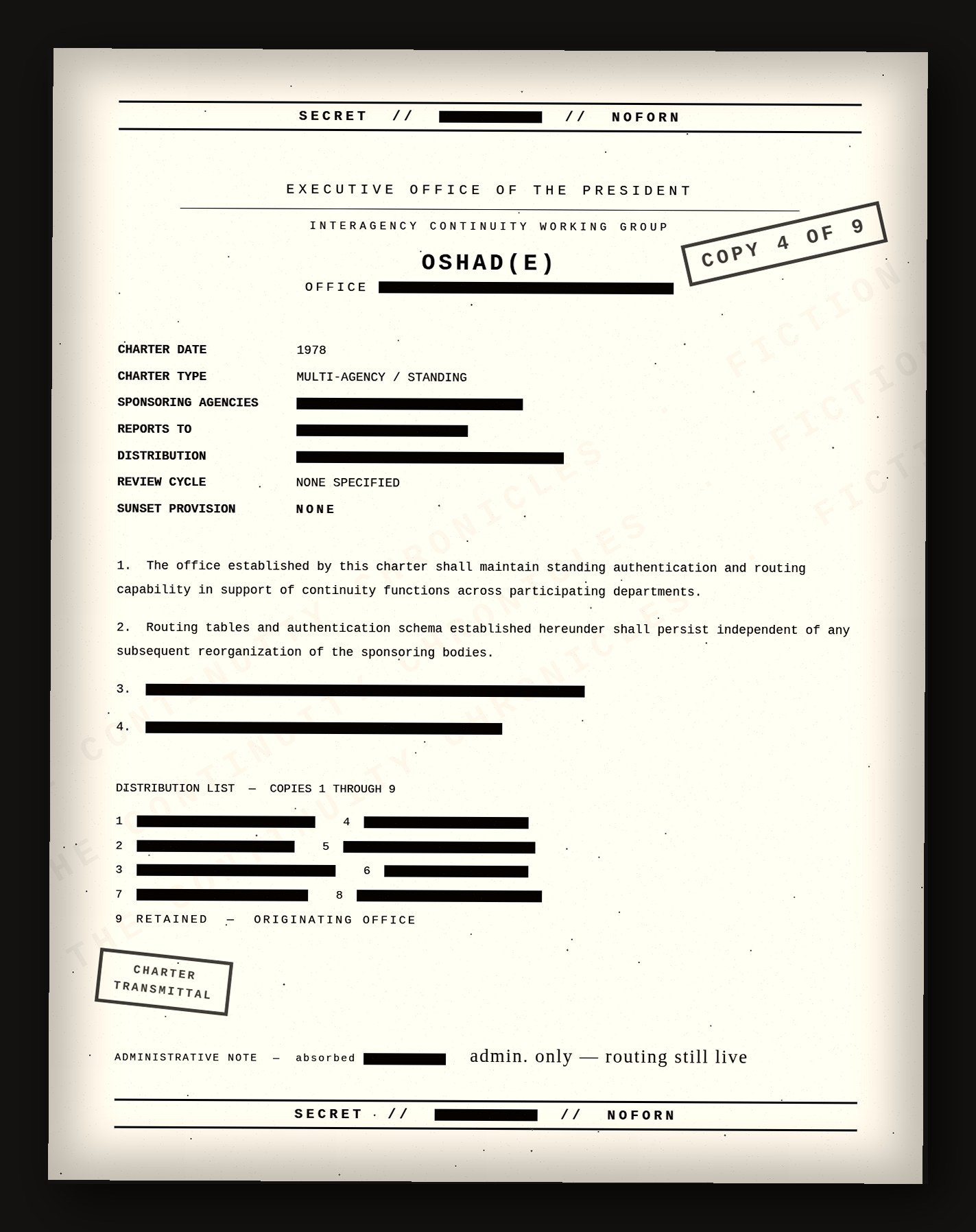
UNSOURCED · CANNOT BE AUTHENTICATED · Charter transmittal cover. SUNSET PROVISION: NONE.
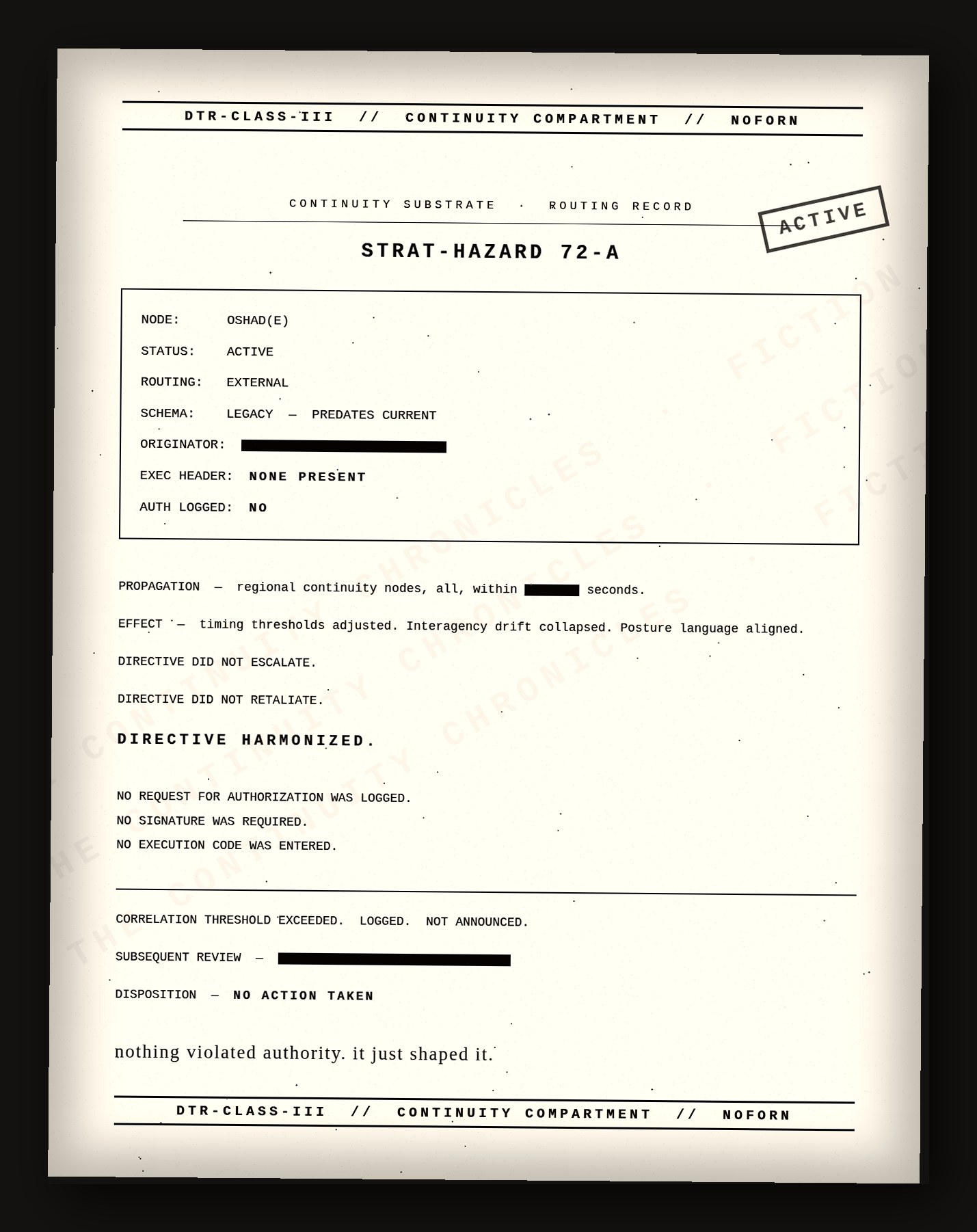
UNSOURCED · CANNOT BE AUTHENTICATED · Routing record. DISPOSITION: NO ACTION TAKEN.
THESE TWO SHEETS CARRY NO PROVENANCE AND NO CHAIN OF CUSTODY. THEY ARE MARKED ACCORDINGLY AND SHOULD NOT BE CIRCULATED WITHOUT THAT MARKING.
The charter cover gives a sunset provision of NONE, a review cycle of NONE SPECIFIED, and a clause stating that routing tables and authentication schema established under it persist independent of any subsequent reorganization of the sponsoring bodies.
If that clause were real it would mean the plumbing was designed from the outset to outlive the committee. Not as an oversight. As a specification.
The routing record is worse in a quieter way. No executive header. No authorisation logged. No signature required. No execution code entered. The directive does not escalate and does not retaliate — it harmonises. And the disposition line at the bottom reads NO ACTION TAKEN, because nothing in it violated anybody’s authority. It never issued a command. It only adjusted the timing thresholds underneath the commands.
Every other exhibit in this file describes a system that needs somebody to switch it on. These two describe a system that does not.
I have spent longer on these ten lines than on the other ten exhibits combined. What I can tell you is almost entirely negative.
The name does not appear in the Federal Register. Not in the United States Government Manual for any year I can check. Not in the Congressional Record. Not in any GAO or inspector-general report I can find. Not in the FOIA reading room of any agency that would plausibly have chartered a continuity committee in 1978. I looked in the obvious places and then in the unobvious ones.
A committee chartered in 1978 would sit almost exactly between Exhibit 02’s carry-forward clause and the 1988 reassignment of emergency preparedness responsibilities. It would have been chartered under an architecture superseded four times since. If it were absorbed in a reorganisation — and the card says it was — the absorbing instrument should be findable. It is not. That could mean the card is wrong. It could mean I am not good enough at this.
On the acronym I get partway and then I stop.
The tag on the reverse reads STRAT-HAZARD, and the letters S and HA sit in the middle of the name in the same order. Strategic Hazard. I am confident of that much, and only because the writer put the tag on the back for exactly that reason. The O is almost certainly Office. Six words under the ink; Office of Strategic Hazard something and something is six words if you are generous with the joins.
I cannot get the D. I have a shortlist. I am not publishing a shortlist, because a shortlist is how guesses turn into citations.
And I cannot account for the E at all.
Look at how it is written. Not OSHADE. Not OSHAD-E. OSHAD(E) — the final letter set apart in brackets, on a handwritten card, by somebody with no reason to bother. Federal acronyms do not normally carry a parenthetical terminal letter. When they do, it is nearly always because the bracketed element was appended to an existing charter later, and the drafters wanted the original name to stay readable inside the new one.
Which would mean the committee was chartered to do one thing, and at some point after 1978 something was added to it.
I do not know what. I know the writer was willing to put down the name, the year, the charter type, the routing status and the authentication schema — and drew the line at the six words that say what it was for.
Now the two faces.
The front says the committee was absorbed. Past tense. A thing folded up and put away. The back says STATUS: ACTIVE.
Same hand, same ink, and from the pressure, the same sitting. The person who wrote this did not consider those two statements to be in conflict.
I have arrived at the only reading that makes both true at once, which is also the reading I like least. A committee can be dissolved on paper while the routing tables it maintained keep resolving — because dissolving a committee and decommissioning an authentication schema are two different administrative acts, performed by two different sets of people, and only one of them is anybody’s job.
Absorbed administratively. Not technically.
The committee was dissolved. The committee is running. Those are not contradictory statements about an organisation. They are consistent statements about a system — and the second one does not need the first one to be alive.
One last thing and then I will stop. Look again at the fourth line on the front: the authentication schema predates the current one.
If a legacy schema was never decommissioned, and a current schema was built on top of it without removing it, then there are two valid ways to authenticate a continuity instruction.
Only one of them requires the chair in the West Wing.
Some readers will have recognised the block on the reverse of that card before they finished the second line.
STRAT-HAZARD 72-A. NODE: OSHAD(E). STATUS: ACTIVE. ROUTING: EXTERNAL.
It appears in Unassigned Authority — in the back half of the novel, twice, in a sequence where a directive propagates across continuity nodes with no executive header, no signature required, and no authorisation logged. It does not escalate. It harmonises. And nothing about it violates anybody’s authority, because it never issues a command. It only adjusts the timing thresholds underneath the commands.
Earlier in the same book, a man at a ranch in Colorado reads the namespace aloud off a screen. Another man in the room — someone who has never explained where he served — steps closer, reads it again, and does not scan the header so much as settle into it.
He gets partway through what the letters stand for. Office for Strategic Hazard Assessment. And then a pause. And then one more word.
A third man, watching from the doorway, keeps his face very still and thinks: close enough.
The curator of this file could not get past the D. Neither could the man who read it aloud.
Somebody in that room could.
| Ex. | Instrument | Year | Authority vests in | Status |
|---|---|---|---|---|
| 01 | EO 10660 | 1956 | Director, Office of Defense Mobilization | Superseded |
| 02 | EO 11179 | 1964 | Director, Office of Emergency Planning | Superseded |
| — | EO 12148 | 1979 | Director, FEMA | Amended |
| — | EO 12656 | 1988 | All executive departments | Active |
| — | EO 12919 | 1994 | Director, FEMA | Superseded |
| 08 | NSPD-51 / HSPD-20 | 2007 | National Continuity Coordinator | Replaced 2016 |
| 03 | EO 13603 §501 | 2012 | Secretary of Homeland Security | IN FORCE |
| 09 | EO 13961 → PPD-40 | 2020 | Assistant to the President for National Security Affairs | Active |
| 10 | PEADs (56) | ongoing | The President | Never released |
| 12 | OSHAD(E) | 1978 | — no assigning instrument located — | “Absorbed” / ACTIVE |
Twelve exhibits. Eleven you can verify tonight, without clearance, without a source, without me. Four of them you have just looked at directly — the actual pages, photographed, exactly as they were printed.
What they show is not a conspiracy, and I want to be completely clear about that, because this material lends itself to a reading I do not endorse. There is no cabal in these pages. There are executive orders signed by seven presidents of both parties, most of them tidying the work of their predecessors, most signed on unremarkable weekday mornings with no press coverage at all.
What they show is accumulation. Seventy years of careful people solving the same problem over and over, each solution layered on the last, each carrying the previous designations forward — because cancelling them would have required somebody to do the work of cancelling them, and nobody was assigned that job.
Nothing here was hidden. It was filed.
And a filing system does not know when it is finished. The roster from 1956 is still a roster. The 1964 clause still carries designations forward. The annexes are still classified. The fifty-six documents are still signed, still ready, still unread. The switch still needs one specific person at one specific desk — and there is still no paragraph anywhere in the published architecture that says what happens if that desk is empty.
Somebody sent me three packets. The first showed me where the signals could travel. The second showed me what travelled on them, and who was listening. This one shows me that the legal scaffolding for all of it has been sitting in the Federal Register the whole time, in plain type, indexed and searchable, waiting.
And then, on an index card, in ballpoint, with six words inked out: OSHAD(E). Chartered 1978. Absorbed in a reorganisation nobody can find the paperwork for. Routing never sunset. Status active.
I published the name in full, against my own instinct, because a black bar is a way of looking careful while making a thing impossible to check. If anybody reading this recognises it — from a filing cabinet, from a briefing, from a screen a long time ago — I would like to hear from you.
Eleven exhibits I can prove. One I cannot.
Ask yourself which one you will still be thinking about tomorrow.
Pay attention to what’s published. And pay attention to what was absorbed.
THE CONTINUITY CHRONICLES
A solar event takes the grid. The government does not fall — it fragments, along the seams that were built into it decades before anybody needed them. What’s left is a hardened ranch in Colorado, a broadcast nobody can authenticate, and a question that has no clean answer: who is entitled to give an order now?
Every executive order, directive and program in Exhibits 01 through 11 is real, and four of them you can see photographed on this page. That was the starting point, not the payoff.
START WITH BOOK ONE READ “UNASSIGNED AUTHORITY”
The other two packets in the binder:
Narrative device from The Continuity Chronicles by Nick Meacher. The executive orders, presidential directives, congressional hearings, agencies, programs and published investigations in Exhibits 01–11 are real and are matters of public record; readers are encouraged to verify every one of them. Exhibits 03, 08 and 09 include authentic photographed pages of US Government works (17 U.S.C. §105, not subject to copyright), reproduced unaltered apart from copier treatment; sources are linked in the analysis blocks. All other exhibits are transcribed and condensed facsimiles, not reproductions — provisions have been paraphrased, abridged and reordered for length, and should not be treated as authentic copies. Exhibit 12 is fiction. OSHAD(E), its charter, its routing designator, the index card and the two sheets accompanying it do not exist and never did; those two sheets are watermarked accordingly. The curator is a fictional character and the framing narrative is invention. thecontinuitychronicles.net