$12.95
Description
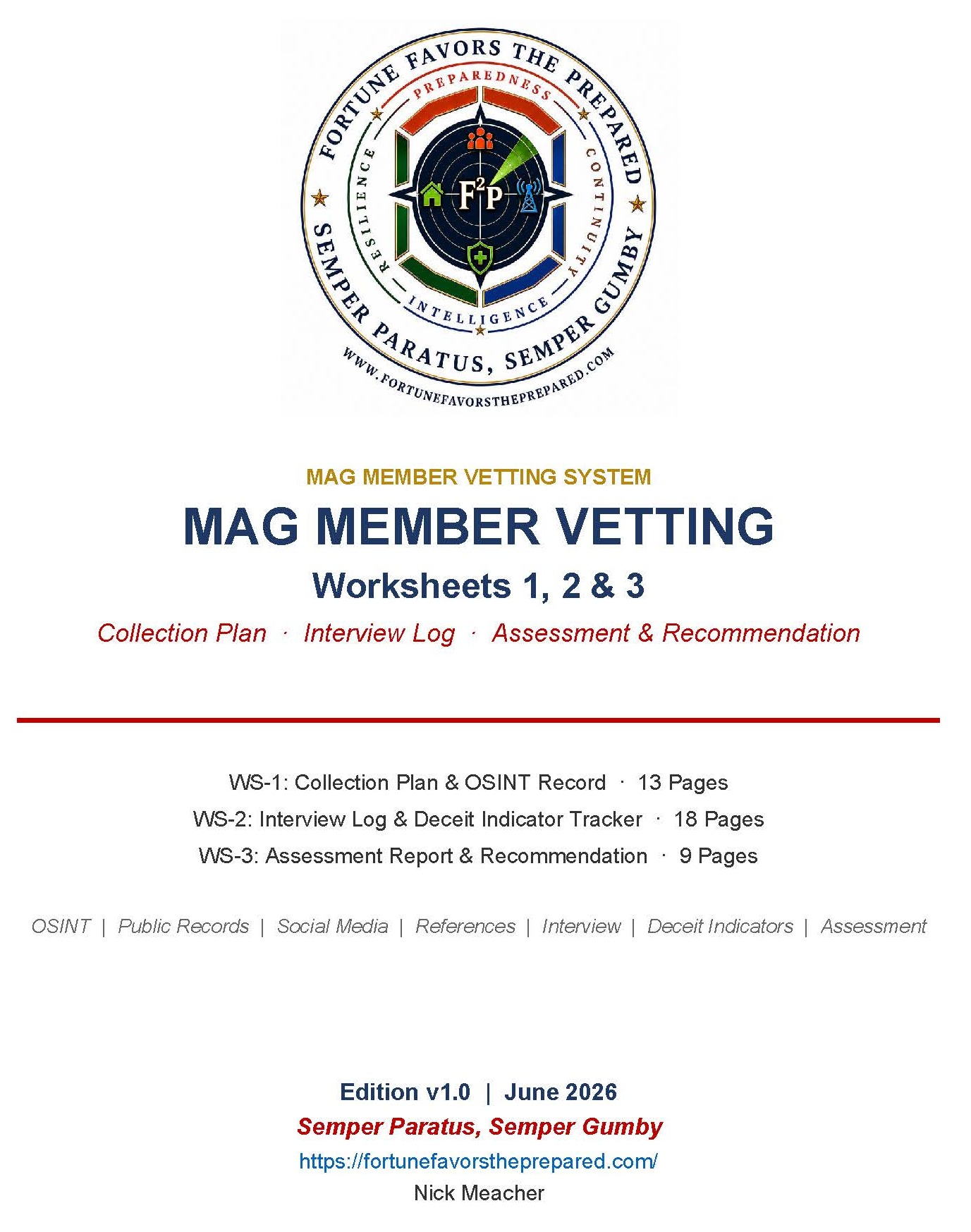
The Complete MAG Vetting
Worksheet Set
Collection Plan · Interview Log · Assessment Report & Recommendation
Reference Elicitation
Deceit Indicators
Values & Judgment
Assessment & Recommendation
Post-Rejection OPSEC
Most preparedness groups vet candidates the same way: a conversation, a gut check, and a handshake. The MAG Vetting Worksheets replace that with a disciplined, sequence-locked investigative process built on intelligence collection doctrine — the same framework used to assess human sources in professional environments.
Three worksheets. One per phase. Passive collection before active engagement. References before the interview. The interview before the report. The sequence is not optional — and now it’s on paper, with fields, stop rules, and a permanent decision record that holds up if a decision is ever challenged.
Three Worksheets. One Direction. No Shortcuts.
Each worksheet is a phase gate. You do not move to the next worksheet until the current one is complete. The stop rules are printed on the forms.
Sections 1–8
Define your specific question for this candidate across six EEI categories: Identity, Background Consistency, Behavioral Pattern, Network, Motivation, Stability.
CERT, Ham Radio, Military, Law Enforcement, Fire, EMS, Firearms. Each category triggers specific additional verification steps with exact sources.
14 record categories: voter registration, property records, professional licenses, court records, PACER, sex offender registry, bankruptcy, civil judgments, DMV, protective orders.
Facebook, Instagram, LinkedIn, X/Twitter, YouTube, TikTok, Reddit, Nextdoor. Archive instructions, account age tracking, anomaly fields.
Telegram, Gab, Truth Social, Rumble, SurvivalistBoards, AR15.com, Patriots.win, 8kun, 4chan /pol/. Sweep run on every candidate — presence alone is not a finding.
Structured log of all findings with A–E source quality rating and 1–5 confidence scale per ICD 203 standards.
Four subsections: Instability indicators, Deception indicators, Extremism indicators (WN, OMC, anti-government, accelerationism), Sovereign Citizen movement indicators.
What OSINT confirms. What gaps remain. EEI confidence summary. Indicator probe log. Investigator pre-contact checklist — 10 items, all must be checked before proceeding.
Sections 1–4
Three background references, three character references, one uninstructed reference (not named by the candidate — highest-value category). Knowledge depth assessment for each. Network architecture analysis to detect constructed reference pools. The three character questions for each reference.
Four phases: History & Background (Phase 1), Skills Verification (Phase 2), Values & Judgment (Phase 3), Extremism Screening (Phase 4). Reasoning quality rating on every values question. Verbatim response fields. Behavioral observation notes separate from content notes.
12 indicator types from Army field interrogation doctrine: timeline inconsistency, body language mismatch, knowledge gap, evasion, self-serving pattern, technical vocabulary failure, OSINT contradiction, repeat question inconsistency, lack of extraneous detail, exact wording repetition, appearance mismatch, vocabulary mismatch.
Interview environment checklist. Character assessment summary across six dimensions. Investigator self-assessment for bias. Overall interview confidence level with rationale.
Sections 1–9
One-sentence BLUF. Four decision categories: Accept / Accept with Conditions / Reject / Extend Observation. Each has defined criteria — no vague decisions.
Confirmed facts only. Every entry requires a named source and access date. Unconfirmed claims go in Section 4 — not here.
Pattern across six dimensions synthesized from WS-2 interview and character references. Reference corroboration check — shallow praise without specific incidents does not corroborate.
Sourced, specific concerns on security and character tracks with confidence levels and disqualifying determination. Gaps documented with resolution path and acceptability assessment.
Security track and character track summaries. Conditions stated precisely — vague conditions cannot be enforced. Specific findings basis for rejection or extended observation.
Access level during probation. Duration. Demonstration requirements. Observation responsibility. Trigger events for re-evaluation. Controlled testing log: three doctrine-based tests for information security, reliability, and information-seeking behavior.
Exposure inventory: what the rejected candidate learned. Likely response assessment. Monitoring period. Completed for every rejection regardless of reason — a clean separation is the only thing that protects your methodology for the next investigation.
Signed decision record with leadership concurrence. Camp X Lecture A.12 motive category quick reference — eight motive types with MAG-context risk assessment.
Intelligence Doctrine. Paper Form.
These worksheets encode how professional investigators actually vet sources — not how preparedness groups imagine they do.
Sequence-Locked
Stop rules are printed on the forms. The sequence is not a suggestion — passive collection before active engagement, references before the interview, interview before the report.
Two-Track Assessment
Security track (OSINT, records, consistency, deception) and character track (values, judgment, accountability, loyalty) run in parallel throughout. Both must clear.
FM 2-22.3 Deceit Indicators
The behavioral indicator tracker is built directly from Army field interrogation doctrine — 12 indicator types with specific probe guidance for each.
Four-Phase Interview
History, skills verification, values and judgment, extremism screening. Phase 4 questions are structured so a thoughtful answer is expected — evasion or hostility is the finding.
Permanent Decision Record
WS-3 is a sourced document, not notes. Every claim requires a named source. Every confidence level is stated. If a decision is ever challenged, the process is documented.
Post-Rejection OPSEC
Every rejection triggers an exposure inventory. A clean separation that reveals nothing protects your vetting methodology for the next investigation. This is the section most groups forget entirely.
Built for MAG Leadership and Vetting Officers
- MAG Vetting Officers running a candidate through the full intake process — WS-1 through WS-3 is the complete workflow, start to finish.
- MAG leadership reviewing a completed vetting package before a membership decision — WS-3 Section 1 gives you the BLUF and the basis without reading the whole file.
- Groups that have never formalized their vetting and need a process they can hand to a new Vetting Officer and have it run correctly the first time.
- Any preparedness organization that has already accepted a member they shouldn’t have — and doesn’t want to do it again.