Most families and preparedness groups have a Primary communications system and nothing else. When it fails — which it reliably does in significant disasters through network overload, infrastructure damage, or power failure — communication stops and improvisation begins. PACE is the structured answer: a pre-decided, ordered sequence of communications methods, with defined triggers for moving between them, that you build and test before you need it.
The COM-01 Student Companion Guide is a field reference that pairs with this course. It contains the PACE framework reference, systems-by-tier tables, failure trigger worksheets, a PACE plan template, a failure mode catalogue, and doctrinal sources — formatted to use during family or group planning sessions and exercises.
Where PACE Comes From
PACE originated in US military signal corps doctrine as a framework for ensuring command and control continuity when Primary communications are degraded or destroyed. It has been standard military communications planning practice for decades. CISA now formally promotes it for public safety and emergency communications through its guidance on leveraging the PACE plan into the emergency communications ecosystem.
The preparedness community adopted it because the underlying problem is identical: Primary systems fail at exactly the moments when communication is most critical. Cell towers overload within hours of a major disaster. Repeater sites lose power when extended grid outages exhaust their battery backup. The families and groups that maintain communication through those failures are the ones that decided — before the emergency — exactly what they would do next.
The Non-Negotiable Sequence
The sequence of PACE is not a suggestion. It is a pre-decided priority structure that exists to prevent improvisation under stress. In a communications emergency, what is most convenient is not always what is most resilient. A family or group that stays on a failing Primary because no one has decided when to switch will lose more time and more coordination than a group that has a clear trigger and executes it immediately.
This principle extends across the entire plan. Every tier transition must have a specific, observable, pre-agreed trigger — a time window, a number of attempts, or a confirmed observation — that anyone can recognize independently. The trigger eliminates the decision. Under stress, you execute the plan instead of make one.
A major storm knocks out grid power across the county at 11pm. The local repeater — your group’s Primary — runs on battery backup. By 8am the following morning, the battery is exhausted and the repeater goes silent. Your group has a VHF handheld listed somewhere in notes as a “backup option.”
Without a PACE plan: some members try the repeater frequency repeatedly. Others assume the silence means the group is fine. No one knows which simplex frequency to use, whether to try it, or how long to wait before attempting something else. Hours pass without contact.
With a PACE plan: the failure trigger — “no response on the repeater after three scheduled check-in windows” — fires. Every member moves to the documented simplex frequency. Contact is established within minutes. The plan worked because the decision was made before the emergency.
How to Use These Lessons
Each lesson covers one component of PACE in depth. The structure is consistent: a bottom line up front, substantive content on the framework or skill, scenario examples, a knowledge check, and a summary checklist. Read the lessons in order the first time through.
The knowledge checks are not decoration. They are designed to expose the specific failure modes that occur most often at each step. If you miss a question, read the feedback carefully — it tells you exactly what the wrong answer costs in a real scenario.
After completing the course, use the companion guide during family or group planning sessions. The PACE plan worksheet is designed to be completed together, not alone. Every member who may need to initiate or respond on any tier must understand and have practiced the plan.
How PACE Fits the Broader Framework
PACE does not operate in isolation. Two companion frameworks from the FFTP planning system give your PACE plan its operational context:
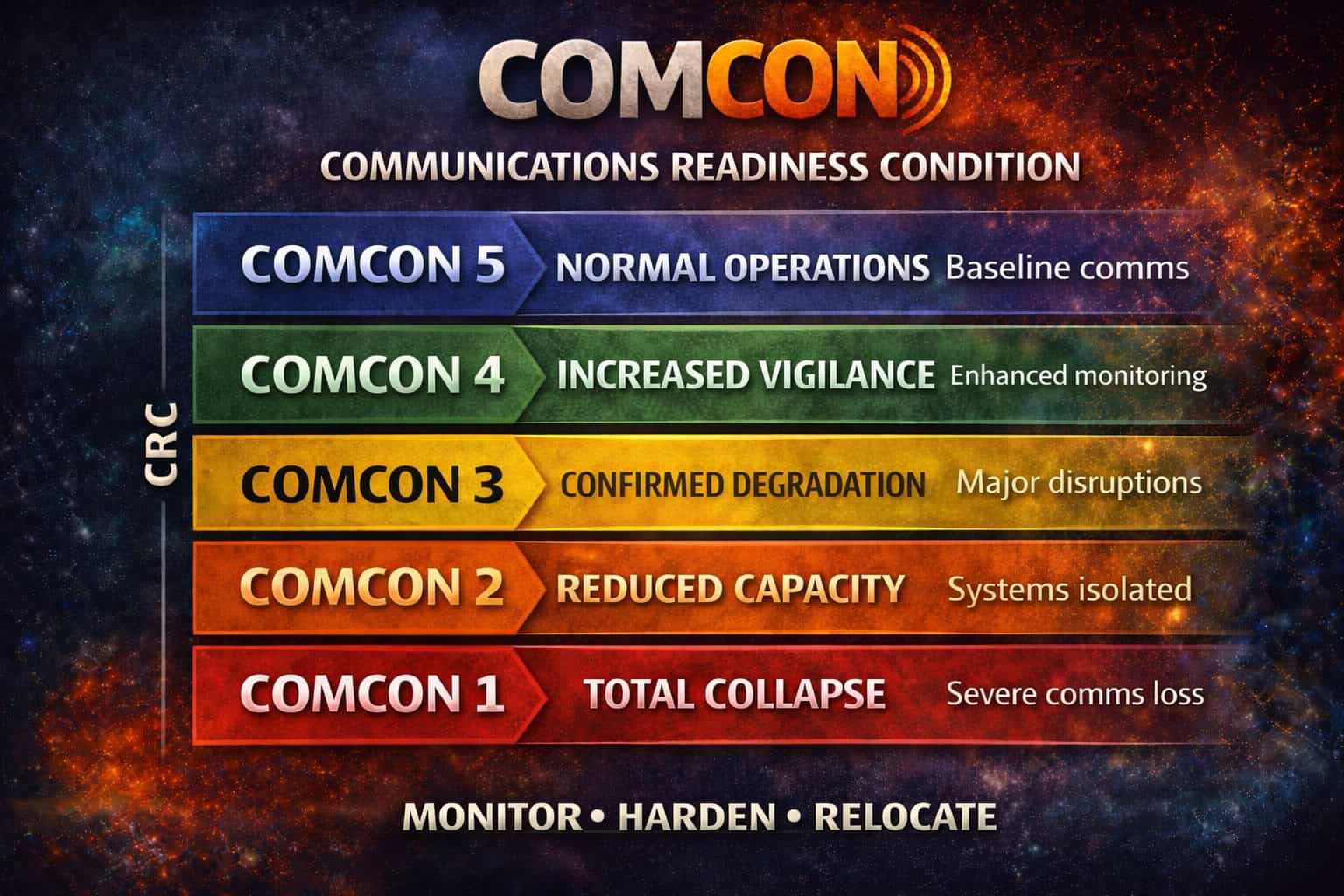
COMCON (Communications Readiness Condition) is the five-level status indicator for your communications infrastructure. COMCON 5 is normal operations; COMCON 1 is total collapse. Your COMCON level tells you which PACE tier you should be operating on right now. When your family or group declares COMCON 3 (Confirmed Degradation), that is the signal to move off Primary and activate Alternate. COMCON 1 means Emergency tier only.
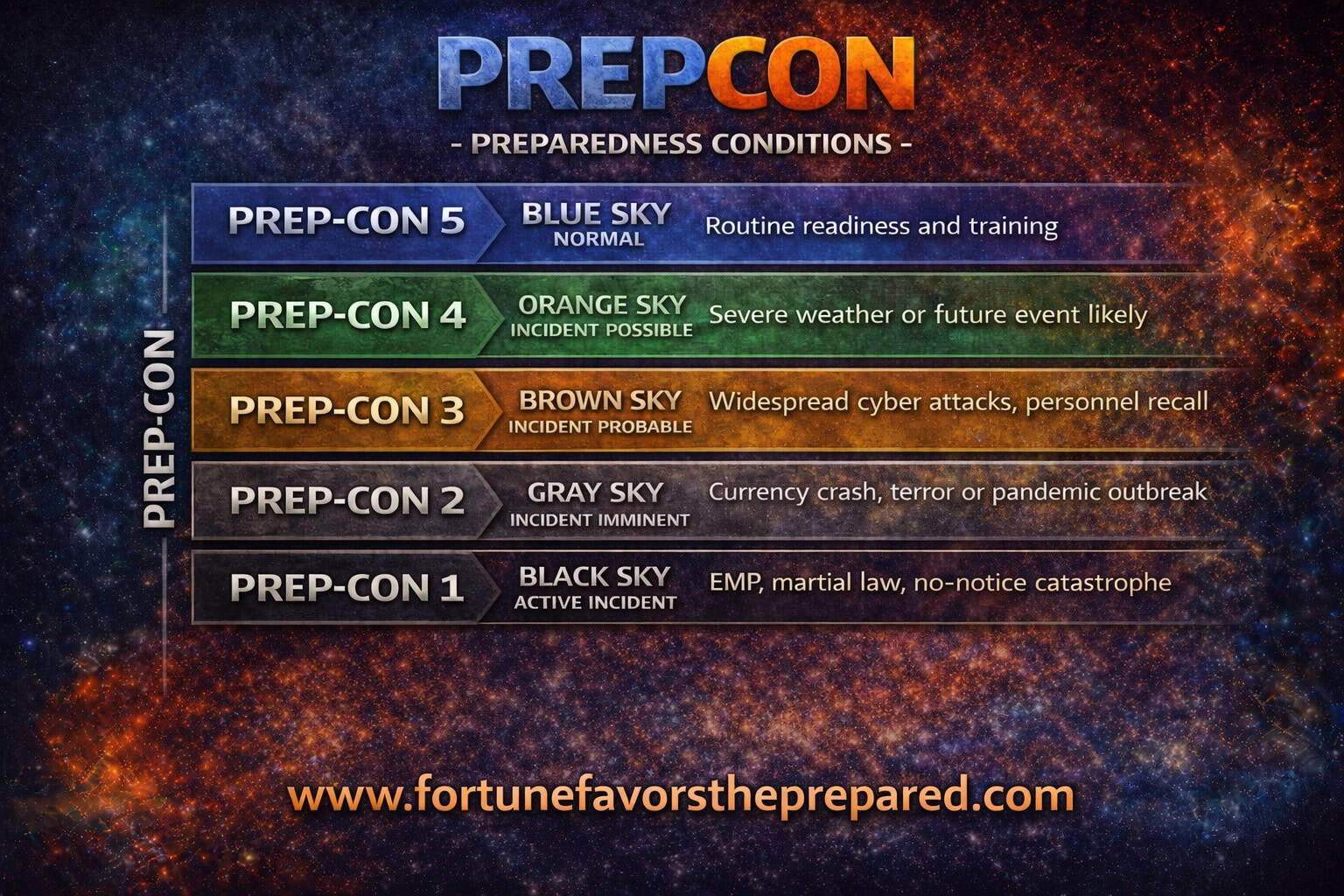
PREP-CON (Preparedness Conditions) is the broader five-level threat assessment. PREP-CON sets the overall situational context — Blue Sky (normal) through Black Sky (active catastrophe) — that drives your COMCON assessment, which in turn drives your PACE tier selection. As PREP-CON escalates, so does COMCON, and so does the tier your family or group should be prepared to operate on.
The relationship: PREP-CON → COMCON → PACE tier. Your PACE plan is the communications execution layer of this framework. Complete COM-01, then see PREP-CON (Book of Knowledge) and PLN-05: COMCON to understand the full planning system.
COMCON — Communications Readiness Condition is the FFTP five-level status framework for communications infrastructure health. COMCON levels directly map to your PACE tier: COMCON 5 (Normal Operations) means Primary is working; COMCON 3 (Confirmed Degradation) means you should be on Alternate or Contingency; COMCON 1 (Total Collapse) means Emergency tier only.
PREP-CON — Preparedness Conditions is the FFTP five-level overall threat assessment framework. PREP-CON sets the situational context that drives COMCON which drives your PACE tier selection. PREP-CON 3 (Incident Probable) or below should put your group on heightened COMCON and ready to execute lower PACE tiers.
Book of Knowledge: PREP-CON → · Preparedness Conditions (PREP-CON) →
Some systems in your PACE stack may require an amateur radio license (FCC Technician or General class) or a GMRS license. This course teaches PACE planning regardless of your current licensing status — understanding the framework is the first step. COM-02 and the licensing preparation resources cover the regulatory requirements in detail.