$29.95
The Mutual Assistance Group Workbook is a structured, practitioner-built framework for forming, organizing, and sustaining a small trusted network of people and households prepared to face disruptions that no single family can handle alone. Written by a 30-year emergency management professional, it delivers the doctrine, decision frameworks, and working templates a MAG founder and leadership cell need to build something real.
Description
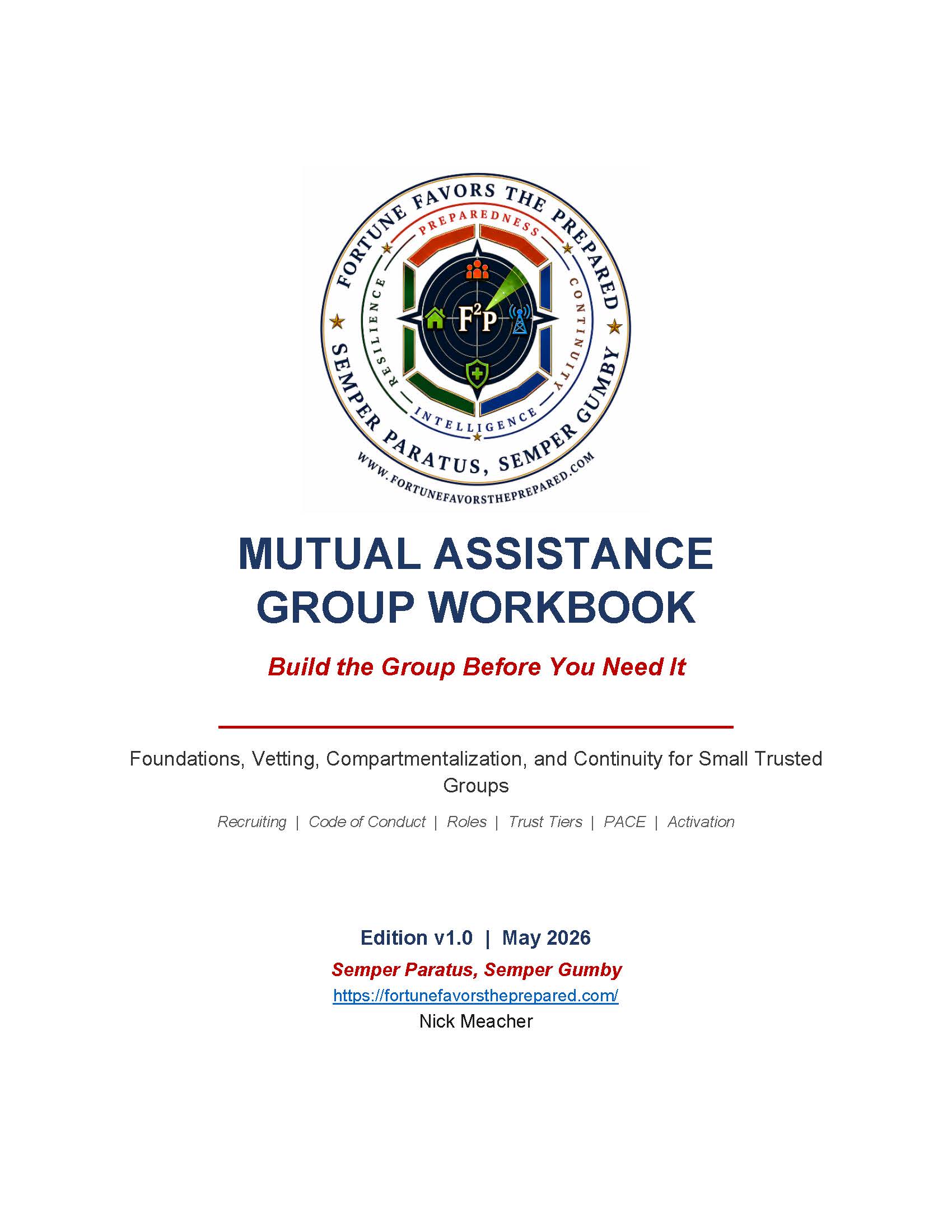
Mutual Assistance Group Workbook Build Your Trusted Preparedness Network Before You Need It
Most preparedness guides focus on what to store. This one focuses on who you can count on.
The Mutual Assistance Group Workbook is a structured, practitioner-built framework for forming, organizing, and sustaining a small trusted network of people and households prepared to face disruptions that no single family can handle alone. Written by a 30-year emergency management professional, it delivers the doctrine, decision frameworks, and working templates a MAG founder and leadership cell need to build something real.
What’s inside:
- Section 1 – Foundations: Define what kind of group you’re building — live-in, live-out, hybrid, or network — before you recruit anyone. Covers group size, leadership models, legal and ethical boundaries, and succession planning.
- Section 2 – Threat Picture and Mission: Hazard identification, scenario coverage (24-hour disruptions through long-duration grid-down), and a structured mission statement worksheet.
- Section 3 – Code of Conduct: A values alignment framework with a signature page. Every member signs before they advance. Character before capability.
- Section 4 – Individual Skills Inventory: A structured skills matrix across eight domains — food systems, medical, power and mechanical, construction, communications, intelligence and planning, security, and general community skills — with a capability roll-up to identify training and recruitment gaps.
- Section 5 – Role Assignments: Defined functional roles with redundancy checks. Ensures no critical function has only one person behind it.
- Section 6 – Recruitment and Vetting: A five-phase intake process from initial contact through gradual trust and access. Includes red flags, evaluation criteria, and a prospect tracking sheet.
- Section 7 – Compartmentalization and Trust Tiers: A five-tier model that keeps sensitive information — rosters, cache locations, real frequencies — out of centralized documents and held by the right role leads at the right access level.
- Section 8 – Continuity, Devolution, and PACE Planning: Leadership succession, PACE worksheets for critical group functions, and a devolution model for when leadership is unavailable.
- Section 9 – Communications: Group-level PACE framework for communications planning, training cadence, and record-keeping protocol for the comms lead.
- Section 10 – Logistics and Resource Planning: Category-level resource summary with role-based record segregation.
- Section 11 – Operations and Activation: Activation triggers, decision-making protocols under stress, and an After-Action Review template.
- Section 12 – Training Plan: Annual training calendar framework.
- Sections 13–14: Conflict resolution, member removal, group dissolution, and the maintenance and review cycle.
Built on a core principle: This workbook holds doctrine and templates, never names, addresses, cache coordinates, or frequencies. The information that matters most stays out of this binder. The workbook tells you exactly how to set that up.
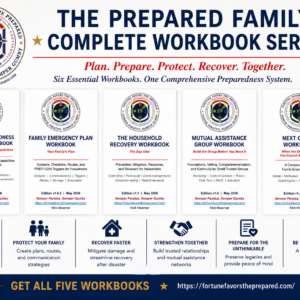
This is the third workbook in the Fortune Favors the Prepared Household Resilience Suite, stacking with the Personal Preparedness Assessment Workbook (individual) and the Family Emergency Plan Workbook (household). Each builds on the last. The MAG Workbook is designed for use after you’ve completed the first two.
Ideal for: preparedness-minded households ready to move beyond individual readiness, CERT-trained community members, neighborhood resilience organizers, off-grid communities, faith-based disaster teams, and anyone who has realized that “two is one, one is none” applies to people as much as it does to gear.
Use it on blue-sky days. Build the group before you need it.
Additional information
| Weight | 1 lbs |
|---|