Observations that live only in a notebook are not intelligence. They become intelligence when they are formatted, attributed, and shared with decision-makers in a structure that communicates what was seen, what it means, and what should happen next. This final lesson teaches the two reporting formats used to translate INT-08 collection into actionable products: the Spot Report for immediate deviation reporting, and the Pattern of Life Summary for periodic baseline updates.
The Purpose of Reporting
Reporting closes the intelligence cycle. Collection gathers raw information. Analysis evaluates it against the baseline. Reporting delivers the finished product to whoever needs to act on it.
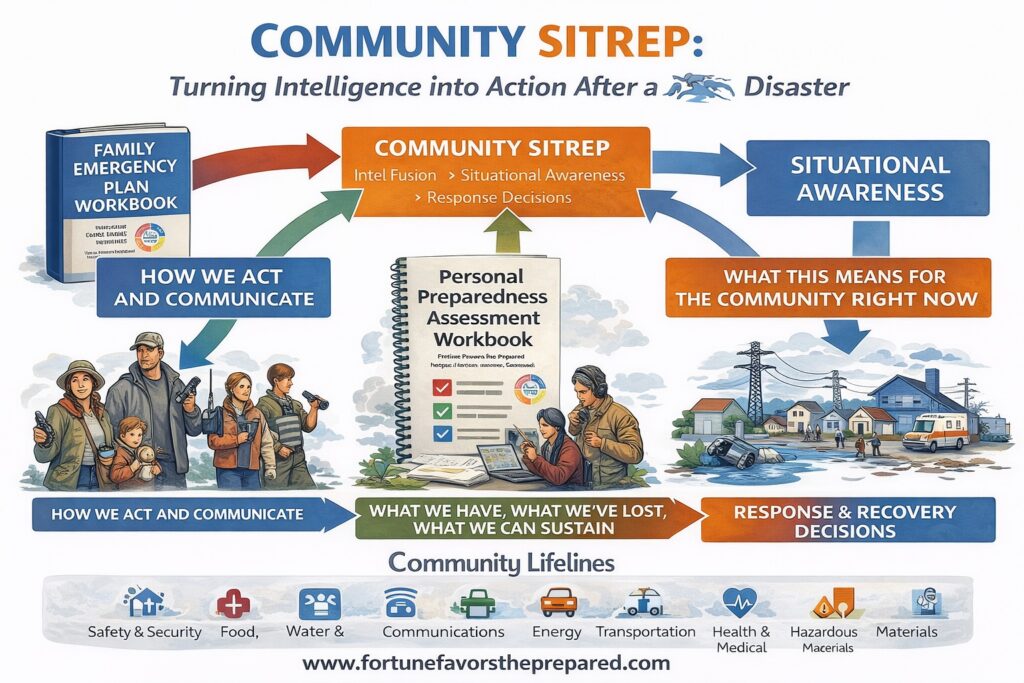
In a community intelligence context, that means your MAG leadership, your neighborhood preparedness team, or the officer responsible for PLN-01 situational awareness. It may also mean contributing to a Community SITREP — in which case your reporting product becomes an intelligence input to a larger shared picture.
Two failure modes are worth naming before covering the formats:
- Under-reporting: Observations that never leave the notebook. The most common failure. If a deviation is worth logging, it is worth reporting to at least one other person.
- Over-reporting: Every observation reported as an alert, regardless of threshold. This is how teams stop reading reports. Calibrate your reporting to your threshold framework from Lesson 2.
Format 1: The Spot Report
The Spot Report is used for any observation that has crossed the AMBER or RED deviation threshold. It is designed to be transmitted quickly, in any medium — verbal, written, radio, text — using a standardized structure that ensures no critical element is omitted.
The format is derived from the SALUTE reporting format used in military reconnaissance, adapted for civilian community use:
S – Size: How many? (People, vehicles, infrastructure failures)
A – Activity: What is happening? Describe behavior, not inference.
L – Location: Where exactly? Named point, intersection, grid reference.
U – Unit/ID: Who or what entity, if identifiable? (Vehicles, organization, agency)
T – Time: When observed? Date and 24hr time.
E – Equipment: What equipment, configuration, or distinguishing features?
+ Baseline Ref: What is the established normal for this indicator? How does this observation deviate?
+ Threshold: AMBER or RED?
+ Recommended Action: Monitor, corroborate, escalate, or act?
A Spot Report without a baseline reference is a rumor in a formal format. The baseline reference is what separates an observation from an intelligence product. It answers: how do I know this is unusual? Every Spot Report should be able to answer that question explicitly.
This lesson introduces the SALUTE-adapted Spot Report as it applies to pattern-of-life collection. INT-03: SALUTE and SPOT Report Training covers all four tactical reporting formats in full depth — SALUTE, SPOT, SALT, and SITREP — including field exercises and printable report cards. If reporting formats are a gap, take INT-03 alongside or after this course.
Spot Report — Worked Example
S: 14 vehicles (observed over 45 minutes)
A: Vehicles traveling southbound, normal highway speed, mix of loaded pickups and one flatbed with covered load
L: Route 9 / Elm Street intersection, northbound shoulder observation point
U: No consistent markings; civilian vehicles, no government or fleet ID visible
T: 2026-07-14 0630–0715
E: One vehicle had roof rack with container; two pickups were loaded high, covered with tarps
Baseline Ref: Normal vehicle count for this location, Mon 0600–0800: 4–7 vehicles (12 observations over 6 weeks)
Threshold: AMBER (14 observed vs. 4–7 baseline, 100–250% above norm; first occurrence)
Rec. Action: Corroborate with southern observation point; check infrastructure domain for fuel/supply indicators same date
Format 2: The Pattern of Life Summary
The Pattern of Life Summary is a periodic reporting product — weekly or monthly — that provides decision-makers with a concise overview of baseline stability across all four domains. It is not an alert. It is an intelligence briefing that answers: is our environment changing, and if so, how?
Period: Collection dates covered
Prepared by: Observer ID / team
Human Activity: Status (STABLE / DRIFTING / DEGRADED) | Key observations | Trend
Infrastructure: Status | Key observations | Trend
Vehicle/Movement: Status | Key observations | Trend
Communications: Status | Key observations | Trend
Deviations this period: Number AMBER | Number RED | Event Template references
Cascade indicators: Any multi-domain patterns identified?
Baseline changes: Any baseline values updated this period? Reason?
Collection priorities next period: What to watch, and why
The Pattern of Life Summary is your primary contribution to PLN-01. When a Community SITREP is initiated post-incident, the most recent POL Summary provides the baseline reference against which incident conditions are assessed. Teams with mature summaries produce better SITREPs. Teams without them are back to guessing.
The diagram below shows how intelligence inputs — including INT-08 collection — flow into the Community SITREP and produce situational awareness and response decisions. Your Pattern of Life Summary is the pre-incident component that makes the post-incident assessment faster and more accurate.
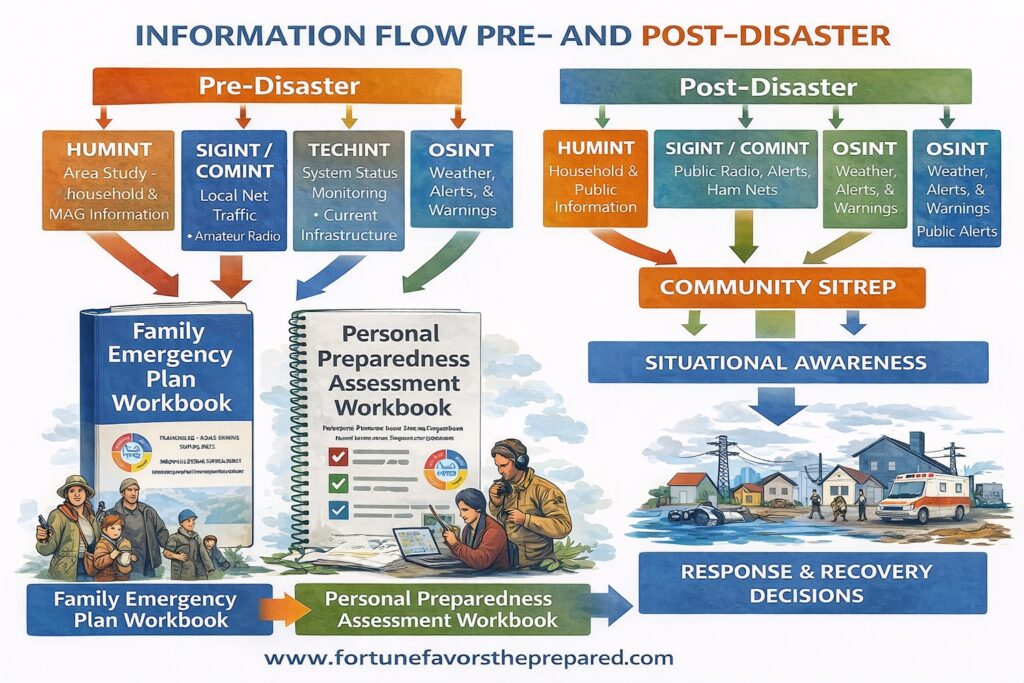
During an extended power outage following a severe ice storm, a MAG team submitted their most recent POL Summary — completed six days before the storm — as the baseline document for the Community SITREP. The Summary showed that infrastructure domain was already in DRIFTING status before the storm: one fuel station had shown partial resupply issues the prior two weeks, and road conditions on two secondary routes had been degraded since December. The SITREP team used that baseline to immediately flag those locations as highest-priority assessment targets in the first operational period. They did not waste time discovering degradation that the baseline had already documented. Total assessment time for those targets was cut by roughly half.
Reporting Discipline
Good reporting comes from disciplined collection. Three habits that separate reliable reporters from inconsistent ones:
- Report observations, not conclusions. “14 vehicles observed, 200% above baseline” is a reportable observation. “Something bad is happening” is not. Draw conclusions in the analysis section of the Event Template. Report what you saw in the Spot Report.
- Attribute everything. Every report should state who observed it, when, and from where. Anonymous reports are not intelligence products. They are tips.
- Close the loop. When a Spot Report triggers follow-on collection, document the outcome. Whether the corroboration confirmed or contradicted the initial observation, the record should reflect it. Your collection system is only as good as its closed loops.
Consider how you transmit Spot Reports and POL Summaries. These documents describe your community’s vulnerabilities, infrastructure status, and observation patterns. In a permissive environment they can move freely within your MAG. In a degraded or contested environment, treat them as sensitive. Agree on a handling protocol with your team before you need one.
Close the loop on your pre-course document. In Lesson 0, you wrote down what you thought your environment looked like at 0700 on a Tuesday. Now, having completed the course:
1. Review what you wrote. How specific was it? Does it contain observable, countable, domain-organized data — or impressions?
2. Identify which of the four domains you would need to add to it to have a usable baseline starting point.
3. Write a single Spot Report for one observation from your environment in the past week that, in retrospect, may have been a deviation from normal. Apply the SALUTE format.
If you can complete step 3, you are ready to maintain an operational collection framework.