The Ham-Run VoIP Telephone Network for Preparedness & Disasters
Hamshack Hotline (HHL) officially ended service on August 29th, 2025.
Its role within the amateur radio preparedness community has since been taken over by Hams Over IP (HOIP), a ham-run VoIP telephone network built by amateur radio operators, for amateur radio operators.
Like HHL before it, Hams Over IP functions as a closed, private VoIP telephone system—offering extensions, call routing, voicemail, conference bridges, and PBX-style features—while remaining completely separate from the public telephone network (PSTN).
Hams Over IP is not a repeater-linking system like EchoLink or IRLP, and it is not RF-based. Instead, it provides a dedicated IP voice coordination layer that complements amateur radio operations when internet connectivity exists.
For preparedness-minded individuals and groups, HOIP fills the same critical niche HHL once did: low-friction voice coordination before, during, and after disruptive events—without consuming RF resources.
What Hams Over IP Is (and Is Not)
What it is
- A non-commercial, ham-operated VoIP PBX network
- Access restricted to licensed amateur radio operators
- Users are assigned a unique extension (often callsign- or region-based)
- Compatible with:
- Desk IP phones
- Softphones (PC, tablet, or smartphone)
- ATA adapters for analog phones
- Supports:
- Direct extension dialing
- Ring groups
- Voicemail
- Conference bridges
What it is not
- ❌ Not RF
- ❌ Not connected to the public phone system (no PSTN access)
- ❌ Not a replacement for HF, VHF, or UHF radio
- ❌ Not grid-independent by default
Think of Hams Over IP as “the wired side of the shack”—a coordination and command layer that complements radio communications rather than replacing them.
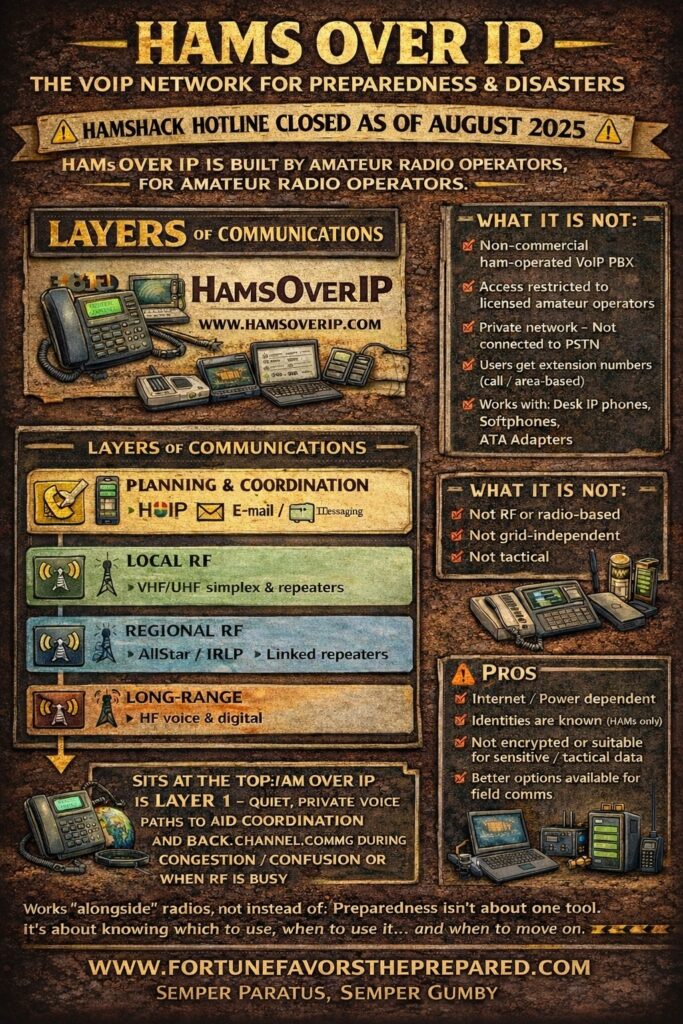
Why Hams Over IP Matters in Preparedness
In real-world emergencies, communications rarely fail instantly. More often, the first failures are congestion, confusion, and poor coordination, not total silence.
Hams Over IP excels in this gap.
Typical Use Cases
- Net control back-channels
- Leadership and logistics coordination
- Quiet planning conversations without occupying RF
- Cross-region liaison during developing incidents
- Training, drills, and rehearsal communications
When RF channels are saturated—or intentionally kept clear—HOIP provides clean, reliable voice paths for coordination and decision-making.
Pros and Cons
Pros
- Clear, reliable audio: No noise, fading, or RF interference
- Fast coordination: Dial extensions instead of searching for frequencies
- Scalable: Conference bridges, ring groups, and group calls
- Reduces RF congestion: Keeps emergency nets focused
- Low barrier to entry: Inexpensive hardware and familiar phone operation
- Ham-only access: Less exposure than public VoIP platforms
Cons
- Internet-dependent: No IP connectivity = no HOIP
- Power-dependent: Requires powered network equipment
- Not anonymous: Extensions are associated with licensed operators
- Not tactical: Unsuitable for mobile or field communications
- Limited COMSEC: See below
COMSEC Considerations
Hams Over IP operates under the same legal and practical constraints as amateur radio:
- No encryption for message privacy
- Traffic may be monitored by system administrators
- Operator identities and callsigns are known
Practical Implications
HOIP is appropriate for:
- Coordination
- Logistics
- Status reporting
- Tasking and planning
It is not appropriate for:
- Sensitive personal data
- Tactical movement details
- Anything you would not say on an open amateur net
Mitigation Strategies
- Use brevity codes and plain operational language
- Separate coordination from execution
- Pair VoIP coordination with offline plans and pre-arranged actions
Resiliency & Redundancy
Hams Over IP itself is not inherently resilient—your setup determines how long it survives.
Improve Your Odds
- UPS support for:
- Modem
- Router
- Switch
- IP phone
- Secondary ISP (e.g., cable plus LTE/5G)
- Generator or battery backup
- Softphone fallback on a laptop or tablet
Redundant Thinking
- Assume HOIP will fail eventually
- Practice smooth transitions to RF
- Never allow VoIP to become a single point of failure
Used correctly, Hams Over IP buys time—and time is often the most valuable resource during a crisis.
Hams Over IP in a Layered Communications Plan
A resilient communications architecture is layered, not linear.
Example Layered Stack
Layer 1 – Planning & Coordination
- Hams Over IP
- Email / messaging
Layer 2 – Local RF
- VHF/UHF simplex and repeaters
Layer 3 – Regional RF
- Linked repeaters
- AllStar / IRLP
Layer 4 – Long-Range
- HF voice and digital
Hams Over IP occupies the top coordination layer, reducing RF load while improving situational awareness and decision quality.
Use in Disasters
Early Phase (Watch / Warning)
- Situation awareness calls
- Group coordination
- Planning conferences
Impact Phase
- Net control support
- Leadership back-channels
- Cross-area coordination
Recovery Phase
- Logistics coordination
- Resource matching
- Rebuild and restoration planning
In every phase, Hams Over IP functions as a force multiplier, not a replacement for radio.
Bottom Line
Hamshack Hotline is gone.
Hams Over IP is its functional successor.
Hams Over IP is:
- Not magic
- Not grid-proof
- Not tactical
But it is:
- Purpose-built
- Ham-controlled
- Extremely effective when used intentionally
In a preparedness context, HOIP belongs alongside radios—not instead of them. It is the quiet, efficient voice layer that keeps plans aligned and people coordinated—until it’s time to transition fully to RF and keep going.
Preparedness isn’t about one tool.
It’s about knowing which layer to use, when to use it, and when to move on.