
Civilian Readiness Lifecycle
In The Conspiracy Chronicles, civilian survival is treated not as a single event, but as a progressive lifecycle—one that moves from preparation, to adaptation, and ultimately to long-term continuity under degraded or collapsed systems.
This lifecycle explains how civilians transition from anticipation of disruption into a persistent operating reality, and why different readiness frameworks exist at each stage.
At its core, the civilian readiness lifecycle recognizes one hard truth:
Preparation eventually gives way to continuity.

The Meadow Project – book 1 of The Continuity Chronicles
The Brush – book 2 – out very soon
The Civilian Readiness Lifecycle (High-Level)
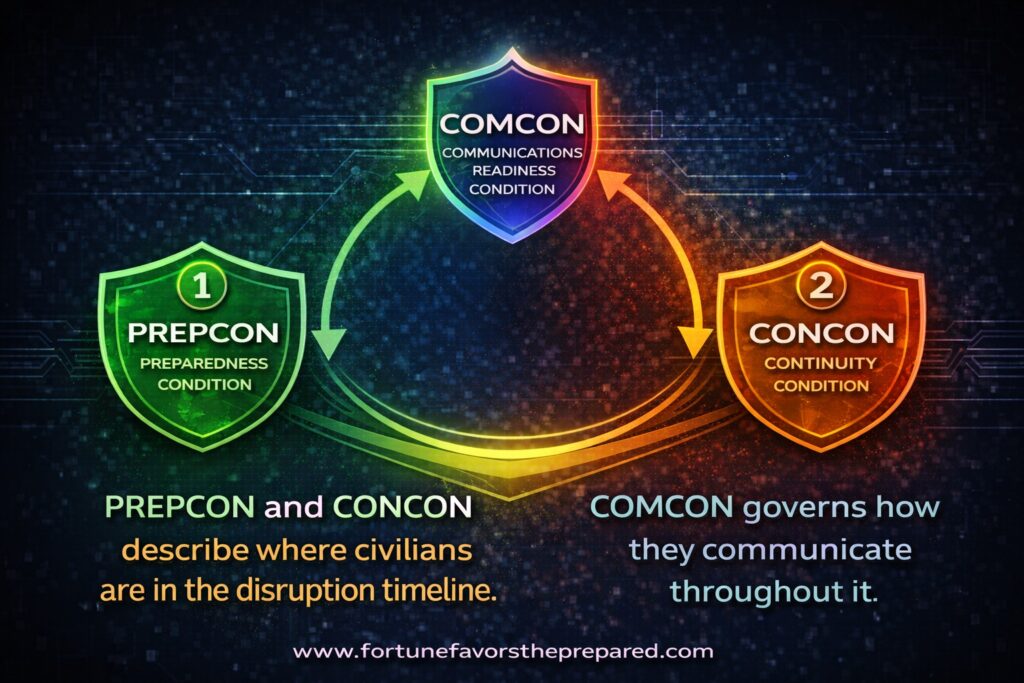
The lifecycle is composed of three interrelated frameworks, each addressing a different aspect of civilian adaptation:
- PREPCON — Preparedness Condition
- CONCON — Continuity Condition
- COMCON — Communications Readiness Condition (Cross-cutting)
PREPCON and CONCON describe where civilians are in the disruption timeline.
COMCON governs how they communicate throughout it.
PREPCON — Preparedness Condition
PREPCON (Preparedness Condition) governs the phase where disruption is anticipated but not yet permanent.
PREPCON answers:
How urgently must we prepare, and what options still exist?
During PREPCON:
- Infrastructure is still partially functional
- Mobility and choice remain possible
- External assistance may still arrive
- Decisions are largely reversible
PREPCON activities typically include:
- Stockpiling and staging supplies
- Hardening locations and plans
- Information gathering and monitoring
- Training, rehearsals, and drills
- Establishing decision thresholds
PREPCON represents the last window of flexibility—the point where proactive choices still meaningfully shape outcomes.
Origins of PREPCON
PREPCON was created approximately a decade before The Conspiracy Chronicles as a practical preparedness framework, independent of any fictional setting. It was later incorporated into the books because it provided a clear, realistic way to describe escalating civilian readiness without heavy exposition.
Its use in the series reflects its original intent: a structured method for making decisions before conditions become irreversible.
CONCON — Continuity Condition
CONCON (Continuity Condition) begins when civilians accept that disruption is no longer temporary.
CONCON answers:
How do we function now that normal systems cannot be relied upon?
CONCON governs:
- Day-to-day survival routines
- Resource management and rationing
- Governance, rules, and decision authority
- Security integration into civilian life
- Medium- to long-term planning horizons
Unlike PREPCON, CONCON assumes that outside rescue is unlikely and that continuity must be self-generated.
Relationship to Government COGCON`
CONCON is conceptually aligned with government COGCON (Continuity of Government Conditions).
Where COGCON focuses on:
- Preservation of state authority
- Leadership succession
- Essential government functions
CONCON applies the same logic at the civilian level:
- Preservation of community function
- Continuity of decision-making
- Sustained operation without external support
CONCON can therefore be understood as a civilian analog to COGCON, adapted for non-government populations.
COMCON — Communications Readiness Condition
COMCON (Communications Readiness Condition) was developed specifically for The Conspiracy Chronicles to provide a disciplined, realistic way to adapt communications behavior as risk increases.
Although fictional in origin, COMCON reflects real-world communications security principles and is directly applicable to preparedness planning.
COMCON answers:
How safely can we communicate right now?
COMCON as a Cross-Cutting Framework
COMCON applies across all phases of the civilian readiness lifecycle.
As conditions escalate:
- Communications become more constrained
- Authentication becomes more critical
- Assumptions of interception increase
- Convenience is intentionally sacrificed for safety
COMCON governs:
- Communication methods and tools
- Message frequency and timing
- Authentication and verification
- Emissions discipline
- Expectations of compromise
Why COMCON Matters to Preparedness
In both fiction and reality, communications failures often cause more damage than material shortages.
Poor communication discipline can:
- Expose intent and vulnerabilities
- Accelerate panic and misinformation
- Undermine trust within groups
- Create friction between preparedness and continuity efforts
Incorporating COMCON into civilian planning:
- Forces advance decisions before stress degrades judgment
- Preserves coordination under pressure
- Reinforces trust when verification matters most
If communications are not planned, they will fail at the worst possible moment.
Lifecycle Summary
- PREPCON — Preparing for disruption
- CONCON — Operating within disruption
- COMCON — Communicating safely throughout
Together, these frameworks form a coherent civilian readiness model, moving from anticipation to endurance without assuming a return to normal.
