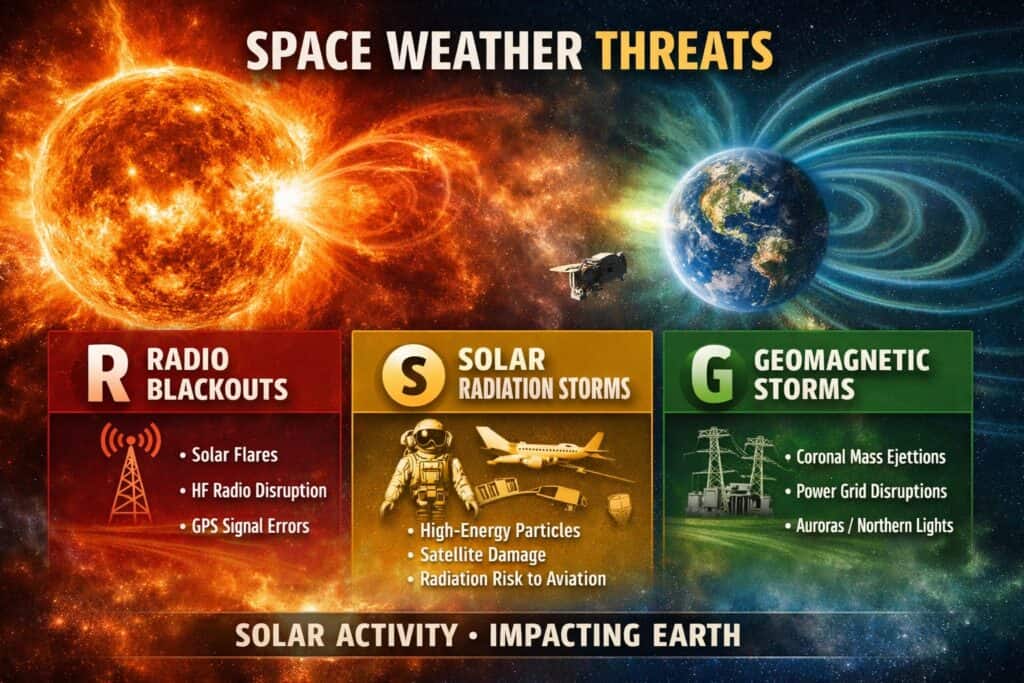
SWX-CON is the Fortune Favors the Prepared space-weather readiness condition. It mirrors NOAA’s Space Weather Prediction Center (SWPC) G-scale (geomagnetic storms), S-scale (solar radiation storms), and R-scale (radio blackouts). SWX-CON is a separate condition from terrestrial weather (WX-CON) and from communications infrastructure status (COMCON). When a space weather event is significant enough to degrade communications or stress the grid, SWX-CON drives downstream into COMCON and PREP-CON. This page tells you how we score it, what each level means, and what to do at each level.
Why space weather matters
Solar flares, coronal mass ejections, and geomagnetic storms reach the ground in three ways. First, ionospheric absorption degrades or blacks out HF radio (the 3 to 30 MHz spectrum that carries amateur radio long-haul, military command and control, aviation oceanic communications, and emergency back-channel traffic). Second, induced currents on long conductors stress the power grid and have historically tripped large regional outages. Third, direct radiation effects degrade satellites in low Earth orbit, scramble GPS positioning accuracy, and elevate radiation exposure for high-altitude aviation crews and passengers.
NOAA’s deep space satellite, DSCOVR (Deep Space Climate Observatory), orbits about one million miles from Earth at the L1 Lagrange point and provides 15 to 60 minutes of advance warning of solar wind and coronal mass ejection arrival. ACE, NOAA’s older L1 satellite, continues to provide redundant solar wind data. That advance-warning window is the operational reason space weather can be planned for at all. Without DSCOVR and ACE there would be no actionable forecast for geomagnetic storms.
The three NOAA space weather scales
NOAA publishes three independent scales because space weather is not one phenomenon. A geomagnetic storm (G-scale), a solar radiation storm (S-scale), and a radio blackout (R-scale) can occur together or separately. SWX-CON tracks all three and reports the worst-active sub-scale as the banner level. The reader should always look at the descriptor line in the DTR to see which sub-scale is driving the level.
All three NOAA scales run from level 1 (Minor) to level 5 (Extreme). Higher number means worse conditions. This matches WX-CON and is the opposite of PREP-CON and COMCON, where lower numbers indicate worse posture. The split exists because NOAA’s scales have decades of public familiarity that we did not want to recolor.
G-scale: Geomagnetic Storm (driven by Kp index)
The G-scale tracks geomagnetic field disturbance driven by the solar wind and arriving coronal mass ejections. Kp is the three-hour planetary geomagnetic index, scaled 0 to 9. A Kp of 5 is the G1 threshold. The G-scale is the one most likely to drive aurora visibility, GPS accuracy degradation, and power grid stress. Severity depends not just on storm magnitude but on the southward orientation (Bz) of the arriving solar wind: a strongly southward Bz at impact couples efficiently into Earth’s magnetosphere and can drive a forecast G2 into an observed G4.
| Level | Kp Threshold | Effect |
|---|---|---|
| G1 Minor | Kp = 5 | Weak grid fluctuations, minor satellite operation impact, aurora visible at high latitudes. Roughly 900 events per 11-year solar cycle. |
| G2 Moderate | Kp = 6 | High-latitude power systems may see voltage alarms. HF radio fading at high latitudes. Aurora visible as far south as New York and Idaho. About 360 events per cycle. |
| G3 Strong | Kp = 7 | Voltage corrections may be required on power systems. False alarms on protection devices. Surface charging on satellites. Intermittent HF radio. GPS errors at the meter level. About 130 events per cycle. |
| G4 Severe | Kp = 8 | Possible widespread voltage control problems and partial blackouts. Satellite tracking and orientation problems. Sporadic HF radio blackouts. GPS degraded for hours. About 60 events per cycle. |
| G5 Extreme | Kp = 9 | Widespread voltage control problems. Transformer damage possible. Grid system collapse possible. HF radio impossible in many areas. GPS unusable for hours. Aurora visible to mid latitudes. About 4 events per cycle. |
S-scale: Solar Radiation Storm (driven by 10 MeV proton flux)
The S-scale tracks high-energy protons accelerated by solar events. It measures particle flux in particles per square centimeter per second per steradian at energies above 10 MeV. S-level events affect satellites, high-latitude aviation (where polar route diversions become routine at S3 and above), and astronauts on the ISS. Ground-level effects are limited at lower S levels, but a major S-storm can produce a ground-level enhancement (GLE) that registers on neutron monitors.
| Level | 10 MeV Proton Flux | Effect |
|---|---|---|
| S1 Minor | 10 pfu | Minor impact on HF in polar regions. No biological effects. About 50 events per cycle. |
| S2 Moderate | 100 pfu | Infrequent single-event upsets on satellites. Small effects on HF propagation through polar regions. Passenger and aircrew radiation exposure at high altitudes. About 25 per cycle. |
| S3 Strong | 1,000 pfu | Satellite single-event upsets common. Noise in imaging systems. HF radio degraded through polar regions and navigation positioning errors likely. About 10 per cycle. |
| S4 Severe | 10,000 pfu | Memory device problems and noise on imagery. Star tracker problems may cause orientation issues. Blackout of HF radio through polar regions. Increased radiation hazard to astronauts and high-altitude aviation. About 3 per cycle. |
| S5 Extreme | 100,000 pfu | Satellites may be rendered useless. Severe HF radio blackouts in polar regions. Navigation impossible. Unavoidable high radiation hazard to astronauts. Less than 1 per cycle. |
R-scale: Radio Blackout (driven by peak X-ray flux)
The R-scale tracks the immediate effect of solar flare X-ray emission on the sunlit side of Earth. When a flare peaks, the increased X-ray flux ionizes the D-layer of the ionosphere on the daylit hemisphere and absorbs HF radio for the duration of the flare (typically minutes to a couple of hours). R-events are local in time but global in coverage on the sunlit side. An R3 during your daylight hours is an HF blackout you cannot work around.
| Level | Peak X-ray Flux | Effect |
|---|---|---|
| R1 Minor | M1 flare | Weak or minor HF radio degradation on sunlit side for tens of minutes. Loss of radio contact intermittently. Low-frequency navigation signals degraded briefly. About 2,000 per cycle. |
| R2 Moderate | M5 flare | Limited HF radio blackout on sunlit side, loss of radio contact for tens of minutes. Degradation of low-frequency navigation signals for tens of minutes. About 350 per cycle. |
| R3 Strong | X1 flare | Wide-area HF radio blackout, loss of radio contact for about an hour on sunlit side. Low-frequency navigation degraded for about an hour. About 175 per cycle. |
| R4 Severe | X10 flare | HF radio communication blackout on most of the sunlit side of Earth for one to two hours. HF radio contact lost during this time. Low-frequency navigation signal disrupted, causing increased error in positioning for one to two hours. About 8 per cycle. |
| R5 Extreme | X20 flare | Complete HF (high frequency) radio blackout on the entire sunlit side of Earth lasting for a number of hours. No HF radio contact with mariners and en route aviators in this sector. Low-frequency navigation signals used by maritime and general aviation systems experience outages on the sunlit side of Earth for many hours. Less than 1 per cycle. |
The SWX-CON banner level is MAX(active G, active S, active R). The sub-scales are independent. G3 plus R1 active simultaneously yields SWX-CON Level 3 (Strong) driven by the G-scale, but the R1 still gets reported in the descriptor line so HF operators know to expect both effects.
How SWX-CON drives downstream conditions
SWX-CON does not stand alone. When space weather is severe enough, it propagates into the communications and household preparedness postures. The diagram below shows the pathway from a SWX-CON level to its expected drive into COMCON (communications readiness) and PREP-CON (overall household readiness).
HF propagation impact by SWX-CON level
For amateur radio operators, EmComm operators, and anyone running HF as a primary or PACE-tier communication path, the band-by-band impact matters more than the level itself. The matrix below shows expected HF band conditions across the SWX-CON levels. These are baseline assessments under typical Bz orientation. A strongly southward Bz at storm arrival will push conditions a full level worse than this matrix shows.
| Band | SWX-CON 1 | SWX-CON 2 | SWX-CON 3 | SWX-CON 4 | SWX-CON 5 |
|---|---|---|---|---|---|
| 10m / 12m | Good | Fair | Degraded | Closed | Closed |
| 15m / 17m | Good | Good | Degraded | Poor | Closed |
| 20m | Good | Good | Fair | Degraded | Poor |
| 30m / 40m | Good | Good | Good | Fair | Degraded |
| 60m / 80m | Good | Good | Good | Good NVIS | Fair NVIS |
| 160m | Good | Good | Fair | Degraded | Poor |
The pattern is straightforward: high-band (10m to 17m) closes first because it depends on F2-layer ionization that storm activity disrupts. Low-band NVIS (Near Vertical Incidence Skywave on 60m and 80m) is the most resilient propagation path during storms and is the EmComm operator’s primary tool when SWX-CON is elevated. If you have not read the NVIS page, do so before the next G3 watch comes in.
Action matrix by SWX-CON level
| Trigger | Window | Actions |
|---|---|---|
| SWX-CON 1 (Minor) | Routine | No action required for most households. HF operators verify polar-path circuits before transmitting. Aurora chasers note possible visibility at high latitudes. |
| SWX-CON 2 (Moderate) | Routine | HF operators expect fading on high bands at high latitudes. Pilots and mariners verify GPS-dependent operations have a backup. No general preparedness action. |
| SWX-CON 3 (Strong) | 24 to 72 hours | Top off vehicle fuel (pumps are GPS-timed). Charge phones and power banks. HF operators shift to lower bands and verify NVIS capability. GPS-critical operations confirm backups. Surge-protect sensitive electronics. Verify generator readiness. |
| SWX-CON 4 (Severe) | 24 to 72 hours | All Level 3 actions completed. Expect regional grid stress and multi-hour GPS outages. Pre-fill water containers. Confirm cell backup is charged and PACE plan rehearsed. EmComm operators stand up local nets on 80m / 60m NVIS. Brief household on potential cascading outage. |
| SWX-CON 5 (Extreme) | 0 to 48 hours | Treat as a national-scale grid event. Pre-position 7 to 14 days of essentials. Expect possible cascading grid collapse and transformer damage with multi-week recovery. Activate full PACE plan and mutual assistance group linkup. Unplug sensitive electronics during storm peak. |
Where the SWX-CON signal comes from
The SWX-CON banner in every Fortune Favors the Prepared Daily Threat Report is anchored to the following NOAA SWPC products. None of these are subscription services. All are public.
- SWPC 3-Day Forecast with Kp index, R-scale, and S-scale probabilities.
- SWPC Alerts, Watches, and Warnings, including the G-scale watch notices (WATA serial numbers).
- DSCOVR Real-Time Solar Wind showing Bz orientation, density, and speed as the CME approaches L1.
- SWPC OVATION Aurora Forecast showing where aurora is most likely in the next 30 minutes.
- NOAA Space Weather Scales Explanation, the authoritative definitions of the G, S, and R scales used on this page.
The relationship between SWX-CON, COMCON, WX-CON, and PREP-CON
SWX-CON is one of eight readiness conditions tracked in every Daily Threat Report. The full set is:
- DEFCON. Defense Readiness Condition (military posture)
- COGCON. Continuity of Government Condition
- FPCON. Force Protection Condition
- CYBERCON. Cyber Readiness Condition
- COMCON. Communications Readiness Condition
- WX-CON. Severe Weather Readiness Condition
- SWX-CON. Space Weather Readiness Condition (this page)
- PREP-CON, overall household Preparedness Condition
SWX-CON and WX-CON use NOAA-native scales (high number = worse). The other six use the FFTP scale convention (low number = worse). This is a deliberate split. The natural-hazard conditions match the publishing authority’s color scheme so readers do not have to retranslate. The threat-driven conditions follow the FFTP convention.
SWX-CON drives downstream effects on COMCON (because HF and GPS degrade) and on PREP-CON (because grid stress and satellite degradation affect every household). When you see a SWX-CON 3 or higher in the DTR, expect that level to be reflected in the COMCON and PREP-CON banners as well, with descriptors pointing back to the space-weather entry as the driver.
Remember, Fortune Favors the Prepared.
See also
PREPCON – Preparedness Condition (civilian)
CONCON – (Civilian) Continuity Conditions