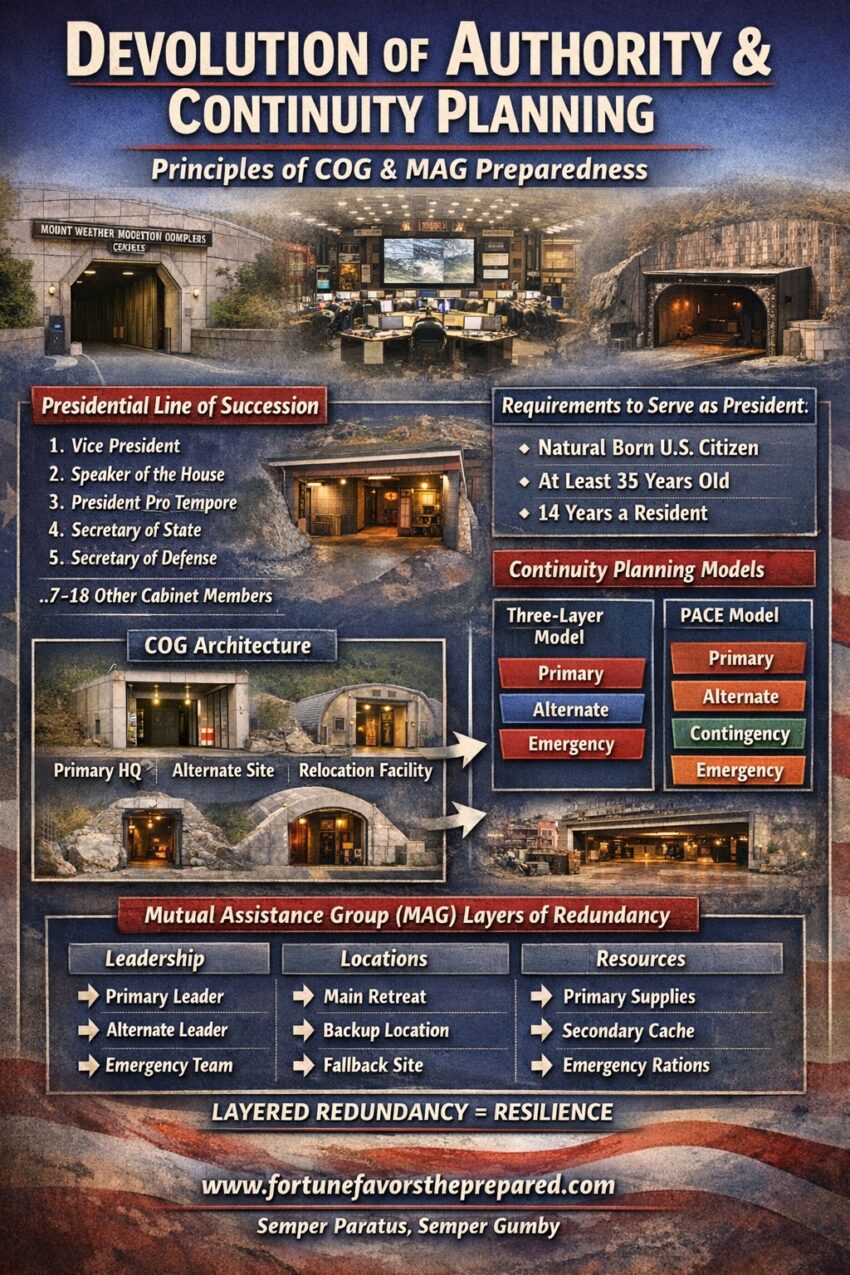
How Federal COG Architecture Reflects the Same Principles Used in Business Continuity, PACE Planning, and Mutual Assistance Groups

This article references parts of the story in my fiction books in The Continuity Chronicles:
The Meadow Protocol
After The Brush
Unassigned Authority
Available in my store for signed paperback and hard copies and from Amazon to include Kindle and Audible.
Continuity planning exists for one simple reason: organizations must be able to function even when their normal leadership, infrastructure, or locations are disrupted.
At the national level, this concept forms the backbone of Continuity of Government (COG) planning for the United States. But the principles used by federal continuity planners are not unique to government. The same ideas appear in corporate continuity plans, emergency management doctrine, preparedness planning, and even small community mutual assistance groups (MAGs).
Whether the organization is a federal agency, a major corporation, or a small preparedness group, the same core rule applies:
Critical functions must survive disruption through layers of redundancy.
Understanding how the federal government designs continuity can provide valuable insight into how individuals and organizations should structure their own preparedness plans.
Devolution of Authority: Leadership That Survives Disruption
One of the most important principles in continuity planning is devolution of authority.
Devolution ensures that decision-making authority automatically passes to alternate leaders if the primary leadership becomes unavailable due to disaster, attack, or communications failure.
In federal continuity doctrine, agencies maintain:
• Lines of succession for leadership
• Delegations of authority allowing alternate leaders to act
• Pre-designated relocation teams capable of operating from alternate sites
This ensures that essential functions can continue even if senior leadership and headquarters are incapacitated.
For example, federal agencies maintain detailed succession plans that can extend many levels deep, ensuring leadership continuity even in extreme scenarios.
The Architecture of Continuity of Government
Continuity of Government planning relies on multiple layers of survivability, including leadership succession, alternate facilities, and distributed operations.
Major elements of the architecture include:
Primary operating locations
Normal headquarters and operating facilities.
Alternate operating facilities
Backup locations where agencies can relocate if primary sites become unusable.
Emergency relocation sites
Highly protected facilities designed to support government leadership during catastrophic events.
Examples historically associated with continuity operations include:
• Mount Weather Emergency Operations Center
• Raven Rock Mountain Complex
• Cheyenne Mountain Complex
These facilities form part of a broader system designed to ensure government functions continue under nearly any conditions.
But continuity is not just about bunkers or relocation sites.
The real strength of continuity planning lies in layered redundancy across leadership, facilities, communications, and personnel.
The Presidential Line of Succession
A critical element of continuity at the national level is the Presidential Line of Succession, which ensures that executive authority continues even if the President and Vice President are unable to serve.
The modern framework is defined by the Presidential Succession Act of 1947 and supported by the Twenty‑fifth Amendment to the United States Constitution.
The current order of succession is:
- Vice President
- Speaker of the House of Representatives
- President Pro Tempore of the Senate
- Secretary of State
- Secretary of the Treasury
- Secretary of Defense
- Attorney General
- Secretary of the Interior
- Secretary of Agriculture
- Secretary of Commerce
- Secretary of Labor
- Secretary of Health and Human Services
- Secretary of Housing and Urban Development
- Secretary of Transportation
- Secretary of Energy
- Secretary of Education
- Secretary of Veterans Affairs
- Secretary of Homeland Security
This layered structure ensures that multiple successors exist to maintain executive authority during catastrophic events.
Constitutional Requirements to Serve as President
Any individual who assumes the presidency through succession must meet the constitutional eligibility requirements outlined in Article II of the United States Constitution.
The acting president must:
• Be a natural-born citizen of the United States
• Be at least 35 years old
• Have been a resident of the United States for at least 14 years
In addition, congressional or cabinet officials must:
• Hold their office legitimately
• Not be disqualified from federal office
• Resign their previous office upon assuming the presidency
If a successor does not meet these requirements, authority moves to the next eligible official in the succession line.
The “Three-Layer” Continuity Principle
Most corporate and organizational continuity planning uses a three-layer model.
This model ensures that if one layer fails, the next layer can assume responsibility.
A typical continuity structure might look like this:
Layer 1 — Primary Operations
Normal leadership, facilities, and systems.
Layer 2 — Alternate Operations
Backup leadership teams, alternate sites, or secondary systems.
Layer 3 — Emergency Operations
Last-resort contingency plans designed to maintain minimal critical functions.
This layered structure is common in:
• Corporate business continuity plans
• Emergency management doctrine
• Critical infrastructure resilience planning
• Disaster recovery frameworks
The concept is simple:
Never rely on a single point of failure.
The Relationship to the PACE Planning Model
Preparedness communities often use the PACE planning model, which stands for:
Primary
Alternate
Contingency
Emergency
While commonly applied to communications planning, PACE is actually a general framework for layered redundancy.
PACE introduces a fourth layer beyond the typical three-layer continuity model:
| Layer | Function |
|---|---|
| Primary | Normal method or system |
| Alternate | Backup solution |
| Contingency | Degraded but functional option |
| Emergency | Last-resort method |
This model expands traditional continuity planning by adding an additional fallback layer, improving resilience during cascading failures.
Although PACE is often discussed in the context of communications, the concept can apply to any critical function.
Applying Continuity Principles to Preparedness
The principles used in government and corporate continuity planning translate directly to personal preparedness and community resilience.
Rather than relying on a single plan, preparedness planning should consider layers of capability.
Examples might include redundancy in:
• Leadership and decision-making
• Meeting locations
• Logistics and supply sources
• Transportation options
• Operational procedures
Each additional layer reduces the risk that a single failure will collapse the entire system.
Continuity Layers in a Mutual Assistance Group (MAG)
Mutual Assistance Groups — small networks of families or trusted individuals working together for resilience — can apply the same continuity principles used by governments and corporations.
A MAG might structure continuity planning across multiple layers:
Leadership continuity
• Primary group leader
• Alternate leader
• Emergency decision team
Operational continuity
• Primary meeting location
• Alternate rally location
• Contingency meeting location
• Emergency fallback location
Resource continuity
• Primary supply sources
• Backup supply caches
• Emergency ration plans
The goal is not complexity.
The goal is resilience through redundancy.
If one layer fails, another layer takes its place.
Continuity Is About Surviving the Unexpected
Continuity planning is fundamentally about accepting that disruptions will happen — sometimes in ways we cannot predict.
Whether the organization is a national government, a Fortune 500 company, or a small preparedness group, the principles remain the same:
• Avoid single points of failure
• Build layered redundancy
• Establish leadership succession
• Create fallback operating options
These ideas form the backbone of Continuity of Government planning, but they are equally valuable for individuals, businesses, and communities preparing for uncertain futures.
The Continuity Connection
In The Continuity Chronicles, the struggle to maintain authority and coordination during cascading crises reflects the real-world challenges addressed by Continuity of Government planning.
When leadership is disrupted and infrastructure fails, the organizations that survive are those that planned for devolution of authority, layered redundancy, and resilient operations.
Continuity is not about predicting the exact crisis.
It is about ensuring that no single failure can bring the entire system down.wn.