$29.95
Description
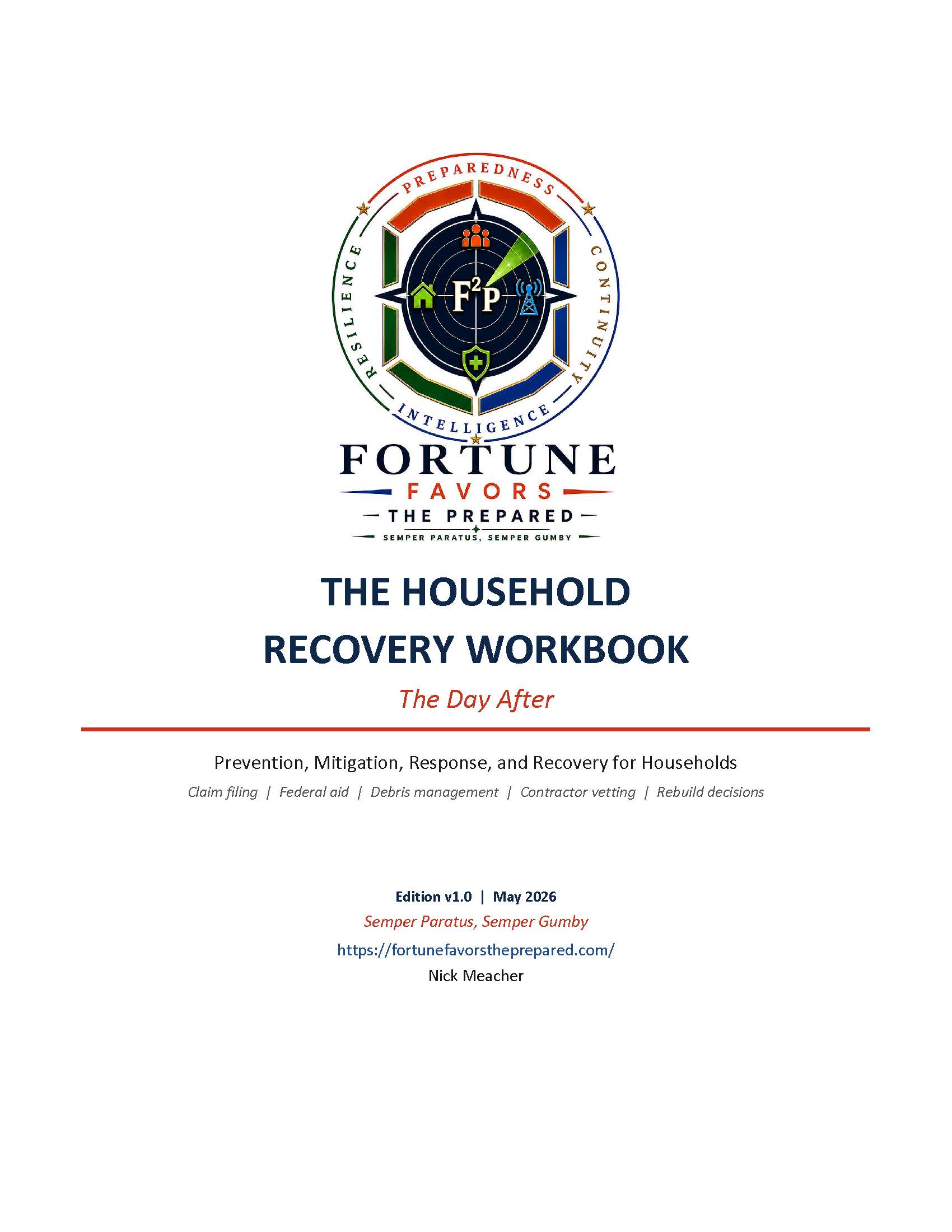
The operational playbook for the day after disaster strikes.
When the wind stops, the water recedes, or the smoke clears, a second crisis begins. Insurance claims. FEMA Individual Assistance. Contractor scams. Document recovery. Tax decisions. Mental health for the household. The legal documents tell you what you own. The first responders tell you you’re safe. Nobody tells you what comes next.
The Household Recovery Workbook is what comes next.
Why this exists
Every household preparedness product on the market focuses on the same two phases: getting ready and getting through. Plan workbooks. Threat assessments. Bug-out bags. Communications gear. They answer the question “what do I do before, and what do I do during?” None of them answer the harder question: “what do I do after?”
After the immediate threat is gone, most families face the same operational reality. The insurance adjuster wants documentation they were never trained to produce. The FEMA Individual Assistance application has a window they don’t know exists. The contractor at the door has a price that seems reasonable until you realize what you’ve signed. The vital records they need to replace are scattered across federal, state, and county offices. The casualty loss tax deduction has rules that change everything about which year they should claim it in. Month four of rebuilding is harder than month one — and nobody warned them.
This is the workbook for that year.
It is built from thirty years of operational experience in emergency management — the same discipline that produces continuity-of-operations plans for governments and large organizations. Applied to a household. With the assumption that the people reading it have already lost something and don’t have the energy to figure out the system from scratch.
It is paper-first by design. After a disaster, the cloud is unreliable, the phone is dead, and the laptop is in storage. The household needs a binder they can pick up, flip to the right page, and start working through.
What’s inside
The workbook is organized by phase:
Pre-fill now. The worksheets you complete the day you receive the workbook, before anything happens. Household identity sheet, insurance master register, mortgage and loan ledger, photo index instructions, document locations index. If you fill in nothing else, fill in this section.
First 72 hours. Stabilization checklists. Immediate-needs request scripts for shelter, prescriptions, and dependent care. The “do not do this in the first three days” list of decisions most families make under pressure and regret later.
Damage documentation. Room-by-room loss inventory worksheets. Photo index logs. Receipt capture sheets that survive a denied claim. Salvage versus loss decision matrix.
Insurance claims. Claim filing tracker. Adjuster meeting prep with the questions to ask and the answers that protect you. Loss-of-use logs and Additional Living Expense worksheets. The supplemental claim triggers most homeowners don’t know they’re entitled to file. What to push back on, and how.
Federal and state aid. FEMA Individual Assistance application walkthrough in plain language. SBA disaster loan navigation. State-by-state assistance program references. What stacks, what doesn’t, and the appeal process when FEMA says no.
Vital records recovery. Federal, state, and county replacement paths for IDs, titles, deeds, certificates, and professional licenses. Cost and turnaround tables so you know what to chase first and what can wait.
Contractor vetting. License and bond verification worksheets. Scope-of-work template. Payment schedule guardrails. Scam pattern field guide drawn from FTC and state attorney general data. Complaint paths with phone numbers and case-tracking sheets.
Tax implications. Federal disaster declaration tax provisions explained without IRS jargon. Casualty loss deduction worksheet. IRA early-withdrawal disaster exemption rules. The records the IRS will want and the elections that can pull a deduction into the prior year.
Mental health timeline. The honeymoon-disillusionment-reconstruction model that most disaster survivors didn’t know was coming until they were inside it. What to watch for in adults, in children, and in aging parents. Resources by phase.
Rebuild decisions. Repair versus replace versus relocate. Mitigation upgrades and code-plus opportunities. Insurance recategorization at completion.
Lessons learned. An after-action review template adapted from incident command, applied to your household. The section that closes the loop back to your Family Emergency Plan Workbook so you don’t face the same gaps a second time.
Annexes. Quick-reference phone number cards. Acronym glossary. Federal aid eligibility matrix. Designed for high-stress, low-attention reading.
Every section is tagged so you know whether it’s something to fill in now, something your household will use after the event, or both.
Who this is for
Anyone who owns a home. Renters too — the renter sections cover ALE, displacement assistance, and tenant-side claim filing — but homeowners face the deepest claim and recovery complexity, and most of the workbook is built for them.
Anyone in a federally declared disaster area, ever, in their lifetime. That’s most of the country at this point. Hurricanes, wildfires, floods, severe storms, tornadoes, ice storms. The list grows every year. The probability is no longer “if.”
Anyone with significant assets or specialized possessions. Multiple insurance policies, business interests, collections, firearms, vehicles, outbuildings, livestock. The more your household touches, the more your recovery touches, and the more a documented playbook saves you.
Anyone who has already done the prep work. If you have completed the Family Emergency Plan Workbook and Personal Preparedness Assessment Workbook, you have the before. This is the after. The three workbooks together cover the full preparedness lifecycle: plan, assess, recover.
Anyone whose neighbors have been through a disaster. If you have ever talked to a household that went through a hurricane, a wildfire, or a severe flood, you have heard the same stories. The fight with the adjuster. The contractor that disappeared. The FEMA application that was denied for a paperwork issue. The receipts they didn’t keep. The decisions they wish they could redo. This workbook is the playbook those households wish they had.
What makes this different
Most recovery resources are pamphlets, websites, or webinars. They tell you what FEMA does. They tell you what an insurance adjuster looks for. They tell you to “keep records.” They don’t give you the records to keep.
This workbook gives you the records to keep.
It’s a working binder, not a reading book. Every section has worksheets, trackers, and decision tools you fill in. Every section has phone numbers, deadlines, and links you’ll need but won’t know to look for. Every section assumes the reader is exhausted, under deadline pressure, and operating from a hotel room with a borrowed laptop.
If you’ve ever read a disaster recovery guide and felt it didn’t match the reality of the conversation you’re going to have with the insurance company at 8:00 AM on a Tuesday, you’re right. This one does.
How to use it
The Pre-fill Now section is designed to be completed in two or three sittings totaling two to four hours. Insurance details, mortgage information, and the photo index. That work alone — done before anything happens — pays for the workbook ten times over the moment a claim is filed.
The rest of the workbook waits in the binder until you need it. Designed so the next person who picks it up — you, your spouse, an adult child, a trusted friend helping out — can flip to the right section and start working through it without reading the whole thing first.
The working copy goes in a fire-resistant home safe alongside the Family Emergency Plan Workbook and the Next of Kin Workbook. A scanned backup goes on an encrypted USB held off-site by a trusted person. You review the Pre-fill Now section annually, and after any major change to insurance, mortgage, or household composition.
The workbook is more valuable 50% complete than 0% complete. The pre-fill section alone, completed and filed, is worth the cost.
Already a Fortune Favors the Prepared customer?
If you own the Family Emergency Plan Workbook, your discount code is printed on the inside cover. Use it at checkout to receive a discount on the Household Recovery Workbook.
If you’re a Patreon supporter, log in to your Patreon-linked account on this site and visit the members area. The Household Recovery Workbook is available to you at the member rate of $23.95, no code required — your membership unlocks it automatically.
Honest about what this isn’t
This workbook is not a will, an insurance policy, a tax return, or a legal claim. It is not legal, financial, medical, or tax advice. It is the operational layer that runs alongside those instruments — the answers to the practical questions your household will ask in the days and weeks and months after a disaster, that the legal and financial documents do not address.
If you have not yet completed a Family Emergency Plan Workbook or a Personal Preparedness Assessment Workbook, those come first. This workbook is most powerful when it sits next to a finished plan and a current insurance policy.
You hope you never have to open it. If you do, you’ll be glad it was already there.
Additional information
| Weight | 2 lbs |
|---|---|
| Dimensions | 11 × 8.5 × 1 in |