
Understanding Commercial Satellite Systems
Modern life depends on an invisible infrastructure orbiting above us. From GPS navigation and global communications to weather forecasting and emergency response, commercial satellites form the backbone of critical global systems.
Understanding how they work—and who controls them—is essential for anyone serious about preparedness.
What Are Commercial Satellites?
Commercial satellites are privately or publicly operated systems in space that provide services for business, government, and civilian use. Unlike military satellites, these systems are accessible—directly or indirectly—to the public.
They fall into several major categories:
- Communications (internet, phone, TV)
- Earth Observation (imaging and analytics)
- Navigation (GPS and timing)
- Weather Monitoring
- Emergency & Rescue Services
Orbital Layers: Where Satellites Live
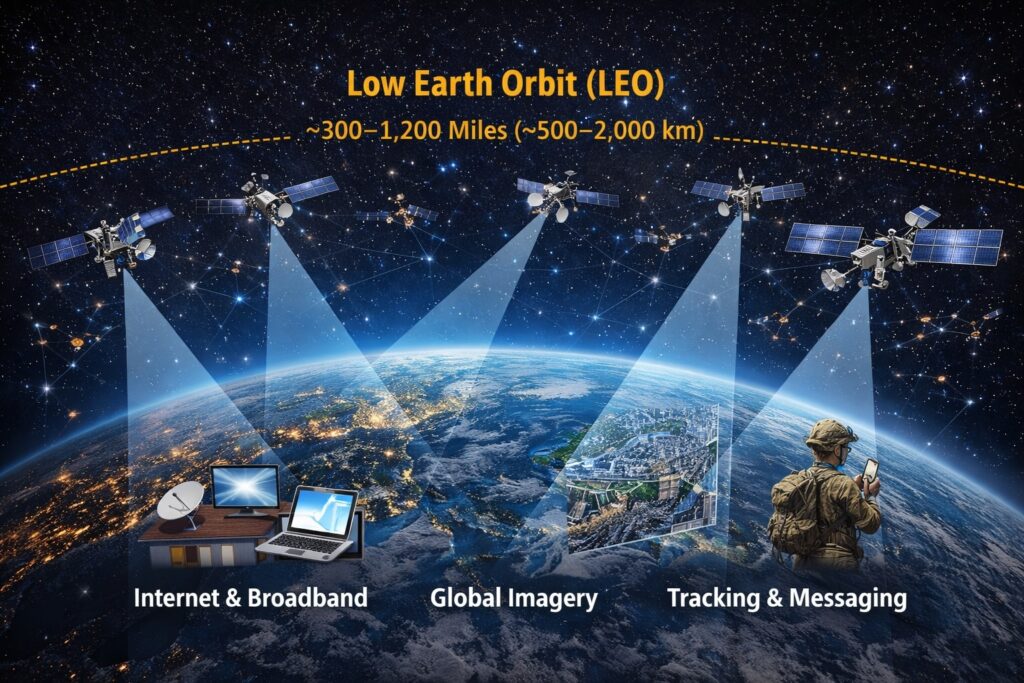
Low Earth Orbit (LEO)
- Altitude: ~300–1,200 miles
- Fast, low latency, large constellations
- Used by: Starlink, OneWeb, Iridium
Why it matters:
LEO enables near real-time communications and global coverage—but requires hundreds or thousands of satellites.
Medium Earth Orbit (MEO)
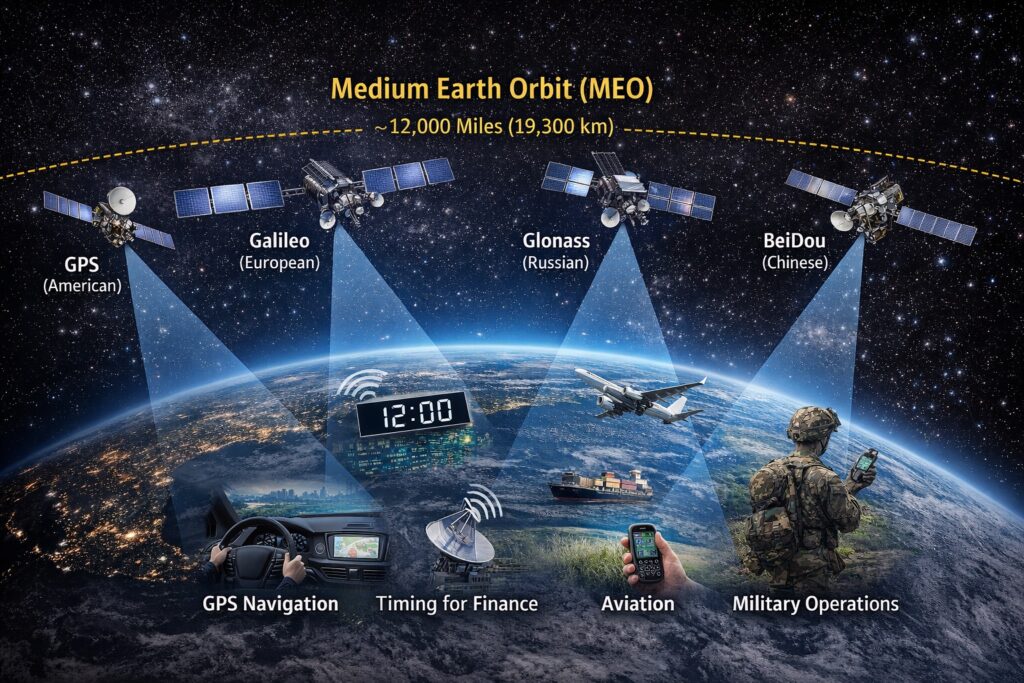
Altitude: ~12,000 miles
- Used primarily for navigation systems
Examples:
- GPS
- Galileo
Why it matters:
MEO provides stable, global positioning and timing—critical for aviation, finance, and military operations.
Geostationary Orbit (GEO)
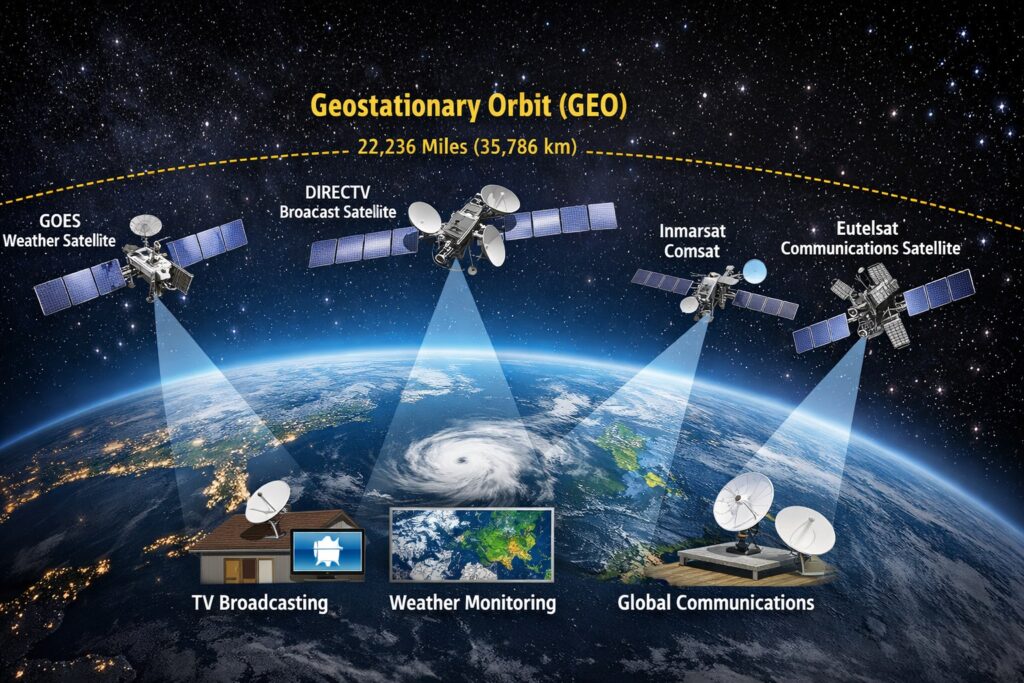
Altitude: ~22,236 miles
- Satellites remain fixed over one point on Earth
Used for:
- TV broadcasting
- Weather monitoring
- Long-range communications
Why it matters:
A single satellite can cover an entire continent—but with higher latency.
Major Commercial Satellite Providers
Low Earth Orbit Networks
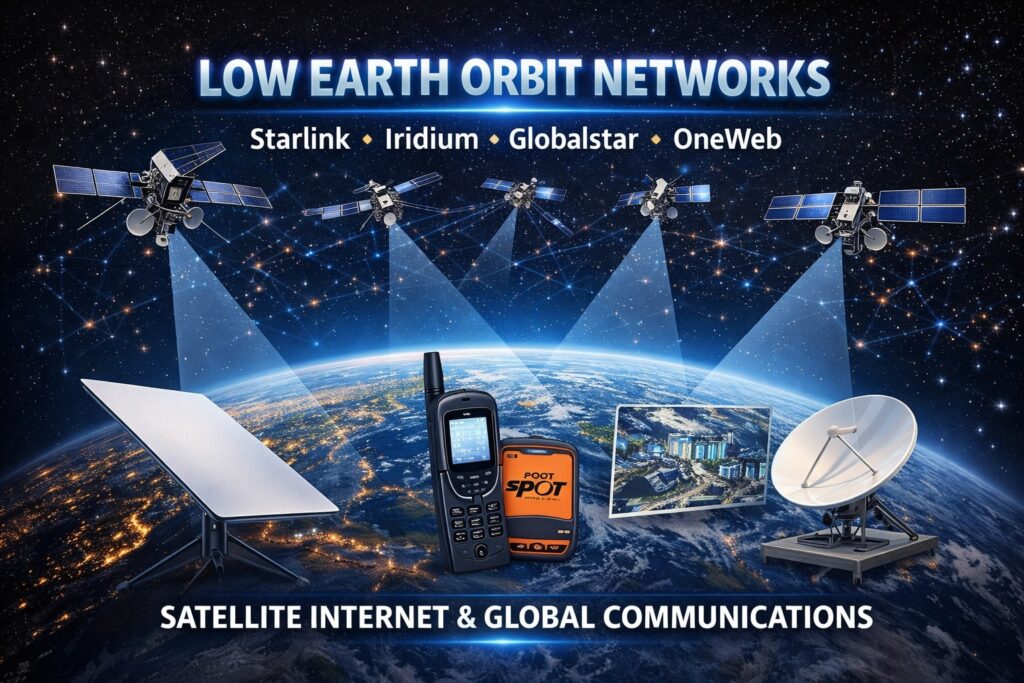
- SpaceX (Starlink)
- Massive LEO constellation
- High-speed satellite internet
- Rapid global expansion
- Iridium Communications
- True global coverage (including poles)
- Satellite phone and push-to-talk services
- Globalstar
- Regional coverage focus
- IoT and emergency messaging
- OneWeb
- Enterprise and government connectivity
Geostationary & Broadcast Providers
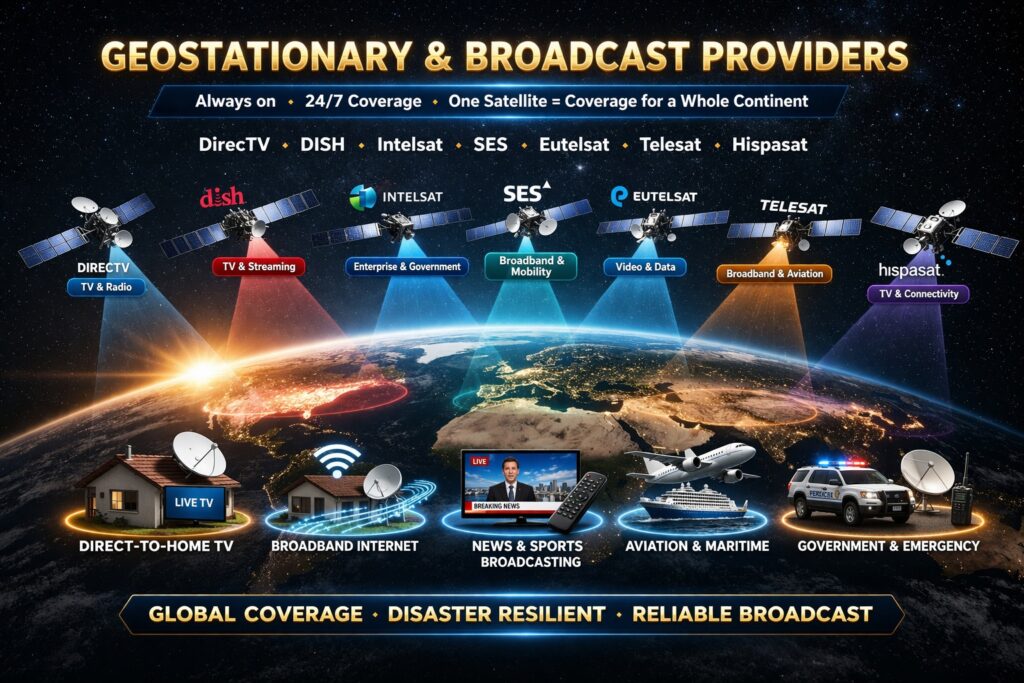
- DirecTV
- Satellite TV distribution across the U.S.
- SiriusXM
- Nationwide satellite radio and audio services
- Viasat & Hughes Network Systems
- GEO-based internet services
Earth Observation & Imaging Satellites
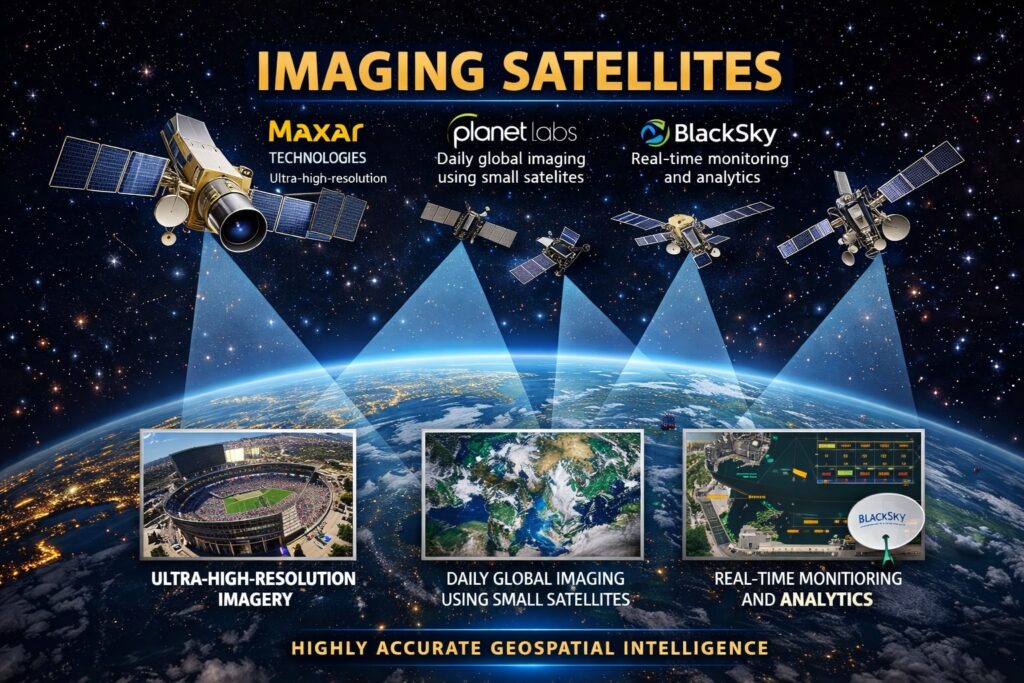
- Maxar Technologies
- Ultra-high-resolution imagery
- Planet Labs
- Daily global imaging using small satellites
- BlackSky
- Real-time monitoring and analytics
Why it matters:
These systems provide near real-time intelligence on:
- Supply chain disruptions
- Military activity
- Natural disasters
How Ground Stations Work
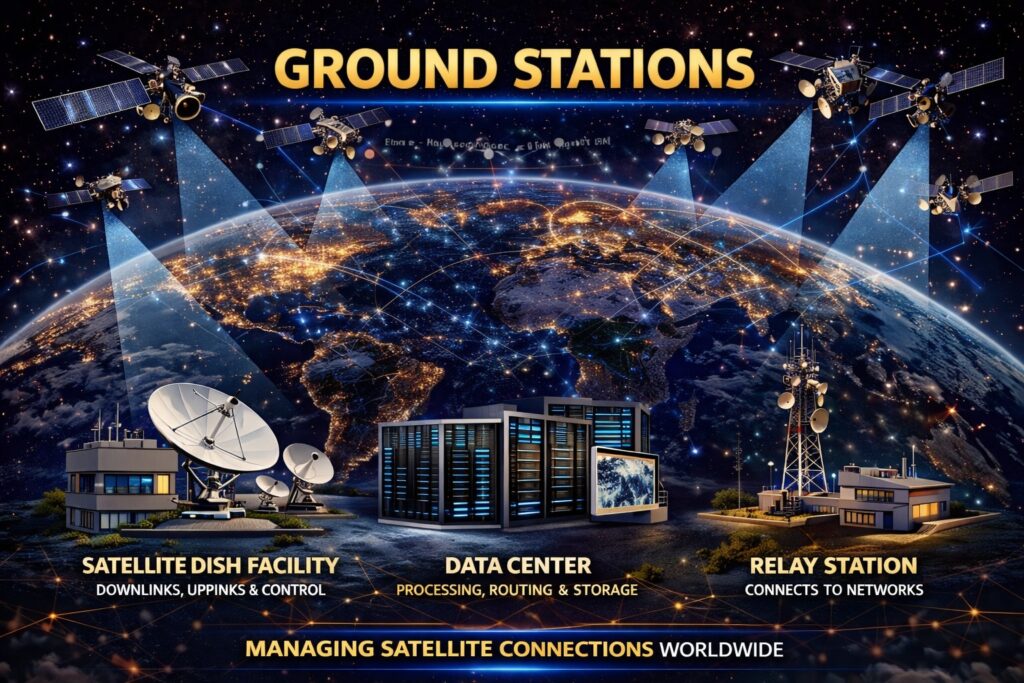
Satellites don’t operate alone—they rely on ground infrastructure.
Key Components:
- Ground Stations (Earth Stations): Communicate with satellites
- Teleports: Large hubs routing data to terrestrial networks
- Network Operations Centers (NOCs): Control satellite fleets
How it connects:
- User device → satellite
- Satellite → ground station
- Ground station → internet backbone
Reality check:
The number and distribution of ground stations determine:
- Network resilience
- Latency
- Vulnerability to disruption
Provider Comparison: Starlink vs Iridium vs Globalstar
| Feature | Starlink | Iridium | Globalstar |
|---|---|---|---|
| Orbit | LEO | LEO | LEO |
| Coverage | Expanding global | True global | Regional |
| Latency | Low | Moderate | Moderate |
| Internet | Yes (broadband) | Limited | Limited |
| Voice | VoIP | Native satphone | Limited |
| Push-to-Talk | No | Yes | No |
Key Insight:
- SpaceX Starlink = high-speed internet
- Iridium Communications Iridium = mission-critical comms
- Globalstar Globalstar = niche + emergency
Radio Over Satellite: What Works Where
- Iridium:
Native satellite push-to-talk and handheld radios - Globalstar:
Supports emergency messaging (e.g., SPOT devices) - Starlink:
❗ Not a direct radio network
Important distinction:
Starlink provides internet, not satellite radio.
Can POC Radios Work Over Starlink?
Yes—but indirectly.
Push-to-talk over cellular (PoC) radios can work over Starlink if:
- Connected via Wi-Fi or router
- Using IP-based communication platforms
Limitation:
- No native satellite fallback
- Requires Starlink terminal + power
Preparedness & Risk Considerations
Commercial satellite systems are resilient—but not invulnerable.
Key risks:
- Ground station targeting
- Space debris collisions
- Signal jamming/spoofing
- Cyber attacks on network infrastructure
Key takeaway:
Redundancy matters.
No single provider is sufficient for critical operations.
Final Assessment
Commercial satellite networks are no longer optional infrastructure—they are critical to:
- Communications
- Navigation
- Intelligence
- Emergency response
Understanding their strengths, limitations, and dependencies allows you to stay ahead of disruption.
See also
The World Is Watching – Global ISR landscape
Seeing Through Everything (SAR)
Which Beacon Should I Carry?
The Commercial Eye
The Five Eyes Satellite Intelligence Network
Personal Satellite Communications
Satellite Mutual Aid Radio Talkgroup (SMART)
Amateur Radio Satellites (AMSAT)