This article references parts of the story in my fiction books, The Meadow Protocol and book 2, After The Brush, part of The Continuity Chronicles series. Available in my store for signed paperback and hard copies for from Amazon to include Kindle and Audible.
1. Hand & Arm Signals (Silent, Close-Range Comms)
These form the foundation of silent movement for patrols and small teams when any sound risks detection. Standard military sets include gestures for “stop,” “freeze,” “advance,” “enemy sighted,” “rally here,” “number of enemies,” and “direction.” Groups should customize their own set and drill regularly to ensure everyone interprets them the same way.
Pro Tip: Practice in low-light conditions (red-lensed lights or natural low-light like fading auroras). Add a countersign—such as a specific finger movement or head tilt in reply—to confirm the signal is authentic and not mimicked by an adversary.
2. Dead Drops & Visual Markers (Passive, Non-Contact)
These allow secure exchange of messages, small items, or intel without direct contact. A drop site is pre-arranged, and readiness or safety is signaled through subtle, everyday markers.
Common signaling markers:
- A specific chalk symbol (e.g., an X in the bottom left corner of a fence post) to indicate a drop is ready.
- A small piece of gum or tape stuck in a predetermined spot.
- A pebble placed on top of a larger rock in a particular pattern.
- A newspaper or object folded/positioned in a unique way on a bench or porch.
Pro Tip: Rotate drop locations frequently and use natural camouflage (hollow logs, under loose stones, behind signage). Always include a “danger” or compromised marker (e.g., an inverted symbol) to warn others to abort.
3. Flashlight Morse Code (Low-Profile Night Signaling)
A compact LED flashlight, headlamp, or even a vehicle’s headlights can transmit Morse code over long distances with very low risk of detection—perfect for signaling “friendly” status (e.g., a single “V” flash) or short messages.
Pro Tip: Use short, sharp presses for dots and longer holds for dashes. Shield the light from the sides to prevent side-scatter. In an auroral-lit night, bounce the beam off snow or trees for subtle diffusion. For maximum stealth, add an IR filter so the signal is only visible with night-vision devices.
4. Ground-to-Air & Large-Scale Visuals (For Rescue or Long-Distance Recognition)
In survival or exfil scenarios, create massive symbols visible from aircraft, drones, or distant observation points using natural or scavenged materials.
Standard symbols include:
- “V” = Require assistance
- “X” = Need medical help
- “SOS” or directional arrow = Indicate direction of travel or desired pickup zone
Pro Tip: Make symbols at least 10–20 feet across using contrasting materials (dark rocks/logs on light snow, bright fabric on bare earth, or trampled grass patterns). Position them in open clearings for maximum visibility from above.
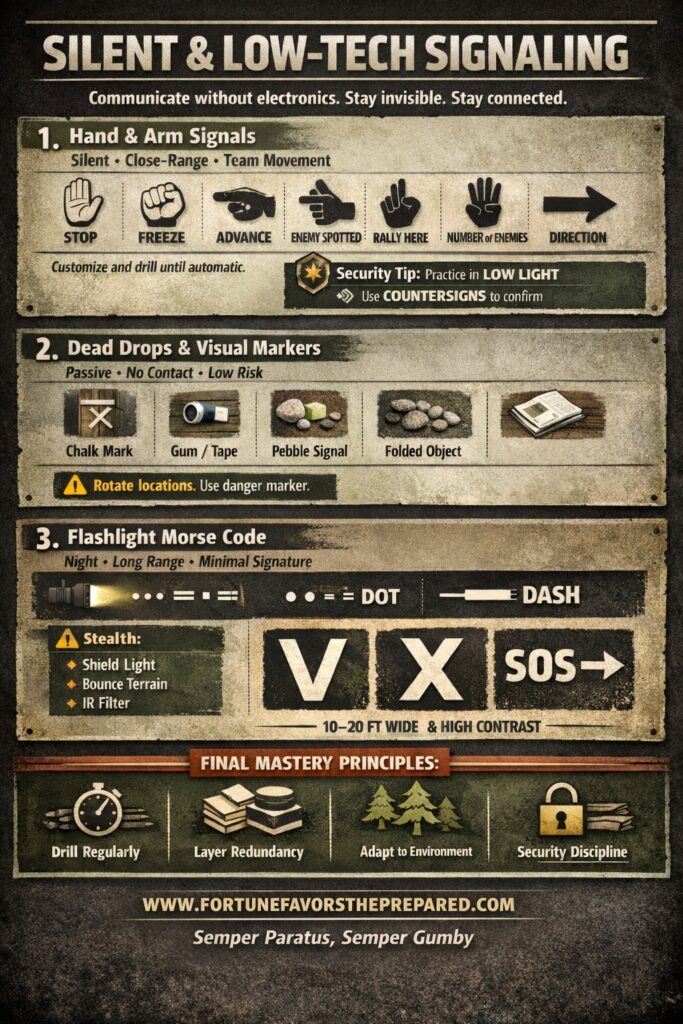
Final Mastery Tips
- Drill Regularly: Run full scenarios with your group—time how quickly and accurately you can convey complex messages like “enemy approaching from east, three tangos” using only silent methods.
- Layer Redundancy: Combine techniques (hand signals + flashlight confirmation + dead drop backup) so one compromised method doesn’t break the chain.
- Environmental Adaptation: In a Ranch-like setting, use snow for footprint patterns as countersigns, auroral glow for backlit silhouettes, or pine branches for hidden mirror flashes.
- Security Discipline: Assume everything is observed. Change codes monthly, use one-time pads for critical intel, and never reuse a compromised site or marker.
Mastering these low- and no-tech signals keeps communication alive when electronics fail, turning silence into a strategic advantage. In a world where the grid is down and threats are closing in, staying invisible while staying connected is the difference between holding the line and being overrun. Stay low, stay sharp.