Threat Assessment · Planning
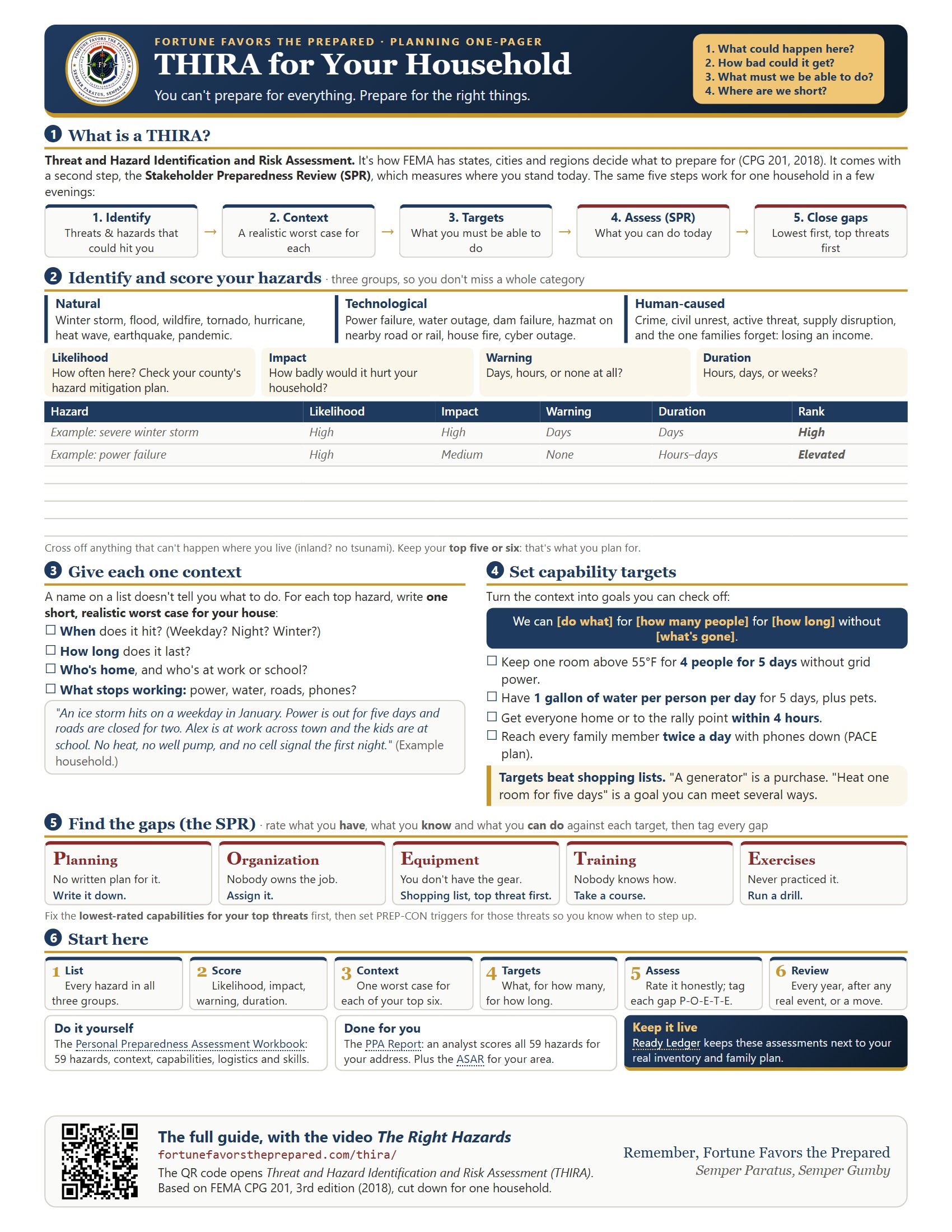
You can’t prepare for everything, so prepare for the right things. A THIRA is how emergency managers decide what those are. Here is the same process, cut down to fit one household.
Free download · one-page guide
THIRA for Your Household
Score your hazards, write a worst case for the top few, set capability targets and tag every gap – with a fill-in worksheet, on one printable page.
Download the PDFWhat is a THIRA?
THIRA stands for Threat and Hazard Identification and Risk Assessment. It’s FEMA’s standard way for states, cities, tribes and regions to answer three questions: what could happen here, how bad could it get, and what do we need to be able to do about it?
It always comes with a second step, the Stakeholder Preparedness Review (SPR). Once the THIRA sets the targets, the SPR measures what you can actually do today and names the gaps. FEMA describes both in Comprehensive Preparedness Guide (CPG) 201, 3rd edition (2018).
- What it answers
- What to prepare for, how much, and what to fix first
- The THIRA
- 1. Identify threats and hazards · 2. Give them context · 3. Set capability targets
- The SPR
- Rate what you can do now, find the gaps, and choose how to close them
- Gap types
- POETE: Planning, Organization, Equipment, Training, Exercises
- At home
- Same steps, one address, a few evenings of work. Review it every year.
Why bother with the formal version? Because most families prepare for the disaster they saw on the news, not the one most likely to hit their own street. Scoring hazards one by one fixes that.
Watch: The Right Hazards (2:20)
A few weeks after the winter storm, Sam asks Dana where to start. She walks him through a household THIRA in Ready Ledger: rank the hazards, check the supplies and skills, then find the gaps. The Harpers are an invented demo family; every screen is the real app.
Step 1: Identify threats and hazards
List everything that could realistically affect your household. Use three groups so you don’t miss whole categories:
Natural
Weather and earth
Winter storms, floods, wildfire, tornadoes, hurricanes, heat waves, earthquakes, pandemics.
Technological
Things that break
Power failure, water main or dam failure, hazmat spills on nearby roads or rail, house fire, cyber outages.
Human-caused
Things people do
Crime, civil unrest, active threats, supply disruption, and the one families forget: losing an income.
Then score each one. The workbook below uses 59 hazards; a quick version rates each on four things:
- Likelihood: how often it happens where you live (check your county’s hazard mitigation plan and local history).
- Impact: how badly it would hurt your household.
- Warning time: days, hours, or none.
- Duration: hours, days, or weeks.
Rank them by the total. Anything that can’t happen where you live (no coastline, no tsunami) gets crossed off. Keep your top five or six; that’s what you plan for.
| Example: the Harpers | Likelihood | Impact | Warning | Duration | Rank |
|---|---|---|---|---|---|
| Severe winter storm | High | High | Days | Days | High |
| Power failure | High | Medium | None | Hours–days | Elevated |
| House fire | Low | Severe | None | Weeks | Elevated |
| Flood | Medium | High | Hours | Days | Elevated |
| Earthquake | Low | Medium | None | Days | Low |
| Tsunami | Not possible inland | Not here | |||
Step 2: Give them context
A hazard on a list doesn’t tell you what to do. For each top hazard, write one short, realistic worst case for your house: when it hits, how long it lasts, who’s home and who isn’t, and what stops working.
Example context: winter storm
“An ice storm hits on a weekday in January. Power is out for five days and roads are closed for two. Alex is at work across town when it starts, and the kids are at school. No heat, no well pump, and no cell signal for the first night.”
That paragraph does the heavy lifting. It tells you to plan for heat, water, a family reunion plan and a way to talk when phones fail.
Step 3: Set capability targets
Turn each context into targets you can measure: what your household must be able to do, for how many people, for how long. For the storm above:
- Keep one room above 55°F for four people for five days without grid power.
- Have one gallon of water per person per day for five days, plus pets.
- Get everyone home, or to the agreed rally point, within four hours.
- Reach every family member twice a day with phones down (see PACE planning).
Targets beat shopping lists. “A generator” is a purchase; “heat one room for five days” is a goal you can meet several ways and check off.
Then find the gaps (the SPR)
Now be honest about where you stand against each target, in three areas:
- What you haveSupplies and equipment: water, food, power, heat, medical, comms, go-bags. Count what’s really on the shelf.
- What you know and can doRate each person’s skills: first aid, generator safety, radio, food preservation. Note the skills nobody in the house has.
- Where you fall shortRate each capability, then tag every gap with its cause so you know how to fix it.
| Gap type | What it means | How you fix it |
|---|---|---|
| Planning | No written plan for it | Write it down: family plan, PACE, rally points |
| Organization | Nobody owns the job | Assign it: who checks the generator, who gets the kids |
| Equipment | You don’t have the gear | Shopping list, highest-ranked hazard first |
| Training | Nobody knows how | Take a course (several below are free) |
| Exercises | Never practiced it | Run a drill: a lights-off night, a reunion test |
Work the lowest-rated capabilities for your top threats first. Then set your readiness-condition (PREP-CON) triggers for those same threats, so you know when to step up. Review the whole thing every year, and again after any real event or a move.
Tools to do it
Do it yourself
Personal Preparedness Assessment Workbook
This whole process on paper: score 59 hazards, give them context, then the capabilities, logistics and personnel skills assessments.
Done for you
Personal Preparedness Assessment Report
An analyst scores all 59 hazards for your address with local data and writes the context (Steps 1 and 2), ready to drop into the workbook.
Know your area
Area-Specific Assessment Report
The local research behind the plan: hospitals, repeaters, NOAA SAME codes, dispatch numbers and the area threat picture.
Keep it live
Ready Ledger
The same assessments on your computer, next to your real inventory and family plan, and it imports a PPA Report or ASAR file.
Ready to score your own hazards? Start with the workbook, or let an analyst do Steps 1 and 2 for you.
Get the workbookRemember, Fortune Favors the Prepared
Semper Paratus, Semper Gumby