Most families these days do not have more than a week’s worth of food stored, many have less.
Look at a grocery store on the way home from work and see how many people are buying supper for that evening. Look at how many people buy fast food on the way home.
One of the biggest challenges in having long term food storage is space. Many homes, and certainly apartments, do not have cupboard space for more than a week’s worth of food.
Update (2026): Ready.gov now says to have enough food, water and other supplies to last for several days; for longer outages, extension services suggest a one to two week supply. See Ready.gov Build A Kit and University of Arkansas Extension.
Many years ago families grew their own food. During World War II many people turned their lawns into gardens and grew their own food to support their families. Any surplus they traded for other goods and services. People who were not able to grow, or needed additional food, would go to local farms. As towns and cities grew we became dependent on complex production and distribution systems for our food, our food is not as fresh as if we grew it ourselves or obtain from a local farm.
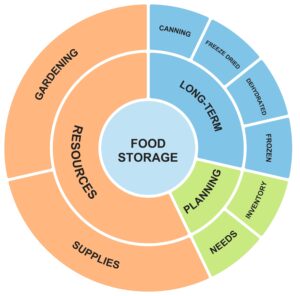
There are many options for food storage, from just adding a few cans to your weekly shopping to various types of food suitable for long term storage. You can grow your own vegetables or get them from local farmers and can them for long term storage. There are options for every budget.
Your food storage needs to take into account your situation, including any dietary restrictions, and the kinds of situations that you might be in. Some foods are better for keeping in your car for emergencies, others are more suitable for preparing food for groups versus an individual.
In this section
In this section we will look at a lot of options for you to begin your food storage program.
Water storage has its own page, and every pillar is on the Preparedness Pillars page.
Water All pillarsRemember, Fortune Favors the Prepared
Semper Paratus, Semper Gumby