Fortune Favors the Prepared
Home Find a topic Intelligence Today's DTR Training Ready Ledger Ready Trainer The Continuity Chronicles Blog References Shop About Contact
Skip to content

Fortune Favors the Prepared

Semper Paratus, Semper Gumby

Menu
  • The Continuity Chronicles
  • Intelligence Reports
        • DAILY THREAT REPORT
        • DAILY THREAT REPORT – LITE
        • DAILY PREPAREDNESS BRIEF
        • Analytical Standards and Tradecraft
        • Acronym & Abbreviations Glossary
        • Source Registry
        • FLASH & SPECIAL REPORTS
        • Area-Specific Assessment Report
        • SOFT TARGET SECURITY BRIEF
        • THE HOUSEHOLD BRIEF
        • COMMS WATCH
        • FINANCE SECTOR
        • HEALTHCARE SECTOR
        • TRANSPORTATION & LOGISTICS SECTOR
        • AI, DATA CENTER & INFRASTRUCTURE REPORT
        • CONSTRUCTION & MANUFACTURING SECTOR
        • Water and Wastewater Security Report
        • Energy Sector Report
        • Strategic Intelligence Supplement
  • WATCH DESK
  • About
        • The Why
        • Vision and Mission
        • Services
          • Business Resiliency
        • Testimonials
        • Insider
        • Friends
          • Patriot Volunteer Examiner (VE) Team
          • Angery American
          • Signal Stuff
          • Forward Observer
  • Communications
        • Stump Knocker
          • SOI
          • STUMP KNOCKER DMR UPDATES
          • MMDVM Hotspot
        • Preparedness Communications
          • What Radio Should I Get for Preparedness?
            • What Radio to Buy?
              • What Radio to Buy? – video
              • Ham Radio on a Budget
              • Live – What Radio to Buy?
              • Mobile Communications
          • Emergency Communications Principles
          • Communications Options
          • Starter Radio Paths by Preparedness Scenario
          • How Communications Fail
          • HF Communications
            • SHTF HF Communications
            • NVIS in Amateur Radio
        • Amateur (HAM) Radio
          • Why Do I Need a Ham License?
            • How to Obtain Your Amateur Radio License
              • Amateur Radio Learning Resources
              • Finding a Ham Exam
                • HAM Exam Accommodation
            • Are You Expired?
            • Why You Should Upgrade to a General Ham License
          • HAM Simplex Frequency Card
          • Analog versus Digital
          • Analog vs Digital Voice: A Preparedness-Focused Comparison
          • What are CTCSS and DCS
          • Programming Radios with Software
          • ARES, RACES, ACS and AUXCOMM
          • Ham Radio Beyond Line-of-Sight
            • Linked Analog Repeaters
            • EchoLink and IRLP
            • AllStarLink
            • Yaesu System Fusion & WIRES-X
            • D-STAR
            • Digital Mobile Radio (DMR)
            • P25 in Amateur Radio
            • NXDN in Amateur Radio
            • Amateur Radio Satellites (AMSAT)
            • The 60-Meter Band (5 MHz)
          • Meshtastic
          • HAM VoIP
        • Personal Radio Services
          • FCC Rules for Personal Radio Services
          • Family Radio Service (FRS)
          • General Mobile Radio Service (GMRS)
          • Multi-Use Radio Service (MURS)
          • Citizen Band (CB) Radio
            • CB Frequency Card
        • Other Radio Services
          • Communications Continuity Programs and Capabilities
          • Marine Communications
        • Cell Sites and Their Services
          • When Cell Service Fails
          • Radio over LTE and Rapid Radios
            • LTE Radio Comparison
        • Satellite Communications
          • America’s Secret Eyes
          • The Commercial Eye
          • Seeing Through Everything (SAR)
            • Remote Area Emergency Communication Devices
            • Which Beacon Should You Carry?
          • Personal Satellite Communications
        • Wired Communications
          • MAG Phone System
          • TA-312/PT Field Telephone and SB-22/PT Switchboard
          • Understanding Telephone Wiring
          • The AT&T Long Lines Program
        • Communications Planning
          • Communications Plan Annex
            • Communications P.A.C.E.
            • Finding Information for Your Communications Plan
            • Area-Specific Assessment Report
          • Automatic Link Establishment (ALE)
          • Understanding Communications Resiliency
        • Communications Resiliency Programs
          • ARES, RACES and ACS
          • Auxiliary Communications (AUXCOMM)
          • Military Auxiliary Radio System (MARS)
          • U.S. Coast Guard Auxiliary Communications
          • Civil Air Patrol Communications
          • The 60-Meter Band (5 MHz)
            • Understanding the 60-Meter Band
        • Government Communications Continuity Programs
          • Government Emergency Telecommunications Service (GETS) and Wireless Priority Service (WPS)
          • National Warning System (NAWAS)
          • National Interoperable Frequencies
          • The FEMA National Net (FNARS)
          • National Emergency Communications Network (NECN)
          • The SHARES Program
          • State Emergency Capability Using Radio Effectively (Operation SECURE)
          • The High Frequency Global Communications System (HFGCS)
          • Satellite Mutual Aid Radio Talkgroup (SMART)
          • The AT&T Long Lines Program
        • Communications & Emissions Discipline
          • Communications Security (COMSEC)
            • Book Cipher
            • One Time Pads (OTP)
              • Decrypting One Time Pad Message
              • One Time Pads (OTP) Live Video
              • One Time Pad Training
          • Cryptographic Security (CRYPTOSEC)
          • Transmission Security (TRANSEC)
          • Communications Transmission Discipline (TRANSDISC)
          • Emissions Control (EMCON)
          • Communications & Emissions Training Framework
        • DMR Programming
          • DMR Programming – Talk Groups
          • DMR Programming - Roaming
          • MMDVM and Yaesu System Fusion (YSF)
          • Encryption in DMR Radios
        • Digital Mobile Radio (DMR) Networks
          • WR3IRS Interstate DMR Network
            • South Central PA (SC PA)
            • North East PA (NE PA)
            • Washington-Baltimore (W-B)
            • West Central Florida (WCF)
          • Florida Digital Amateur Radio Network (F-DARN)
          • Southeast Florida DMR Repeater Network W2GGI
          • Virginia DMR (DMRVA)
          • NC PRN DMR Network
          • SC Hospital Emergency Amateur Radio Team (SCHEART)
          • HEARS – Hospital Emergency Amateur Radio System
          • New England Digital Emergency Communications Network (NEDECN)
        • Baofeng/BTECH Radios Quick Guide
          • Manually Programming a Baofeng Radio – Video
          • A User’s User Manual for Baofeng Radios
        • MESSAGES & REPORTS
          • Phonetics
          • Procedure Words (Prowords)
          • Date Time Group (DTG)
          • NTS Radiogram Form
            • ARL Numbered Radiograms
          • SALUTE, SPOT, and SALT Reports
          • ACE/LACE Reports
          • GOTWA Report
          • CASREP (Casualty Report) Format
          • MEDEVAC Request Report
          • Formatted Messages (downloads)
        • Communications Knowledge Library
          • Communications Resiliency
          • Radio Etiquette, Jargon, and Best Practices
          • AmRRON RESOURCES & REFERENCES
          • Anytone Programmable Keys
          • Phonetics
          • Amateur Radio Colorado
            • Colorado Linked Repeater Systems
        • COMMUNICATIONS REFERENCES
  • Planning
        • Family Emergency Plan – The Basics
          • Family Emergency Plan
            • Area-Specific Assessment Report
          • Why Every Family Needs an Emergency Plan
        • Family Contingency Binder
          • Family Contingency Binder MindMap
        • Triggers
          • Preparedness Conditions – PREP-CON
            • Preparedness Conditions (PREP-CON) MindMap
          • Space Weather
        • Family Emergency Plan Workbook
          • Family Emergency Plan Workbook - owner resources
            • Area-Specific Assessment Report
            • Family Emergency Planning Form
            • Communications Plan
              • P.A.C.E.
            • Emergency Evacuation
            • Emergency Food Supplies
            • Family Contingency Binder
            • Message Drops
            • Get Home Bag
            • Bug Out Bag & Bins
            • Miscellaneous
        • Household Recovery Workbook
          • Household Recovery Workbook Updates
          • Disaster Debris — What to Do at the Curb
          • Dealing With Grief
        • Next of Kin Workbook
          • Next of Kin Workbook Updates
        • METT-TC: Decision Discipline
          • METT-TC - tactical planning
        • Planning Your Preps
          • Charity in Planning
        • Mutual Assistance Group
          • Mutual Assistance Group Workbook
            • MAG Workbook Forms & Updates
          • Mutual Assistance Groups (MAGs): Skills, Vetting, and Building Real Resilience
          • Mutual Assistance Group (MAG): Recruitment Code of Conduct
          • MAG: Private Vetting & Intake Process
          • Compartmentalization in Mutual Assistance Groups (MAGs)
          • Resiliency Index
          • Continuity of Government & Application to MAGs
  • Threat Assessment
        • Personal Preparedness Assessment Workbook
          • Personal Preparedness Assessment Report
          • Personal Preparedness Assessment Workbook - owner resources
        • Readiness Conditions for Preparedness
          • PREP-CON - Preparedness Conditions
          • COMCON – Communications Readiness Condition
          • WX-CON Weather Conditions
          • SWX-CON Space Weather Condition
          • CONCON – Civilian Continuity Conditions
        • Readiness Conditions – Hierarchy and Relationships
          • LERTCON – Alert Condition
          • DEFCON – Defense Readiness Condition
          • COGCON - Continuity of Government
          • INFOCON – Information Operations Condition
          • FPCON – Force Protection Condition
          • EMERCON – Emergency Condition
          • CYBERCON – Cyber Readiness Conditions
          • CPCON – Cyberspace Protection Condition
          • WATCHCON – Watch Condition
          • SIPRNet – Secret Internet Protocol Router Network
          • REDCON – Readiness Condition
          • NC3CON – Nuclear Command, Control, and Communications
        • Readiness Conditions in The Continuity Chronicles
          • CERCON – Cerberus Readiness Condition
          • COMCON – Communications Readiness Condition
          • C-OPS – CERBERUS Operational Status Conditions
          • CONCON – Civilian Continuity Conditions
        • Being Prepared for Civil Unrest
          • Civil Unrest – Area Intelligence
          • Civil Unrest – Be Prepared
          • Civil Unrest – Defense
          • Civil Unrest – Defense (part 2)
        • Staying Informed Before, During and After Emergencies
          • Weather Awareness
            • Weather Event Codes
            • Weather Radio Comparison
        • Cascade Analysis & Infrastructure
          • Cascade Effects
          • Community Lifelines
          • Area Intelligence
          • Area-Specific Assessment Report
          • National Power Grid
        • Near Earth Object / End of Life Event (ELE)
  • Intelligence
        • ANALYSIS, TRADECRAFT & REPORTING
          • Analytical Standards and Tradecraft
          • Analytical Tradecraft: A Guide to OSINT Analysis
            • OSINT Analysis Study & Reference Guide
          • Understanding Intelligence Analysis Tools
            • Understanding Analysis of Competing Hypotheses (ACH)
            • Understanding MDCOA
            • Understanding OAKOC
        • Operations Security (OPSEC)
          • OPSEC for Teens
          • OPSEC for Kids
          • The Gray Man
          • OPSEC: Don't Become the Target
          • Counterintelligence Tradecraft for the Prepared
        • Community Intelligence
          • Area Intelligence – Now!
            • Area-Specific Assessment Report
          • Community SITREP
          • Radio Traffic Situational Analysis During Emergencies
          • SALUTE, SPOT, and SALT Reports
        • ELECTRONIC THREAT & SURVEILLANCE
          • Staying Informed Before, During and After Emergencies
          • Integrated Public Alert and Warning System (IPAWS)
          • Communications Continuity Programs and Capabilities
          • Short Wave Scanning
          • Seeing Through Everything (SAR)
            • Which Beacon Should You Carry?
          • Wireless Recon Devices
          • Flock Cameras – What You Need to Know
        • The Architecture of Intelligence
        • Intelligence Gathering & Analysis
        • INTELLIGENCE DISCIPLINES
          • Communications Intelligence (COMINT)
          • Electronic Intelligence (ELINT)
          • Tactical Electronic Intelligence (TACELINT)
          • Signals Intelligence (SIGINT) – the basics (2020)
          • Signals Intelligence – Information Gathering Basics (2022)
          • Signals Intelligence (SIGINT)
          • Technical & Infrastructure Intelligence (TECHINT)
          • Electronic Counter-Surveillance
          • Open-Source Intelligence (OSINT)
            • How to Conduct a Daily Threat Analysis Using OSINT
          • Measurement and Signature Intelligence (MASINT)
          • Electronic Surveillance (ES)
          • Overhead Imagery & Geospatial Intelligence (IMINT / GEOINT)
        • INTELLIGENCE REFERENCES
  • Medical
        • Medical Training
          • Patient Assessment & Casualty Management
            • MARCH-PAWS Rapid Assessment
            • DCAP-BTLS – Secondary Trauma Assessment
            • SAMPLE + OPQRST Secondary Assessment
              • Medical History as a Preparedness Skill
            • START Triage
            • MEDEVAC Request Report
            • Patient Assessment – Documentation
              • Patient Care Report Forms
              • CASREP (Casualty Report) Format
        • Medical Kits
          • Individual First Aid Kit (IFAK)
          • BooBoo and IFAK Kits Video
          • BooBoo & IFAK Kit Mind Map
        • Medical Myths
          • Medical Myths – Tampons
          • Medical Myths – Ingested Poisoning
        • MEDICAL REFERENCES
  • Transportation
    • Transportation Plan B
    • Improvised Transportation
    • Winter Vehicle Prep and Kit
  • Animals
    • Preparedness for Pets
  • Food
        • Why You Should Start a Food Storage Plan
        • Food Storage Quick Start
        • Buying in Bulk
        • Inventory Tracking
        • FOOD PRESERVATION RESOURCES
  • Water
    • Water From Air
  • Power
        • Power Grid
        • UPS
        • The Data Center Next Door
  • Bags etc.
        • Bug Out versus Get Home Bags
        • Get Home Bag – Contents
          • Get Home Bag – video
          • Get Home and Bug Out Bags - video from live 2-10
  • Navigation & Signalling
        • Grid Coordinates and Map Reading
        • Map & Compass Land Navigation
        • Practitioners Guide to GPS
          • Quick Instruction Sets
        • Which Emergency Beacon Should You Carry?
        • Covert Signals
        • Emergency Signaling
  • References
        • PLANNING & OPERATIONS
        • SECURITY OPERATIONS
        • INTELLIGENCE
        • CRYPTOLOGY
        • COMMUNICATIONS
        • REPORTING FORMATS
        • GENERAL/MISC
        • MEDICAL
        • FOOD PRESERVATION
        • CRITICAL INFRASTRUCTURE
        • SURVIVAL MANUALS
        • OPSEC
        • COUNTER INSURGENCY & CIVIL DISTURBANCE
        • EMP / CME
        • Training
          • Training Videos
          • One Time Pad (OTP) Exercises
            • 45662
            • 222135ZDEC22
        • Media and Press
  • Blog
    • Boomer
      • Day 1 – The Journey Home
      • Day 2 – First Day in the New Home
      • Day 3 – More Training
      • Day 4 – Dad Goes Back to Work
      • Day 5 – A Day at Home with More Training with Dad (Boomer’s version)
      • Day 6 – More Training with Dad at Home
      • Day 7 – Dad Goes Back to Work, Boring Day
    • Mountain Readiness Fallout Workshops
    • Mapping DMR Repeaters
    • COMMUNICATIONS RESILIENCY
    • Getting The Message Through
    • What are you preparing for?
    • Never Let an Opportunity Go To Waste
    • Cascade Effects and the Perfect Storm
    • DO NOT REPLY
    • Space Weather Warning
    • Good, and Sad, News
    • Necessity vs. Luxury
    • Don’t Put off Until Tomorrow
    • No Plan Survives First Contact
    • Threat and Hazard Identification and Risk Assessment (THIRA)
    • Live – What Radio to Buy?
    • Big Daddy Unlimited Affiliate
    • Food – Tue 16th 7pm MST
    • Live from 2021-2-3
    • Live 2021-01-26
    • FLASH SALE
    • Live 2021-01-11
    • What Is Freedom?
    • Preparedness for Pets
    • What If The Lights Go Out?
    • Hoarding or Prepping?
    • Why Do I Need a Ham License?
    • How Bad is the SolarWinds Orion Issue?
    • How To Begin Prepping
    • Members Only Live Videos
    • Live 11/24
    • Ham Radio VoIP Phone
    • Training Calendar
    • A Chat (with some whisky)
    • Blog 2020 11 02
    • Live with Charlie Hogwood
    • EARTH EX 2020
    • A Live with Angery American
    • Have You Woken Up Yet?
    • BUG OUT READY
    • The Gray Man
    • Area Intelligence – Now!
    • Being Prepared for Civil Unrest
    • It Depends
    • The Art of Being Prepared – The New Prepper
    • Get Home versus Bug Out Bags
    • Why You Need an IFAK AND Training
  • Ready Ledger
        • Ready Ledger Training E01 – Initial Setup
        • Ready Ledger Training Video E02 – Places
        • Ready Ledger Training E03 – People
        • Ready Ledger Training E04 – Containers
        • Ready Ledger Training E05 – Your Spreadsheets
  • Training Curriculum
  • Ready Trainer
  • Shop
  • Contact
    • Mailing List
Menu

Multi-Use Radio Service (MURS)

MURS, the Multi-Use Radio Service, is five VHF channels that anyone can use with no license, no exam and no fee. It’s limited to 2 watts and you can’t use repeaters, but it sits on a different band from FRS and GMRS. That makes it quieter, a little better in woods and rolling hills, and a useful second (or third) layer in a family or group comms plan.
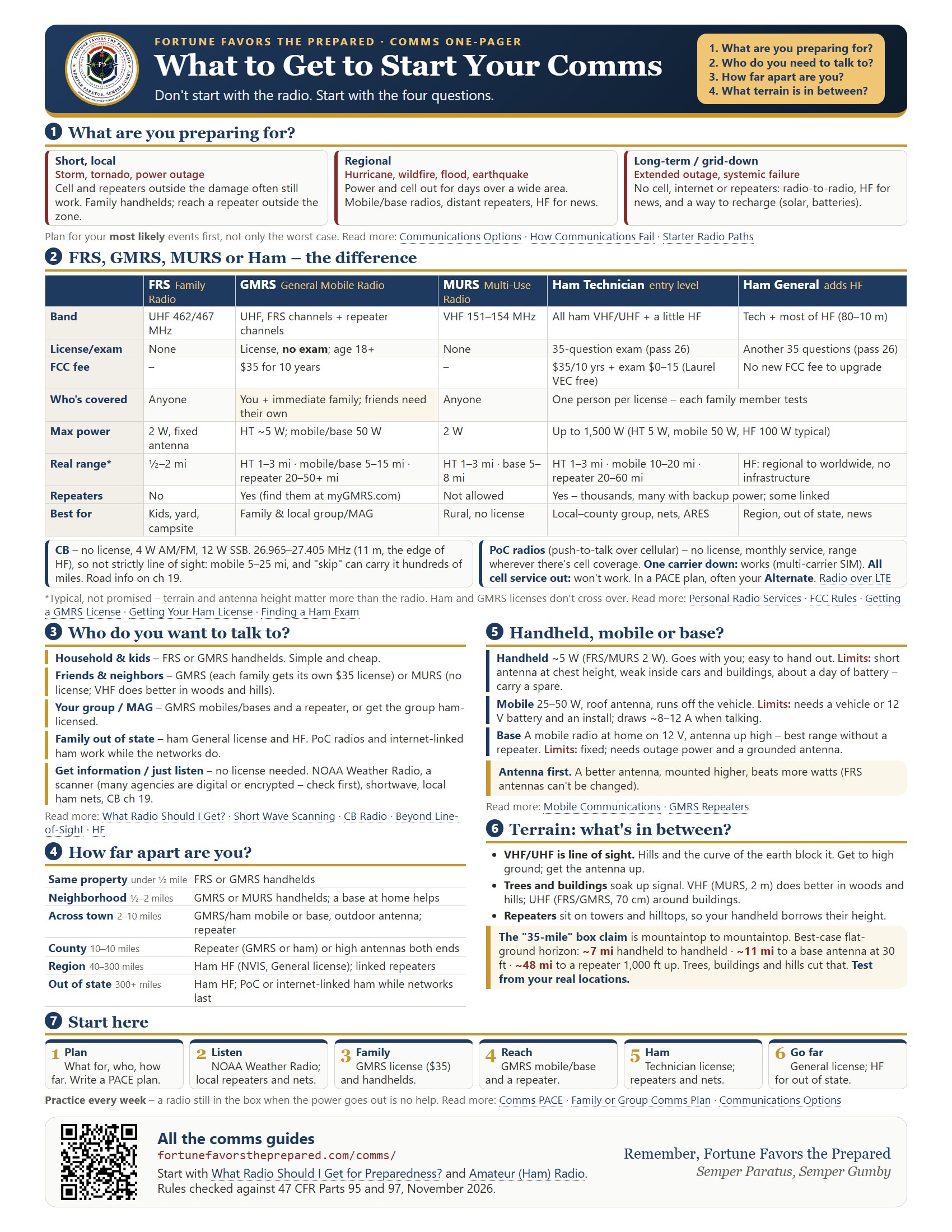
What to Get to Start Your Comms one-page guide

Free download · one-page guide

What to Get to Start Your Comms

What are you preparing for, who you need to reach and how far. FRS, GMRS, MURS, ham, CB and PoC radios: licenses, fees, real-world range, handheld vs mobile vs base, and terrain – on one printable page.

Download the PDF

On this page

  1. MURS at a glance
  2. The five MURS channels
  3. The rules that apply to MURS
  4. Which radios you can use
  5. Range, antennas and height
  6. MURS in your comms plan
  7. Downloads and sources

MURS at a glance

License
None. MURS is “licensed by rule”: buy a certified MURS radio and follow the rules (§95.305).
Who can use it
Anyone, any age. The only people excluded are foreign-government representatives and anyone under an FCC cease-and-desist order.
Cost
No FCC fee. Just the radio.
Band
VHF, 151–154 MHz. FRS and GMRS are UHF (462–467 MHz).
Channels
Five, shared with everyone (and with some older business users on two of them).
Power
2 watts transmitter output, on every channel.
Antenna
Removable and external antennas are allowed, including gain antennas. The top of the antenna may be no more than 60 ft above the ground or 20 ft above the structure it’s on.
Repeaters
Not allowed. Every MURS contact is radio-to-radio.
Call sign
None. MURS has no station identification rule.
What you can send
Voice (FM or AM), data, images, telemetry and remote control. Privacy tones (CTCSS/DCS) are allowed.
Where
The U.S. and its territories, and U.S. vessels. Not aboard aircraft in flight.

The five MURS channels

The FCC lists MURS by frequency, not channel number. The numbers 1–5 below are the common convention most radios use; channels 4 and 5 are also widely known by their old business-radio names.

ChannelFrequency (MHz)Max bandwidthNotes
MURS 1151.82011.25 kHz (narrow)
MURS 2151.88011.25 kHz (narrow)
MURS 3151.94011.25 kHz (narrow)Used by the AmRRON Channel 3 Project as a MURS calling channel
MURS 4154.57020 kHz (wide allowed)“Blue Dot” – you may hear businesses here
MURS 5154.60020 kHz (wide allowed)“Green Dot” – you may hear businesses here

Program every radio in your group the same way: the same channels, the same privacy tone and the same narrow/wide setting. A wide radio talking to a narrow one sounds loud and distorted one way and quiet the other.

The rules that apply to MURS

MURS rules are in 47 CFR Part 95, Subpart J. The general rules for all Personal Radio Services in Subpart A apply too. Here is every rule that matters to someone using MURS, in plain English.

Operating rules (what you must and mustn’t do)

RuleWhat it means for youSection
Use a certified radioThe radio must be FCC-certified for MURS. Using one that isn’t voids your authority to operate.95.335
Listen before you talkCheck the channel is clear before transmitting and take reasonable steps not to interfere with others.95.2725
No repeaters or boostersNo repeater stations, signal boosters or store-and-forward packet (digipeating).95.2733
No phone patchMURS can’t be connected to the public telephone network.95.2749
No continuous carrierYou can’t leave a transmitter keyed up continuously.95.2757
Antenna heightTop of the antenna no more than 60 ft above ground or 20 ft above the structure it’s mounted on. Extra limits apply near airports.95.2741, 95.317
Replacing partsYou may replace a damaged antenna with the same or a compatible type, and batteries with the type the manufacturer specifies. Other repairs must be done by someone qualified.95.2719, 95.319
Faulty equipmentIf your radio isn’t working properly, stop transmitting on it (except for emergencies) until it’s fixed. Brief test transmissions are fine.95.319
Not in aircraftNo MURS use aboard aircraft in flight.95.2707
Prohibited usesNothing illegal, no advertising or broadcast material, no messages for hire, no deliberate interference, nothing obscene, profane or indecent, nothing false or deceptive.95.333
FCC lettersIf the FCC writes to you about your station, you must reply in writing within the time it gives.95.311

What MURS is allowed to carry

RuleWhat it means for youSection
Permitted usesVoice, data or image signals, plus telemetry and telecommand (remote sensing and remote control).95.2731
Emission typesFM and AM voice, and several data modes. Voice may include tone squelch or selective calling (CTCSS/DCS).95.2771
Bandwidth11.25 kHz on 151.820, 151.880 and 151.940; 20 kHz on 154.570 and 154.600; AM voice no wider than 8 kHz.95.2773
Power2 watts transmitter output, all channels.95.2767
Grandfathered usersBusinesses licensed on these frequencies before November 13, 2000 can keep operating under their old terms. Expect to share.95.2705

Equipment rules (mostly for manufacturers and sellers)

RuleWhat it means for youSection
One service onlyA radio can’t be certified for MURS if it can also transmit in another service (Part 15 low-power devices excepted). That rules out ham radios such as Baofengs.95.2761(c)
No scramblingRadios with voice scrambling or other obscuring features can’t be certified for MURS (applications from Dec. 27, 2017).95.381
No sale of uncertified radiosIt’s illegal to make, import, sell or offer for sale non-certified equipment for the Personal Radio Services.95.391
Technical limitsFrequency accuracy, audio filter and unwanted-emission limits the radio must be designed to meet.95.2765, 95.2775, 95.2779

Rule change, December 2025. The FCC removed paragraphs (a) and (b) of §95.2761 (90 FR 57712, Dec. 12, 2025). They repeated the general requirement that every MURS radio be certified, which still applies under §95.335. Paragraph (c), the one-service-only rule, is unchanged.

Codes and encryption. Unlike GMRS, MURS has no rule against code words or brevity codes. But no radio with scrambling or encryption can be certified for MURS, so everything you say goes out in the clear. Assume anyone with a scanner can hear you. If you need to protect message content, that’s a COMSEC problem, not a MURS one.

Which radios you can use

Use a radio sold as MURS-certified. You can check any radio by looking up its FCC ID in the FCC equipment authorization database: the grant should list Part 95 Subpart J (MURS).

  • Ham radios (Baofeng, BTECH UV series, AnyTone and similar): they can tune to MURS frequencies, but they aren’t certified for MURS. Most also put out more than 2 watts. Using them on MURS is a violation, even on low power. They’re fine for listening to MURS, and fine on the ham bands if you’re licensed.
  • Commercial (Part 90) business radios: unless the radio is also certified under Subpart J, it isn’t a MURS radio. Business-band licensing is a separate Part 90 path for eligible organizations.
  • MURS alarms and sensors: wireless driveway and gate alarms that use MURS are legal telemetry, and many families already own one. Your MURS radio can hear them.

“Any frequency in an emergency” is a myth. Part 95 has no rule letting you use an uncertified radio, or someone else’s frequencies, because it’s an emergency. The amateur-radio emergency rules (§97.403 and §97.405) cover licensed ham stations, not MURS. Plan with radios that are legal for the service you’ll use.

Even the FCC’s informal answers on this have been inconsistent. One staff response on record reportedly supported using a modified amateur radio on non-amateur frequencies in a genuine emergency; another said flatly that Part 97 only covers amateur frequencies. Conflicting informal statements from individual staff are not a legal foundation to plan around.

Range, antennas and height

Like FRS and GMRS, MURS is line of sight. Two watts doesn’t go far from a handheld held at chest height, but MURS lets you do something FRS doesn’t: use a better antenna and put it up high.

SetupTypical range*
Handheld to handheld1–3 miles
Handheld to a base antenna up high3–6 miles
Base to base, outdoor antennas at legal height5–8 miles, more from high ground

*Rules of thumb, not promises. Terrain, trees, buildings and antenna height matter more than the radio.

  • The 2 W limit is transmitter output, not radiated power. A gain antenna on a mast is legal and can make a big difference, as long as the top stays within the height limit.
  • Height beats power. Getting the antenna 20 ft above your roofline does more than any amount of extra wattage.
  • VHF in the woods. MURS (VHF) gets through trees and over rolling ground a little better than FRS/GMRS (UHF). In towns, among buildings, UHF often does better.
  • Use good coax. On a base antenna, cheap thin coax can lose a good part of your 2 watts before it reaches the antenna.

MURS in your comms plan

MURS won’t out-reach a GMRS repeater, and it doesn’t need to. Its value is that it’s different: a different band, with no license barrier and fewer people listening.

  • Homestead and rural groups: a good primary for property and neighbor comms where VHF handles the terrain better.
  • Neighbors and visitors without a license: anyone can use MURS, so you can hand radios to people who don’t have a GMRS license.
  • An alternate layer: use it as the Alternate or Contingency in a PACE plan alongside FRS/GMRS and ham.
  • Write it down: list your MURS channels and tones in your family or group comms plan the same way you would GMRS.

Obscurity isn’t security. Fewer people monitor MURS, so you’re less likely to be overheard by chance. That is not protection. Anyone who checks MURS hears you in the clear. To keep your signal footprint down, see Emissions Control (EMCON) and the COM-04 EMCON course.

Downloads and sources
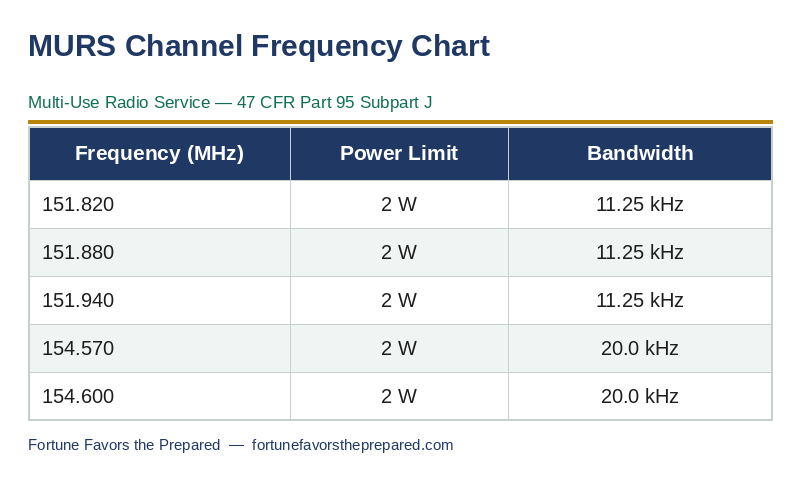
MURS channel frequency chart: five frequencies, 2 W power limit and bandwidth
MURS Channel Frequency Chart – print it and keep it with the radio.

Sources: 47 CFR Part 95 Subpart J (MURS) and Subpart A (general rules), eCFR current as of October 29, 2026.

See also

  • Personal Radio Services
  • Family Radio Service (FRS)
  • General Mobile Radio Service (GMRS)
  • Citizen Band (CB) Radio
  • FCC Rules for Personal Radio Services
  • What Radio Should I Get for Preparedness?

Related training

  • COM-01 PACE Planning (free)
  • COM-03 COMSEC
  • COM-04 EMCON (Emissions Control)
  • COM-05 ICS-205 Communications Plan

Remember, Fortune Favors the Prepared

Semper Paratus, Semper Gumby

Start here

  • Where to start
  • What to prepare for
  • The Preparedness Pillars
  • Workbooks
  • Communications
  • Training courses

Free guides & tools

  • Where to Start Being PreparedPDF
  • THIRA for Your HouseholdPDF
  • What to Get to Start Your CommsPDF
  • POC Radios and Your PACE PlanPDF
  • Start a Food Storage PlanPDF
  • Winter Vehicle KitPDF
  • Message FormatterFREE TOOL
  • Field Report Formats

The Continuity Chronicles

  • The Meadow ProtocolBook 1
  • The BrushBook 2
  • Unassigned AuthorityBook 3
  • About the series
  • Shadow Government LeakA leaked file from the books
  • All three books bundle

Shop

  • Family Emergency Plan WorkbookMost popular
  • Personal Preparedness Assessment Workbook
  • Communications Card Bundle13 field cards
  • All workbooks
  • Area assessments (ASAR)
  • The Continuity Chronicles books
  • Ready Ledger
Visit the shop →

Search the site

Login with Patreon

Login with Patreon

Cart

About FFTP

  • Support us on Patreon
  • About
  • Contact
©2026 Fortune Favors the Prepared | Built using WordPress and Responsive Blogily theme by Superb