The impact of solar flares and storms has an impact on communications and power distribution, as power lines act like an antenna.
NOAA has a deep space satellite, DSCOVR: Deep Space Climate Observatory that orbits 1 million miles from Earth. It can give 15-60 minutes advance warning of the exact solar winds and impacts that will impact the Earth. This is not a lot of time to take action should one the size of the 1859 Carrington Event be about to hit the Earth.
Update (2026): NOAA’s new SOLAR-1 satellite (formerly SWFO-L1) reached its orbit about 1 million miles out in January 2026 and has been the primary operational spacecraft at that point since June 10, 2026, alongside older craft such as DSCOVR and NASA’s ACE. See SWPC: SOLAR-1.
A lot of prediction is done based on observation of the sun and flares when they leave the sun. Therefore it is prudent to sign up for notifications from NOAA or one of the other space weather prediction sites.
Three categories are used with solar storms; geomagnetic, solar radiation and radio blackouts. As with other weather events, there are levels within each.
Triggers
You should incorporate space weather triggers into your emergency plan. Actions should include protecting your communications equipment, like disconnecting the antennas and possibly putting radios into a faraday cage/box.
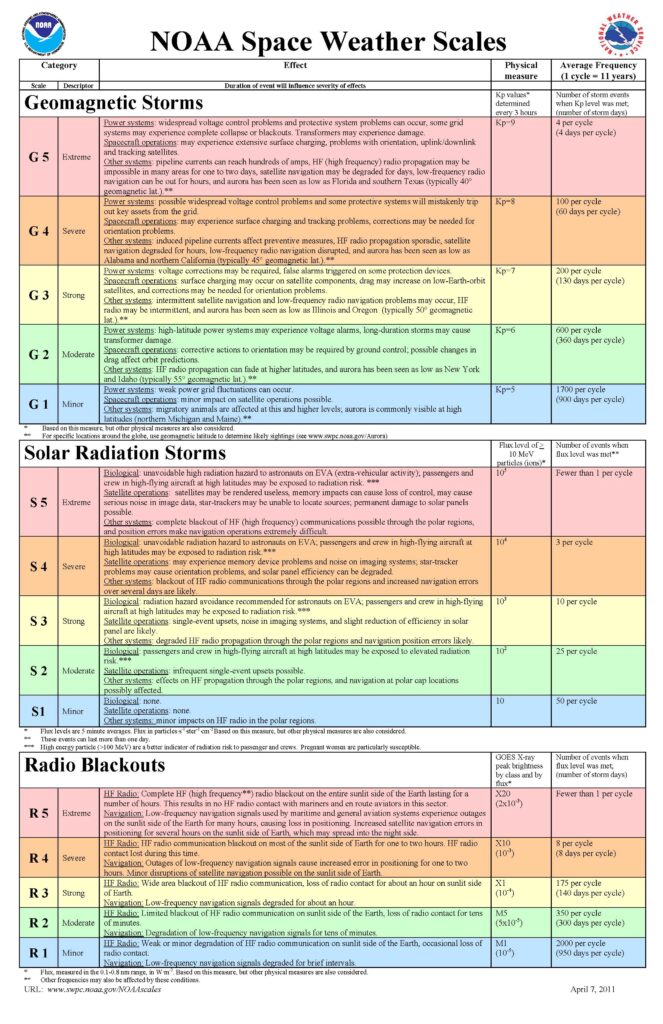
NOAA keeps the current version of these scales on its Space Weather Scales page.
Remember, Fortune Favors the Prepared
Semper Paratus, Semper Gumby