COM-01 · Lesson 5 of 5
PACE Beyond Communications
Transfer the framework to all critical planning domains — then build your group’s comms plan
The Framework Transfers Directly
The four-tier structure of PACE — pre-decided sequence, specific failure triggers, documented and distributed, tested before you need it — applies without modification to any planning domain that requires redundancy. What changes is the systems in each tier. The logic is identical.
A family or group that has internalized PACE for communications can extend it to evacuation, water, power, medical, food, and leadership in a single planning session. The questions are always the same: What do we use normally? What is our first fallback? What is independent of both? What works when everything else is gone? When exactly do we move from one to the next?
Applying PACE to Critical Domains
| Domain | P — Primary | A — Alternate | C — Contingency | E — Emergency |
|---|---|---|---|---|
| Evacuation | Main highway | Secondary roads | Off-road / unpaved track | On foot via trail |
| Water | Municipal tap | Stored water reserves (30+ day) | Rainwater collection | River / stream filtered |
| Medical care | Hospital / urgent care | Group medic with full kit | Field improvisation | Buddy care / self-care protocols |
| Power | Grid electricity | Generator (fuel stored) | Solar / battery bank | Manual / no-power methods |
| Leadership | Designated leader | Second-in-command | Senior member present | Most capable person available |
| Food | Store and supply chain | Family or group stockpile | Foraging, hunting, fishing | Reduced-calorie rationing protocol |
A family or group builds a power PACE plan: P = grid, A = generator, C = solar battery bank, E = manual. The generator belongs in Alternate because it is fuel-dependent. The solar bank belongs in Contingency because it has no fuel dependency.
Then they discover that their solar charge controller firmware requires an internet connection to initialize after a factory reset, and their inverter has a cloud-dependent app for configuration. Their Contingency tier has an internet dependency they never checked. A grid outage that also kills the internet takes out three tiers at once.
The check is always the same: If the tier above this one fails for reason X, does this tier also fail for reason X? Apply it to every domain before you declare any tier operational.
Capstone Exercise: Build Your Family or Group’s PACE Communications Plan
This exercise produces your group’s actual, usable PACE communications plan. Work through it with your family or group — not alone. Every person who may need to activate any tier should be present and must agree to the plan before it is final.
A PACE plan decided by one person and handed to the rest of the group is not a functional plan. Each member needs to understand the failure triggers, know the frequencies or contact methods for every tier, and have agreed to the plan in advance. Do not complete this exercise solo.
Step 1: Identify Your Communications Relationships
List every relationship your family or group needs to maintain in an emergency. Most families and groups have at least three:
- Local — household members, immediate neighbors, or people within 1–3 miles
- Regional — MAG members, trusted contacts across the county (10–50 miles)
- Out-of-area — family welfare check-in, contacts 100+ miles away
You will need a separate PACE plan for each relationship. Build the local plan first — that is the plan you are most likely to need first and most often.
Step 2: Inventory Your Equipment
List every communications device your family or group actually owns or has reliable access to. For each one, determine:
- What system does it use? (cell, GMRS, amateur VHF/UHF, HF, satellite, app-based PTT)
- What infrastructure does it require? (cell tower, repeater, internet, satellite)
- What license or subscription does it require? (none, GMRS, Technician, General, satellite plan)
- What is its realistic range in your terrain?
- Who in your family or group can operate it without assistance?
Before finalizing your system choices, review the relevant FFTP Preparedness Pillars sections for detailed capability and equipment comparisons: Radio Over LTE / PTToC covers Zello, ESChat, dedicated PTToC devices, and when each is appropriate. Remote Devices covers remote base stations, internet-linked radio systems, and their PACE planning implications.
Step 3: Build the Stack — Local Plan
Using your equipment inventory and the system reference from Lesson 3, assign systems to each tier for your local communications relationship. A realistic example for a GMRS-licensed group with one or more Technician-class amateur operators:
P — Primary: Cell phone with Zello group channel. All members on the same Zello channel; PTT available on both cellular and home Wi-Fi. Failure trigger: no cellular signal for 30 minutes AND Zello channel shows all members offline.
A — Alternate: GMRS via local repeater on 462.600 (+ 5.0 MHz offset, 100.0 Hz CTCSS). All members have GMRS handhelds programmed with the local repeater. Failure trigger: no response on scheduled 8am repeater check-in for three consecutive mornings.
C — Contingency: GMRS simplex on 462.675 MHz (national calling). Direct radio-to-radio; no infrastructure. Each member checks at 8am, 12pm, and 6pm if Alternate is unavailable. Failure trigger: no simplex contact within 24 hours of last confirmed communication.
E — Emergency: Runner to pre-agreed rally point (documented address in companion guide). Also: Garmin inReach SMS to out-of-area contact who relays status. Failure trigger: none — Emergency activates when Contingency trigger fires.
Note: GMRS license covers the whole family. No amateur license required for this plan. Adding an amateur VHF repeater Alternate or HF Contingency would require Technician or General class respectively.
Step 4: Write the Failure Triggers
For each tier transition, write the specific, observable, time-bounded trigger. Use the companion guide worksheet. Do not accept vague triggers. Test each one: could any member evaluate this trigger independently, without calling a leader, in the middle of the night?
| Transition | What Makes a Trigger Strong |
|---|---|
| P → A | Time window + observable indicator (not “when it doesn’t work”) |
| A → C | Count of missed scheduled contacts + time elapsed |
| C → E | Hours elapsed since last confirmed contact + number of check-in attempts made |
Step 5: Document, Distribute, and Schedule Tests
- Complete the PACE Plan Worksheet in your companion guide (Part III)
- Create a laminated wallet card for every family member or group member with tier, frequency, and trigger
- Schedule your first four tests: one per tier, one per month for the next four months
- Record results in the Tier Test Log (Part III of companion guide)
Open the companion guide to Part III. Complete the PACE Plan Worksheet for your local relationship. All four tiers must have: a named system or method, specific frequency or contact information, a written failure trigger, and a scheduled first test date. Finish the worksheet before you move on. If working with your group, complete the Group PACE Summary Card as well.
The PACE Mindset
Redundancy without a plan is clutter. A group with four radios and no PACE plan will improvise when the first one fails. A group with two radios and a tested PACE plan will communicate.
Every time a new system enters your group’s kit, ask: where does this go in the PACE plan? Every time you run a drill, include one scenario where Primary is unavailable. That habit, practiced consistently, is what keeps your PACE plan from becoming a shelf document.
PACE is not limited to communications. Every critical planning domain — evacuation, water, medical, power, leadership — benefits from the same four-tier logic. You have the framework. Apply it everywhere.
Building Out From COM-01
A tested PACE plan is the foundation. The courses below address the layers that sit on top of it — how to operate on those tiers securely, when to transmit at all, and how to integrate your communications posture with your broader preparedness readiness.
- COM-07: One-Time Pads (OTP) — encrypted messaging for MAG communications security. Once your PACE plan is built, OTP provides the COMSEC layer for traffic on the Contingency and Emergency tiers.
- COM-04: EMCON — Emissions Control — when to transmit, when to go dark, and how to keep a minimal electronic signature. EMCON governs when and how you activate each PACE tier.
- Preparedness Conditions (PREP-CON) — the full PREP-CON framework and how it drives your group’s readiness posture.
- PLN-05: COMCON — the Communications Readiness Condition in depth: how it is assessed, what each level means operationally, and how it drives your PACE plan.
The Full Framework: PREP-CON → COMCON → PACE
PACE is the execution layer of a three-tier planning framework. Understanding how the layers connect gives your group a complete operational picture.
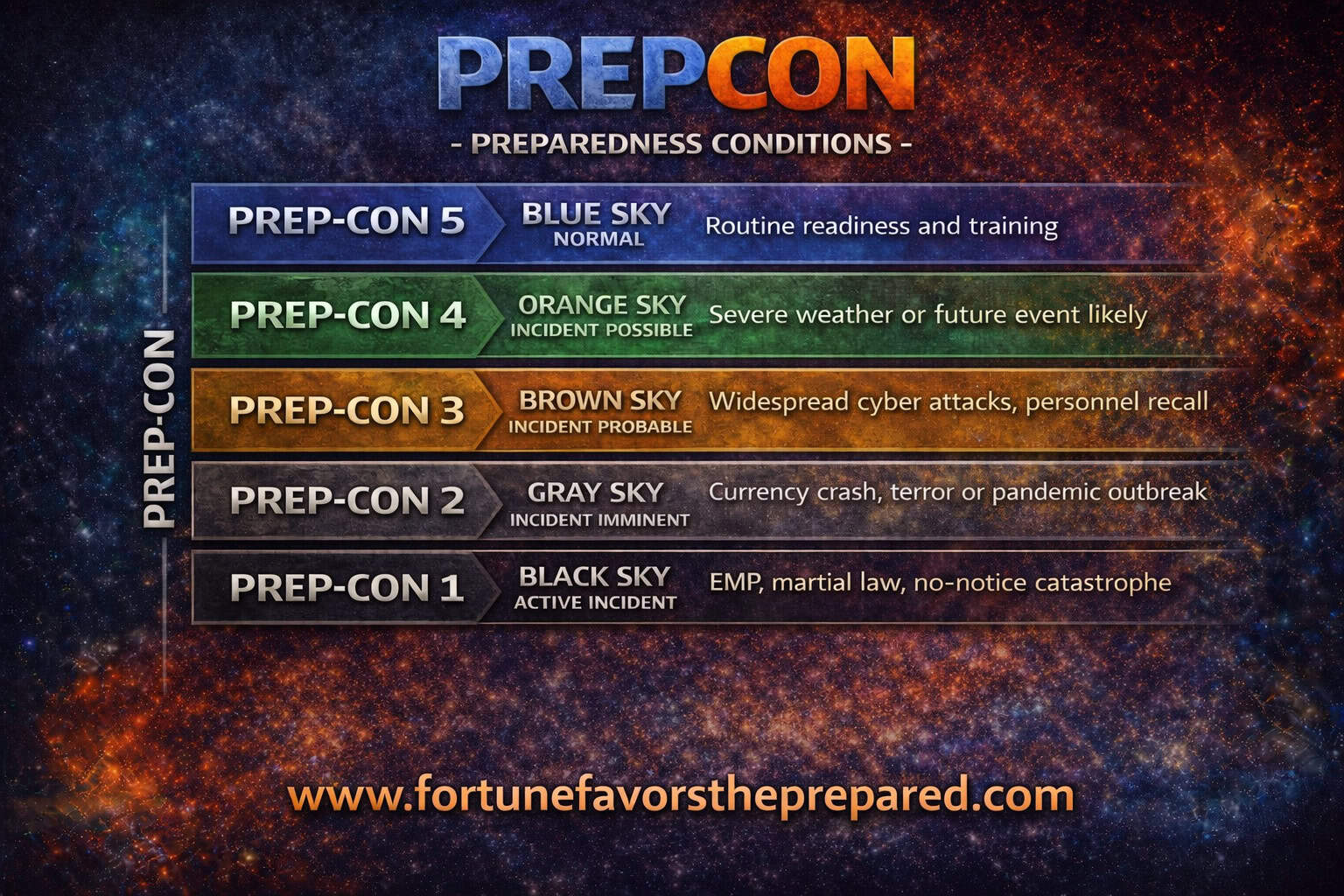
PREP-CON sets the overall threat context, from Blue Sky (5) to Black Sky (1); it is the input that drives your COMCON assessment.
PREP-CON (Preparedness Conditions) is the highest-level assessment: what is the overall threat environment? PREP-CON 5 (Blue Sky) is routine. PREP-CON 1 (Black Sky) is active catastrophe. Your PREP-CON level drives how much pre-positioning and monitoring your group should be doing.
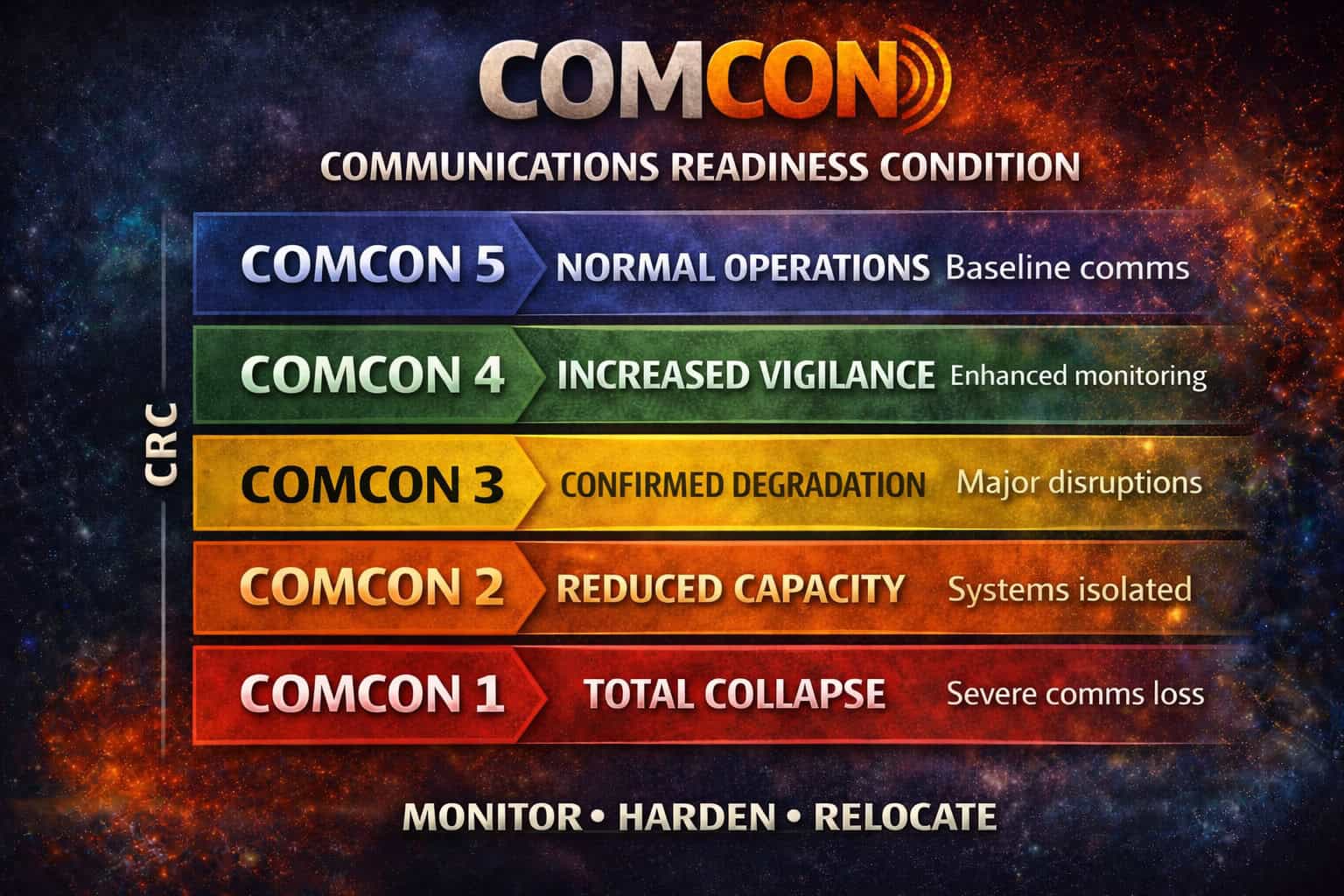
COMCON’s five levels run from Normal Operations (5) to Total Collapse (1); each level tells the group which PACE tiers are still in play.
COMCON (Communications Readiness Condition) is the communications-specific status. It takes the PREP-CON context and applies it to your comms infrastructure: at COMCON 5 you are on Primary; at COMCON 1 you are on Emergency only. Declaring a COMCON level is how your group communicates its assessed position in the PACE cascade.
PACE (this course) is the execution layer: the specific systems, frequencies, failure triggers, and test schedule that implement whatever COMCON level your group has declared.
The relationship flows one way: PREP-CON sets the threat context → COMCON translates it to a communications status → PACE specifies exactly what system you operate and how you transition. The PREP-CON article and PLN-05: COMCON complete the picture. COM-01 is the execution foundation.
COMCON — Communications Readiness Condition is the FFTP five-level status framework for communications infrastructure health. COMCON levels directly map to your PACE tier: COMCON 5 (Normal Operations) means Primary is working; COMCON 3 (Confirmed Degradation) means you should be on Alternate or Contingency; COMCON 1 (Total Collapse) means Emergency tier only.
PREP-CON — Preparedness Conditions is the FFTP five-level overall threat assessment framework. PREP-CON sets the situational context that drives COMCON which drives your PACE tier selection. PREP-CON 3 (Incident Probable) or below should put your group on heightened COMCON and ready to execute lower PACE tiers.
Course Complete
When you’ve answered this lesson’s knowledge checks, all five lessons of COM-01 are done. Return to the Course Map to collect your certificate of completion, and keep the companion guide with your group’s plan: the worksheets and the Tier Test Log are what keep a PACE plan from becoming a shelf document.
| Complete this lesson’s Knowledge Check to continue |
| ← Back to Lesson 4 | Course Map |
Fortune Favors the Prepared · Semper Paratus, Semper Gumby · fortunefavorstheprepared.com