Space-Based Communications for Skill, Reach, and Resilience
Amateur radio satellites allow licensed operators to communicate through spacecraft orbiting hundreds of miles above Earth. Often called “birds,” these satellites function as space-based repeaters, linear transponders, or digital relays—providing wide-area communication without reliance on local infrastructure.
With modest equipment, disciplined technique, and proper planning, operators can make contacts hundreds or even thousands of miles away using just a handheld radio and directional antenna.
This comprehensive guide covers:
- How amateur satellites work
- Required equipment (radios, antennas, tracking tools)
- Operating procedures
- Costs and licensing
- Suitability for disasters and preparedness
- Authoritative references
What Are Amateur Radio Satellites?
Amateur radio satellites are spacecraft carrying radio payloads specifically for licensed amateur use. Many are coordinated or supported by AMSAT and university programs.
Most active amateur satellites are:
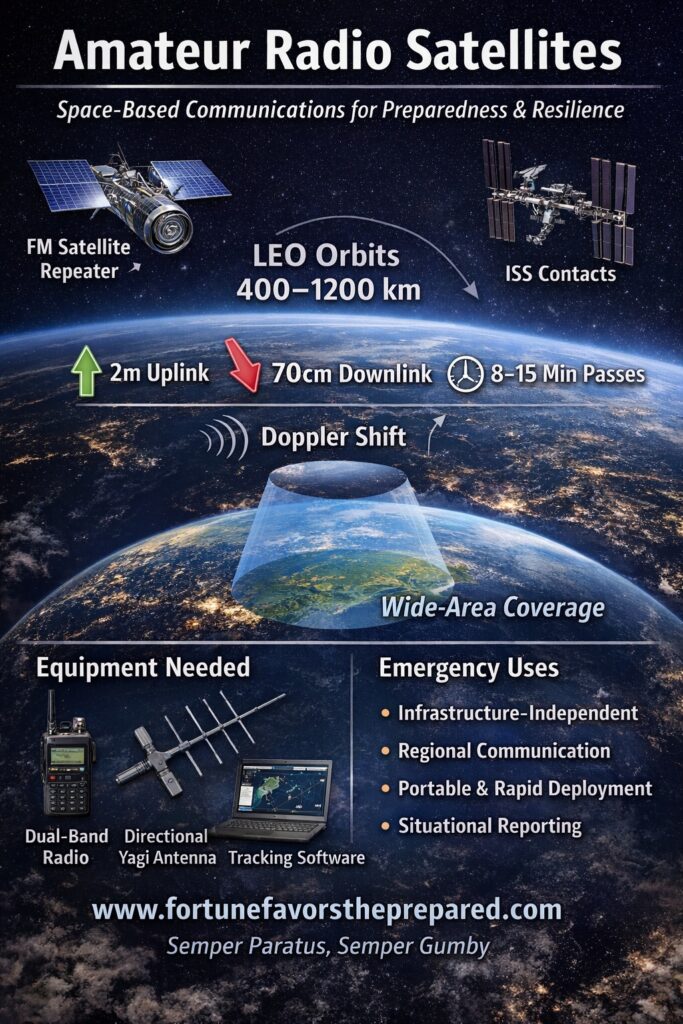
- Low Earth Orbit (LEO) — 400–1,200 km altitude
- FM Voice Repeaters — simple cross-band uplink/downlink
- Linear Transponders — SSB/CW passband allowing multiple simultaneous QSOs
- Digital / APRS Relays — packet-based messaging
The International Space Station also hosts amateur radio equipment under the ARISS program, enabling voice contacts and digital modes.
Because these satellites orbit Earth roughly every 90 minutes, they are only available during specific “passes” overhead.
How Satellite Communication Works
Unlike terrestrial repeaters, satellites move rapidly across the sky. Successful operation requires timing and technique.
Key Terms
- AOS (Acquisition of Signal) – Satellite rises above the horizon
- LOS (Loss of Signal) – Satellite drops below the horizon
- Footprint – Area on Earth covered during a pass
- Doppler Shift – Frequency change due to relative motion
A typical FM satellite uses:
- Uplink (you transmit) on 2 meters (VHF)
- Downlink (you receive) on 70 cm (UHF)
Because UHF frequencies are more susceptible to Doppler shift, operators adjust frequency slightly during the pass.
Pass duration: 8–15 minutes depending on elevation.
Equipment Requirements
Satellite operation does not require massive stations—but quality equipment improves success dramatically.
Radios (Transceivers)
Minimum Configuration (FM Satellites)
- Dual-band handheld (2m/70cm)
- Split-frequency capability
- Preferably full-duplex (can hear your own downlink while transmitting)
Full-duplex is highly recommended because:
- You can confirm you are accessing the satellite
- You avoid interfering with other operators
- You can correct Doppler in real time
Reliable equipment is available from manufacturers such as Yaesu, Icom, and Kenwood.
Advanced Configuration (Linear Satellites)
For SSB/CW satellites:
- All-mode VHF/UHF transceiver
- True full-duplex capability
- Fine frequency tuning
- Stable oscillator
Linear satellites require lower power and more precise tuning but allow multiple simultaneous conversations.
Antennas
The antenna is more important than raw power.
Entry Level
- Stock dual-band whip (possible, but limited performance)
Recommended
- Handheld dual-band directional Yagi
- Lightweight
- Manually aimed
- Significantly improved gain
Advanced
- Cross-polarized Yagis
- Azimuth/elevation rotator systems
- Mast-mounted low-noise preamps
Directional antennas:
- Improve signal strength
- Reduce interference
- Allow controlled access to crowded satellites
Power
Most FM satellites require only:
- 5 watts or less
- Often 1–3 watts is sufficient
Linear satellites often require even less.
Excessive power is discouraged—it monopolizes shared resources.
Tracking & Prediction Tools
You must know when a satellite is overhead.
Common tools:
- AMSAT pass predictions
- Gpredict
- SatPC32
- Web-based services such as Heavens-Above
These provide:
- Pass times
- Elevation angles
- Doppler frequency corrections
- Footprint visualization
Operating Techniques
FM Satellite Operating Procedure
- Begin listening before AOS.
- Track satellite visually or via prediction software.
- Keep transmissions short (5–10 seconds).
- Exchange call sign and grid square only.
- Avoid ragchews—these are shared systems.
Typical exchange:
“KJ7XYZ FN20”
“W1ABC EN91”
Efficient and professional.
Linear Satellite Technique
- Tune the downlink first.
- Find your own signal.
- Use minimal power.
- Avoid calling CQ continuously.
Linear satellites allow multiple operators simultaneously—but require discipline.
Licensing Requirements
In the United States:
- FCC Amateur Radio License (Technician class or higher)
- Compliance with Part 97 regulations under the Federal Communications Commission
Operators must identify properly and follow amateur radio operating standards.
Cost Overview
| Level | Estimated Cost |
|---|---|
| Entry (HT + whip) | $100–300 |
| Recommended (HT + Yagi) | $250–500 |
| Advanced (All-mode + rotators) | $1,000–3,000+ |
Satellite operation is accessible without extreme expense.
Suitability for Disasters, Emergencies & Preparedness
Amateur satellites occupy a unique position in emergency communications planning.
They are not a replacement for HF, local repeaters, or digital messaging systems—but they provide an independent, wide-area redundancy layer.
Advantages in Disaster Scenarios
Infrastructure Independence
LEO satellites:
- Do not rely on local repeaters
- Do not depend on internet backhaul
- Are unaffected by regional power outages
If terrestrial systems fail, satellites may still function normally.
Wide-Area Reach
During a pass, one satellite footprint can cover:
- Multiple states
- Large regions
- Cross-border areas
This enables communication between impacted and unaffected regions.
Portable Deployment
Satellite capability can fit in:
- A backpack
- A go-kit
- A field deployment case
With 5 watts and a handheld Yagi, meaningful long-distance contact is possible.
Limitations in Emergency Use
Preparedness planning must be realistic.
Limited Availability
- 8–15 minute windows
- Specific pass times
- Not continuous coverage
Bandwidth Constraints
FM satellites can become congested during major events.
Skill Requirement
Satellite operation requires:
- Practice
- Doppler adjustment familiarity
- Antenna tracking technique
- Efficient operating discipline
This is not a plug-and-play system.
Best Emergency Use Cases
✔ Initial situation reporting
✔ Short accountability messages
✔ Bridging affected areas to unaffected regions
✔ Redundant regional communications
When Satellites Are Not Ideal
✘ Continuous tactical coordination
✘ Long-form logistics traffic
✘ High-volume data transmission
✘ 24/7 command nets
HF or terrestrial systems are better suited for those roles.
Integrating Satellites Into a Resilient Communications Plan
A layered preparedness communications stack may include:
- Local repeaters
- Simplex VHF/UHF
- HF regional capability
- Digital messaging systems
- LEO satellite capability
Satellite communications should be viewed as:
A surge redundancy layer—portable, independent, and strategic.
Training Recommendations
If satellites are part of your preparedness strategy:
- Practice routinely during normal conditions
- Log successful passes
- Pre-program Doppler frequencies
- Develop a short emergency message script
- Train for low-power discipline
Do not attempt first-time satellite operation during a crisis.
Authoritative References
- AMSAT – Satellite status and resources
- ARRL – Operating guides
- ARISS – ISS operations
- Federal Communications Commission – Part 97 regulations
Final Thoughts
Amateur radio satellites combine:
- Physics
- Timing
- Skill
- Discipline
They are one of the most accessible ways to experience space-based communication firsthand.
For operators focused on communications resilience, they are more than novelty—they are capability.
With preparation and training, a handheld radio and directional antenna can connect you through a spacecraft traveling 17,000 mph overhead.
In a layered communications strategy, that is a powerful tool.