Integrating volunteer and auxiliary communicators into the Incident Command System
Modern emergency response depends on communications — but not simply radios, frequencies, or technology. What matters is integration: who is authorized, how tasking flows, and how communications supports incident objectives.
Auxiliary Communications (AUXCOMM) exists to solve that problem.
AUXCOMM is not a radio service, a volunteer club, or a replacement for existing programs. It is a national framework designed to integrate auxiliary and volunteer communications capabilities into the Incident Command System (ICS) in a disciplined, standardized, and operationally effective way.
Why AUXCOMM exists
For decades, volunteer and auxiliary communicators — including amateur radio operators — have provided critical support during disasters. However, after major incidents, after-action reports repeatedly identified the same challenges:
- Volunteers operating parallel to, rather than within, ICS
- Unclear authority and tasking
- Inconsistent expectations between agencies and volunteers
- Difficulty integrating auxiliary communicators into Emergency Operations Centers (EOCs)
- Communications assets available, but not optimally used
These issues became especially visible following Hurricane Katrina and other large-scale disasters, where communications failures were not solely technical — they were organizational and structural.
The conclusion was clear:
auxiliary communications must be integrated into command structures before disasters occur.
AUXCOMM emerged as the solution.
What AUXCOMM is — and what it is not
AUXCOMM is:
- A national integration framework for auxiliary communications
- Aligned with NIMS and ICS doctrine
- Focused on roles, tasking, and expectations, not equipment
- Applicable at local, state, tribal, and federal levels
AUXCOMM is not:
- A radio service
- A volunteer organization
- A replacement for ARES, RACES, or ACS
- Limited to amateur radio
Instead, AUXCOMM provides a common operational language that allows diverse auxiliary communications programs to function together inside ICS.
Programs AUXCOMM is designed to integrate
AUXCOMM is intentionally broad. It is designed to integrate any auxiliary or volunteer communications capability, including:
- Amateur radio programs (ARES, RACES, ACS)
- Military Auxiliary Radio System (MARS)
- Civil Air Patrol communications assets
- United States Coast Guard and Coast Guard Auxiliary communications
- Government auxiliary communications units
- Technical specialists supporting voice, data, or interoperability
The focus is not uniformity of tools, but unity of command and coordination.
AUXCOMM and the Incident Command System (ICS)
AUXCOMM is explicitly designed to function inside ICS, not alongside it.
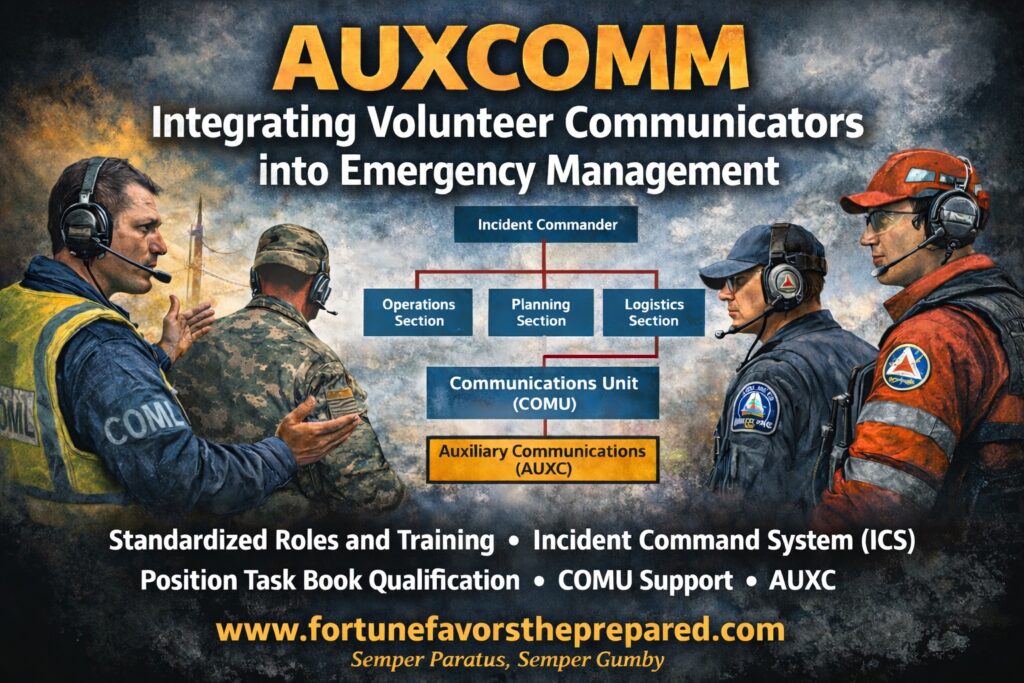
Within ICS, communications is managed through the Communications Unit (COMU) under the Logistics Section. AUXCOMM-trained personnel integrate into this structure to support:
- EOC and incident communications operations
- Interoperability and contingency communications
- Augmentation of COML and COMT functions
- Coordination of auxiliary communications assets
This alignment ensures that auxiliary communicators:
- Receive tasking through proper channels
- Support incident objectives, not independent missions
- Are accountable within the incident organization
AUXCOMM as a recognized ICS position (AUXC)
A significant evolution in recent years is that AUXCOMM is now a formally recognized ICS position, commonly abbreviated as AUXC.
This recognition means:
- AUXCOMM is no longer an informal or ad-hoc role
- AUXCOMM follows the same qualification philosophy as other ICS positions
- Agencies have clearer expectations of AUXCOMM capabilities
- AUXCOMM personnel are treated as part of the incident organization
As AUXC, auxiliary communicators are expected to operate with the same professionalism, discipline, and accountability as other ICS positions.
The AUXCOMM course (24 hours)
The foundation of AUXCOMM qualification is the AUXCOMM course, a 24-hour instructor-led course.
Course characteristics
- Typically delivered over three full days
- Classroom-based with scenario-driven instruction
- Focuses on ICS integration, not radio operation
- Emphasizes tasking, information flow, and professional conduct
- Applicable to all auxiliary communications programs
Sponsorship and delivery
The AUXCOMM course is usually sponsored by the Statewide Interoperability Coordinator (SWIC) within each state, often in coordination with:
- State emergency management agencies
- Homeland security offices
- Communications interoperability programs
The course is not typically open enrollment. Participation often requires agency or organizational sponsorship.
Completion of the AUXCOMM course is considered the entry point into formal AUXCOMM qualification — not the endpoint.
Common prerequisites
While exact requirements vary by state, typical prerequisites include completion of FEMA ICS/NIMS coursework:
- IS-100: Introduction to the Incident Command System
- IS-200: Basic Incident Command System
- IS-700: National Incident Management System (NIMS)
- IS-800: National Response Framework (NRF)
Additional requirements may include:
- Affiliation with an auxiliary communications organization
- Sponsorship or recommendation
- Background check or credentialing
From training to qualification: the AUXCOMM Position Task Book (PTB)
After completing the AUXCOMM course, participants are expected to complete the AUXCOMM Position Task Book (PTB).
The PTB:
- Documents demonstrated performance of required AUXCOMM tasks
- Must be completed during exercises, drills, or real incidents
- Is evaluated and approved through state or regional processes
- Aligns AUXCOMM with other ICS position qualification pathways
This ensures AUXCOMM personnel are proven, not just trained.
🔗 AUXCOMM Position Task Book (PTB) – CISA
https://www.cisa.gov/resources-tools/resources/auxcomm-position-task-book
The AUXFOG: Auxiliary Communications Field Operations Guide
A key doctrinal reference for AUXCOMM is the AUXFOG (Auxiliary Communications Field Operations Guide).
The AUXFOG:
- Defines AUXCOMM roles and responsibilities
- Explains how auxiliary communicators integrate into ICS
- Establishes common terminology and expectations
- Serves as a reference for both volunteers and agencies
The AUXFOG exists to ensure auxiliary communicators arrive aligned, prepared, and effective, rather than improvising their role during incidents.
How AUXCOMM relates to ARES, RACES, and ACS
AUXCOMM does not replace existing programs — it connects them.
- ARES provides a trained amateur radio volunteer base
- RACES provides a legally defined civil defense communications pathway
- ACS provides a government-managed auxiliary communications model
- AUXCOMM provides the ICS integration framework that allows all of them to function together
In practice, AUXCOMM is the bridge between capability and command.
What AUXCOMM means for volunteers
For volunteers, AUXCOMM represents a shift:
- From technical contribution → operational integration
- From informal activation → structured tasking
- From parallel operations → ICS-aligned response
It also represents opportunity:
- Greater trust from agencies
- Access to EOCs and command-level roles
- Clear qualification pathways
- Meaningful participation in complex incidents
AUXCOMM-qualified personnel are not “extra help” — they are part of the response system.
The bottom line
Resilient communications require more than technology. They require integration, discipline, and trust.
AUXCOMM exists to ensure that auxiliary communications resources — amateur radio, military auxiliary, aviation, maritime, and technical — are used effectively, professionally, and in alignment with ICS when it matters most.
Sources and References
- Auxiliary Communications (AUXCOMM) Overview
Cybersecurity and Infrastructure Security Agency (CISA)
https://emcomminfo.com/auxcomm/ - Auxiliary Communications Field Operations Guide (AUXFOG)
CISA / U.S. Department of Homeland Security
https://www.cisa.gov/sites/default/files/publications/auxcomm-field-operations-guide.pdf - AUXCOMM Position Task Book (PTB)
Cybersecurity and Infrastructure Security Agency (CISA)
https://www.cisa.gov/resources-tools/resources/auxcomm-position-task-book - National Incident Management System (NIMS)
Federal Emergency Management Agency (FEMA)
https://www.fema.gov/emergency-managers/nims - NIMS Information and Communications Technology (ICT) Functional Guidance
Federal Emergency Management Agency (FEMA)
https://www.fema.gov/sites/default/files/documents/fema_ict-functional-guidance.pdf - Statewide Interoperability Coordinator (SWIC) Program
Cybersecurity and Infrastructure Security Agency (CISA)
https://www.cisa.gov/safecom/swic - Military Auxiliary Radio System (MARS)
U.S. Department of Defense
https://www.usarmymars.org/ - Civil Air Patrol – Emergency Services Communications
U.S. Air Force Auxiliary
https://www.gocivilairpatrol.com/programs/emergency-services - United States Coast Guard Auxiliary – Communications
U.S. Coast Guard
https://wow.uscgaux.info/content.php?unit=CM-DEPT
See also
ARES, RACES, ACS & AUXCOMM