Coordinated Federal Communications During National-Level Emergencies
Executive Summary
When emergencies escalate beyond a single jurisdiction, the challenge is no longer just communications availability—it is coordination across organizations with different missions, authorities, and systems.
The National Emergency Communications Network (NECN) exists to address that challenge.
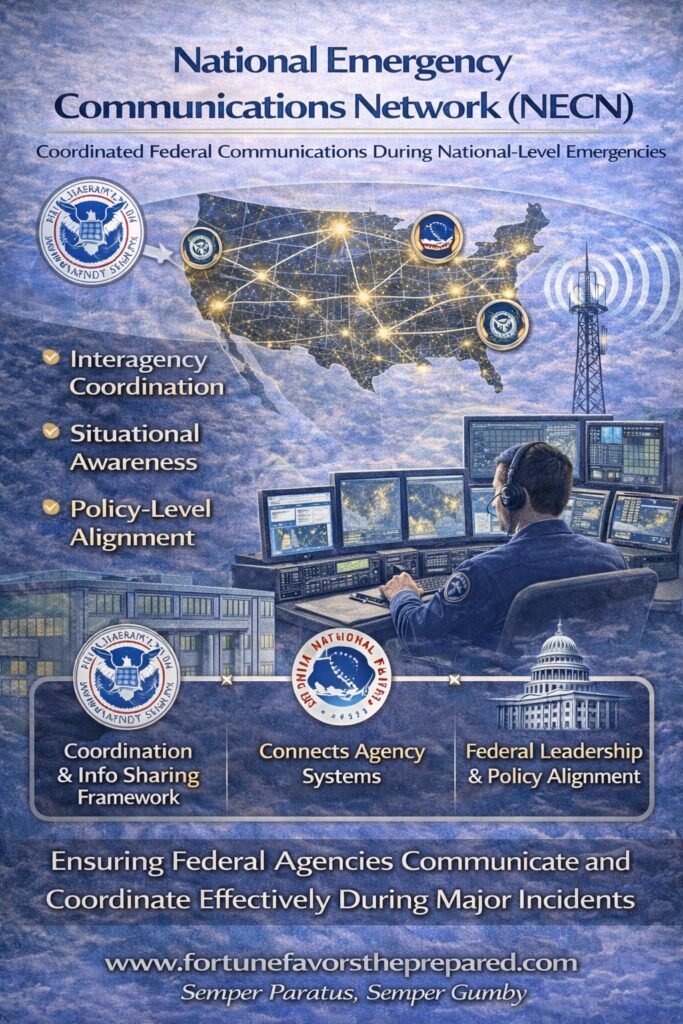
NECN is a federally coordinated communications framework designed to support interagency coordination and situational awareness during national-level incidents, disasters, and continuity events. Rather than operating as a single standalone system, NECN functions as a governance-driven network of networks, aligning existing federal communications capabilities to ensure information flows between decision-makers when it matters most.
NECN emphasizes coordination, policy alignment, and interoperability, not tactical voice operations.
What Is NECN?
NECN is a federal emergency communications coordination construct overseen by the Cybersecurity and Infrastructure Security Agency (CISA).
It is designed to:
- Enable cross-agency communications coordination
- Support national-level incident management
- Provide a structured framework for sharing information during emergencies
- Reduce fragmentation between federal communications systems
NECN does not replace agency-specific systems. Instead, it provides a common coordination layer that connects them during crises.
Purpose and Mission
The primary mission of NECN is to ensure that federal departments and agencies can communicate and coordinate effectively during major incidents, even when systems are stressed or operating under degraded conditions.
NECN focuses on:
- Situational awareness
- Policy-level coordination
- Operational alignment
- Information sharing among leadership and coordination centers
It is particularly relevant during:
- Large-scale disasters
- National emergencies
- Complex, multi-agency incidents
- Continuity of Government (COG) and Continuity of Operations (COOP) events
NECN Is Not a Single Communications System
A common misunderstanding is that NECN is a discrete technical network like a radio system or satellite service.
It is not.
NECN:
- Does not prescribe specific radios, frequencies, or carriers
- Does not replace agency communications systems
- Does not function as a tactical or field-level network
Instead, NECN:
- Coordinates how federal systems are used together
- Establishes common procedures and expectations
- Aligns communications governance during emergencies
This distinction is critical to understanding where NECN fits in a resilience strategy.
Who Participates in NECN
NECN participation includes:
- Federal departments and agencies with emergency or continuity missions
- National-level coordination and operations centers
- Communications leadership and policy representatives
- Emergency communications stakeholders across the federal enterprise
Participation is role-based and mission-driven, not universal.
How NECN Supports Emergency Operations
NECN supports operations by:
- Providing a framework for interagency coordination
- Facilitating information sharing at the national level
- Supporting decision-makers during complex incidents
- Reducing delays caused by organizational silos
It is especially valuable when:
- Multiple agencies must coordinate simultaneously
- Authorities and responsibilities overlap
- Communications systems differ across organizations
NECN and Communications Resilience
NECN is best understood as a coordination layer, not a resilience layer by itself.
It depends on:
- Existing agency communications systems
- Priority access services
- Infrastructure-independent capabilities operated by participating agencies
NECN adds value by ensuring those systems are used coherently, rather than independently, during emergencies.
Where NECN Fits in a Communications Resilience Stack
| Layer | Role |
|---|---|
| Interoperable Frequencies | Immediate on-scene coordination |
| Agency LMR / Cellular | Routine and tactical operations |
| Priority Services (e.g., GETS/WPS) | Congestion management |
| Satellite / HF Systems | Infrastructure-independent continuity |
| NECN | Federal coordination & governance layer |
NECN sits above individual technologies, ensuring leadership-level coordination even when operational systems vary.
NECN vs Tactical Communications
NECN is often confused with operational systems like:
- Interoperable radio channels
- Satellite talkgroups
- HF contingency networks
Key differences:
- NECN is policy- and coordination-focused
- Tactical systems are operator- and field-focused
- NECN enables decision-making
- Tactical systems enable execution
Both are required—but they serve different purposes.
Why NECN Matters
Large incidents fail not because agencies lack radios—but because information does not move between organizations fast enough.
NECN exists to:
- Reduce coordination friction
- Clarify communications pathways
- Align federal response during complexity
In modern emergency management, coordination is as critical as connectivity.
Common Misconceptions
“NECN is a radio network.”
False. It is a coordination framework.
“NECN replaces agency systems.”
False. It connects them.
“NECN provides infrastructure independence.”
False. It relies on participating systems.
“NECN is only used during catastrophic events.”
False. It supports a range of national-level incidents.
How NECN Differs from NAWAS and FNARS
Although they are sometimes mentioned together, NECN, NAWAS, and FNARS serve fundamentally different roles within the national emergency communications ecosystem. Confusing them can lead to flawed continuity planning.
National Emergency Communications Network (NECN)
Role: Coordination & governance
Function: Interagency alignment and information sharing
Operator: Cybersecurity and Infrastructure Security Agency
NECN is not a technical network. It does not provide radios, frequencies, or transport. Instead, it establishes policy, coordination pathways, and expectations for how federal agencies communicate and coordinate during national-level incidents.
Primary value:
Ensures federal leadership and coordination centers are aligned, informed, and communicating coherently during complex emergencies.
Quick Comparison
| System | Primary Purpose | Communications Type | Infrastructure Independent |
|---|---|---|---|
| NECN | Federal coordination & governance | Policy / coordination framework | No |
| NAWAS | Authoritative warning | Dedicated voice circuits | Mostly |
| FNARS | Continuity backstop | HF radio | Yes |
Conclusion
The National Emergency Communications Network (NECN) represents a shift in how emergency communications are viewed at the federal level—from isolated systems to coordinated capability.
By focusing on governance, alignment, and interagency coordination, NECN ensures that when incidents escalate, communications do not fragment along organizational lines.
NECN does not replace radios, satellites, or networks.
It ensures that the right people can communicate, coordinate, and decide—together.
In a world of increasingly complex emergencies, that coordination layer is not optional—it is essential.
Sources & References
- Cybersecurity and Infrastructure Security Agency (CISA)
https://www.cisa.gov
(Federal lead for emergency communications policy, coordination, and governance) - CISA – Emergency Communications
https://www.cisa.gov/emergency-communications
(National emergency communications coordination mission and programs) - CISA – National Emergency Communications Network (NECN)
https://www.cisa.gov/national-emergency-communications-network
(Official NECN program overview and coordination role) - Department of Homeland Security (DHS)
https://www.dhs.gov
(Federal emergency management and interagency coordination framework) - National Emergency Communications Plan (NECP)
https://www.cisa.gov/national-emergency-communications-plan
(Strategic context for NECN governance and coordination) - Federal Emergency Management Agency (FEMA)
https://www.fema.gov
(Federal continuity, emergency management, and interagency coordination partner) - Continuity Guidance Circular (CGC)
https://www.fema.gov/emergency-managers/national-preparedness/continuity
(COOP / COG framework relevant to NECN coordination missions) - National Response Framework (NRF)
https://www.fema.gov/emergency-managers/national-preparedness/frameworks/response
(Federal coordination doctrine NECN supports)
Note on Public Documentation
Publicly available information on NECN is intentionally limited. NECN functions primarily as a federal coordination and governance framework, not a tactical communications system. As a result, most detailed operational procedures are addressed through interagency agreements, planning guidance, and exercises rather than public technical documentation.