The Survivable Backbone of U.S. Emergency Warning and Coordination
Executive Summary
Long before cell phones, satellite communications, and internet-based alerting platforms, the United States identified a critical requirement: a national warning system that would function under the worst possible conditions.
The National Warning System (NAWAS) was built to meet that requirement.
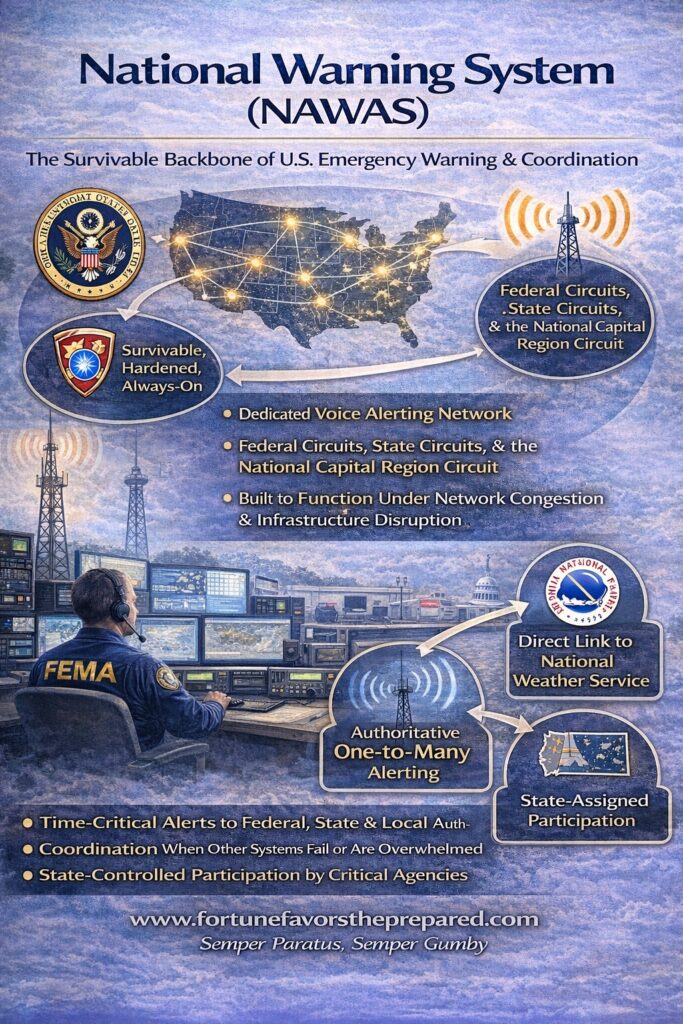
NAWAS is a dedicated, hardened, nationwide voice communications system designed to rapidly disseminate authoritative warnings and enable immediate coordination among federal, state, and selected local entities. Unlike modern communications tools that rely on public networks or shared infrastructure, NAWAS operates as a closed, always-available circuit engineered specifically for survivability.
Though rarely discussed publicly, NAWAS remains a foundational element of U.S. emergency communications—especially for time-critical, high-consequence events where seconds matter and other systems may be congested, degraded, or unavailable.
What Is NAWAS?
NAWAS is a party-line voice alerting system that allows designated government warning points to issue, receive, and acknowledge emergency warnings in real time.
Key characteristics include:
- Dedicated, non-public circuits
- Always-on connectivity
- One-to-many voice alerting
- Immediate audible acknowledgment
- Minimal reliance on public telecommunications infrastructure
NAWAS is used for:
- National emergency warnings
- Severe weather coordination
- Civil emergency notifications
- Continuity of Government (COG) and Continuity of Operations (COOP) support
- Rapid intergovernmental coordination during catastrophic incidents
The system is intentionally simple. That simplicity is a design choice that enhances reliability.
Historical Origins
NAWAS originated during the early Cold War, when emergency planners were focused on the possibility of strategic nuclear attack.
At the time, planners recognized several realities:
- Warning timelines could be measured in minutes
- Decisions would need to be made immediately
- Public telephone networks could not be relied upon during national emergencies
NAWAS evolved from early civil defense warning networks into a nationally standardized, survivable alerting system designed to function even during extreme disruption.
While the threat landscape has changed, the underlying requirement—rapid, authoritative warning under degraded conditions—has not.
NAWAS Architecture Overview
NAWAS is structured as a tiered system of interconnected circuits, each serving a specific coordination role:
- Federal NAWAS circuits
- State NAWAS circuits
- Specialized regional circuits, most notably the National Capital Region (NCR) circuit
This architecture ensures warnings move quickly, clearly, and reliably from national authorities to state and local action points.
Federal NAWAS Circuits
The federal level represents the origin and national coordination layer of NAWAS.
Federal circuits connect national warning authorities and federal operations centers, including those operated by the Federal Emergency Management Agency.
Federal NAWAS circuits are used to:
- Initiate national or catastrophic alerts
- Coordinate federal emergency actions
- Disseminate authoritative warnings to the states
This layer establishes priority, legitimacy, and urgency, ensuring warnings are immediately recognized as official.
State NAWAS Circuits
Each state operates a state NAWAS circuit, which serves as the primary warning and coordination channel within that state.
State Circuit Functions
State NAWAS circuits connect:
- State Emergency Operations Centers (EOCs)
- Designated state warning points
- Selected regional or local warning authorities
They are used to:
- Receive federal warnings
- Disseminate alerts statewide
- Coordinate rapid state-level actions
- Maintain shared situational awareness during fast-moving events
State circuits form the critical bridge between national warning and local response.
State Authority Over NAWAS Participation
Although NAWAS is national in scope, participation at the state level is determined by each state.
Each state’s emergency management agency and designated warning point has authority to decide which organizations within the state are authorized to be connected to the state NAWAS circuit.
State Responsibilities Include:
- Managing circuit access
- Designating authorized warning points
- Establishing activation and acknowledgment procedures
- Enforcing operational discipline
This decentralized governance allows states to tailor NAWAS participation based on:
- Risk profile
- Population centers
- Critical infrastructure concentration
- Operational necessity
NAWAS is intentionally not open enrollment. Limited participation preserves clarity, discipline, and effectiveness.
Authorized Participants on State Circuits
Common state-authorized participants include:
- State Emergency Operations Centers
- State police or highway patrol communications centers
- Major metropolitan emergency management agencies
- Designated regional or county warning points
Airports and Aviation Facilities
States may authorize certain airports to participate in NAWAS, particularly:
- Major commercial service airports
- Airports supporting military or national-level operations
- Facilities with significant regional or national impact
Airport participation is typically limited to designated operations or communications centers, not general airport operations. Inclusion supports:
- Rapid dissemination of time-critical warnings
- Coordination during severe weather and civil emergencies
- Protection of critical transportation infrastructure
National Weather Service (NWS) Role in NAWAS
The National Weather Service is a core operational participant in NAWAS.
NWS on State NAWAS Circuits
NWS forecast offices are connected to state NAWAS circuits for the geographic areas they serve. This allows NWS to:
- Issue immediate voice warnings
- Coordinate directly with state authorities
- Confirm and clarify alerts during rapidly evolving events
This direct voice coordination is especially critical for:
- Tornadoes
- Flash flooding
- Hurricanes
- Severe winter weather
- Other fast-moving, life-threatening hazards
NWS participation ensures human-to-human coordination remains available when automated systems may be delayed or unavailable.
National Capital Region (NCR) NAWAS Circuit
The National Capital Region (NCR) NAWAS circuit is a specialized, high-priority circuit serving the Washington, D.C. metropolitan area.
Why the NCR Circuit Is Unique
The NCR includes:
- Federal executive leadership
- National command authorities
- Critical federal institutions
- Dense population and infrastructure
The NCR circuit is designed to:
- Support immediate intergovernmental coordination
- Enable rapid leadership decision-making
- Provide redundancy for national-level continuity
It functions as a separate and reinforced element within the NAWAS architecture.
How NAWAS Operates
NAWAS uses a party-line voice model:
- All connected stations hear alerts simultaneously
- Warnings propagate instantly
- Acknowledgment is audible and immediate
This design:
- Eliminates routing delays
- Avoids selective congestion
- Creates shared situational awareness
The system’s simplicity reduces both technical and cognitive failure points during crisis.
Why NAWAS Still Matters
NAWAS remains relevant because it addresses failure modes that continue to affect modern communications:
- Network congestion
- Cyber disruption
- Power instability
- Cascading infrastructure failures
It embodies a core preparedness principle:
If it must work every time, keep it simple and keep it separate.
Common Misconceptions
“NAWAS is obsolete.”
False. Its architecture intentionally avoids modern vulnerabilities.
“NAWAS is only for nuclear war.”
False. It supports all-hazards warning and coordination.
“NAWAS has been replaced by newer technology.”
False. It remains a deliberate, survivable capability.
Conclusion
The National Warning System (NAWAS) is one of the quiet constants of U.S. emergency preparedness—rarely visible, seldom discussed, and indispensable when seconds matter.
Through its federal circuits, state-controlled participation, National Weather Service integration, and the specialized National Capital Region circuit, NAWAS ensures that authoritative warnings move rapidly from national leadership to state and local action, even under extreme conditions.
In an era of increasingly complex communications technology, NAWAS stands as proof that true resilience is not about sophistication—it is about survivability.
Sources & References
- Federal Emergency Management Agency (FEMA)
https://www.fema.gov
(Continuity of Government, Continuity of Operations, national warning and coordination doctrine) - FEMA – National Warning System (NAWAS)
https://www.fema.gov/emergency-managers/practitioners/naefs/nawas
(Program overview and operational context) - National Weather Service (NWS)
https://www.weather.gov
(Severe weather warning authority and NAWAS participation) - National Weather Service – Warning Dissemination & Coordination
https://www.weather.gov/enterprise/alerting
(Role of NWS in direct warning and coordination with state authorities) - Department of Homeland Security (DHS)
https://www.dhs.gov
(Federal emergency management and continuity framework) - FEMA Continuity Guidance Circular (CGC)
https://www.fema.gov/emergency-managers/national-preparedness/continuity
(COOP / COG principles relevant to NAWAS mission) - National Capital Region (NCR) Emergency Preparedness
https://www.fema.gov/about/regions/region-3
(Federal regional coordination context applicable to NCR NAWAS operations) - Historic Civil Defense & Warning System References (Cold War Era)
https://www.archives.gov
(Historical background on U.S. civil defense warning systems)