Priority Access, Not Infrastructure Independence
Executive Summary
During disasters, major incidents, and national emergencies, communications systems rarely fail all at once. More often, they become congested. Networks may still be technically operational, but demand overwhelms capacity, preventing critical calls from completing.
The Government Emergency Telecommunications Service (GETS) and Wireless Priority Service (WPS) exist to address this specific problem by providing priority access on existing landline and cellular networks for authorized personnel performing mission-essential functions.
It is critical to understand what these programs do—and do not—provide. GETS and WPS increase the likelihood that calls will complete on functioning terrestrial networks, but they do not operate independently of infrastructure. They are an important layer in a communications resilience strategy, but they must be paired with infrastructure-independent systems to fully address continuity risks.
What Are GETS and WPS?
GETS and WPS are federally managed priority telecommunications programs administered by the Cybersecurity and Infrastructure Security Agency (CISA).
They are designed to ensure that authorized users can complete voice calls during periods of:
- Network congestion
- High call volume
- Partial infrastructure degradation
These programs do not create separate networks. Instead, they work by signaling priority to participating telecommunications carriers, allowing authorized calls to move ahead of non-priority traffic when network capacity is constrained Communications Continuity Progr….
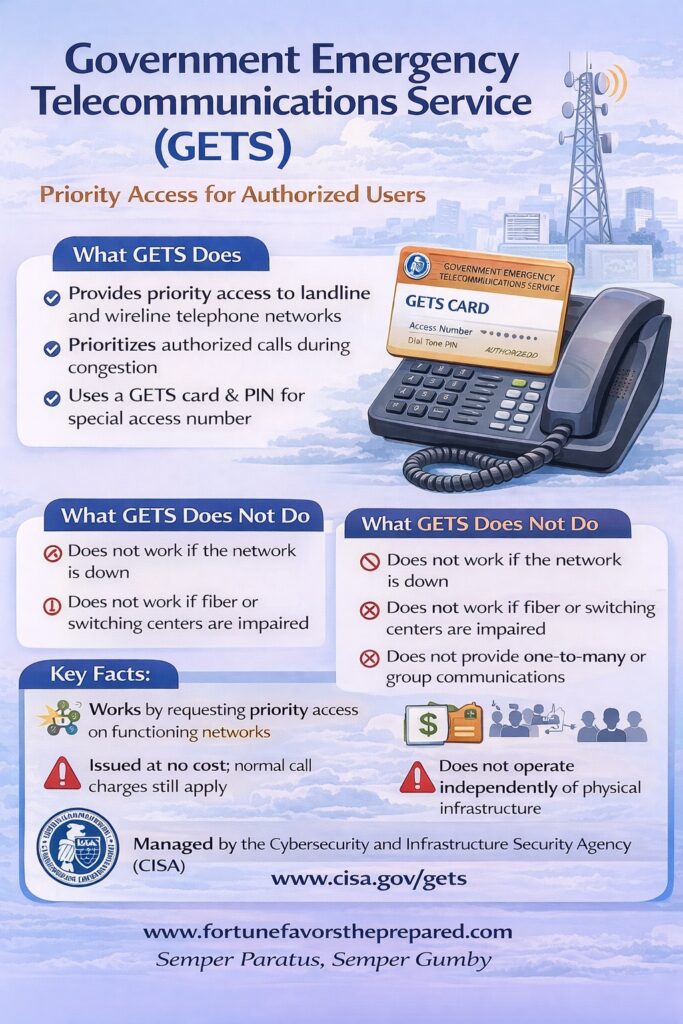
Government Emergency Telecommunications Service (GETS)
What GETS Does
GETS provides priority access on landline and wireline telephone networks, including:
- Traditional landlines
- Certain VoIP services supported by participating carriers
Authorized users receive a GETS card and use a dedicated access number with a personal identification number (PIN) to invoke priority routing.
When invoked:
- Calls receive priority treatment in network switching
- Calls are more likely to complete during congestion
- Priority applies only for the duration of the call attempt
What GETS Does Not Do
GETS:
- Does not function if the underlying telephone network is down
- Does not bypass physical damage to switching centers or fiber
- Does not provide group or one-to-many communications
- Does not operate independently of power or carrier infrastructure
GETS is best understood as a traffic-management tool, not a survivable communications system.
Wireless Priority Service (WPS)
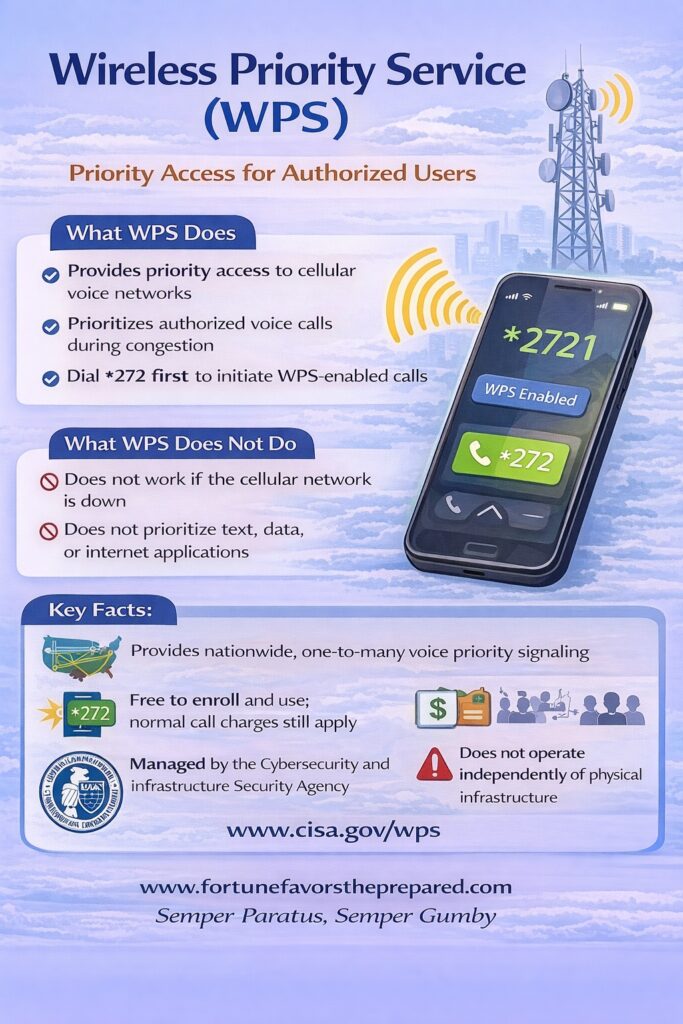
What WPS Does
WPS extends priority access to cellular voice calls on participating wireless carrier networks.
Authorized users:
- Dial *272 before placing a call
- Receive priority treatment for call setup during congestion
- Experience improved call-completion probability during emergencies
WPS applies only to voice calls. It does not prioritize:
- Text messages
- Data sessions
- Internet access
- Push-to-talk or messaging applications
Priority Levels
WPS supports multiple priority levels based on:
- Role
- Mission essentiality
- Continuity responsibilities
Priority levels are assigned administratively through organizational points of contact in accordance with CISA guidance Communications Continuity Progr….
What WPS Does Not Do
WPS:
- Does not work if cellular sites are offline
- Does not restore coverage where towers are damaged
- Does not provide interoperability or group communications
- Does not bypass power or backhaul failures
Like GETS, WPS improves access only when the network still exists.
GETS and WPS in a Communications Resilience Stack
GETS and WPS are often misunderstood as “backup communications.” In reality, they are priority overlays on existing systems.
| Capability | GETS | WPS |
|---|---|---|
| Network type | Landline / wireline | Cellular |
| Infrastructure dependent | Yes | Yes |
| Improves call completion | Yes | Yes |
| Works during congestion | Yes | Yes |
| Works during outages | No | No |
| One-to-many communications | No | No |
| Infrastructure-independent | No | No |
They are most effective:
- Early in an incident
- During surge conditions
- When infrastructure is stressed but not destroyed
They are least effective during:
- Widespread power failure
- Switching-center or fiber outages
- Long-duration regional disasters
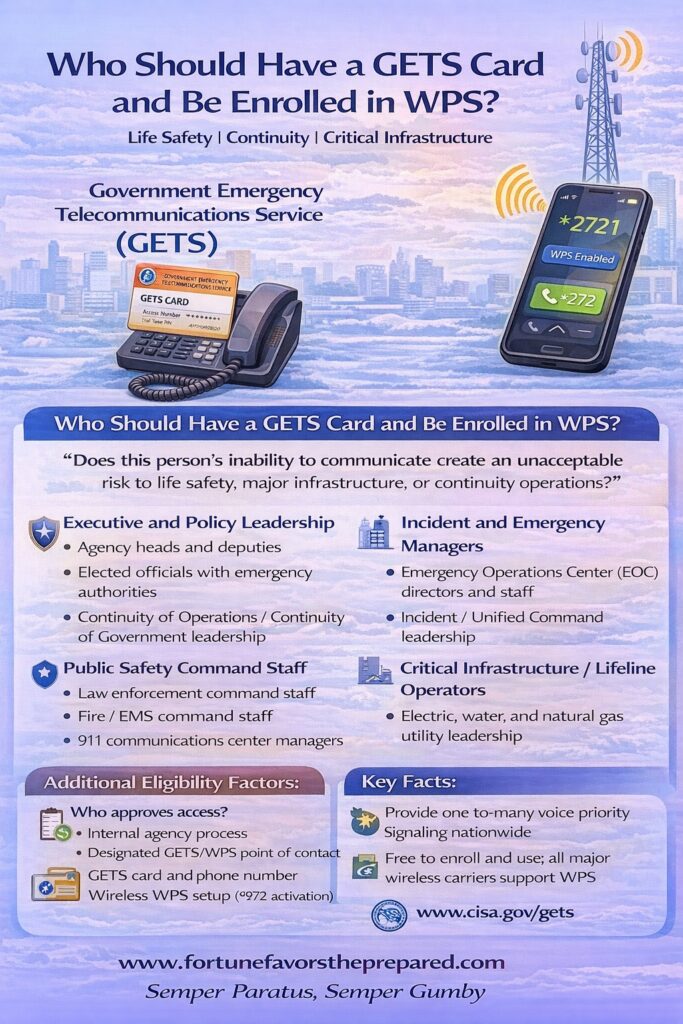
Who Should Have a GETS Card and Be Enrolled in WPS
GETS and WPS are not intended for universal distribution. They are designed for personnel whose inability to communicate would directly impact life safety, operations, continuity, or critical infrastructure protection.
Recommended Roles and Functions
Executive and Policy Leadership
- Agency heads and deputies
- Elected officials with emergency authorities
- Continuity of Government / Continuity of Operations leadership
Emergency Management and Command
- Emergency Operations Center (EOC) directors and section chiefs
- Incident Commanders and Unified Command staff
- Duty officers and watch commanders
Public Safety and Response Leadership
- Law enforcement command staff
- Fire and EMS leadership
- Public safety communications center leadership
Critical Infrastructure and Lifeline Sectors
- Electric, water, wastewater, and gas utility leadership
- Transportation system operations leadership
- Healthcare system executives and emergency coordinators
- Telecommunications and network operations leadership
Continuity and Emergency Communications
- Communications unit leaders
- Continuity planners and coordinators
- Primary and alternate emergency coordination points of contact
Role-Based Assignment Matters
GETS and WPS should be assigned based on function, not rank alone. Personnel who must coordinate resources, authorize actions, or communicate externally during incidents should be prioritized.
Best practice includes:
- Multiple qualified personnel per role
- Coverage across shifts
- Identified alternates and successors
Quick Eligibility Checklist: GETS & WPS
If the answer is “yes” to any item, enrollment is strongly recommended.
Mission & Role
- ☐ Performs a mission-essential function
- ☐ Has decision-making authority during emergencies
- ☐ Serves in incident command or EOC leadership
- ☐ Acts as a duty officer or on-call coordinator
Communications & Coordination
- ☐ Coordinates across agencies or jurisdictions
- ☐ Communicates with state, regional, or federal partners
- ☐ Activates plans, resources, or operational decisions
Critical Infrastructure
- ☐ Oversees lifeline services (power, water, healthcare, transport)
- ☐ Can authorize restoration or prioritization of services
Continuity
- ☐ Identified in a COOP, COG, or EOP
- ☐ Serves as a successor or alternate for a key role
Operational Impact
- ☐ Loss of communications would delay response
- ☐ Loss of communications would increase life-safety risk
Outcome
- One or more boxes checked → GETS and WPS recommended
- Multiple boxes checked → High-priority enrollment
Enrollment and Administrative Responsibility
Organizations should designate a GETS/WPS Point of Contact (POC) responsible for:
- Requesting and managing access
- Assigning priority levels
- Maintaining accurate user lists
- Removing access when roles change
Enrollment and management are handled through official CISA processes Communications Continuity Progr….
Costs and Carrier Participation
GETS
- GETS cards are issued at no cost
- No subscription or monthly fees
- Normal call charges may apply based on service plans
WPS
- No WPS monthly fees are currently charged by participating wireless carriers
- No carrier surcharge for WPS activation
- Normal cellular plan charges still apply for voice usage
Cost is no longer a valid barrier to enrolling mission-essential personnel Communications Continuity Progr….
Common Misconceptions
- “GETS and WPS work when everything is down.”
False. They require functioning infrastructure. - “They guarantee calls will go through.”
False. They improve probability, not certainty. - “They replace satellite or radio systems.”
False. They complement them. - “Everyone in leadership automatically has access.”
False. Access must be requested and managed.
Conclusion
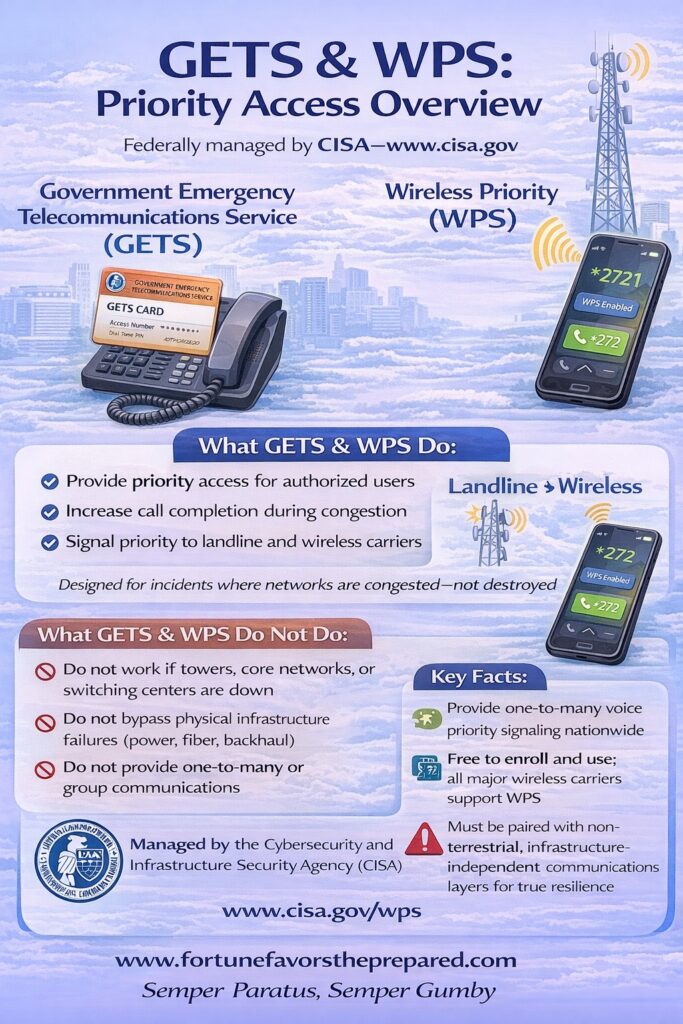
The Government Emergency Telecommunications Service (GETS) and Wireless Priority Service (WPS) are essential priority-access tools, not survivable communications systems.
They are highly effective at managing congestion on functioning networks and are most valuable during the early and transitional phases of incidents. However, because they remain dependent on terrestrial infrastructure, they must be paired with infrastructure-independent communications layers to achieve true resilience.