Shared Resources High Frequency Radio Program
The SHARES Program (Shared Resources High Frequency Radio Program) is a federally coordinated, voluntary national HF radio program that enables government and critical infrastructure organizations to exchange essential voice and data communications during disasters, emergencies, and continuity events when normal communications are unavailable, degraded, or unreliable.
SHARES is specifically designed to support National Security and Emergency Preparedness (NS/EP) missions by providing a survivable, interoperable communications capability that operates independent of commercial telecommunications infrastructure.
Purpose and Mission
Modern communications systems are highly capable—but highly dependent on power, backhaul, and centralized infrastructure. During large-scale disasters, cyber incidents, or cascading infrastructure failures, those dependencies can fail simultaneously.
SHARES exists to ensure that critical decision-makers can still communicate when:
- Commercial telecommunications are disrupted or overloaded
- Internet and IP-based services are unavailable
- Cellular networks are damaged or congested
- Satellite systems are degraded, denied, or inaccessible
- Power outages are prolonged or widespread
HF radio’s ability to propagate over long distances without reliance on terrestrial infrastructure makes SHARES a foundational resilience layer for national emergency communications.
Program Administration and Governance
The SHARES Program is administered by the U.S. Department of Homeland Security through the Cybersecurity and Infrastructure Security Agency (CISA) and coordinated via the National Coordinating Center for Communications (NCC).
CISA and the NCC are responsible for:
- Program governance and policy
- Coordination of participating organizations
- Assignment of SHARES frequencies and call signs
- Operational guidance and activation coordination
- Integration with broader NS/EP communications planning
SHARES participation is organizational, not individual, and is aligned with official mission requirements.
Spectrum Authority and Authorization
SHARES operations do not use FCC-issued licenses and do not fall under FCC jurisdiction.
In the United States:
- The Federal Communications Commission (FCC) regulates non-federal spectrum use
- The National Telecommunications and Information Administration (NTIA) manages federal spectrum on behalf of the Executive Branch
SHARES operates under federal spectrum authority, with frequencies, call signs, and operating parameters assigned and coordinated by the SHARES Program Office through NTIA-managed processes.
SHARES stations are authorized, not licensed.
This distinction is critical: SHARES is not an amateur service, not a commercial service, and not an FCC emergency allocation.
Participants and Eligibility
Participation in SHARES is open to approved organizations that support NS/EP missions, including:
- Federal departments and agencies
- State, local, tribal, and territorial (SLTT) governments
- Emergency management agencies
- Public safety organizations
- Critical infrastructure owners and operators
- Select private-sector entities with continuity responsibilities
Individual hobbyists and volunteer operators do not independently participate in SHARES, although some personnel may hold amateur licenses separately.
How SHARES Works
SHARES leverages High Frequency (HF) radio, typically operating between 2–30 MHz, enabling communications over regional, national, and intercontinental distances using ionospheric propagation.
Operational characteristics include:
- Point-to-point and net-based communications
- Voice and digital data modes
- Interoperability across agencies and jurisdictions
- Operation without reliance on public networks
Participating organizations maintain HF stations, trained operators, and predefined procedures that allow rapid activation during emergencies or continuity events.
Integration with Other Communications Systems
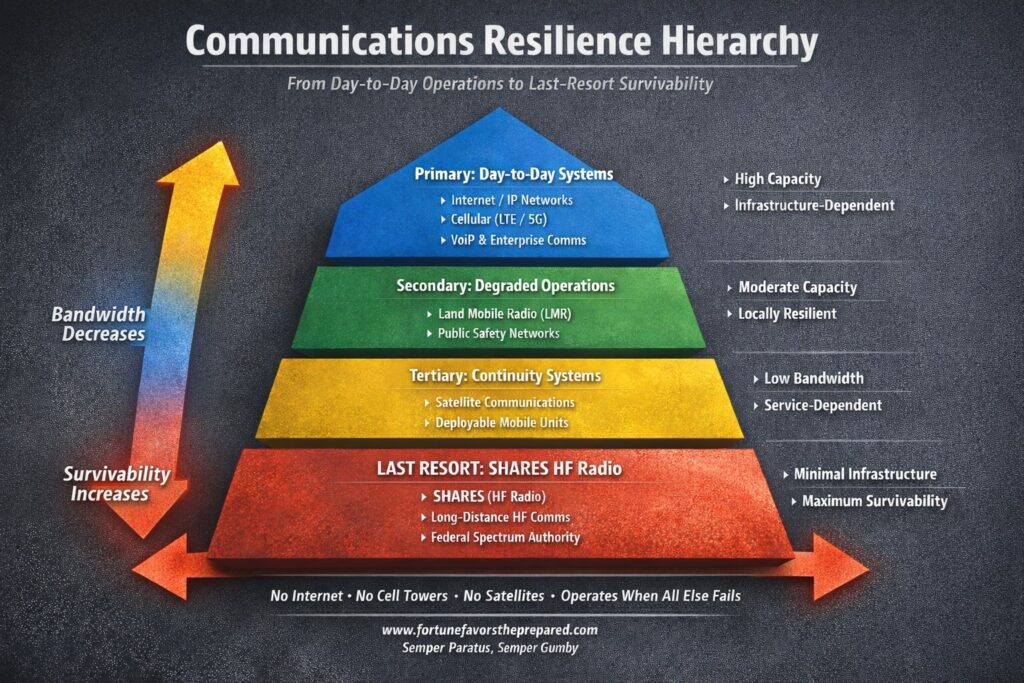
SHARES is not intended to replace modern communications systems. Instead, it is designed to complement and backstop them.
SHARES is commonly integrated with:
- Land Mobile Radio (LMR) systems
- Satellite communications
- IP-based and VoIP systems
- Emergency Operations Center (EOC) communications plans
- Continuity of Operations (COOP) frameworks
In resilient communications architectures, SHARES typically serves as a low-bandwidth, high-survivability layer when higher-capacity systems fail.
SHARES vs. Amateur Radio (Clarified)
While both use HF radio, SHARES and amateur radio serve fundamentally different purposes.
| Aspect | SHARES | Amateur Radio |
|---|---|---|
| Purpose | NS/EP & continuity communications | Public service & personal use |
| Authority | Federal spectrum (NTIA) | FCC amateur service |
| Participation | Approved organizations | Licensed individuals |
| Traffic | Official operational communications | Non-commercial |
| Governance | DHS / CISA / NCC | FCC rules & volunteer groups |
The systems may coexist, but they are not interchangeable.
Common Myths About SHARES
Myth: SHARES is part of amateur radio
False. SHARES is a federal emergency communications program, not an amateur service.
Myth: SHARES stations require FCC licenses
False. SHARES stations operate under federal spectrum authority, with assignments coordinated by the SHARES Program Office.
Myth: Anyone with an HF radio can use SHARES
False. Participation is limited to approved organizations supporting NS/EP missions.
Myth: SHARES is outdated technology
False. HF remains one of the most resilient long-range communications methods available during infrastructure failures.
Why SHARES Matters for Preparedness
Disasters increasingly involve complex, cascading failures—power, communications, logistics, and governance can all be impacted simultaneously. SHARES provides:
- Infrastructure-independent reach
- National-scale interoperability
- Proven survivability
- A communications path when everything else fails
For emergency managers, continuity planners, and critical infrastructure operators, SHARES represents a strategic national capability, not a convenience backup.
Key Takeaway
SHARES is a federally coordinated HF radio program administered by DHS through CISA and the NCC, operating under NTIA-managed spectrum authority to support National Security and Emergency Preparedness communications.
Organizations responsible for public safety, emergency response, or infrastructure continuity should understand SHARES, plan for it, and integrate it into their communications resilience strategy.