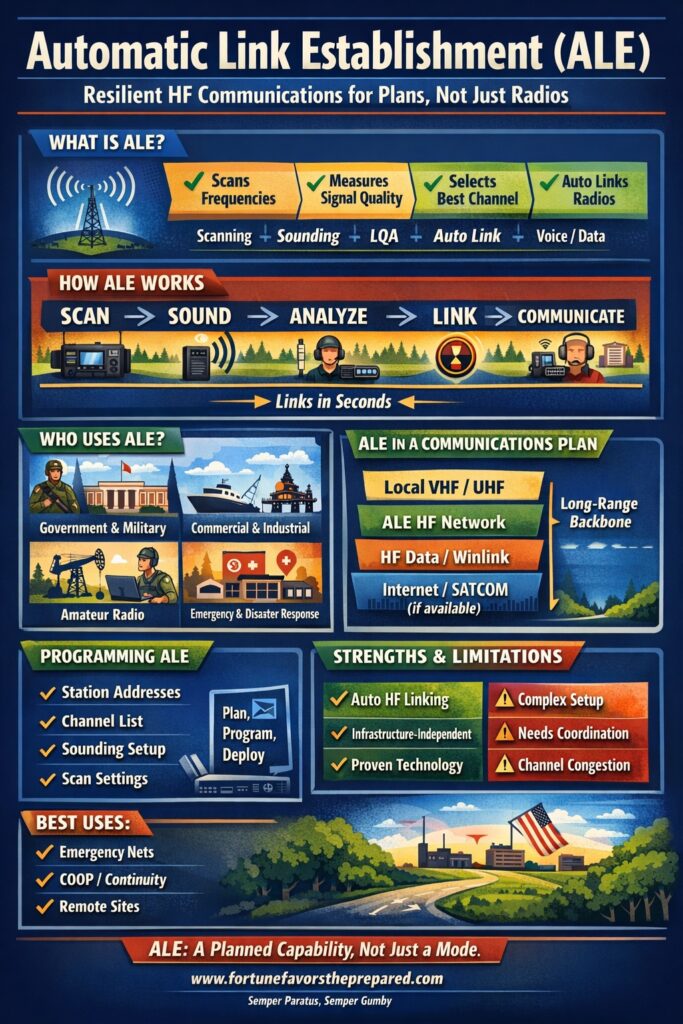
Smart HF Communications When It Matters Most
When infrastructure is damaged, networks are congested, or conditions are unpredictable, high-frequency (HF) radio remains one of the most resilient communication tools available. Automatic Link Establishment (ALE) enhances HF by removing much of the guesswork—allowing radios to automatically find the best frequency and establish reliable links without constant operator intervention.
ALE has been trusted for decades by governments, militaries, commercial operators, and emergency communicators worldwide. For preparedness-focused organizations and individuals, ALE represents a proven backbone capability for long-range, infrastructure-independent communications.
What Is Automatic Link Establishment (ALE)?
Automatic Link Establishment (ALE) is a digital signaling protocol used on HF radio systems that enables radios to:
- Scan multiple HF frequencies automatically
- Measure real-time propagation conditions
- Select the best available frequency
- Establish point-to-point or group links
- Maintain or re-establish connections as conditions change
Instead of manually calling on multiple frequencies hoping one works, ALE radios continuously evaluate link quality and connect automatically—often in seconds.
Most modern implementations use 2G ALE (MIL-STD-188-141B). Newer 3G ALE (STANAG 4538) improves speed, performance, and reliability in crowded or noisy RF environments.
Who Uses ALE?
Government & Military
ALE was originally developed for government and military use and remains a core HF capability for organizations such as the United States Department of Defense and NATO partners.
Why ALE is used:
- Global HF reach without reliance on satellites
- Automatic adaptation to changing propagation
- Reduced operator workload
- Reliable communications in denied or degraded environments
ALE is frequently combined with encryption, frequency hopping, and HF data modes to support command, control, logistics, and continuity-of-operations missions.
Commercial & Industrial Users
Commercial ALE users include:
- Maritime shipping operators
- Aviation support and flight-following networks
- Oil, gas, and mining operations
- Utilities and remote infrastructure providers
Commercial advantages:
- Reliable long-range communications without cellular coverage
- Automation for non-radio specialists
- Lower recurring cost than satellite systems
- Proven operation in remote and austere locations
For vessels at sea or operations far from population centers, ALE supports routine check-ins, emergency alerts, and data transfer with minimal operator involvement.
Amateur Radio (Ham Radio)
Within amateur radio, ALE is used by:
- Emergency communications groups (ARES, RACES, AUXCOMM)
- Preparedness-focused operators
- HF digital experimentation networks
While less common than voice or popular digital modes, ALE offers structured, predictable HF networking that aligns well with emergency and contingency planning.
Amateur ALE benefits:
- Automatic frequency selection
- Organized calling and net operations
- Reliable regional, national, or international reach
- Support for unattended or semi-attended stations
Many amateurs deploy ALE alongside voice, Winlink, and other HF tools as part of layered communications planning.
Emergency Management & Disaster Response
ALE excels during disasters where:
- Internet access is disrupted or unavailable
- Cellular networks are overloaded or destroyed
- Trained operators are limited
- Communications must be restored quickly and maintained over time
Emergency use cases include:
- Statewide or regional HF emergency networks
- Automatic check-ins from remote sites
- Linking shelters, EOCs, and field teams
- Sustained operations as propagation changes day to night
Because ALE automatically adapts to conditions and re-links as needed, it is particularly well-suited for long-duration incidents.
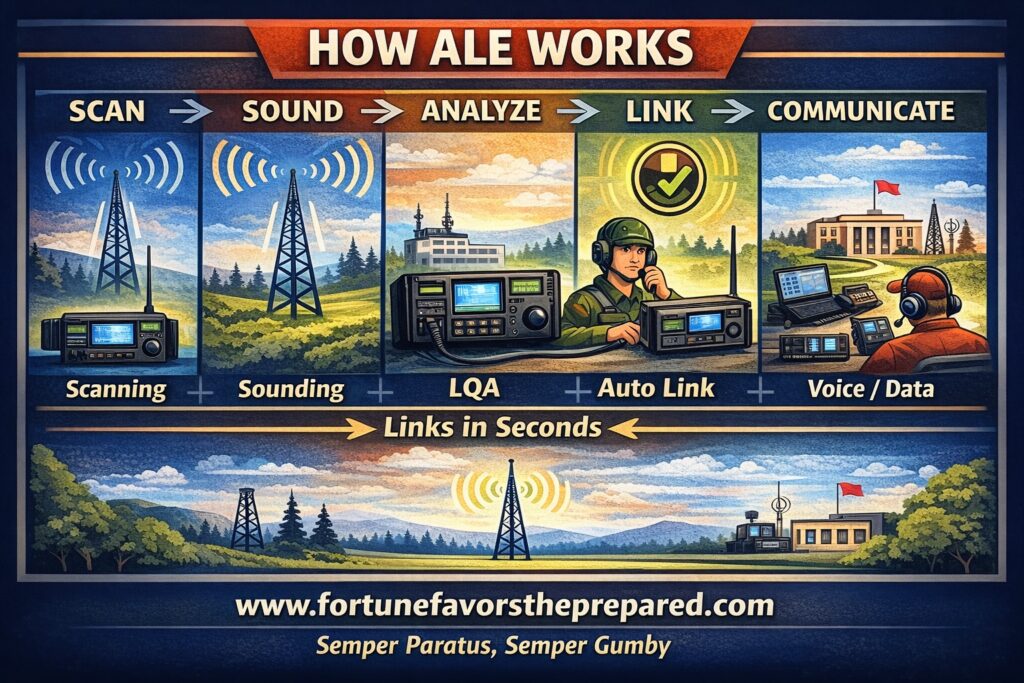
How ALE Works (Simplified)
- Scan Lists
Radios scan a programmed list of HF channels. - Sounding
Stations periodically transmit brief ALE soundings to announce availability. - Link Quality Analysis (LQA)
Each radio evaluates received signals and builds a local propagation table. - Calling
When a station initiates a call, the radio automatically selects the best frequency. - Link Established
Once linked, operators transition to voice or data communications.
This entire process typically takes only a few seconds.
Programming & Configuration Overview
Programming ALE requires more planning than basic HF voice but is well within reach for organized users.
Core Programming Elements
1. Station Address
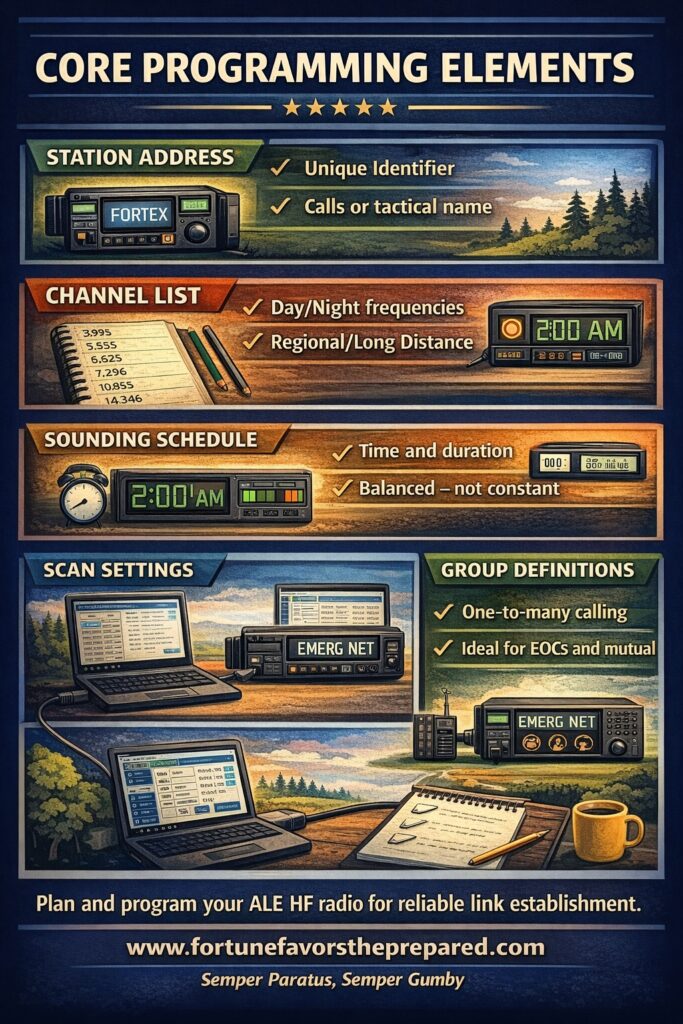
- Unique identifier (callsign or tactical name)
- Supports individual and group addressing
2. Channel / Frequency Lists
- Multiple HF channels covering:
- Daytime propagation
- Nighttime propagation
- Regional and long-distance paths
3. Sounding Configuration
- Defines how often stations announce presence
- Balanced to maintain awareness without congesting channels
4. Scan Parameters
- Scan order and dwell times
- Optimized for coverage area and mission needs
5. Group Definitions
- Enables one-to-many calling
- Ideal for emergency nets and mutual-aid groups
Programming is typically performed via manufacturer software using a computer connection to the radio.
Strengths and Limitations
Strengths
- Infrastructure-independent
- Automatically adapts to HF propagation
- Long-range capability
- Reduced operator workload
- Ideal for organized, planned networks
Limitations
- Requires upfront planning and coordination
- More complex than basic HF voice
- Potential channel congestion if poorly configured
- Learning curve for new users
ALE in a Communications Plan
ALE is not a replacement for local VHF/UHF systems, repeaters, or manual HF voice—it is a strategic backbone capability.
Within a communications plan, ALE provides:
- Long-range reach when other systems fail
- Predictable connectivity across time and geography
- Automated fallback paths that reduce decision-making under stress
For those serious about communications resilience, ALE remains one of the most mature and field-proven HF technologies available.