Yaesu System Fusion (YSF) occupies a unique place in the digital voice landscape. Unlike DMR’s structured talkgroup model or D-STAR’s data-centric design, Fusion blends digital and analog FM in a way that prioritizes ease of use, backward compatibility, and graceful degradation.
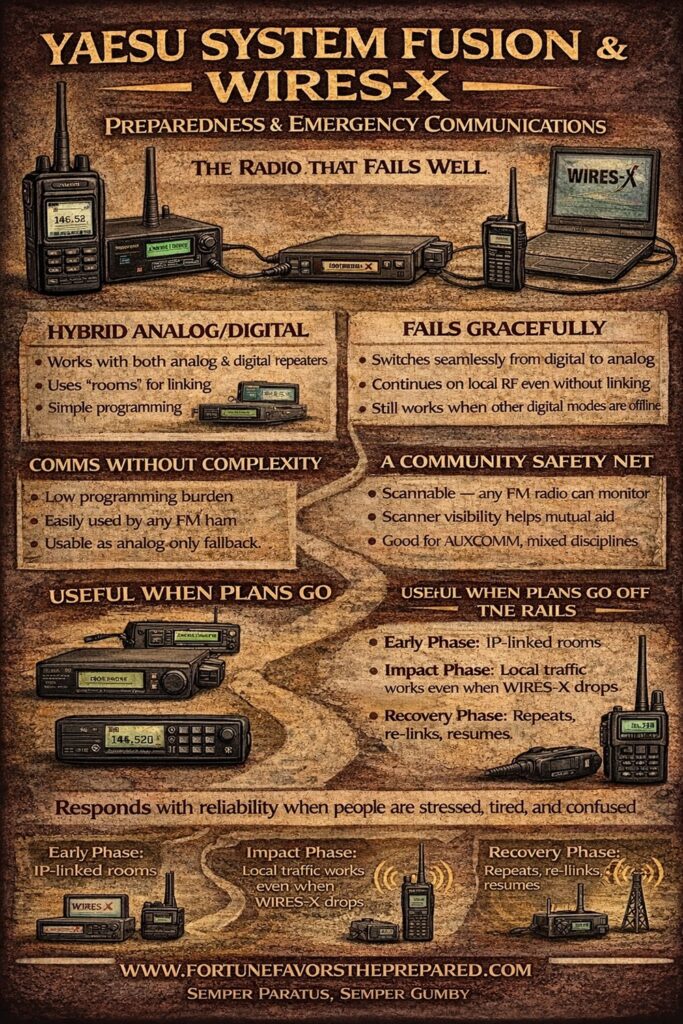
For preparedness-minded operators, Fusion’s real value is not that it is “digital,” but that it fails well—often continuing to pass usable voice even when networks, servers, or linking infrastructure disappear.
What Is Yaesu System Fusion?
System Fusion is Yaesu’s digital voice system designed to coexist seamlessly with traditional analog FM.
Core characteristics:
- Uses C4FM digital modulation
- Supports analog FM and digital voice on the same repeater
- Designed for simple user operation
- Integrated with WIRES-X, Yaesu’s IP linking system
Fusion radios and repeaters are commonly configured to automatically switch between analog and digital modes depending on the incoming signal.
That single design choice has major preparedness implications.
What Is WIRES-X?
WIRES-X is Yaesu’s IP-based linking system that connects Fusion repeaters and nodes into Rooms (similar in concept to talkgroups).
Key points:
- Rooms function as shared virtual channels
- Repeaters or personal nodes can join or leave Rooms dynamically
- Linking is IP-dependent
- Voice remains plain, readable audio (no encryption)
WIRES-X excels at organized, low-friction coordination when the internet is available—but does not prevent local RF operation when it isn’t.
Why System Fusion Matters in Preparedness
In disasters, communications often degrade in stages:
- Congestion
- Partial infrastructure failure
- Loss of linking
- Local-only RF
Fusion handles this progression exceptionally well.
Key Preparedness Strengths
- Analog compatibility
Any FM radio can hear (and often participate in) traffic - No talkgroup complexity
Minimal programming burden - Graceful fallback
When WIRES-X drops, the repeater still works locally - Scanner visibility
Analog FM traffic can be monitored by:- Scanners
- Mutual aid agencies
- Non-ham partners
This makes Fusion especially useful in community response, AUXCOMM, and mixed-discipline environments.
Fusion vs DMR: The Practical Difference
In preparedness terms:
- DMR is a communications framework
- Excellent for command, logistics, and scaling
- Requires planning, discipline, and programming
- System Fusion is a communications safety net
- Easy to use under stress
- Accessible to analog-only operators
- Less brittle when plans fall apart
Neither replaces the other. They solve different problems.
Use in Emergencies & Disasters
Early Phase (Watch / Warning)
- WIRES-X Rooms for coordination
- Local repeaters carry both digital and analog traffic
- Easy onboarding of unfamiliar operators
Impact Phase
- Analog FM continues when linking drops
- Local repeaters remain usable
- Scanner monitoring allows situational awareness beyond the ham community
Recovery Phase
- WIRES-X reconnects easily
- Regional coordination resumes
- Minimal reconfiguration required
Fusion shines when simplicity beats structure.
COMSEC & Monitoring Reality
System Fusion provides no encryption.
This is not a flaw—it is a feature in preparedness contexts.
Implications:
- Traffic is openly monitorable
- Interoperability with agencies using scanners
- Transparency during public-facing incidents
Fusion is appropriate for:
- Coordination
- Status updates
- Community response
- Resource requests
It is not appropriate for:
- Tactical movement
- Sensitive personal information
- Anything requiring privacy
System Fusion in a PACE Communications Plan
Fusion fits naturally into layered planning.
Example PACE Integration
Primary
- Local Fusion repeater (analog + digital)
Alternate
- WIRES-X linking via IP
Contingency
- Analog simplex FM
Emergency
- HF voice or digital
Fusion often acts as the bridge between casual operators and structured systems.
Where Fusion Excels (and Where It Doesn’t)
Excels At
- Mixed-skill groups
- Community preparedness
- Local emergency response
- Analog/digital coexistence
- Fast adoption under stress
Falls Short At
- Large-scale structured command
- Complex multi-layer nets
- Fine-grained traffic separation
- International scalability
That’s not a weakness—it’s a design choice.
Bottom Line
Yaesu System Fusion is not trying to be DMR.
It’s trying to be reliable when people are confused, tired, and under stress.
In preparedness terms, Fusion is:
- Forgiving
- Accessible
- Resilient
- Easy to monitor and integrate
Preparedness isn’t about the most advanced system.
It’s about the system that still works when the plan doesn’t.