An Overview of Linked Amateur Radio Systems and Networks
Amateur radio is often misunderstood as short-range, point-to-point communication limited by terrain and line-of-sight. While simplex operation and single repeaters remain foundational skills, modern ham radio has grown into a layered, interconnected ecosystem of linked systems that routinely span cities, regions, nations, and even continents.
This article is a high-level introduction to the major types of linked ham radio systems—how they work conceptually, why they matter, and how they expand communications capability for everyday operation, emergency response, and preparedness. Each system discussed here will be explored in greater depth on dedicated pages.
The Core Concept: Linking Systems, Not Just Radios
At its simplest, a linked ham radio system allows a transmission made into one radio or repeater to be repeated elsewhere—sometimes hundreds or thousands of miles away.
Linking can occur via:
- RF (radio-to-radio) links
- Microwave point-to-point paths
- IP networks (public or private)
- Hybrid combinations of all three
The key idea is that local RF access remains the entry point, but the reach of that access is no longer limited to a single site or coverage bubble.
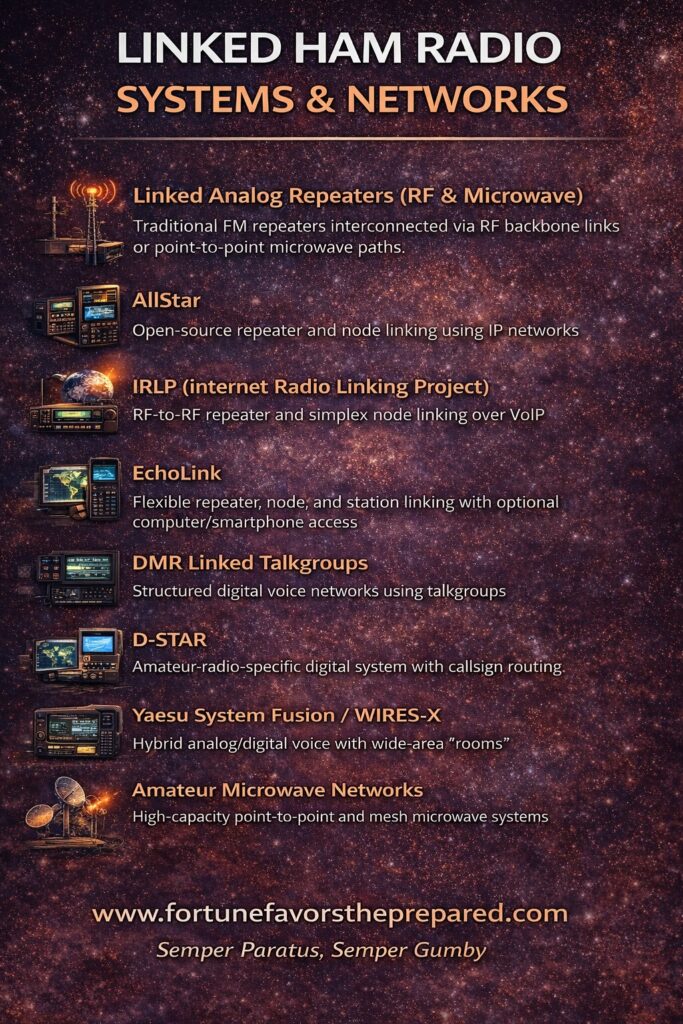
Linked Analog Repeaters (RF & Microwave)
Long before digital voice, amateur radio operators were linking repeaters together to extend coverage.
How It Works
- Multiple FM repeaters are interconnected
- Audio is passed via RF backbone frequencies or microwave links
- Users operate normally on local VHF/UHF repeaters
Why It Still Matters
- Works with basic analog radios
- Familiar operating procedures
- Often engineered for power outages
- Can function without the internet
Many long-standing regional emergency and public-service networks still rely on linked analog repeaters because of their simplicity and resilience.
If you go to RepeaterBook.com one of the options at the top of the state pages is linked systems.
AllStar: The Modern Backbone for Analog Linking
One of the most important—and often misunderstood—linked systems in amateur radio today is AllStar.
What AllStar Is
AllStar is an open-source linking system built on the Asterisk PBX platform. It allows:
- Analog repeaters
- Simplex nodes
- Hubs and bridges
to be interconnected using IP networks.
Why AllStar Matters
AllStar has become the de facto backbone for many modern analog repeater systems because it is:
- Extremely flexible
- Hardware-agnostic
- Capable of running on private or public networks
- Well-suited for regional and statewide systems
Many repeaters that appear “standalone” are, in reality, part of an AllStar-linked network behind the scenes.
Radio-to-Radio Linking Over IP: IRLP and EchoLink
As internet connectivity became widespread, amateurs began extending RF systems globally while still preserving RF access.
IRLP (Internet Radio Linking Project)
IRLP links repeaters and simplex nodes using VoIP, with strict design rules:
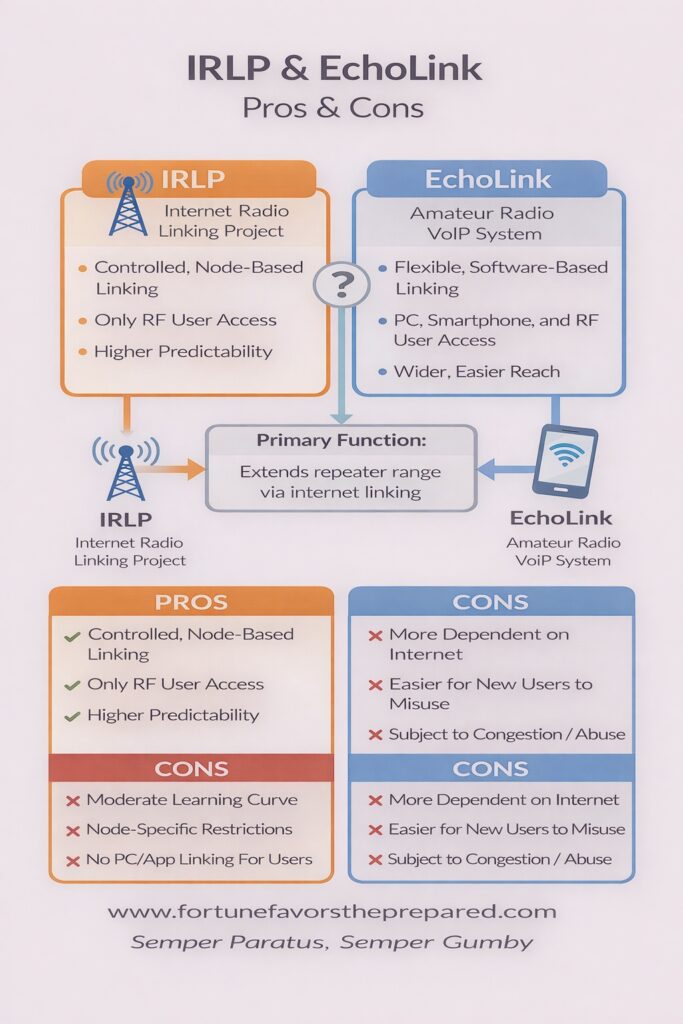
- RF must exist on both ends
- No computer-only users
- Emphasis on discipline and reliability
IRLP is commonly used for:
- Scheduled nets
- Emergency coordination
- International voice connections
EchoLink
EchoLink offers a more flexible model:
- Repeater-to-repeater linking
- Station-to-station connections
- Optional computer and smartphone access
EchoLink is often used for:
- Training and outreach
- Traveling operators
- Contingency access when RF paths are limited
Both systems extend RF reach while retaining amateur radio identity and control.
Digital Voice Networks and Structured Linking
Digital voice systems add structure and scalability to linked communications.
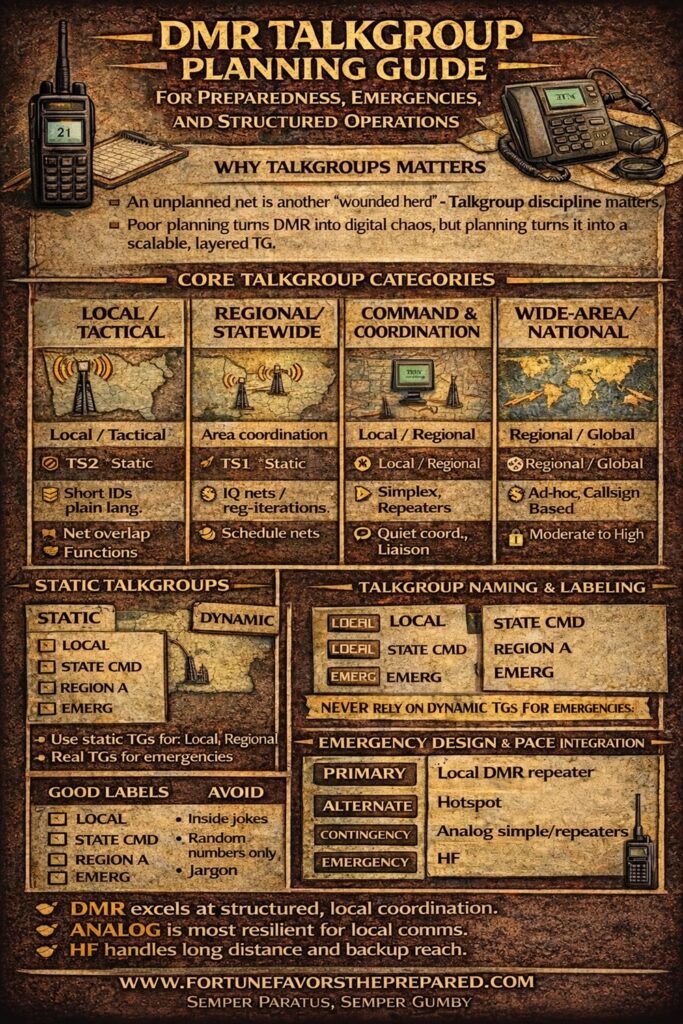
DMR and Talkgroups
DMR organizes communications using talkgroups:
- Local, regional, national, and worldwide
- Repeaters dynamically link based on talkgroup selection
- Thousands of repeaters interconnected globally
DMR excels at:
- Efficient spectrum use
- Predictable channel organization
- Rapid scaling during events or emergencies
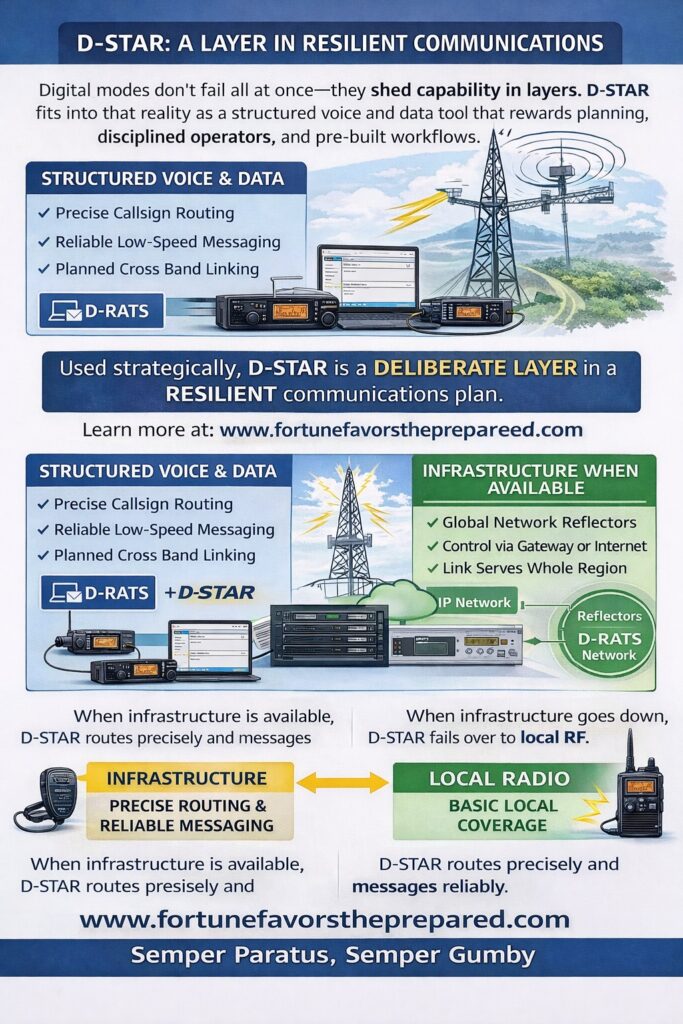
D-STAR
Designed specifically for amateur radio, D-STAR integrates:
- Digital voice
- Callsign routing
- Data and GPS capabilities
D-STAR is particularly effective for directed and organized communications, making it popular with coordinated groups and emergency operations.
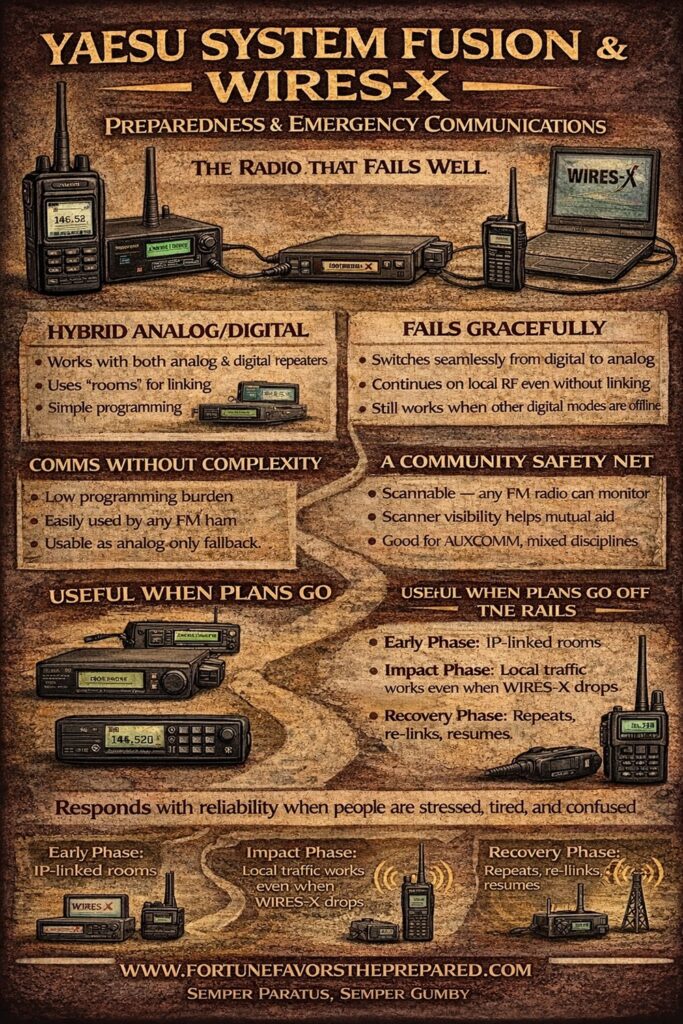
Yaesu System Fusion and WIRES-X
System Fusion blends analog and digital operation:
- Automatic mode switching
- Simple user experience
- WIRES-X “rooms” that act like digital conference spaces
Fusion is commonly used in:
- Club repeater systems
- Regional networks
- Mixed analog/digital environments
Microwave and High-Capacity Ham Networks
Beyond voice, amateur radio also uses microwave networks to:
- Link repeaters
- Carry IP traffic
- Provide resilient regional backbones
These systems often support:
- AllStar networks
- Digital voice backhaul
- Emergency data services
Microwave links are frequently independent of commercial ISPs, making them valuable in disaster scenarios.
Why Linked Systems Matter for Preparedness
Linked ham radio systems provide advantages that isolated radios cannot:
- Geographic reach: Local handhelds accessing regional or global networks
- Redundancy: Multiple transport paths for the same traffic
- Scalability: Small local nets expanding instantly
- Training value: Everyday use builds familiarity before emergencies
Equally important, these systems degrade gracefully:
- Local RF continues when links fail
- Regional coverage persists with partial backbones
- Wide-area connectivity returns as infrastructure recovers
This behavior closely mirrors real-world disaster conditions.
What This Article Is — and Is Not
This article is:
- An orientation to the linked ham radio landscape
- A framework for understanding capabilities
- A starting point for deeper exploration
This article is not:
- A setup guide
- A licensing tutorial
- A “best mode” comparison
No single system is universally superior. Each has tradeoffs in complexity, dependency, and resilience.
The Big Picture
Modern amateur radio is no longer just point-to-point voice. It is a distributed communications fabric built from analog repeaters, digital voice, AllStar backbones, microwave links, and IP networks—often designed and maintained by volunteers with resilience in mind.
For preparedness and disaster response, advantage doesn’t come from owning more radios. It comes from understanding how your signal moves, how far it can go, and what it depends on along the way.
Linked ham radio systems make that reach possible.
See also