Choosing Radios and Planning for Failure

This article references parts of the story in my fiction books, The Meadow Protocol (book 1) and The Brush (part 2), part of The Continuity Chronicles series. Available in my store for signed paperback and hard copies or from Amazon to include Kindle and Audible.
In emergencies, communications usually fail before food, fuel, or security—and not because radios stop working. They fail because assumptions do. Networks degrade, habits break, and coordination collapses long before silence arrives.
Preparedness communications isn’t about owning the “best” radio. It’s about maintaining coordination as systems degrade, people are stressed, and information is incomplete. That requires choosing radios deliberately and planning—explicitly—for failure.
This section is organized to help you do both.
Why Preparedness Communications Are Different
Most everyday communications assume:
- Working infrastructure
- Stable power
- Low stress
- Instant feedback
Preparedness assumes the opposite.
Disasters and disruptions introduce latency, overload, partial outages, and human error. LTE and internet-linked systems may work—until they don’t. Repeaters may help—until they’re down or overwhelmed. Even radio-to-radio links fail if users don’t know when to switch, where to go next, or how to communicate under pressure.
Prepared groups plan for degradation, not perfection.
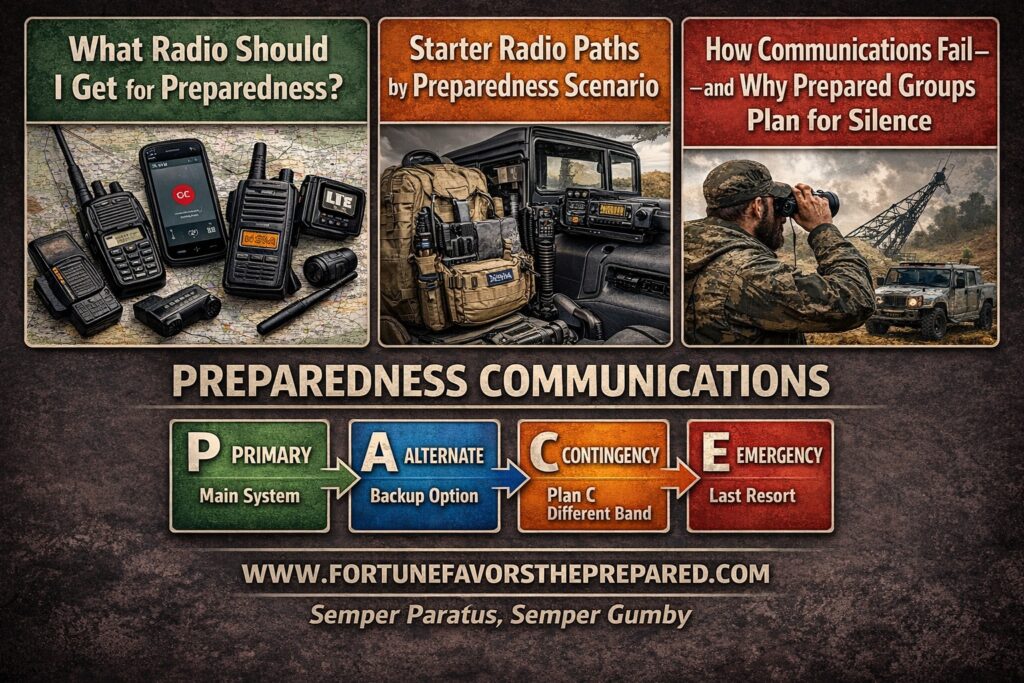
How to Use This Section
These articles are arranged in a deliberate learning order. Start where you are, then move deeper.
1) What Radio Should I Get for Preparedness?
Start here if you’re new or deciding what to buy.
This article frames radios as capabilities, not gadgets. It helps you choose based on:
- Who you need to talk to
- How far away they are
- What infrastructure you’re willing to trust
- How much time and money you’ll realistically commit
It compares FRS, GMRS, MURS, CB, LTE push-to-talk, and amateur radio—plainly and honestly—so you avoid wasted purchases and false confidence.
2) Starter Radio Paths by Preparedness Scenario
Read this when you’re ready to build a plan.
Different scenarios demand different tools. This article lays out practical starter paths for:
- Short-term local emergencies
- Family + local groups
- Rural and homestead environments
- Vehicle-based movement and evacuation
- Organized MAG operations
- Regional and long-term disruptions
It shows how to layer radios sensibly, where LTE fits (and where it doesn’t), and how to scale capability without overcomplicating things.
3) How Communications Fail—and Why Prepared Groups Plan for Silence
Read this to understand why good plans still fail.
This article explains how communications failures cascade:
- Latency creates bad decisions
- Missed check-ins consume manpower
- OPSEC erodes under stress
- Coordination collapses before radios go quiet
Using grounded analysis and The Continuity Chronicles as a realism check, it shows why disciplined groups plan what happens next—before failure forces the lesson.
The Doctrine Thread That Connects Them
Across all three pieces, the same principles apply:
- Mission first, gear second
- Assume infrastructure failure
- Plan transitions, not just tools
- Practice under degraded conditions
- Silence is a condition—unplanned silence is a crisis
This is why preparedness communications rely on PACE planning (Primary, Alternate, Contingency, Emergency) and why LTE, repeaters, and convenience systems are treated as advantages, not dependencies.
Where to Begin
Preparedness communications isn’t about how much you already know—it’s about what problem you’re trying to solve right now. Use the guidance below to start in the right place.
If you’re asking:
“What radio should I buy?”
Start with: What Radio Should I Get for Preparedness?
This is the orientation point. It helps you think clearly about:
- Who you need to talk to
- How far away they are
- What infrastructure you’re willing to rely on
- How much time and money you’ll realistically commit
Read this first if you’re new, overwhelmed by options, or trying to avoid wasting money.
If you’re asking:
“How do I actually set this up for my situation?”
Go to: Starter Radio Paths by Preparedness Scenario
This is the application guide. It shows how different radios fit real-world scenarios:
- Short-term local emergencies
- Family and small groups
- Rural and homestead environments
- Vehicle movement and evacuation
- Organized MAG operations
- Long-term or regional disruption
Read this when you’re ready to move from theory to planning.
If you’re asking:
“Why do smart groups still lose coordination?”
Study: How Communications Fail—and Why Prepared Groups Plan for Silence
This is the failure analysis. It explains how communications break down:
- Gradually, not suddenly
- Through latency, overload, and habit
- Long before radios go quiet
Read this to understand why gear and good intentions aren’t enough—and why disciplined groups plan for silence before it arrives.
Not Sure Where You Are Yet?
Start with What Radio Should I Get for Preparedness?
Then move through the others in order.
Prepared groups don’t rush to tools.
They build understanding, then capability, then resilience.
That’s the progression these articles are designed to support.