More came out of the binder. But not out of the same copy.
Every sheet in the first packet carried the same handwritten copy number in the corner — 007 of 012. These two are stamped in the distribution block, not handwritten, and they read COPY 03 OF 07. Different number. Different run. Seven copies authorized instead of twelve.
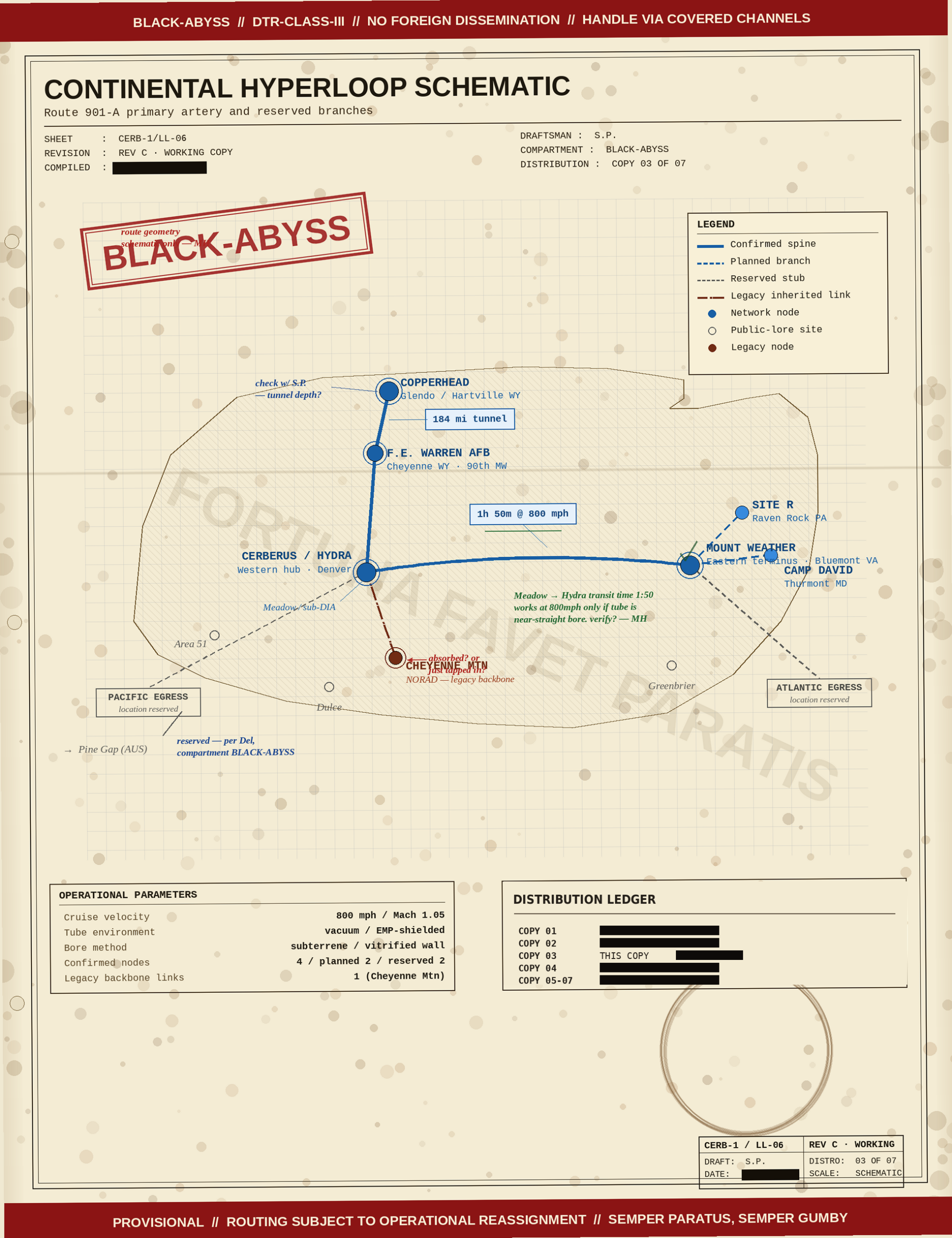
I had assumed the source was working from one physical binder and photographing it in passes. That assumption is now wrong. Whatever access this person has, it reaches across at least two separate distribution ledgers of the same compartment — and a distribution ledger is the one document in a classified program specifically designed to make that impossible. The first of these two sheets carries that ledger as a panel on its face — seven rows, six of them blacked out, and the third annotated this copy.
The draftsman is the same. S.P., in the block, bottom right, both sheets. The compartment is the same. The classification stack is the same.
The reviewer is not. T.B. — the red pen that ran through all six sheets of the first packet, the one I said you should pay attention to — does not appear on either of these. In T.B.’s place is a hand initialed MH, writing in two colors: red for the questions, green for the things that have been checked. Same handwriting, same person, two pens, two jobs.
MH is not a new name. In the first packet, MH appeared exactly once, as an attribution inside somebody else’s annotation — the red note on RGN-02 reading “NOT ON THE NETWORK — confirmed MH.” T.B. was citing MH. On these sheets MH is holding the pen.
There’s a third hand, in blue, that signs nothing and asks other people for things. Read them in order, and pay attention to the pen.
Route 901-A
| Sheet | Title | Rev | Pages |
|---|---|---|---|
| CERB-1 / LL-06 | Continental Hyperloop Schematic | C · working | 1 of |
| CERB-1 / LL-07 | Mid-Atlantic Continuity Detail | A · working | 2 of |
Start with the number, because the first packet asked for it. On LL-05, the reviewer wrote a small red question into the empty Pacific Northwest corner — “why no PNW node? check LL-0?” — the sheet number left as a question mark, because they didn’t know whether the next sheet existed. It does. This is it. And it answers them in a way I don’t think they expected: there is a Pacific node. It’s drawn here as a reserved coastal egress with its location deliberately unpinned.
The subtitle names the thing: Route 901-A primary artery and reserved branches. A western hub marked Cerberus / Hydra sits under Denver, annotated Meadow · sub-DIA, and a confirmed spine runs east from it to Mount Weather in Bluemont, Virginia, marked eastern terminus. Branches to Site R at Raven Rock and Camp David at Thurmont are drawn as planned, not built. A confirmed northern leg runs up through F.E. Warren AFB at Cheyenne — the 90th Missile Wing — and continues 184 miles to Copperhead at Glendo and Hartville, Wyoming. RGN-02 put Copperhead at 184 miles north with a tunnel terminus at F.E. Warren. The two sheets agree to the mile.
Hydra is now on its third sheet with its third meaning. On LL-01 it was one of two conduits that mapped to nothing I could locate. On RGN-02 it was a hyperloop spine. Here it’s a hub, sharing a node label with Cerberus. Same overload pattern as Chimera and Crowbar, third instance, in a compartment where names are supposed to be unique.
The parameters panel is specific in a way that invites checking, so check it. Cruise velocity 800 mph, which the sheet gives as Mach 1.05. Tube environment vacuum, EMP-shielded. Bore method subterrene, vitrified wall — which is not an invented word. The subterrene was a real Los Alamos program in the 1970s, a nuclear-heated borer that melted rock into a glass lining instead of cutting and hauling it. There are patents. RGN-02 described The Meadow as having a vitrified perimeter. Same method, same binder.
Then Cheyenne Mountain, drawn as a legacy node on a legacy inherited link, with the NORAD backbone absorbed rather than built. The red pen asks: “absorbed? or just tapped in?”
Here is why that matters. On RGN-02, the annotation settling this question read “NOT ON THE NETWORK — confirmed MH” — and MH is the hand holding the pen on this sheet. So MH asked the question here and answered it there, and the answer contradicts what the draftsman drew. Either this sheet predates RGN-02 and we’re looking at the reviewer’s working-out, or S.P. kept drawing a link MH kept striking. I can’t date either. Every date in this binder is blacked out. But the argument is preserved rather than resolved, which is not how documents leave a desk when someone has time to clean them.
The green pen does the arithmetic in the margin: Meadow to Hydra at 1:50 works at 800 mph only if the tube is a near-straight bore. So I did it too. One hour fifty at 800 is about 1,470 miles. Denver to Bluemont in a straight line is roughly 1,450. The margin note isn’t approximately right. It’s right.
The blue hand asks “check w/ S.P. — tunnel depth?” next to the Copperhead leg, and marks the Pacific egress “reserved — per Del, compartment BLACK-ABYSS.” Blue defers to the draftsman rather than reviewing him, and cites somebody called Del for a routing decision. Both coastal egress nodes — Pacific and Atlantic — are drawn and left unpinned, location reserved. I’ll note that LL-05 in the first packet had a redaction bar sitting on the Gulf Coast where a hypothetical node had been blacked out.
One more thing, and I want to be direct about it, because it’s the detail that makes people stop taking a document seriously. Area 51, Dulce, the Greenbrier and Pine Gap are all on this sheet — and the legend gives them their own symbol, public-lore site, distinct from network node and legacy node. Not one of them connects to anything. The Greenbrier is a real declassified continuity facility, opened to the public in 1992. Pine Gap is real and is in Australia, which on a continental sheet is a category error nobody drafting seriously makes by accident. The draftsman built a symbol category for the famous ones and then drew every one of them unconnected. A conspiracy chart adds those four sites. This one subtracts them, and made a legend entry to do it.
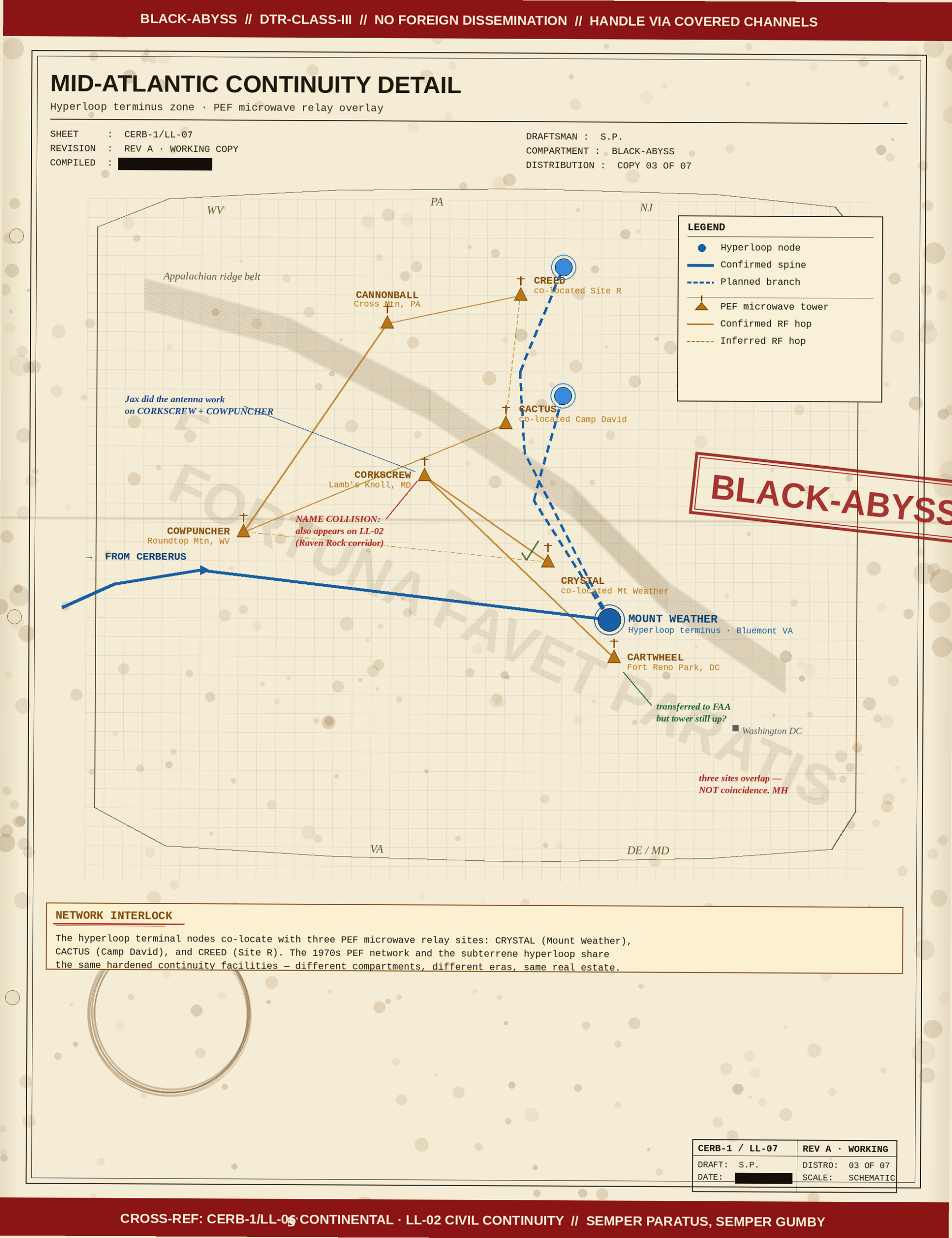
The second sheet drops out of continental scale into one corner of it — the Appalachian ridge belt across West Virginia, Pennsylvania, Virginia and Maryland, which is where Route 901-A ends.
The sheet overlays two networks on one set of ridges. The hyperloop arrives from the west — the arrow is labeled from Cerberus — and terminates at Mount Weather, with the same planned-not-built branches to Site R and Camp David that LL-06 showed. Over the top of it, in amber, sits the 1970s Presidential Emergency Facility microwave relay grid: seven hardened tower sites built under the White House Communications Agency program, with confirmed hops drawn solid and inferred hops dashed.
Three of the seven PEF sites sit directly on hyperloop terminal nodes. Crystal at Mount Weather. Cactus at Camp David. Creed at Site R. The remaining four — Cannonball at Cross Mountain PA, Cowpuncher at Roundtop Mountain WV, Corkscrew at Lamb’s Knoll MD, and Cartwheel at Fort Reno Park in Washington DC — sit along the RF backbone at independent geographies.
The red pen: “three sites overlap — NOT coincidence. MH.” The interlock panel at the foot of the sheet says the quiet part in compiler voice — that the 1970s microwave network and the subterrene bore share the same hardened facilities, in different compartments, from different eras, on the same real estate. Which is the whole thesis of this binder compressed into one line, and the draftsman put it in a box on the page.
MH also flags the name collision: Corkscrew is drawn here at Lamb’s Knoll, and appears on LL-02 as the Raven Rock corridor. A mountaintop tower on one sheet, a tunnel corridor on another, same code-name, same hand.
And there’s one MH didn’t flag. Look at Creed. On LL-02, Creed is a corridor — a tunnel branch running out of the November Tango Charlie junction. On LL-04 and again here, Creed is a relay site co-located at Site R. That’s the Chimera problem exactly: a line on one sheet, a place on another. Chimera, Crowbar, Hydra, Corkscrew, and now Creed. Five. Either this draftsman is the sloppiest person ever cleared into a compartment, or the naming convention is doing work I don’t understand yet.
The blue hand records that “Jax did the antenna work on CORKSCREW + COWPUNCHER.” No initials, no rank, no context — the only person in this entire binder referred to by what looks like a first name, and the only annotation anywhere that describes somebody physically doing a job with their hands. I don’t know who Jax is. It is the single most human mark on either sheet.
The green pen notes that Cartwheel at Fort Reno Park was transferred to the FAA, and asks whether the tower is still up. It is. That’s checkable and public. Which is the second time on these two sheets that the green pen has written down something verifiable and been correct about it, while the red pen asks questions it can’t close and the blue pen asks other people for specifications. One person, two pens, and the green one only comes out when the answer is known.
Two sheets. One draftsman. Three pens, two of them the same person.
What the packet wants you to see is the transit layer. The first packet drew signal — fiber, microwave, tunnels carrying cable. These two draw movement: a vacuum bore running a continent’s width from a hub under Denver to a mountain in Virginia, a northern leg into the Wyoming missile fields, and a terminus in the Blue Ridge that lands directly underneath three Cold War relay towers built for a different program in a different decade. Different compartments, different eras, same real estate. Their words, not mine.
What the packet doesn’t tell you is who was arguing, and this time we can at least see that somebody was. S.P. drew a link to Cheyenne Mountain. MH questioned it here and struck it on another sheet. Working copies get cleaned before distribution. These weren’t. Whoever compiled copy 03 of 07 either had no time to clean it, or wanted the argument to travel with the map.
The questions I’m left with are worse than the ones I started with. How does one source reach two different distribution runs of the same compartment? Why does S.P. keep drawing Cheyenne Mountain onto a network MH has confirmed it isn’t on? Why do five code-names each mean two different things? Where is the sheet T.B. was looking for when they wrote check LL-0? Who is MH? Who is Del? And who is Jax, who climbed the towers?
The honest answer is the same as last time. I know what came to me. I know the installations are real, the WHCA code-names are real, the subterrene program is real, the FAA transfer at Fort Reno is real, and the arithmetic on the transit time works out. I know these two sheets are internally consistent with each other and with most of the six that came before. I know one of them isn’t. What that means is not something I can tell you.
I’m putting it where people can see it. Draw your own conclusions. Pay attention to the pen.
Narrative device from The Continuity Chronicles by Nick Meacher. Real sites named above are fact and real programs referenced are public record; the transit network linking them, and the compartment that owns it, are fiction. Area 51, Dulce, the Greenbrier and Pine Gap appear as reference landmarks only and are not represented as part of any network. fortunefavorstheprepared.com · Semper paratus, semper Gumby.