Why Listening Matters Before, During, and After Disasters

This article references parts of the story in my fiction books, The Meadow Protocol and book 2, After The Brush, part of The Continuity Chronicles series. Available in my store for signed paperback and hard copies for from Amazon to include Kindle and Audible.
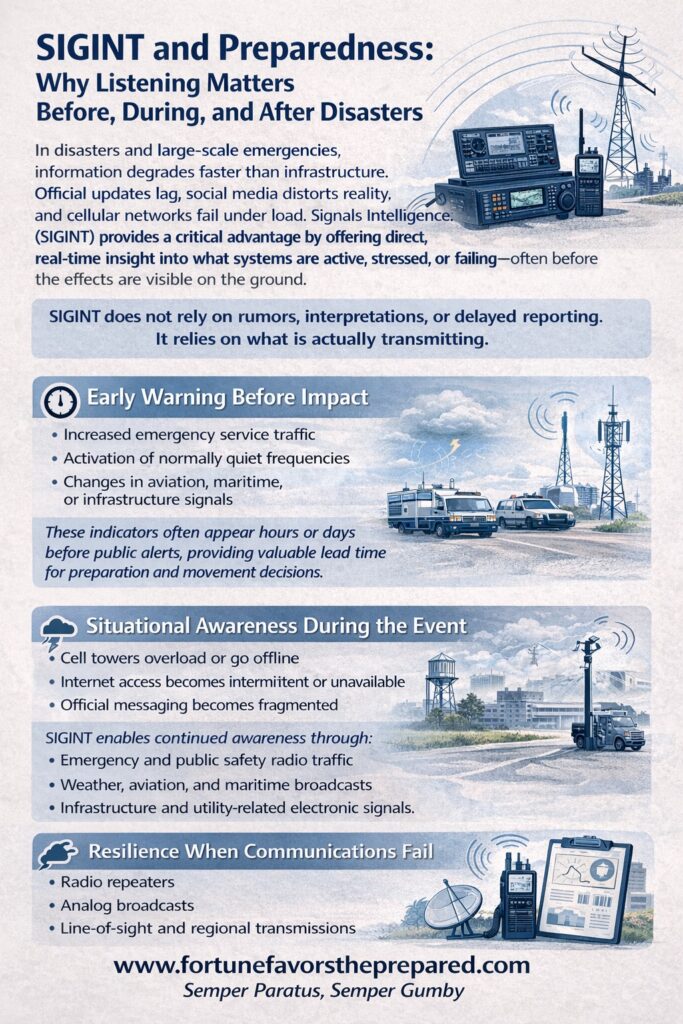
In disasters and large-scale emergencies, information degrades faster than infrastructure. Official updates lag, social media distorts reality, and cellular networks fail under load. Signals Intelligence (SIGINT) provides a critical advantage by offering direct, real-time insight into what systems are active, stressed, or failing—often before those effects are visible on the ground.
SIGINT does not rely on rumors, interpretations, or delayed reporting.
It relies on what is actually transmitting.
For preparedness-minded individuals, families, and communities, SIGINT is not about surveillance—it is about passive listening, verification, and gaining the time needed to make better decisions.
How SIGINT Supports Preparedness & Disaster Response
⏱️ Early Warning Before Impact
Shifts in the electromagnetic environment often precede physical effects. Indicators include:
- Increased emergency service radio traffic
- Activation of normally quiet or reserved frequencies
- Changes in aviation, maritime, or infrastructure signals
These signals can appear hours or even days before public alerts, offering valuable lead time for preparation, staging, or movement.
🌪️ Situational Awareness During the Event
When disasters unfold:
- Cell towers overload or go offline
- Internet access becomes intermittent or unavailable
- Official messaging becomes fragmented or contradictory
SIGINT enables continued awareness through:
- Emergency and public safety radio traffic
- Weather, aviation, and maritime broadcasts
- Infrastructure and utility-related electronic signals
This allows communities to understand what is happening now, not what was reported earlier.
🔌 Resilience When Communications Fail
Preparedness assumes systems will fail. SIGINT leverages systems that often persist:
- Radio repeaters
- Analog broadcasts
- Line-of-sight and regional transmissions
Even in blackout conditions, signals remain. SIGINT ensures you can still listen, verify, and adapt.
🧠 Decision Advantage, Not Just Information
SIGINT feeds into analysis tools and planning frameworks, transforming raw emissions into:
- Pattern recognition
- Threat identification
- Movement and shelter decisions
- Resource allocation priorities
Preparedness is not about knowing everything—it is about knowing enough, early enough, to act correctly.
The Subsets of SIGINT (and Why They Matter)
SIGINT is not a single activity. It is a family of related disciplines, each contributing a different perspective on the operating environment. Detailed pages on each exist elsewhere on the site; what follows is a functional overview.
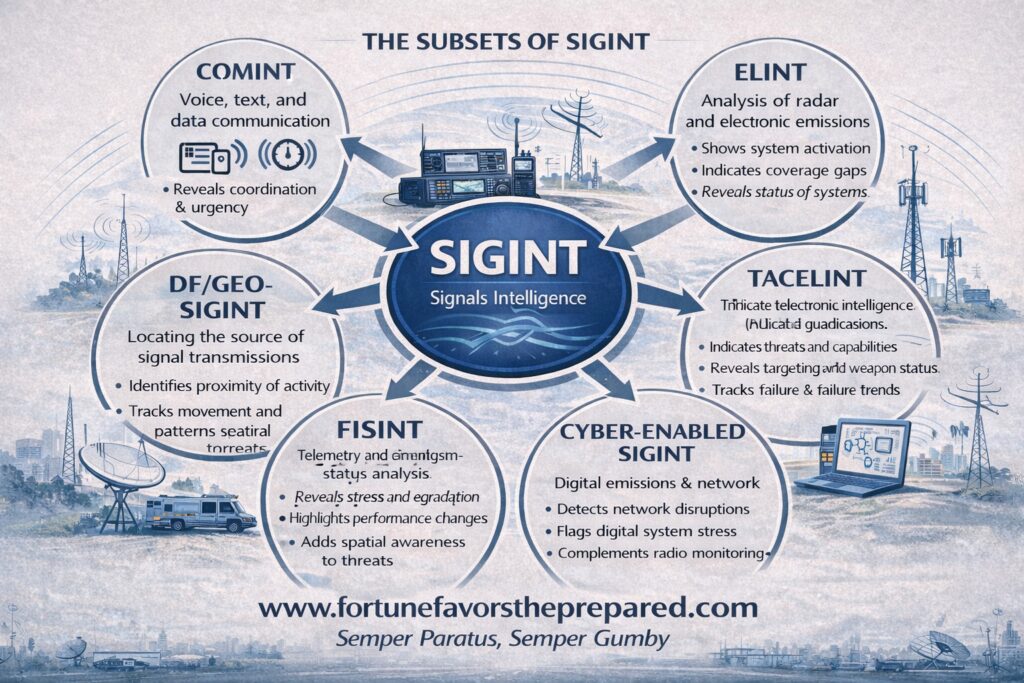
🔊 Communications Intelligence (COMINT)
What it is:
The collection and analysis of voice, text, and data communications.
Preparedness relevance:
- Reveals coordination, urgency, and stress levels
- Provides insight into emergency response tempo
- Confirms real-world activity beyond official statements
COMINT often provides the human context behind unfolding events.
📡 Electronic Intelligence (ELINT)
What it is:
Analysis of non-communication signals such as radar, navigation aids, and electronic beacons.
Preparedness relevance:
- Indicates system activation and coverage
- Reveals infrastructure status and operational boundaries
- Helps identify degraded or overloaded systems
ELINT shows what systems are active, even when no one is talking.
📍 Direction Finding & Geolocation (DF / GEO-SIGINT)
What it is:
Determining the direction or approximate location of signal emitters.
Preparedness relevance:
- Identifies proximity of activity or hazards
- Tracks movement patterns over time
- Helps map where disruptions or responses are occurring
DF adds spatial awareness to signals.
🧪 Foreign Instrumentation Signals Intelligence (FISINT)
What it is:
Analysis of telemetry and specialized system-status signals.
Preparedness relevance:
- Detects performance changes in complex systems
- Reveals stress, degradation, or failure trends
- Supports understanding of infrastructure behavior
FISINT focuses on how systems are performing, not just whether they are active.
🖥️ Cyber-Enabled SIGINT
What it is:
Analysis of digital emissions, metadata, and network-based signal behavior.
Preparedness relevance:
- Reveals network congestion and outages
- Highlights digital system stress points
- Complements traditional radio-based monitoring
As infrastructure becomes more networked, cyber-enabled SIGINT fills critical gaps.
From Signals to Preparedness
SIGINT on its own is observation. Its true value emerges when it feeds into:
- Threat and risk assessment
- Planning and contingency development
- Community coordination and resilience
In uncertain environments where visibility is limited and trust in information is low, the electromagnetic environment does not lie—it simply transmits.
Preparedness is about reducing surprise.
Disasters thrive on confusion.
SIGINT reduces both.
Listening well—before, during, and after a disaster—can be the difference between reacting late and moving early.
Bottom Line
Preparedness rises or falls on awareness. When disasters disrupt infrastructure, overload networks, and distort information, Signals Intelligence (SIGINT) remains one of the few reliable ways to understand what is actually happening in real time. By passively observing communications, electronic activity, and system behavior, SIGINT provides early warning, confirms reality during chaos, and supports better decisions when timing matters most. You don’t need to hear every message—you need to recognize the patterns early enough to act. In preparedness, those who listen well move first, adapt faster, and reduce surprise.