America’s Hidden Cold War Communications Backbone
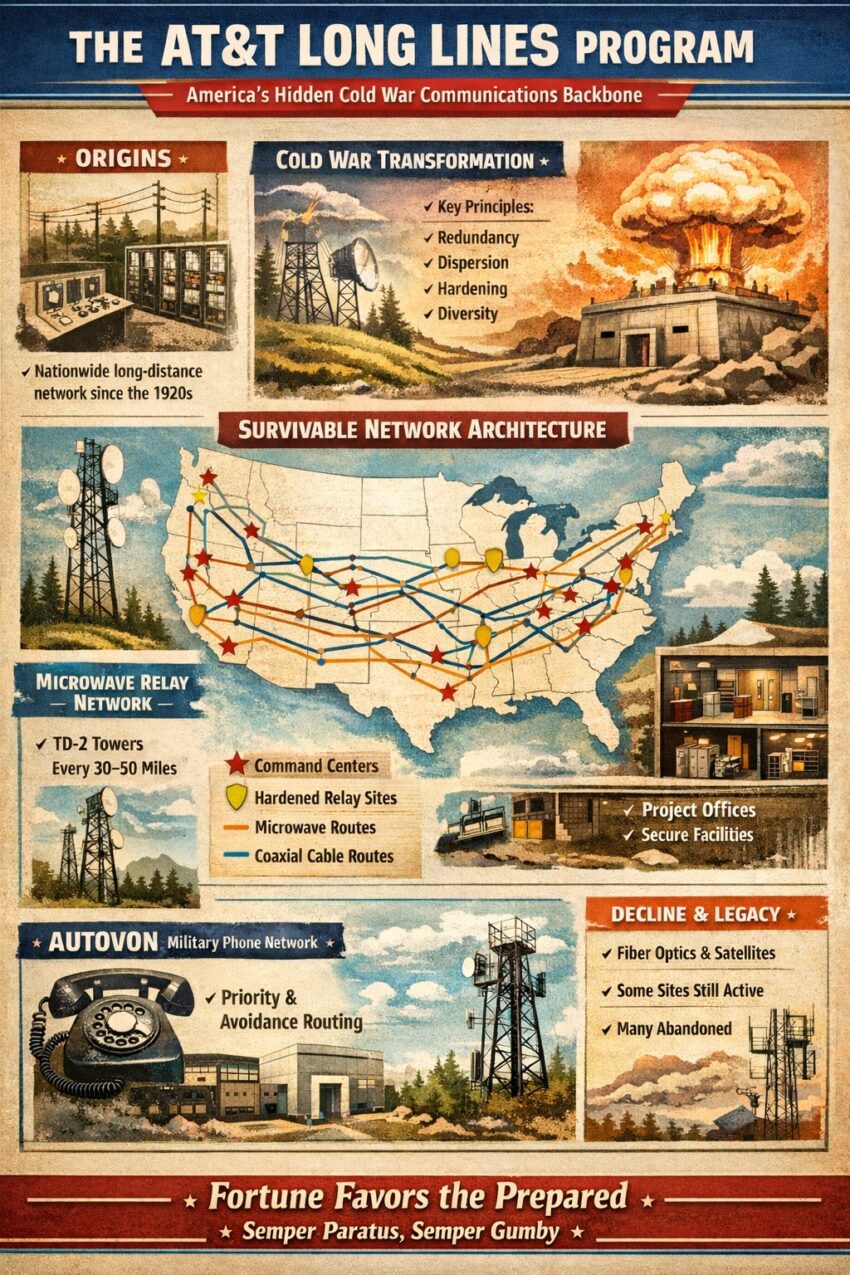
In the decades before fiber optics and satellites quietly carried the world’s data, the United States built something extraordinary—an immense, hardened communications network designed not just for convenience, but for survival.
Known as the AT&T Long Lines program, this system was the invisible nervous system of the nation. It connected cities, military installations, and government command centers across thousands of miles. But beneath its civilian purpose lay a deeper mission: ensuring the United States could still communicate after a nuclear war.
📡 Origins: From Telephone Lines to National Infrastructure
The Long Lines program traces its roots to the early 20th century, when AT&T began building a nationwide long-distance network to connect regional telephone systems. By the 1920s, this evolved into a structured system of switching centers and transmission routes under the General Toll Switching Plan, creating a standardized backbone for long-distance communication.
Early systems relied on:
- Open-wire transmission lines
- Vacuum tube amplification
- Manual switching
But the real transformation came after World War II.
⚙️ The Microwave Revolution
In the 1950s, AT&T deployed the TD-2 microwave relay system, a breakthrough that allowed thousands of calls to be transmitted across the country using line-of-sight radio towers.
These towers:
- Were spaced roughly 30–50 miles apart
- Relayed signals from one to the next
- Carried not just phone calls, but television and military traffic
This created a continental-scale mesh network, far faster and more scalable than copper wire alone.
☢️ Cold War Transformation: Designing for Nuclear Survival
As tensions with the Soviet Union escalated, the Long Lines network took on a new role.
It was no longer just about communication—it was about continuity of government and military command.
The system was redesigned with survivability in mind:
🔒 Key Design Principles
- Redundancy: Multiple parallel routes for every major connection
- Dispersion: Critical nodes located far from major cities
- Hardening: Facilities built to withstand nuclear blast effects
- Diversity: Use of multiple transmission methods (microwave, coaxial cable, later fiber)
This philosophy mirrored the military’s own doctrine:
No single point of failure could be allowed.
🧱 The Hidden Layer: Underground Bunkers and “Project Offices”
Perhaps the most fascinating—and least understood—aspect of the Long Lines system was its hardened underground infrastructure.
Beginning in the 1960s, AT&T constructed a series of facilities internally known as “Project Offices.”
These were not ordinary telecom buildings.
They were:
- Buried dozens of feet underground
- Built with thick reinforced concrete and copper shielding
- Mounted on shock-absorbing systems
- Designed to operate autonomously for extended periods
Some included:
- Dormitories
- Kitchens
- Medical supplies
- Diesel generators
- Secure switching systems
One example, the Frederick (MD-1) site, featured multiple underground buildings, housed hundreds of personnel, and served as a major switching hub for military and government communications.
🪖 AUTOVON: The Military Overlay
Running parallel to—and integrated with—Long Lines was AUTOVON (Automatic Voice Network), the U.S. military’s global telephone system.
Built starting in 1963, AUTOVON:
- Used Long Lines infrastructure and dedicated circuits
- Provided priority-based calling, allowing critical calls to override others
- Connected command centers across the U.S. and overseas
Unlike civilian networks, AUTOVON was designed with “avoidance routing”:
- Routes intentionally bypassed major population centers
- Facilities were placed in less likely target zones
This ensured communications could continue even after major cities were destroyed.
🗺️ The Architecture of Survival
When viewed as a whole, the Long Lines network reveals a deliberate structure:
🔺 1. Core Command Nodes
- Washington, DC
- Alternate command centers (e.g., Raven Rock, Mount Weather)
🛡️ 2. Hardened Relay Ring
- Underground switching sites
- Project Offices
- High-capacity microwave hubs
⛰️ 3. Appalachian Backbone
- Ridge-line relay sites for line-of-sight transmission
- Geographically dispersed for survivability
🌐 4. National Trunk Routes
- Coaxial cable systems stretching coast-to-coast
- Microwave chains connecting major regions
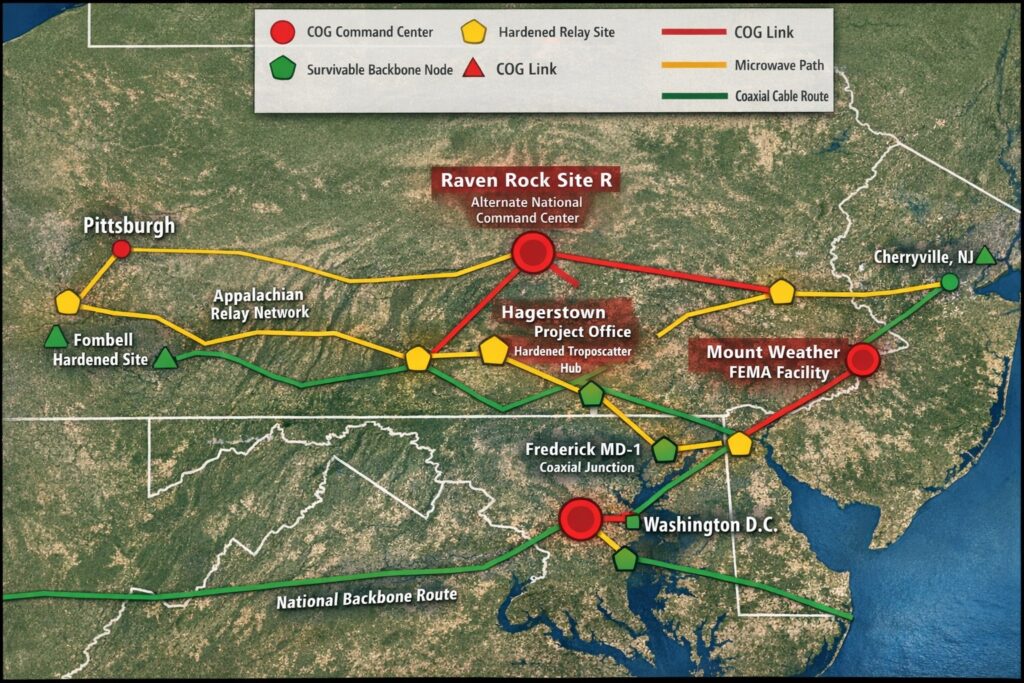
Together, these formed a resilient communications lattice—capable of rerouting around damage and maintaining command continuity.
🔌 The Beginning of the End: Fiber Optics and Satellites
By the 1980s, the Long Lines system began to decline.
New technologies emerged:
- Fiber optic cables (higher capacity, lower cost)
- Satellite communications
- Digital switching systems
These innovations made the massive microwave network increasingly obsolete.
Many towers were dismantled. Others were abandoned.
🏢 The System Today: Ghost Network or Living Infrastructure?
Despite its decline, the Long Lines system never fully disappeared.
🟢 Still Active (Repurposed)
- Some underground facilities remain in use as:
- Fiber hubs
- Data centers
- Government communications nodes
- Certain switching sites (like MD-1) continue operating with modern equipment
🟡 Partially Active
- Towers reused for:
- Cellular networks
- Broadcast infrastructure
🔴 Abandoned
- Remote microwave sites
- Rural relay stations
- Decommissioned bunkers
🧠 The Unanswered Question
Even today, the full extent of the Long Lines survivability network is not publicly known.
Some sites:
- Remain classified
- Have been quietly upgraded
- Or operate under different names and functions
What is clear is this:
The system was never just about making phone calls.
It was about ensuring that, even in the worst-case scenario, someone could still give orders… and someone else could still receive them.
📖 Relevance to The Continuity Chronicles
For a modern audience—and for your narrative universe—the Long Lines program represents:

- A real-world foundation for continuity-of-government storytelling
- A network that blurs the line between civilian and military infrastructure
- A reminder that beneath ordinary landscapes lie extraordinary systems built for extraordinary scenarios
These sites are:
- Hidden command nodes
- Lost bunkers waiting to be rediscovered
- Relics of a war that never happened—but was deeply prepared for
⚡ Final Thought
The Long Lines network was one of the largest machines ever built—not in a factory, but across a continent.
Most people never saw it.
Few understood it.
But for decades, it stood ready for a moment everyone hoped would never come.